

Would you trust a flimsy piece of aluminium to bring your best mate home if they bolted during a summer storm? For many Australian pet owners, the stress of a lost dog is made worse when they realise their contact details have rubbed off or the tag has snapped off the collar entirely. With 73% of Australian households now sharing their lives with a pet, the demand for secure pet identification tags has never been higher. You likely already know that a visible tag is the fastest way for a neighbour to return your pet without a trip to the vet, but not all hardware is built for the rugged Australian environment.
It is a common frustration to deal with constant metal jingling or tags that become unreadable after just a few months of wear. We understand that you want a permanent solution that survives every bushwalk and beach trip. This guide will show you how to select a tag that stays readable and attached for a lifetime. We will explore why high-grade stainless steel outperforms cheaper alternatives, the necessity of deep-mill engraving, and how modern attachment methods ensure your companion stays protected in every scenario.
Key Takeaways
- Understand why a visible tag is your pet's first line of defence, allowing neighbours to return your mate instantly without needing a microchip scanner.
- Compare the longevity of different materials and see why stainless steel is the superior choice for resisting rust and physical damage in the Australian climate.
- Learn how deep-mill engraving prevents friction from wearing away your phone number, ensuring the text stays readable for years.
- Discover the mechanics of fail-safe attachment and how secure pet identification tags paired with Quick Clips prevent accidental loss during outdoor adventures.
- Gain professional insights into selecting hardware that is purpose-built for the unique demands of an active Australian lifestyle.
Beyond the Microchip: Why Secure Pet Identification Tags Are Essential
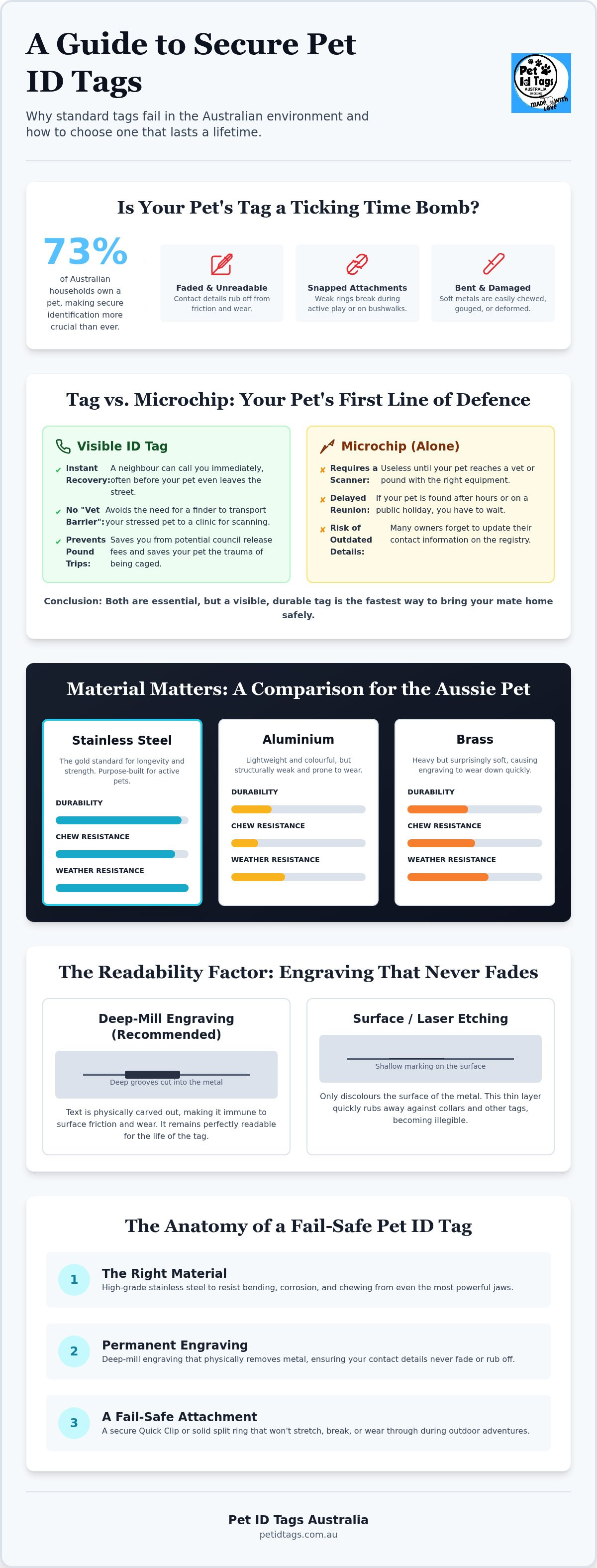
A secure pet identification tag is the most direct link between a lost pet and its owner. While microchips are a critical safety net, they aren't the first thing a neighbour sees when they find your dog wandering the street. Most people who find a lost animal want to help, but they often face a "vet barrier". This is the hesitation a person feels when they realise they must find a car, locate an open clinic, and transport a strange, potentially stressed animal just to get a scan. A phone number on a collar removes this friction instantly and turns a stressful situation into a simple phone call.
This definition of a secure tag is any identification piece that remains perfectly legible and firmly attached under all conditions, from salt-water swims to high-energy play. Investing in secure pet identification tags is the most practical step you can take to ensure your pet's safety beyond the front gate.
The Limitations of Microchipping Alone
Microchips are essential, but they are invisible. They require a specialised scanner, typically found only at veterinary clinics or council pounds. If your pet goes missing on a public holiday or late at night, a microchip alone won't get them home until businesses reopen. Additionally, many owners forget to update their contact details on national registries, which creates a dead end for recovery teams. To understand the full scope of why a multi-layered approach is best, you can read more about Pet Tag vs Microchip Australia: Why Your Pet Needs Both in 2026. Relying solely on internal technology leaves too much to chance when your mate is lost.
The Role of Physical Tags in Rapid Recovery
A visible ID tag allows for immediate, on-the-spot recovery. When a passer-by can see your mobile number, your pet often doesn't even leave the street where they were found. This avoids the trauma of being placed in a cage at the pound or a strange vet clinic while also saving you from potential council release fees. When looking at different types of pet tags, the focus should always be on long-term durability. A "secure" tag is one that won't snap during a bushwalk or fade into an unreadable disc after six months of wear. By prioritising secure pet identification tags, you ensure that the person who finds your pet has everything they need to call you immediately.
Material Matters: Why Stainless Steel is the Gold Standard for Security
Choosing the right material is not just about aesthetics; it is about ensuring the tag survives a crisis. While many local retail chains offer brass or cheap alloys, these often lack the structural integrity needed for secure pet identification tags. Brass is a heavy metal but is surprisingly soft, meaning the engraving wears down as the tag rubs against the collar hardware. Veterinary experts frequently highlight the importance of visible ID tags as the primary recovery method, but a tag that snaps or bends into an unreadable mess is useless. Stainless steel provides a level of permanence that other metals simply cannot match. You can find out more about why Stainless Steel Dog Tags Are the Ultimate Choice for long-term safety.
Stainless Steel vs. Aluminium Dog Tags
Aluminium tags are popular for their lightweight feel and vibrant colours. However, they are significantly softer than steel. Over time, the constant friction from the split ring or clip can wear through the attachment hole, leading to a lost tag. Stainless steel possesses a vastly superior weight-to-strength ratio. It doesn't just look solid; it is structurally sound and resists bending even under extreme pressure. If you have a bored puppy that decides to use their tag as a chew toy, aluminium will show deep gouges and may even become unreadable. Stainless steel resists these bite marks, maintaining the physical integrity of your contact information. It is the only material that truly passes the "chew test" for active dogs.
Battling the Australian Elements
The Australian environment is particularly harsh on pet hardware. High UV exposure and salt-laden air in coastal areas act as aggressive corrosive agents. Aluminium tags often rely on an anodised coating for colour, which can bleach and flake under the intense Aussie sun. Brass, while sturdy, will tarnish and turn green when exposed to humidity or sea spray. Stainless steel is inherently rust-proof and corrosion-resistant. It remains bright and legible even after years of daily beach swims and muddy bushwalks. Understanding Why Pet ID Tags Fade is crucial for owners in sun-drenched regions. Choosing a material that ignores the weather ensures your mate is always protected. For maximum security, browse our collection of Stainless Steel Dog Tags built to withstand the elements.
The Readability Factor: Engraving Methods That Never Fade
Legibility is the soul of any identification system. Many tags found in big-box retail stores rely on surface printing or shallow laser etching. While these look sharp on the shelf, they fail quickly in real-world conditions. Constant friction against a metal collar, a lead clip, or a second registration tag acts like sandpaper. Over time, your phone number simply disappears, leaving your pet with a blank piece of metal. High-contrast lettering is essential for rapid reading, particularly if a stranger finds your pet in low-light conditions like dusk or dawn. A tag you cannot read is no tag at all. This is why secure pet identification tags must prioritise depth over simple surface aesthetics.
Deep Diamond-Tip and Laser Engraving
Professional-grade tags use diamond-tip mechanical engravers or high-powered fibre lasers to physically carve into the material. This process removes metal to create deep grooves rather than just marking the surface. Even if the tag gets scratched during a rugged bushwalk or a day at the beach, the deep-etched characters remain perfectly visible. It creates a permanent physical change to the tag that won't rub off. When deciding what to include on your mate's hardware, our Pet ID Tag Engraving Ideas: The Ultimate 2026 Australian Checklist provides a clear guide on how to layout your contact details for maximum clarity.
Smart Tags and QR Codes: The Next Generation
The 2026 landscape of pet safety now includes digital backups to traditional engraving. Smart tags featuring QR codes allow a finder to scan the tag and access a secure online profile. This is a massive benefit for owners who travel frequently or have multiple contact numbers, as you can update your details instantly without buying a new tag. While these digital layers add significant security, leading organisations like RSPCA Australia on identification still advocate for visible physical details as the primary line of defence. Combining a deep-etched mobile number with a digital QR code creates a comprehensive safety net. For a deep dive into how this technology works, see our guide on Smart Pet Tags Australia: The 2026 Guide to Next-Gen Pet Safety. Ensuring your secure pet identification tags offer both physical and digital readability is the gold standard for modern pet safety.
Fail-Safe Attachment: Ending the Problem of Lost Tags
The attachment method is often the most overlooked part of pet safety. You can invest in the highest quality secure pet identification tags, but they are useless if they are left behind on a trail. Most standard split rings are the weak link in the chain. They are essentially simple coils of wire that can easily be pulled open if your dog snags their tag on a suburban fence or a thick branch during a bushwalk. Once the wire stretches, the tag falls off, and your pet is left without visible identification.
To solve this, many Australian owners are moving away from flimsy hardware in favour of the Quick Clip. This is a secure, heavy-duty alternative that uses a spring-loaded gate to lock the tag onto the collar D-ring. It provides a level of mechanical security that a standard split ring cannot match. For a detailed breakdown of these components, see our Dog Tag Quick Clip Australia: The 2026 Guide to Secure Pet ID Attachment. Ensuring your mate's tag stays where it belongs is just as important as the information engraved on it.
How to Securely Attach a Tag to a Collar
Proper installation is the first step toward long-term security. Follow these practical steps to ensure a reliable fit:
- Step 1: Inspect the collar D-ring for signs of wear or thinning. If the metal is worn down, it may snap under pressure, regardless of the tag's quality.
- Step 2: Choose a gauge-appropriate split ring or a dedicated quick clip. Heavy-duty dogs need thicker hardware that won't deform during high-energy play.
- Step 3: Ensure the tag sits flush against the collar or clip. Reducing the "snag factor" prevents the tag from hanging too low and getting caught on environmental hazards.
For more specific techniques on hardware selection, refer to our guide on How to Attach a Dog Tag to a Collar: The 2026 Australian Guide to Secure ID. A few minutes spent on correct attachment can save hours of searching later.
Stopping the Jingle: Silent Tag Solutions
Constant jingling is more than just an annoyance for owners; it is a sign of mechanical wear. When multiple metal tags rub together, they act as abrasives that slowly grind down the engraving and weaken the attachment points. Silent tag solutions, such as silencers or specialised clips, keep the hardware stationary. This significantly increases the security of the tag by reducing the physical stress on the metal. You can explore modern alternatives in our How to Attach a Dog Tag Without a Split Ring: 2026 Guide to Easy ID. For a professional-grade solution that won't let you down, explore our heavy-duty Pet Tag Quick Clips today.
The Pet ID Tags Australia Standard: Professional Security for Your Mate
Pet ID Tags Australia has operated as a trusted specialist in pet safety since 2004. This twenty-year heritage means we understand exactly what it takes to keep a dog identified in the harshest Australian conditions. Our commitment to high-grade materials and precision Australian engraving ensures that every piece of hardware we produce is built for utility, not just aesthetics. We don't believe in temporary fixes. Our secure pet identification tags are designed to withstand the salt, heat, and friction of an active lifestyle. Supporting a local institution with decades of experience gives you access to hardware that has been proven to work in the real world.
Choosing the right tag from our specialised collection depends on your pet's habits and environment. High-energy dogs that spend their time in the scrub or the surf require the structural integrity of our stainless steel range. For owners who want a digital backup, our smart tags provide a modern layer of protection. By selecting secure pet identification tags from a dedicated specialist, you're investing in a permanent safety solution rather than a disposable accessory that will need replacing in six months.
Customised Security Solutions
Our range includes both traditional stainless steel and modern smart tag options. Every piece of hardware we produce must meet strict readability standards before it leaves our workshop. We don't settle for surface marks that fade or rub away. If you've just brought home a new addition to the family, our Essential Puppy ID Tag Guide: Protecting Your New Best Mate in 2026 provides tailored advice for securing younger, more inquisitive dogs. We ensure that every tag, whether digital or physical, serves as a reliable, permanent link back to you.
Peace of Mind for Australian Pet Owners
Security in pet identification relies on three specific pillars: indestructible material, deep-etched readability, and fail-safe attachment. We combine all three into every product we sell. A professional tag is the fastest way for a neighbour to get your pet home, often before you even realise they've slipped through the side gate. This immediate recovery saves your mate from the stress of a council pound and protects you from expensive release fees. It's about more than just a nameplate; it's a promise that your companion will always find their way back.
Don't leave your pet's safety to chance with inferior materials that snap, rust, or fade. Secure your mate today by choosing from our professional-grade Stainless Steel Dog Tags collection. Our 20-year heritage in Australian pet safety is built into every tag we engrave.
Protecting Your Companion for Life
Ensuring your pet's safety requires a proactive approach that goes beyond the basics. We have explored why secure pet identification tags are the fastest link between a lost pet and home, especially when compared to the limitations of microchips alone. By choosing high-grade stainless steel and deep-mill engraving, you eliminate the risk of faded text or snapped hardware that often plagues cheaper alternatives. A reliable attachment, like a heavy-duty clip, ensures that your contact details stay firmly fixed to the collar during every high-energy adventure.
Pet ID Tags Australia has been trusted by local pet owners since 2004 to provide dependable safety solutions. We specialise in precision deep-engraving for lifetime readability and offer heavy-duty stainless steel options that withstand the harsh Australian elements. Don't wait for an emergency to realise your current tag is unreadable or missing. Secure your best mate with a durable Stainless Steel Dog Tag today and enjoy your next beach trip or bushwalk with total confidence. Your companion deserves the permanent protection of a professional-grade solution.
Frequently Asked Questions
What is the most secure material for a pet ID tag?
High-grade stainless steel is the most secure material available for pet identification. Unlike aluminium, which is soft and prone to thinning at the attachment point, or brass, which tarnishes in high humidity, stainless steel remains structurally sound for a lifetime. It is inherently rust-proof and resists deep gouges from chewing or scratching. This ensures your secure pet identification tags remain intact and readable regardless of how active your pet is in the Australian bush or surf.
Do I really need an ID tag if my dog is microchipped?
Yes, a physical ID tag is your pet's primary recovery tool. While microchips are a vital permanent backup, they are invisible and require a specialised scanner found at vets or shelters. Most people who find a lost dog prefer calling a phone number on a tag immediately rather than transporting an animal to a clinic. Having a visible tag avoids the "vet barrier" and ensures your mate is returned directly to your door without unnecessary stress.
What information is legally required on a dog tag in Australia?
Requirements vary between local councils, but most Australian states mandate that dogs wear a collar with the owner's contact details in public. In many jurisdictions, failing to display a valid tag can result in significant fines issued by local authorities. You should always include your current mobile number and name as a minimum. Check with your specific local council to see if they also require a separate registration tag to be displayed at all times.
How do I stop my pet's ID tag from falling off?
The best way to prevent a lost tag is to replace standard split rings with a heavy-duty alternative like a Pet Tag Quick Clip. These spring-loaded attachments are designed to withstand the physical force of a dog snagging their collar on a fence or branch. Regularly inspecting the D-ring on the collar for thinning metal is also essential. Using secure pet identification tags with reinforced attachment holes further reduces the risk of the metal snapping under pressure.
Why do some pet tags fade so quickly?
Many retail tags use surface-level laser marking or printing that only sits on the top layer of the metal. Constant friction against the collar or other tags acts like sandpaper, eventually rubbing the text away. This is particularly common with softer metals like aluminium. To prevent this, look for deep-mill engraving that physically carves the information into the material. This method ensures the contact details remain legible even after years of daily wear and tear.
Can I put two phone numbers on a single secure tag?
Yes, most high-quality tags allow for multiple lines of text, which is ideal for including a primary and secondary contact number. Having two numbers provides a vital safety net if you are out of range or unable to answer your phone when your pet is found. We recommend placing the pet's name on the front and two mobile numbers on the back to ensure the most critical information is clear and easy for a finder to read.
How often should I check my pet's ID tag for wear?
You should perform a physical inspection of your pet's identification hardware at least once a month. Look for any signs of thinning metal where the tag meets the split ring, as this "keyhole" wear is the most common cause of tags falling off. Check that the engraving is still sharp and high-contrast. If the text is becoming smooth or the attachment hole looks elongated, it is time to upgrade to a more durable, permanent solution.
Are smart pet tags better than traditionally engraved ones?
Smart tags are an excellent digital backup, but they should not replace traditionally engraved text. A QR code allows you to update your details instantly without buying a new tag, which is perfect for travellers. However, some finders may not have a smartphone or data connection. The most secure approach is a hybrid tag that features both a deep-engraved mobile number for immediate contact and a digital component for more detailed information and easy updates.