
A pet ID tag is a life-saving tool first and a style accessory second; deep engraving is the only way to ensure that tool never fails. You want your mate to look great at the local beach or park, but you also worry that a cheap tag will fade or become unreadable when it matters most. It's a common struggle to fit essential contact details onto limited space without sacrificing personality. You might even wonder if putting your dog's name on the tag is a safety risk or a legal necessity in 2026.
We understand that true peace of mind comes from durable, high-quality solutions that withstand the elements. This guide provides the ultimate Australian checklist for pet id tag engraving ideas, helping you strike the perfect balance between essential safety data and creative character. You'll discover exactly what information is legally required by your local council, how to maximise small spaces, and which materials actually survive the Australian sun and surf. We'll also share clever ideas for the back of the tag that give your pet a voice if they ever wander off.
Key Takeaways
- Learn the hierarchy of essential contact information, including why a mobile number and microchip alert are your pet's best chance of a quick return.
- Discover how life-saving medical alerts for conditions like deafness or severe allergies can protect your pet when they are in the care of strangers.
- Explore creative pet id tag engraving ideas that showcase your pet's personality on the back of the tag while keeping the front dedicated to vital safety data.
- Understand why deep mechanical engraving on high-grade materials is the only way to ensure tags remain readable under the harsh Australian sun.
- Get a step-by-step checklist to ensure your tag details perfectly match your current microchip registry information for a seamless recovery process.
Essential Contact Information for Rapid Recovery
The primary purpose of a pet ID tag is to serve as the fastest, most direct link between a person who finds a lost animal and the owner waiting at home. While microchips are a legal requirement across most Australian states, they require a trip to a vet or council shelter to be scanned by a professional. A clear, well-engraved tag bypasses this delay, allowing a neighbour to call you the moment they spot your dog in the street. When considering pet id tag engraving ideas, your first priority must always be immediate accessibility and data accuracy.
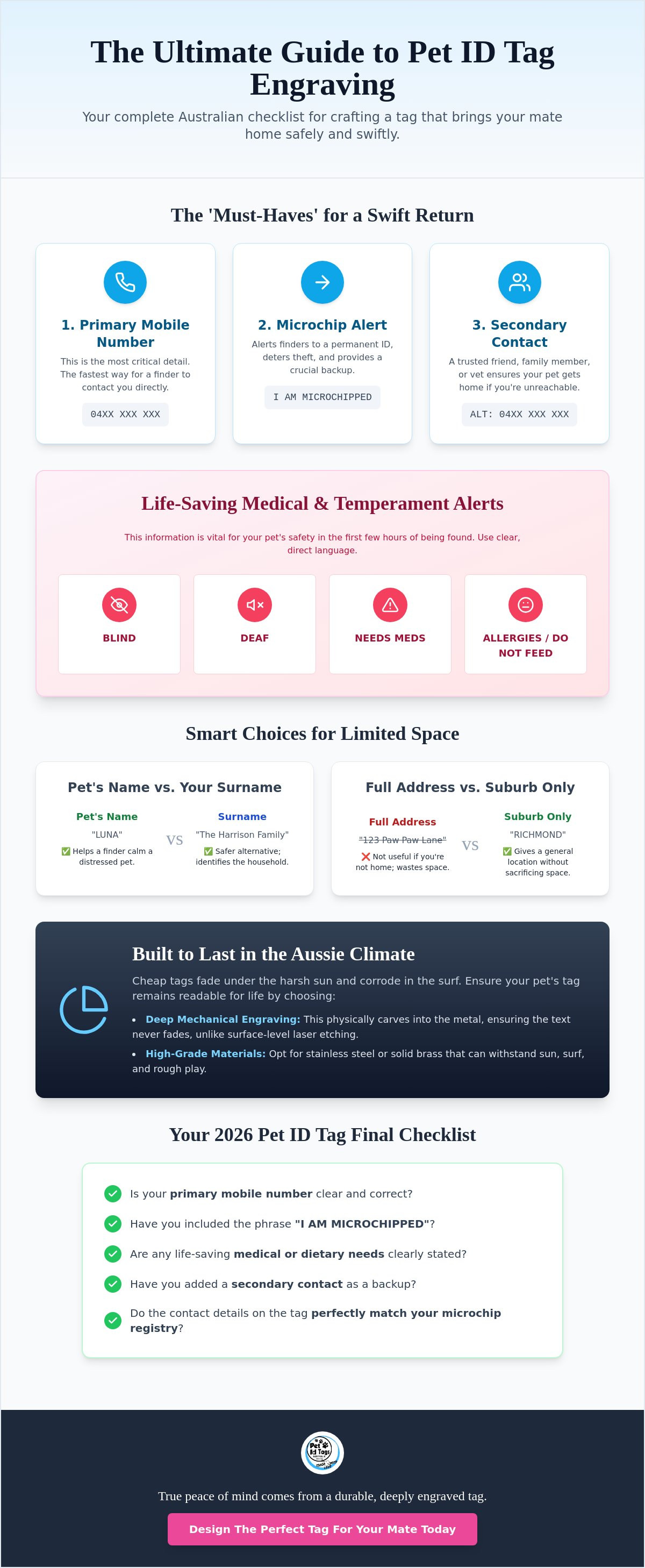
Every tag should feature at least one reliable mobile phone number. In a country as vast as Australia, ensuring the number is in a clear 04XX XXX XXX format is vital for readability. If you frequently travel between states or live near a border, including the Australian area code can prevent any confusion for the finder. You should also consider adding a secondary contact, such as a trusted friend, a family member, or even your local vet. This ensures that if you're in a meeting, out of mobile range, or otherwise unavailable, there's still a pathway for your pet to get home safely. For a comprehensive overview of pet ID tags and their role in animal management, external resources offer deep insights into why these small discs remain the gold standard for pet safety despite technological advances.
Always include the phrase "I am microchipped" on the tag. This simple addition alerts the finder that the pet has a permanent digital record. It acts as a deterrent against theft and provides a vital backup plan if the tag's text becomes obscured by wear and tear over time. By combining your current mobile details with a microchip notification, you create a robust safety net that works in real-world conditions.
The Dog Name Debate: To Include or Not?
Deciding whether to engrave your pet's name is a common point of contention for many owners. On one hand, a finder can use the name to calm a distressed animal, making them easier to handle and secure. On the other hand, some owners worry that knowing a dog's name makes it easier for a stranger to entice or steal the animal. If you have safety concerns, a practical alternative is to engrave your surname instead, such as "The Harrison Family." This provides a personal touch and identifies the household without giving away the specific name your dog responds to.
Address vs. Mobile Number
Space on a tag is a premium commodity. While some older advice suggests including a full street address, a mobile number is far superior for the modern Australian lifestyle. If you're away on holiday or simply at work, your street address doesn't help a finder reach you instantly. If you want to provide a geographic anchor, simply include your suburb. This gives the finder a general idea of where the pet belongs without sacrificing the space needed for a second phone number. When brainstorming pet id tag engraving ideas, always choose the data that facilitates the fastest possible phone call.
Life-Saving Medical and Temperament Alerts
A phone number facilitates a reunion, but medical information ensures your pet remains safe until you arrive. For animals living with chronic health conditions, a tag acts as a portable medical record that speaks when they cannot. Including critical alerts such as "Deaf," "Blind," or "Needs Daily Meds" can literally save a life. These details immediately change how a member of the public interacts with your pet. For instance, a finder who knows a dog is deaf will avoid shouting and instead use physical cues or gentle guidance to secure the animal. This reduces stress for the pet and prevents the finder from becoming frustrated by a lack of response.
Dietary restrictions are equally vital for a lost pet's wellbeing. Well-meaning strangers often offer food or treats to calm a stray animal and build trust. If your pet has "Extreme Allergies" or a sensitive stomach, a "Do Not Feed" instruction prevents a secondary medical emergency while they are away from home. When brainstorming pet id tag engraving ideas, prioritise the information a stranger needs to know in the first hour of finding your pet. While legal requirements for pet identification across Australia typically focus primarily on owner contact details, adding health data provides a necessary layer of protection for vulnerable animals.
Communicating Critical Health Needs
Use bold, clear text for high-stakes conditions like epilepsy or diabetes. We recommend using the phrase "Needs Medication" or "Medical Condition" rather than naming a specific drug. This creates immediate urgency for the finder to contact you or a veterinarian without requiring them to have specialised medical knowledge. This is a primary reason why we advocate for the pet tag vs microchip australia approach; a microchip won't tell a passerby about a looming seizure, but a clear engraving will. To ensure these alerts remain legible for years, consider investing in high-grade Stainless Steel Dog Tags.
Temperament and Handling Instructions
Temperament cues help finders manage the situation safely and effectively. Consider using the following phrases to guide a stranger's approach:
- "I am shy" or "Approach with caution": Prevents finders from accidentally spooking a nervous dog.
- "Friendly" or "Good with kids": Encourages the public to step in and help.
- "Do not approach other dogs": Essential for pets with dog-reactive tendencies.
- "I’m lost, please call my mum": Helps create an emotional connection with the finder.
If your pet is a valuable breed or you live in an area where theft is a concern, adding "Reward for Return" can be a powerful incentive for a safe and swift reunion. These pet id tag engraving ideas ensure that anyone who finds your pet has the confidence and information required to keep them safe until they are back in your arms.
Adding Personality: Creative and Funny Engraving Ideas
Once you've secured the essential safety data on the front of the tag, the reverse side offers a perfect opportunity to showcase your pet's unique character. In Australia, we have a penchant for dry, punchy humour, and your mate’s identification is no exception. However, a professional approach to pet id tag engraving ideas means balancing wit with legibility. You should always prioritise a "Front for Safety, Back for Fun" framework. This ensures that a finder sees your contact number immediately, while the personality-driven text remains a secondary, engaging detail on the back.
Aussie slang provides a wealth of inspiration for these short statements. Labels like "Little Legend," "Chief Sniffer," or "Local Larrikin" fit perfectly on standard 30mm tags without cluttering the space. If your dog is known for their wandering spirit, a cheeky "If Found" line can break the ice with a stranger. Consider phrases like "I know I’m cute, but call my humans" or "Snack Inspector on the loose." These lines are effective because they are short. Overloading a tag with long sentences, as often seen on social media platforms, typically results in tiny, unreadable text that fails when your pet is actually lost.
Humour with a Purpose
Funny engravings can do more than just raise a smile; they can create a sense of urgency. A line like "Call my people before I eat your couch" or "I’m the reason we can’t have nice things" suggests a high-energy pet that the finder will want to return as quickly as possible. You can also match the quote to your pet’s specific breed or "job" around the house. A Greyhound might be a "Professional Napper," while a Kelpie could be the "Head of Security." This adds a layer of storytelling to the tag, making the recovery process feel more personal for the person who finds them.
Minimalist and Modern Designs
For those who prefer a cleaner aesthetic, minimalist designs are often the most practical choice, especially for cats or toy breeds with limited tag space. A "less is more" approach involves using simple icons, such as a small bone, heart, or paw print, alongside the most critical text. When selecting fonts, avoid overly decorative or script styles. These often look great on a screen but become a blurred mess when engraved onto metal. Stick to clean, sans-serif fonts that enhance readability from a distance. High-quality pet id tag engraving ideas always account for the physical constraints of the material, ensuring the text remains sharp and clear for years to come.
Maximising Readability: Engraving Styles and Material Choice
Selecting the right pet id tag engraving ideas is only half the battle. If the text isn't legible or durable, the most creative message won't help your pet get home. In the harsh Australian climate, where high UV levels and saltwater exposure are constant, the method of engraving is critical. Deep mechanical engraving physically carves into the metal, making the text permanent. This differs significantly from surface-printed or "laser-marked" tags, which often use a chemical reaction to darken the surface. While laser marking looks sharp initially, it can fade or rub off under the relentless Australian sun, leaving you with a blank piece of metal in an emergency.
Contrast is another essential factor for rapid recovery. A finder needs to read your phone number at a glance, often in low-light conditions or while managing a wiggly animal. Ensuring the text stands out against the tag colour is non-negotiable. For those looking for the ultimate in longevity, stainless steel dog tags australia owners trust are the gold standard. They provide a high-contrast finish that remains readable for the life of the pet, regardless of how many trips they take to the beach or bush.
Why Stainless Steel Wins in Australia
Stainless steel is the superior choice for active Australian dogs. Its natural resistance to rust and corrosion makes it ideal for pets that love swimming in the ocean or running through damp scrub. Beyond durability, there is a "silent" benefit to steel. Because it is a denser, heavier material than aluminium, it is less likely to jingle excessively against other tags or hardware. While aluminium tags are excellent for their light weight and variety of colours, they are a softer metal. Over time, the link hole can elongate and the surface can scratch. For a tag that survives the elements year after year, steel is the professional choice.
Font and Layout Best Practices
Readability depends heavily on your choice of font and layout. Avoid cursive or "script" fonts. These decorative styles are difficult to decipher, especially if the tag is small or the lighting is poor. Stick to clean, bold, sans-serif fonts. We recommend centring the most important information, usually your primary mobile number, and using the largest font size available for that line. Finally, check the quality of the finish. Cheap engraving often leaves "burrs" or sharp edges that can catch on fur or irritate your pet's skin. A high-quality tag should be smooth to the touch while maintaining deep, crisp lettering.
Ready to upgrade your pet's safety? Explore our range of durable Stainless Steel Dog Tags designed specifically for the Australian lifestyle.
The 2026 Pet ID Tag Final Checklist
Ensuring your pet's identification is current and functional is a continuous responsibility. As we move through 2026, the combination of digital records and physical tags remains the most reliable recovery method. A clear tag provides an immediate solution for a finder, while the microchip serves as the permanent legal backup. Follow this definitive checklist to ensure your pet id tag engraving ideas translate into a high-performance safety tool that works when it matters most.
- Step 1: Verify your contact data. Ensure the mobile numbers you intend to engrave are active. Call them yourself to confirm they're correct.
- Step 2: Sync with the registry. Check your pet's microchip details on the NSW Pet Registry or your relevant state database. The information on the tag must match your digital records to avoid confusion.
- Step 3: Prioritise material strength. Select 316-grade stainless steel. This marine-grade material is the only choice for pets that spend time in the Australian surf or humidity.
- Step 4: Finalise your layout. Stick to the professional standard: critical safety data on the front and personality-driven text on the back.
- Step 5: Audit the hardware. Inspect the attachment ring for thinning metal or signs of "ring wear" every six months. A durable tag is useless if the connector fails.
The Pre-Order Verification
Precision is vital during the ordering process. Double-check every character for spelling errors before submitting your design. A single transposed digit in a phone number renders the tag a useless piece of metal. We recommend the "Readability at a Distance" rule: if you can't clearly read the primary phone number from three metres away in good light, the font is too small or the layout is too cluttered. Finally, ensure the tag size is appropriate for your pet's frame. A large 40mm tag may be too heavy for a toy breed, while a tiny cat tag might be overlooked on a large Labrador.
Maintenance and Upkeep
Australian conditions are notoriously tough on pet hardware. Salt air, red dust, and mud can accumulate in the grooves of even the deepest engraving. Clean your tag periodically with warm soapy water and a soft brush to maintain maximum contrast. This simple step prevents grime from making the text difficult to read. Pay close attention to the point where the tag meets the collar ring. Metal-on-metal friction eventually wears down the hole at the top of the tag. If you notice the metal becoming dangerously thin, it's time for a replacement. Consistency in these small checks provides the ultimate security for your mate.
Browse our range of deep-engraved stainless steel tags for peace of mind.
Future-Proofing Your Pet's Safety
A high-quality identification tag is the most direct way to ensure your mate returns home safely if they ever wander off. By prioritising active mobile numbers and critical medical alerts, you provide finders with the tools they need for a rapid reunion. Balancing these essentials with creative pet id tag engraving ideas on the reverse side allows your pet's personality to shine without compromising their security. Remember that durability is key; only deep engraving on marine-grade materials can withstand the constant exposure to the Australian sun and surf.
With over 20 years of expertise in pet identification, we provide deep-engraved solutions designed for life-long readability. As an Australian-owned and operated business, we understand exactly what it takes to protect your pet in local conditions. Secure your pet’s safety with a custom-engraved tag today and enjoy the peace of mind that comes from professional craftsmanship. Your pet deserves a safety net that never fades.
Frequently Asked Questions
What is the most important thing to put on a dog tag?
The most important information to include is at least one current mobile phone number. This allows a finder to reach you instantly without needing a microchip scanner. Including the phrase "I am microchipped" is also vital, as it alerts finders to a secondary identification method if the tag becomes damaged or lost.
Should I put my address on my dog’s ID tag?
You don't necessarily need to include a full street address on your dog's tag. A mobile number is more useful because it reaches you regardless of your location, which is ideal for travellers. If you want to provide a general area, including just your suburb is one of the most practical pet id tag engraving ideas for using limited space effectively.
Do I need a tag if my dog is microchipped?
Yes, a physical tag is essential even if your dog is microchipped. While microchips are a permanent legal requirement in most Australian states, they can only be read by vets or animal shelters with specific equipment. A tag allows a neighbour or passerby to return your pet immediately, avoiding the stress and cost of a trip to the pound.
Can I put two phone numbers on one pet tag?
You can and should put two phone numbers on a tag if the size allows. Providing a backup contact, such as a partner or a local friend, ensures that someone is always reachable. This redundancy is a core part of robust pet id tag engraving ideas for owners who might be out of mobile range or at work when their pet goes missing.
What is the best material for a long-lasting pet tag?
316-grade stainless steel is the superior material for a long-lasting tag in the Australian climate. It is highly resistant to rust and corrosion, making it perfect for dogs that swim in salt water or spend time in humid environments. Unlike aluminium, stainless steel is a harder metal that won't easily scratch or wear thin over time.
How much information can fit on a standard 30mm pet tag?
A standard 30mm tag typically fits four to five lines of text with approximately 15 characters per line. To maintain readability at a distance, it is best to limit the information to the absolute essentials. Cramming too much text onto a small surface results in a smaller font size that finders may struggle to read in low light.
Is it better to engrave the dog’s name or the owner’s name?
It is often better to engrave the owner's surname or "The [Surname] Family" rather than the dog's first name if you have safety concerns. While a dog's name helps finders build trust and calm the animal, some owners prefer to keep it private to reduce the risk of theft. Using your name ensures the finder knows exactly who to ask for when they call.
How often should I replace my pet’s ID tag?
You should replace a pet ID tag whenever the text becomes difficult to read or the metal around the attachment hole thins out significantly. While high-quality steel tags can last many years, it's wise to inspect the hardware every six months for wear and tear. If your contact details change, you must replace the tag immediately to ensure the information remains accurate.