

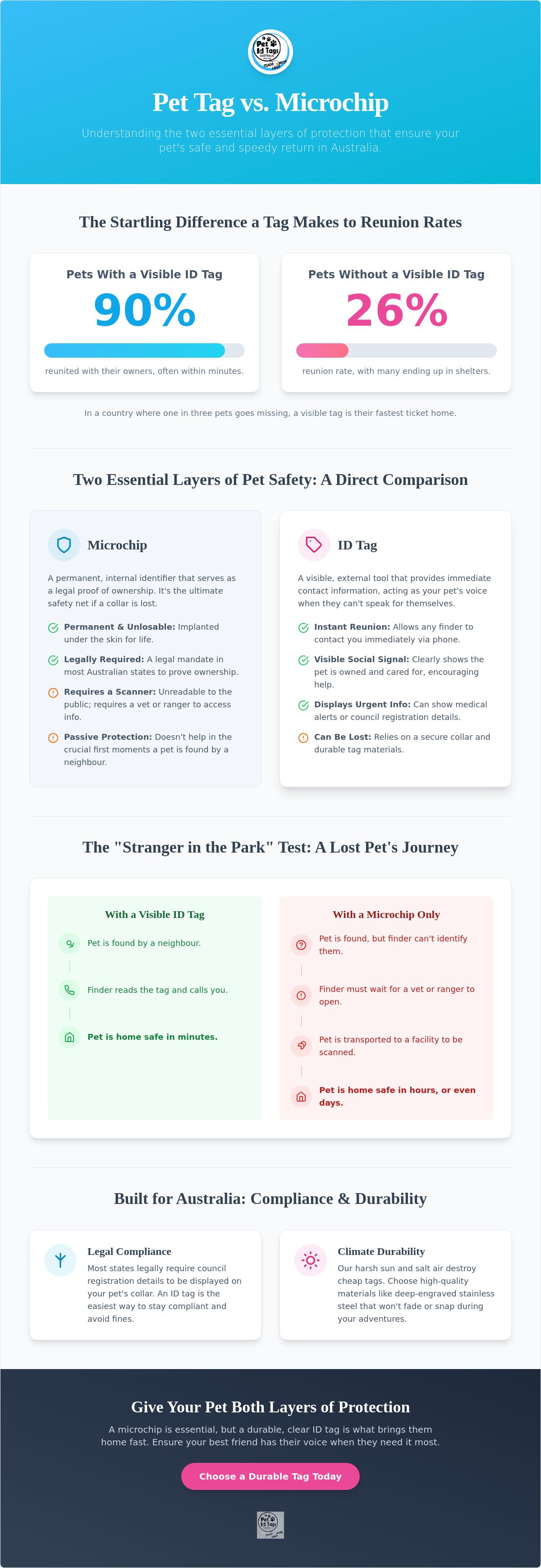
Did you know that dogs with visible identification have a 90% reunion rate in Australia, while those without it drop to just 26%? Understanding the pet tag vs microchip australia debate is the difference between a stressful night at a local shelter and a quick knock on your front door. You already know the weight of keeping your pet safe. In a country where one in three animals goes missing, you can't afford to leave their return to chance.
While microchipping is a legal mandate in most states, it's a silent form of identification. It requires a scanner. If your dog wanders off, a neighbour can't help if they have to wait for a vet to open the next morning. This guide explains why relying solely on a microchip could leave your pet stranded and how the right ID tag acts as your pet's voice, bridging the gap for a safe, instant return.
We'll examine the 2026 council regulations, the rise of QR smart tags, and why durability matters in our harsh climate. You'll gain total peace of mind and a clear strategy to ensure your pet is compliant, protected, and always findable.
Key Takeaways
- Learn why a microchip serves as a permanent internal identifier while a visible ID tag provides the quickest path home for a lost pet.
- Understand the pet tag vs microchip australia requirements to ensure your pet is fully protected by both digital records and immediate contact info.
- Stay compliant with state-specific regulations, including the legal necessity of displaying council registration details on your pet's collar.
- Bypass technical hurdles like microchip scanners and fragmented databases with a clear, external contact point.
- Choose high-quality materials like stainless steel that withstand the Australian climate and won't fade or snap during outdoor adventures.
Understanding Pet Identification in Australia: Chips vs. Tags
Effective pet recovery relies on two distinct layers of protection. One is internal and permanent; the other is external and immediate. In the pet tag vs microchip australia debate, it's a mistake to view them as alternatives. They are partners in a safety system designed to work when things go wrong. While a microchip acts as a hidden database, a tag serves as a public broadcast.
A microchip is a grain-of-rice-sized electronic identifier implanted under your pet's skin. It's a permanent safety net that can't fall off or become unreadable due to wear. Conversely, a pet ID tag is a visible contact point attached to a collar or harness. While the chip holds the legal data, the tag provides the "First Responder" with everything they need to act instantly. Both play a role in ensuring your pet returns home quickly.
Most lost pets are found by neighbours or well-meaning strangers, not council rangers. These people are your first line of defence. They don't carry universal scanners in their pockets. If your dog is wearing a clear, legible tag, that stranger becomes a rescuer who can call you in seconds. Without a tag, that same person has to decide whether to transport an unknown animal to a vet or call the local pound, which adds unnecessary stress to the animal and the owner.
The Australian climate adds another layer of necessity. Our intense UV levels and coastal salt air are brutal on cheap materials. A tag that fades or snaps is useless in a crisis. You need identification that survives the bush and the beach alike. Reliable gear isn't just about aesthetics. It's about ensuring the information remains legible when it's needed most.
The Role of the Microchip: The Permanent Safety Net
Microchips provide a unique 15-digit ISO number that links to a national database. If you're curious about the technical side, you can read about how pet microchips work to understand the radio-frequency identification (RFID) technology involved. This chip is your pet's permanent identity, ensuring they can always be linked back to you even if they lose their collar.
In most Australian states, microchipping is a legal requirement. It's the only way to prove ownership if a pet is stolen or if a collar is lost during an escape. However, the chip is invisible. It offers no help to a person standing on a street corner with your lost Labrador at 9:00 PM on a Sunday. It's a back-end solution that requires professional equipment to access.
The Role of the ID Tag: The Immediate Return
An ID tag is about speed. It bypasses the need for professional intervention. By providing a phone number and a name, you give the finder the power to resolve the situation without involving authorities. This often means your pet is back in your backyard before you even realise they've escaped.
Beyond contact details, tags serve as a vital social signal. A dog with a collar and tag is clearly "owned." It encourages people to help rather than assume the animal is a stray. You can also use tags to communicate urgent needs, such as medical alerts or "I am microchipped" notices. This information is often more critical in the first hour of a pet being lost than the microchip number itself.
Microchip vs. Pet Tag: A Direct Comparison
Choosing between a microchip and an ID tag isn't a matter of "either/or". It's about layers of protection. While a microchip is a permanent, subcutaneous identifier, it remains a passive technology. It only works if someone with the right equipment finds your pet and takes them to a professional facility. In the pet tag vs microchip australia comparison, the ID tag is the active layer. It's the only tool that empowers a member of the public to return your pet instantly.
Microchips offer the benefit of permanence. They cannot be lost, removed, or damaged by external forces. However, they are invisible to the naked eye. An ID tag provides a clear visual signal that a pet belongs to someone. This distinction is vital in preventing well-meaning people from assuming a lost pet is a stray. While the chip is your pet's internal passport, the tag is their external voice.
Accessibility: The "Stranger in the Park" Test
Imagine your dog escapes at 6:00 PM on a Sunday. A neighbour three streets away finds them. If your dog only has a microchip, that neighbour faces a significant hurdle. Most vet clinics are closed. Council rangers may be off-duty or attending to other call-outs. The neighbour must then decide whether to keep an unknown dog in their laundry overnight or drop them at an after-hours shelter. This delay causes hours of unnecessary anxiety for you and your pet.
A visible ID tag removes this barrier entirely. Anyone with a mobile phone can see your number and call you immediately. This direct connection often results in a reunion within minutes. By investing in high-quality engraved tags, you ensure that the first person who sees your pet has the means to bring them home. It bypasses the bureaucracy of the pound system and avoids potential release fees or council fines.
Data Reliability and Maintenance
Microchips are excellent for permanent record-keeping, but they are notoriously difficult to update. Many owners forget which of the various Australian registries their pet is on. If you move house or change your mobile number, the chip becomes a dead end. You should always check the state-by-state microchipping regulations to ensure you're meeting legal requirements, but don't rely on the registry alone for a quick recovery.
Physical tags offer dynamic reliability. When evaluating the pet tag vs microchip australia landscape, consider how easily you can change your contact info. You can update a physical tag in days, or use a smart tag to change your details in seconds. In the harsh Australian sun, plastic tags often become brittle or the ink fades. Stainless steel engraving remains the gold standard because it won't corrode or wear down. It provides a permanent, legible record that survives beach trips and backyard digging. Combining the lifetime security of a chip with the immediate accessibility of a durable tag creates a complete safety net for any Australian pet owner.
Why Microchips Alone Often Fail in Real-World Recoveries
A microchip is a vital legal requirement, but it isn't a silver bullet. The reality of pet recovery in Australia is often messy. When evaluating the pet tag vs microchip australia landscape, owners often overlook "Finder's Friction." This is the psychological and logistical barrier that stops a well-meaning stranger from helping your pet. If your dog is found wandering, the finder is almost certainly a neighbour, not a vet. Most people don't have a scanner in their kitchen drawer. Without a visible tag, the path home is blocked by bureaucracy and technical hurdles.
Australia's fragmented registry system creates a "Registry Maze." Your pet's data might be on Central Animal Records (CAR), the Australasian Animal Registry (AAR), or state-specific databases like the NSW Pet Registry. Even if a finder manages to get your pet to a vet, the professional must then identify which database holds the current record. If you haven't updated your details since moving house three years ago, the microchip becomes a dead end. Additionally, chips can migrate. A chip implanted between the shoulder blades can slip down the leg or toward the chest. If a scanner isn't moved thoroughly over the entire body, the pet might be incorrectly identified as "unchipped."
There is also a psychological element to consider. A dog wearing a high-quality collar and a legible tag looks cared for. It signals to the finder that someone is actively looking for this animal. This visual cue often encourages people to take immediate action. Conversely, a pet with no visible ID often looks like a stray or an abandoned animal. This can lead to finders hesitating or simply calling the council, which triggers a trip to the pound and potential fines.
The Problem with Scanners and Registries
Technical limitations are more common than most owners realise. Older, non-ISO microchips may not be picked up by every scanner. Even when a chip is read successfully, privacy laws create a significant delay. A vet clinic cannot legally give your home address or full name to a stranger. They must attempt to contact you themselves. If you are at work or your phone is on silent, your pet remains stuck at the clinic or, worse, is transferred to a local shelter. A 5-minute reunion facilitated by a tag often becomes a 24-hour ordeal when relying on a chip alone.
The Snag Risk vs. Safety Reward
Some owners avoid collars because they fear the "snag risk" in the Australian bush. While safety is paramount, the risk of a pet being permanently lost far outweighs the risk of a collar getting caught. The solution is a well-fitted collar and a low-profile ID tag. Avoid bulky attachments that hang low. A streamlined, stainless steel tag sits flush and is less likely to hook onto branches. Even if a collar does snap off during an escape, having it on for the first hour of their journey gives them the best possible chance of being spotted and returned before they wander too far.
Australian Laws: What You Legally Need on Your Pet
Compliance with Australian pet laws is about more than just avoiding a fine. It is about ensuring the systems designed to protect your pet actually work. While microchipping is a near-universal requirement across the country, the laws regarding physical identification are often managed at the council level. In the pet tag vs microchip australia framework, the microchip satisfies the state's need for a permanent record, but the tag satisfies the council's requirement for immediate identification in public spaces.
Failing to meet these standards can be costly. In South Australia, for example, failure to microchip a pet by 12 weeks of age can result in a fine of up to $2,500. In Victoria, the State Taxation Further Amendment Bill 2025 is set to double the pet registration levy for councils starting July 2026. This increase highlights the growing government focus on pet ownership accountability. Ensuring your pet is both chipped and tagged is the only way to remain fully compliant with these evolving regulations.
State-Specific Highlights
In New South Wales, the Companion Animals Act requires all dogs and cats to be microchipped by 12 weeks of age. Once registered, dogs must wear a collar and a tag that shows the dog's name and the owner's address or telephone number whenever they are outside their property. Victoria maintains similar strictness. All dogs and cats over three months of age must be registered with the local council. They must wear their council-issued registration tag at all times when off the owner's premises.
Western Australia recently updated its policies, notably removing HomeSafeID from the list of prescribed microchip databases in July 2025. Owners in WA must ensure their data is with an approved provider. Queensland laws place the initial microchipping responsibility on the person selling or giving away the animal, but the ongoing maintenance of that data and the display of council details remains the owner's duty. Most local governments in Queensland require dogs to wear a tag displaying the current registration year and council ID number.
What to Engrave for Maximum Safety
To meet legal requirements and maximise the chances of a safe return, your engraving should focus on utility over aesthetics. The "Critical Three" pieces of information are your current mobile phone number, the phrase "I am microchipped", and your pet's council registration number. While some states mention a home address, a mobile number is far more effective for a rapid reunion. A stranger is more likely to call a number than to drive to an unfamiliar house.
As of 2026, Australian law generally mandates that any dog in a public place must wear a collar with a tag displaying the owner’s contact details and the animal’s current council registration number. To ensure you meet these standards with a durable solution, you can order your council-compliant tags that are built to last. Remember that a faded or illegible tag is legally equivalent to having no tag at all. Regular checks of your pet's hardware are essential for maintaining compliance and safety.
Choosing the Right ID Tag for the Australian Lifestyle
Selecting hardware for an Australian pet isn't just about style. It's about survival. Our environment, from the corrosive salt air of the coast to the abrasive red dust of the interior, destroys inferior materials. When navigating the pet tag vs microchip australia landscape, remember that the hardware's physical integrity is your last line of defence. If the tag is illegible or snaps off during a bushwalk, the immediate link to your pet is severed. You need equipment that matches the active Aussie lifestyle.
This focus on survival extends to the home environment; for those in the Sydney area, securing professional pest control sydney is a key part of protecting your property from local threats like termites that can compromise your living space.
Durability starts with the base material. While plastic or thin tin tags might seem cost-effective, they rarely survive a summer of swimming or rough play. High-quality metals provide the permanence required for a safety tool. Beyond the material, how you attach the tag matters. Standard split rings often stretch and fail. Using pet tag quick clips ensures the ID stays secure while allowing you to move it between different collars or harnesses easily. This flexibility is essential for owners who use specialised gear for different activities, such as hiking or beach trips.
Stainless Steel vs. Aluminium: The Durability Debate
Stainless steel is the undisputed king of durability for the Australian climate. It's naturally resistant to saltwater corrosion, making it the only choice for "beach dogs" who spend their weekends in the surf. It won't rust, bend, or tarnish over time. For smaller breeds or cats, aluminium dog tags offer a lightweight alternative that won't weigh down the neck. Aluminium allows for vibrant colours, but it is a softer metal. Regardless of the material, deep engraving is essential. Surface-level printing wears off within months. Deep, precision engraving ensures the text remains readable even after years of friction against a collar.
Smart Tags: The 2026 Tech Upgrade
As we move through 2026, smart tags have become a standard backup to the traditional microchip. These tags feature a QR code that, when scanned by any smartphone, opens a digital profile. This is the perfect middle ground in the pet tag vs microchip australia comparison. It provides the depth of data found in a microchip registry but makes it accessible to the general public instantly. You can include medical alerts, such as diabetes or severe allergies, which are critical for a finder to know immediately. Unlike a microchip, you can update these digital details in seconds without contacting a registry office.
For pets that are sensitive to noise, silent tags or those secured with snug attachment points eliminate the "jingle factor." This is particularly useful for working dogs or pets that get easily distracted by the sound of their own hardware. By matching the right tag to a personalised dog collar or custom harness, you create a safety system that is both comfortable for the animal and reliable for the owner. View our range of durable Australian pet tags to find a solution that survives the elements and brings your pet home safely.
Complete Your Pet’s Safety System
A microchip is a vital internal safeguard, but it remains a silent one. The pet tag vs microchip australia comparison highlights that true security requires both a digital record and a visible contact point. By combining these layers, you remove the barriers of scanners and registries. This allows any member of the public to bring your pet home instantly. Compliance with 2026 council regulations isn't just a legal duty; it is your pet's best chance at a quick reunion.
We've been trusted by Australian pet owners since 2004 to provide dependable identification. Our tags are deep-engraved for lifelong readability, ensuring your contact details never fade or wear away. We offer fast national shipping from our Australian workshop so you can upgrade your pet's safety gear immediately. Secure your mate’s safety with a custom-engraved Australian pet tag today.
Invest in the durable solutions your pet deserves and enjoy the confidence that they are always protected, no matter where their adventures take them.
Beyond ensuring your pet's physical safety, providing them with high-quality nutrition is a key part of their overall health; you can explore Premium Pet Food recommendations from experts like Garden State Pet Center to keep your companion in top shape.
Frequently Asked Questions
Is a microchip enough for my dog to be legal in Australia?
No, a microchip alone is rarely sufficient to meet all legal obligations. While state laws mandate microchipping, local council regulations usually require your dog to wear a collar and a registration tag when in public. Failing to display this physical ID can result in on-the-spot fines, even if your pet's digital records are perfectly up to date.
What happens if I forget to update my pet’s microchip details?
If your details are outdated, the microchip becomes a silent dead end that prevents a vet from contacting you. Research shows that microchipped dogs are 2.4 times more likely to be returned, but this relies entirely on current data. In Western Australia, a significant update on July 23, 2025, removed HomeSafeID from the approved list, meaning many owners must now re-register with a different provider to stay protected.
Do cats need to wear ID tags if they are indoor-only?
Yes, indoor cats should still wear identification because accidental escapes are common. Most Australian states, including Western Australia and Queensland, have specific ages by which cats must be microchipped and registered. A physical tag provides an immediate way for a neighbour to return your cat before they wander too far into unfamiliar territory.
What is the best material for a dog tag in the Australian climate?
Stainless steel is the superior choice for the Australian environment due to its high resistance to corrosion and physical wear. Unlike aluminium or plastic, it withstands the harsh UV rays and salt air found in coastal regions. When considering the pet tag vs microchip australia balance, a durable steel tag ensures your external contact info remains legible for the life of your pet.
Should I put my pet’s name on their ID tag?
Including your pet's name is helpful but secondary to your mobile phone number. Some owners prefer to omit the name to prevent strangers from easily calling the pet away, but providing a name can help a rescuer calm a stressed animal. The most critical data points remain your current contact number and any urgent medical alerts or council ID numbers.
How do I check which registry my pet’s microchip is on?
You can identify your pet's registry by entering their 15-digit microchip number into the PetAddress search engine. This tool searches various national databases like Central Animal Records and the Australasian Animal Registry. If you don't have the number, your local vet can perform a quick scan to retrieve it for you during a standard check-up.
Can a microchip stop working or get lost inside the pet?
Microchips are designed to last a lifetime and rarely fail electronically, but they can migrate from the original injection site. A chip might move from the shoulder blades to the chest or leg, making it harder for a scanner to locate. This is why a physical ID tag is a vital backup; it remains in a predictable, visible location on the collar.
What information is legally required on a pet tag in NSW and Victoria?
In New South Wales, your dog must wear a tag showing their name and your address or telephone number when in a public place. In Victoria, the law focuses heavily on council registration. Your pet must wear the tag issued by your local council at all times when off your property. This ensures you are compliant with the 2026 standards and easily identifiable by rangers.