
Your dog’s ID tag shouldn’t have an expiry date, yet many Australian pet owners find themselves replacing rusted, illegible discs every few months. If you live near the coast or have a pup that loves the mud, you’ve likely seen a brand-new tag turn into an unreadable scrap of metal far too quickly. It is a common frustration that puts your pet’s safety at risk. Choosing high-quality stainless steel dog tags Australia ensures that your contact details remain crystal clear, no matter how many times your dog dives into the surf or crashes through the scrub.
We agree that your pet deserves a permanent safety net, not a temporary accessory. You need gear that survives salt water, rough play, and the passage of time without the engraving fading into obscurity. This 2026 ultimate buyer’s guide will show you how to choose materials that remain legible for ten years or more. We will walk you through the technical differences in steel grades and the hardware secrets that prevent tags from ever getting lost, giving you total peace of mind on every walk.
Key Takeaways
- Learn why 316 marine-grade steel is the superior choice for preventing rust in Australia’s harsh coastal environments.
- Discover the difference between deep laser engraving and surface marking to ensure your contact details never rub off.
- Find out how premium stainless steel dog tags australia survive UV exposure and red dust better than any other material.
- Use our sizing guide to pick a tag shape that offers maximum comfort and functionality for your specific breed.
- Save on long-term costs by investing in a tag designed to remain readable and secure for at least ten years.
Why Stainless Steel Dog Tags Are the Gold Standard for Australian Pets
Australia presents a unique set of environmental challenges that quickly degrade standard pet accessories. While the purpose of a pet ID tag is to provide permanent identification, many materials fail under the pressure of intense UV radiation and coastal humidity. Choosing stainless steel dog tags australia is a practical decision based on material science and long-term safety. This metal is engineered to withstand our specific conditions without losing structural integrity or legibility.
Brass and aluminium are popular because they are cheap and easy to engrave, but they are soft metals. Over time, the constant friction against a collar or a second tag wears down the surface. This leads to tag rub, where the engraving disappears entirely. Stainless steel is a much harder alloy. It resists surface abrasion, ensuring that your phone number remains readable for the entire life of your dog. It is the only material that truly survives the daily wear and tear of an active Australian pet.
Safety extends beyond just legibility. Puppies often treat hanging tags as chew toys. Aluminium tags are easily bent or crushed, which can make the text unreadable or even create sharp edges. Stainless steel is virtually indestructible under normal pet use. It is also a non-porous, hypoallergenic material. For dogs with sensitive skin or contact allergies, it provides a safe option that won't cause the irritation or skin discolouration often seen with nickel-plated alternatives.
The Australian Lifestyle Test: Beach, Bush, and Backyard
Salt air is a silent killer for most metals. If you live within 50 kilometres of the coast, the high salt content in the air accelerates oxidation. While many products claim to be rust-resistant, they often develop unsightly pitting or surface rust within months. High-grade stainless steel dog tags australia are genuinely rust-proof. Whether your dog is swimming at a leash-free beach or trekking through the dusty red soil of the Outback, the material remains pristine. It doesn't corrode, it doesn't stain, and it doesn't snap during high-impact play.
Cost-Effectiveness Over the Life of Your Pet
Adopting a buy once, cry once mentality saves money and stress. A budget tag might seem like a bargain, but if it needs replacing every twelve months due to wear or rust, the cost adds up quickly. A single investment in a premium stainless steel tag removes the need for frequent replacements. It acts as the most affordable insurance policy you can buy for your pet. You aren't just buying a piece of metal; you are securing a decade of reliable identification that won't fail when it matters most.
Material Matters: 316 Marine Grade vs. Standard Stainless Steel
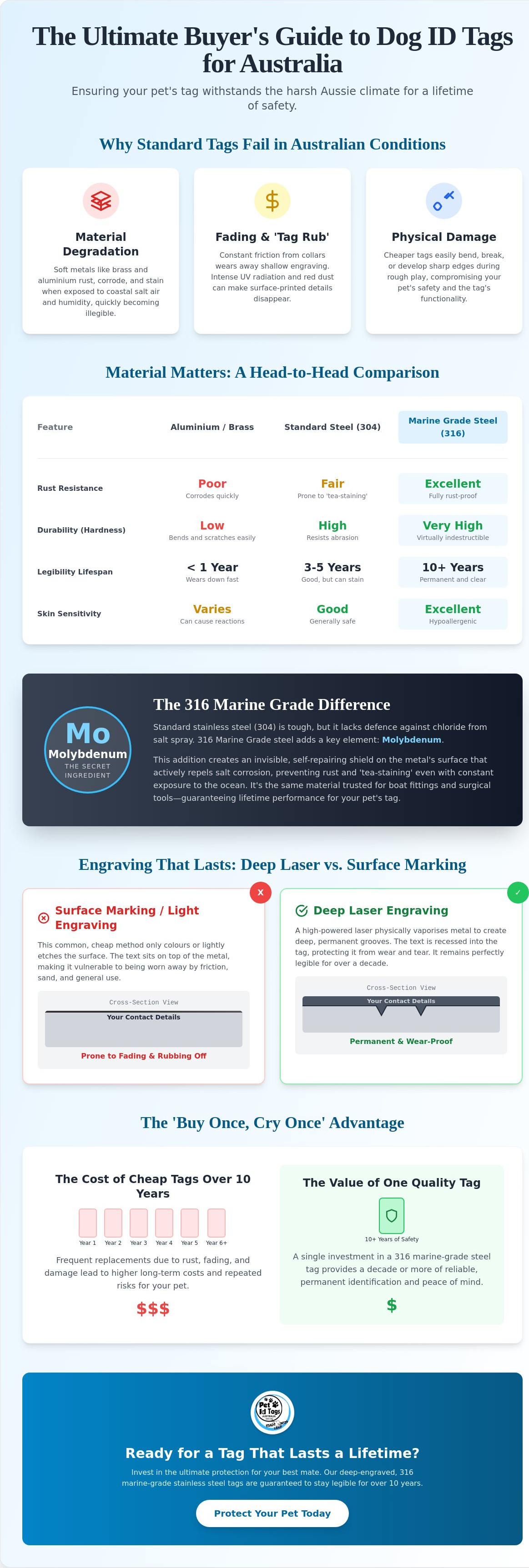
Most shoppers assume that "stainless steel" is a single, uniform material. In reality, the term covers a broad range of alloys with vastly different performance levels. While standard 304-grade steel is common in kitchen appliances, it often struggles when exposed to the salt-heavy air found along the Australian coastline. This is where 316 marine-grade stainless steel becomes essential. Understanding these technical differences is the key to ensuring the importance of permanent identification isn't undermined by a tag that corrodes or stains over time.
The "stainless" property comes from a microscopic layer of chromium oxide on the metal's surface. This layer acts as a shield, preventing oxygen from reaching the iron and causing rust. However, in coastal regions, chloride from salt spray can penetrate this shield on 304-grade steel. This results in "tea-staining," which appears as unsightly brown splotches. 316-grade steel solves this problem by adding a specific element to the mix that reinforces the protective layer against chemical attack.
What is 316 Marine Grade Stainless Steel?
The defining difference in 316-grade steel is the addition of molybdenum. This chemical element significantly increases the metal's resistance to pitting and crevice corrosion in chloride environments. It is the same material used for high-end boat fittings and surgical instruments because it remains pristine in the most punishing conditions. 316 marine-grade stainless steel is the ultimate metal for coastal pet safety because it provides unmatched resistance to chloride-induced corrosion. When you choose stainless steel dog tags australia made from this specific grade, you're opting for industrial-strength protection.
Identifying High-Quality Steel vs. Cheap Imitations
Low-quality tags are often made from "pot metal" or plated alloys that look like steel but fail quickly. You can perform a simple magnet test to check the quality of your tag. Genuine 316 stainless steel is generally non-magnetic or only very weakly magnetic. If a magnet sticks firmly to the tag, it likely contains a high percentage of carbon steel or is merely a plated imitation that will rust once the surface is scratched.
Surface finish also plays a role in longevity. A high-polish finish isn't just for aesthetics; it creates a smoother surface that is harder for salt and dirt to grip. Conversely, some owners prefer a brushed finish to hide the inevitable scratches from active play. Regardless of the look, the thickness must be balanced. A tag that is too thin will eventually tear at the hole, while one that is too thick becomes a heavy burden on a small dog's neck. We source our materials to hit the "sweet spot" of 1.5mm to 2mm thickness, providing maximum strength without unnecessary weight.
Engraving Techniques: Deep Laser vs. Surface Printing
A tag is only as good as the information it carries. If your contact details vanish after a few months of wear, the material's durability becomes irrelevant. This is why the method used to apply your details to stainless steel dog tags australia matters just as much as the metal itself. Many budget options rely on surface marking or chemical etching, which merely changes the colour of the top layer. In contrast, deep fiber laser engraving physically carves into the steel, creating a permanent indentation that survives years of friction.
Active dogs are hard on gear. When a tag hangs from a collar, it constantly rubs against the metal split ring, the collar buckle, or even a second ID tag. This friction acts like sandpaper. Over time, surface-printed designs and shallow markings are ground away until they become illegible. For an owner, this is a significant safety risk. If your pet ever wanders off, a finder needs to be able to read your phone number instantly, without squinting or guessing.
Why Deep Engraving is Non-Negotiable
We prioritise depth because it guarantees longevity. A shallow mark might look crisp when it arrives in the post, but it won't pass the "rub test" after a year of bushwalking or beach trips. Our process ensures the characters are recessed deep enough to remain readable even if the surface of the tag becomes scratched or scuffed. High-contrast marking on polished steel ensures the text stands out clearly against the reflective background, making it visible even in low-light conditions. Pet ID Tags Australia uses precision fiber lasers to ensure every character is sharp and permanent.
Engraving vs. Printing: A Comparison
Choosing the right marking method is a balance of aesthetics and safety. While some competitors offer colourful printed designs, these are essentially stickers or ink layers that can peel or chip. Investing in deep-engraved stainless steel dog tags australia means you won't be back at the shop in six months because the text has rubbed off.
| Feature | Deep Laser Engraving | Surface Printing |
|---|---|---|
| Durability | Permanent; carves into the metal. | Temporary; sits on the surface. |
| Legibility | High contrast; lasts 10+ years. | Fades or chips within months. |
| Safety | Reliable in all conditions. | Risk of becoming unreadable. |
| Maintenance | Zero maintenance required. | Requires frequent replacement. |
To maximise readability, we recommend clean, sans-serif fonts. These styles prevent letters from "bleeding" together when engraved at smaller sizes. Utilising both sides of the tag is also a smart strategy. Place your pet’s name and your primary mobile number on the front for quick access. Use the back for secondary contact details, medical alerts, or microchip information. This layout ensures you never have to sacrifice text size for information density.
Choosing the Right Size and Shape for Your Dog
Selecting the correct dimensions for stainless steel dog tags australia is a balance of visibility and comfort. A tag that is too large for a Toy Poodle or a Maltese Terrier can be cumbersome, potentially interfering with their movement or clinking against their food bowl. Conversely, a tiny tag on a Rhodesian Ridgeback or a German Shepherd is difficult for a finder to locate and read in an emergency. As a general rule, small breeds suit a 20mm to 25mm diameter, while larger breeds should carry a 30mm to 38mm tag for maximum legibility.
Shape functionality is often overlooked in favour of aesthetics. While a bone shape is a classic choice, it provides extra horizontal space that is ideal for longer names or multi-line addresses. A circular tag is the most streamlined and least likely to snag on vegetation during a bushwalk. If your dog spends significant time in the scrub or long grass, a smooth, round tag is the safest option to prevent the collar from getting caught on branches or fencing.
Essential Information for Australian Pet Safety
In most Australian jurisdictions, it is a legal requirement for your dog to wear a collar and ID tag in public places. This is a separate obligation from the national requirement for microchipping. Your tag should ideally include your pet's name, two current mobile numbers, and a clear note stating they are "Microchipped." This provides a redundant layer of safety if a scanner isn't immediately available.
Some owners choose to omit the dog's name for privacy reasons, fearing it makes the pet easier for a stranger to lure. However, including a name often makes a lost pet easier for a stranger to calm and handle until you can be reached. Always check with your local council regarding registration tags. Some councils issue their own plastic or metal discs that must be worn alongside your private ID tag. To minimise the "jingle" of multiple tags clashing, ensure your primary stainless steel tag is the largest item on the collar to act as a buffer.
Attachment Methods: Beyond the Split Ring
The hardware you use to attach the tag is the most common point of failure in pet identification. Standard split rings can stretch or deform if they get caught on a fence or thick brush, leading to a lost tag. We recommend using high-tensile stainless steel split rings that snap back into shape after being opened. If you frequently swap collars for different activities, Check out our Pet Tag Quick Clips for easy collar changes. These clips provide a secure, industrial-strength connection that is far more reliable than the flimsy hooks found on budget accessories.
Selecting a secure attachment is the final step in building a permanent identification solution that lasts a lifetime. For those ready to upgrade their pet's safety, you can browse our range of heavy-duty tags and clips to find the perfect fit for your breed's lifestyle.
Why Pet ID Tags Australia is the Trusted Choice
Experience is the ultimate validator in the pet industry. With over 20 years of dedicated service to Australian pet owners, we have seen every type of tag failure imaginable. We have used that knowledge to refine our production process, ensuring that every product we dispatch meets a standard of durability that others simply cannot match. When you invest in stainless steel dog tags australia from our range, you are benefiting from two decades of technical expertise and a deep understanding of what it takes to keep a pet safe in our unique environment.
Our material selection process for 2026 is our most rigorous yet. We don't just source generic metal blanks. We verify the metallurgical composition of our steel to ensure it meets strict marine-grade standards. This commitment to quality control means your tag won't tea-stain or pit, even if you live right on the beachfront. We handle every stage of the process, from precision laser calibration to final polishing, at our Australian base. This local oversight allows us to maintain a level of craftsmanship that mass-produced international alternatives often lack.
Speed is critical when it comes to pet safety. We understand that a dog without a tag is a dog at risk. Because we operate entirely within Australia, we offer fast national shipping that bypasses the long wait times of overseas retailers. Your custom-engraved tag is processed and dispatched rapidly, ensuring your pet is protected as soon as possible. Our guarantee is simple: we provide safety you can see and durability you can trust for the life of your pet.
The Pawzee Family Heritage
Order Your Custom Stainless Steel Tag Today
Securing your pet's future shouldn't be a complicated task. Our customisation process is designed for efficiency and clarity. You simply choose your preferred shape and size, provide your essential contact details, and let our precision lasers do the rest. We ensure every character is etched with the depth and contrast required for a lifetime of legibility. You won't have to worry about fading text or rusted metal ever again. Shop our full range of Stainless Steel Dog Tags today and give your dog the industrial-strength protection they deserve. It is a one-time investment that provides permanent peace of mind.
Invest in a Lifetime of Safety for Your Pet
Choosing the right identification is a small decision with massive consequences for your dog's security. As we have explored, 316 marine-grade steel and deep fiber laser engraving are the only ways to ensure your contact details survive the harsh Australian elements. By selecting high-quality stainless steel dog tags australia, you are avoiding the cycle of replacing rusted or illegible tags. You are giving your pet a permanent safety net that remains functional for years to come.
Since 2004, Pet ID Tags Australia has provided local pet owners with industrial-strength solutions. Our deep fiber laser engraving and commitment to 316 marine-grade stainless steel ensure that your information remains clear even after a decade of beach trips and bushwalks. With fast national Australian shipping, you can upgrade your pet's gear and receive it at your door rapidly. Take the guesswork out of pet safety and choose a tag designed specifically for the Australian lifestyle.
Secure your pet with a premium Stainless Steel Tag from Pet ID Tags Australia
Your dog's adventures should be worry-free. Equip them with the most durable ID on the market today and enjoy the peace of mind that comes with a truly permanent solution.
Frequently Asked Questions
Are stainless steel dog tags better than aluminium?
Stainless steel is significantly more durable than aluminium. While aluminium is lightweight and inexpensive, it is a soft metal that wears down through constant friction against split rings and collar buckles. Stainless steel resists this abrasion, ensuring the tag remains structurally sound for a decade or more. It is also a hypoallergenic material, making it a safer choice for dogs with sensitive skin that might react to cheaper alloys.
Do stainless steel dog tags rust in salt water?
High-quality stainless steel dog tags australia are designed to resist rust, but the specific grade of metal is what matters most. Standard 304-grade steel may develop surface tea-staining in coastal environments over time. However, 316 marine-grade stainless steel contains molybdenum, which specifically prevents corrosion from salt water. If your dog swims at the beach frequently, 316-grade is the only material that will remain pristine and rust-free.
What is the best material for dog tags in Australia?
316 marine-grade stainless steel is the gold standard for Australian conditions. Our climate combines high UV exposure, salt air, and abrasive red dust, all of which quickly degrade inferior materials like brass or plastic. Stainless steel offers the best combination of physical hardness and corrosion resistance. It ensures that your contact details remain legible despite the punishing outdoor lifestyle common for Aussie pets.
Will the engraving on a stainless steel tag wear off?
Deep fiber laser engraving will not wear off because it physically carves into the metal. Unlike surface printing or light chemical etching, which only change the colour of the top layer, deep engraving creates a permanent indentation. This ensures that even if the tag surface gets scratched during bushwalking or rough play, the text remains readable. It is the most reliable method for long-term identification in the field.
How much information can I fit on a stainless steel pet tag?
Most stainless steel dog tags australia can comfortably fit four to five lines of text on each side. We recommend placing the pet's name and your primary mobile number on the front for immediate identification. The back can then be used for secondary numbers, medical alerts, or microchip details. Utilising both sides allows for larger, clearer fonts which are much easier for a finder to read in an emergency.
Are stainless steel tags too heavy for small dogs or cats?
Stainless steel tags are not too heavy if you select the appropriate size for your pet's frame. A 20mm round tag is lightweight enough for cats and toy breeds while still providing the industrial strength of steel. We balance our tags at a thickness of 1.5mm to 2mm, which offers maximum durability without dragging down the collar. It is a much more secure option than flimsy, lightweight alternatives that break or bend easily.
How do I clean my stainless steel dog tag to keep it shiny?
Cleaning a stainless steel tag is a simple process that requires only mild dish soap and warm water. Use a soft cloth to wipe away dirt, salt, or oils that may have accumulated during outdoor activities. If the tag has lost its lustre, a quick buff with a microfibre cloth will restore its original high-polish shine. Because the material is non-porous, it won't harbour bacteria or develop unpleasant odours over time.
Do I still need a tag if my dog is microchipped in Australia?
Yes, wearing an ID tag is a legal requirement in most Australian states and territories. While microchipping is a vital permanent record, it requires a scanner and a vet visit to access your contact information. A visible tag allows a neighbour or passer-by to contact you immediately, often reuniting you with your pet within minutes of them being found. It acts as the critical first line of defence in pet recovery.