

Imagine the gut-wrenching moment your dog slips out the gate, only for a kind neighbour to find them and realise your phone number has completely vanished from their tag. It is a silent failure that happens more often than you would think under the intense Australian sun. Understanding why pet id tags fade is the first step in ensuring your best mate always has a clear, reliable way back home.
We understand the frustration of spending money on a 'permanent' tag, only to watch the text disappear after a few months of surf and sand. You want the security of a high-quality product that does its job when it matters most. A faded tag is more than just a waste of money; it is a broken promise of safety that leaves your pet vulnerable.
This article reveals the specific environmental stressors that cause tag erosion and explains why common marking methods often fail in our unique climate. You will learn how to identify the most durable materials for Aussie conditions and why deep, mechanical engraving is the only way to keep your pet safely identifiable for years to come.
Key Takeaways
- Understand how metal-on-metal friction and abrasive grit act like sandpaper, explaining the physical science behind why pet id tags fade.
- Distinguish between superficial laser marking and deep mechanical engraving to ensure your pet's details remain readable for life.
- Learn how Australia's intense UV radiation and coastal saltwater conditions erode standard tags and which materials can withstand these harsh elements.
- Identify why high-grade stainless steel is the premier choice for a durable, rust-proof safety investment for active dogs.
- Implement a quick three-month maintenance and cleaning routine to protect your tag from salt build-up and hardware stress.
Why Pet ID Tags Fade: The Science of Wear and Tear
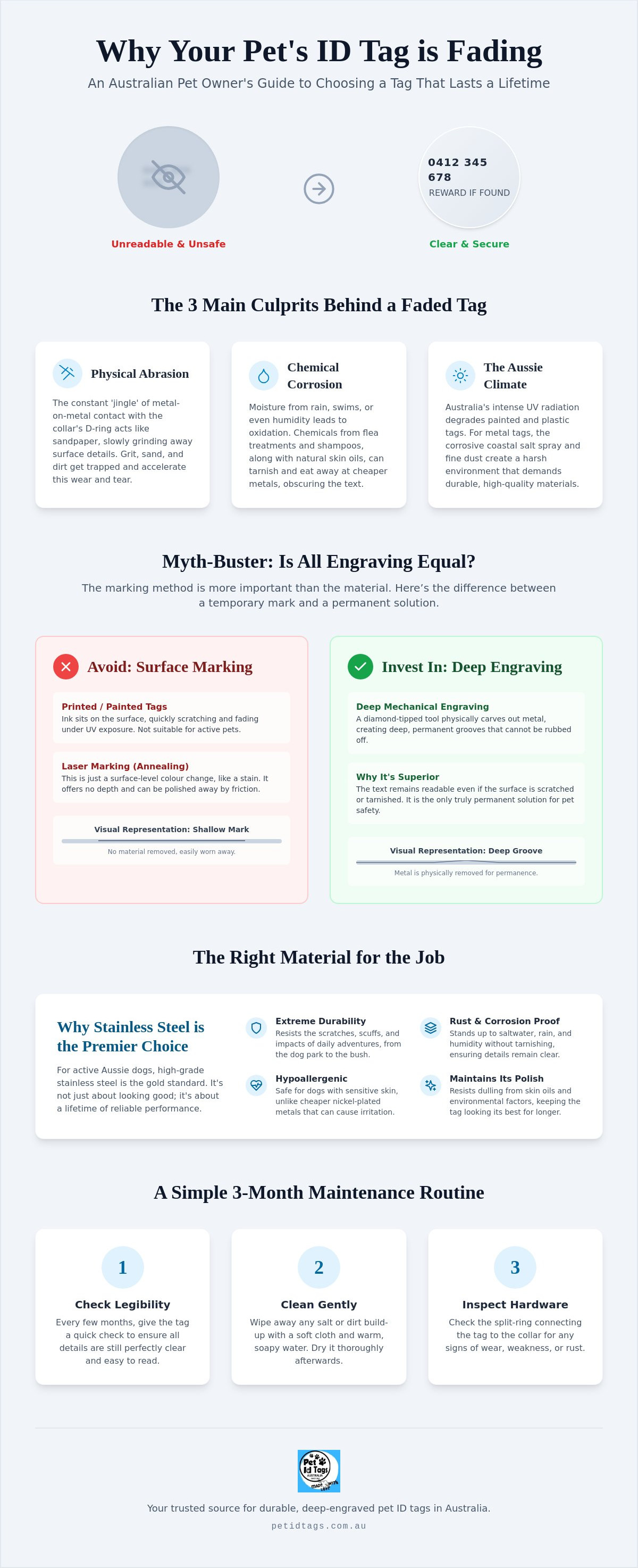
Tag fading is the physical erosion of identification text due to environmental and mechanical stress. While many pet owners blame the sun for a dulling tag, the reality is a combination of physics and chemistry. Understanding why pet id tags fade involves looking at how the Australian environment interacts with the very surface of the metal. While the science of photodegradation details how UV light breaks down polymers and pigments in plastic tags, high-grade metal tags suffer from a more aggressive process: physical abrasion.
Think of your dog's tag as a small piece of machinery that is constantly in motion. This movement creates a grinding effect that slowly removes the top layers of the material. When you combine this with the harsh elements found in our backyard, from coastal salt spray to fine red dust, you have a recipe for rapid degradation. A tag that was perfectly legible in January can become a smooth silver disc by December if it isn't built to withstand these forces. You need to realise why pet id tags fade faster when exposed to these specific Aussie conditions so you can make a better choice for your mate's safety.
The 'Jingle' Factor: Friction and Abrasion
The primary cause of wear is the constant contact between the tag and the metal D-ring of the collar. Every step your dog takes causes the tag to bounce and rub. This metal-on-metal friction acts like sandpaper, slowly grinding away the surface. If your dog wears multiple tags, the 'jingle' you hear is actually the sound of those tags destroying each other's legibility. The friction is constant, occurring during sleep, play, and walks.
Environmental grit makes this wear significantly worse. During a walk at the park or beach, fine particles of sand or soil get trapped between the tags or against the collar hardware. These particles act as an abrasive agent, accelerating the wear during every movement. This is why many owners now opt for 'silent' tags or silicone silencers. By reducing the movement and providing a soft barrier, you can significantly extend the life of the engraving and maintain a clear, readable surface.
Chemical and Environmental Corrosion
Corrosion is the second silent enemy of a clear ID tag. Moisture from rain, humidity, or a quick dip in the ocean can become trapped against the tag's surface for hours. This leads to oxidation, where the metal reacts with oxygen to form a crusty layer or 'pitting' that fills in the engraved letters. Over time, this oxidation can eat deep into the metal, making the contact details disappear entirely.
External chemicals often speed up this breakdown. Common flea treatments, spot-on medications, and medicated shampoos contain active ingredients that can react poorly with certain tag finishes, causing them to tarnish, bubble, or peel. Even the natural oils in a dog's coat can be surprisingly acidic. Cheaper metals like nickel-plated zinc react poorly to these oils, leading to a dull, dark film that makes it nearly impossible to read the emergency contact details when they are needed most.
Myth-Busting: Is All Engraving Created Equal?
Many pet owners assume that buying a metal tag automatically guarantees a lifetime of legibility. This is a dangerous misconception. The material is only half the battle. The method used to apply your contact details is what determines if the tag remains readable after six months of Aussie adventures. When people ask why pet id tags fade, they usually look at the metal first. However, the marking technique is the real culprit. Not all tags are permanent by default, and assuming so could leave your pet vulnerable if they ever wander off.
The Problem with Printed or Painted Tags
Ink and paint are surface-level applications. They sit on top of the material rather than becoming part of it. In the harsh Australian climate, UV radiation breaks down the chemical bonds in these pigments rapidly. Beyond the sun, physical activity is the primary killer of these designs. A single afternoon of your dog pushing through thick scrub or wrestling with a mate at the park can scratch away a phone number. Understanding why pet id tags fade helps you avoid these low-quality alternatives. If your dog gets lost, a tag with half a phone number is as useless as no tag at all. It's a safety risk that isn't worth the cheaper price tag.
Laser Marking vs. Deep Mechanical Engraving
This is where most confusion lies. Many retailers sell "laser engraved" tags that are actually just laser marked. Surface laser marking is often just a chemical colour change on the very top layer of the metal. It creates a dark mark, but it hasn't physically removed any material. Because it is essentially a surface stain, it can be polished away by the constant friction of the collar ring or the abrasive grit we discussed in the previous section. It looks professional on day one, but it lacks the physical depth required for longevity.
Deep mechanical engraving is fundamentally different. It involves a hardened tool physically carving into the metal to create a permanent channel. Even if the surface of the tag gets scratched, tarnished, or covered in mud, the deep grooves remain legible. This is why pet id tag engraving ideas should always be applied with depth in mind. A deep cut ensures that your emergency details survive years of wear and tear, rather than just weeks. For the best protection, it's worth investing in stainless steel dog tags that utilise this deep-cut method. It provides the peace of mind that comes from knowing your pet's ID is truly permanent.
The Australian Environment: A Tough Test for Pet ID
Australia’s landscape is beautiful, but it is notoriously brutal on equipment. While we have already explored how mechanical friction wears down a tag, the environmental stressors unique to our continent are often the final blow for low-quality products. From the tropical humidity of the north to the arid red dust of the centre, your pet's ID is under constant attack. Understanding why pet id tags fade in these conditions requires a look at the specific chemical and physical challenges of the Aussie outdoors.
The Australian UV index is a primary culprit for tag coating failure. Because our sun is significantly more intense than in the Northern Hemisphere, materials that might last years in Europe or North America can fail here in a single summer. This extreme radiation doesn't just fade colours; it fundamentally changes the molecular structure of many common tag components. When you consider why pet id tags fade, you must account for this relentless solar bombardment that turns flexible plastics brittle and clear coatings cloudy.
In regional and outback areas, the challenge is physical. Fine red dust and desert sand act as high-speed abrasives. When these particles get caught behind a tag or between the tag and the collar, they create a grinding paste. Every time your dog shakes their head or runs, this grit polishes away the surface of the tag. Without deep engraving, your contact details simply cannot survive this level of constant environmental sanding.
Saltwater and Corrosion for Coastal Dogs
For dogs that live near the coast or frequent beaches like Bondi or Cottesloe, saltwater is the biggest threat. The chemical reaction between salt, moisture, and oxygen is incredibly aggressive. On inferior metals like brass or nickel-plated zinc, this leads to rapid oxidation and 'pitting,' where the metal surface becomes uneven and corroded. Many tags are marketed as 'rust-proof,' but these claims are often based on controlled laboratory tests rather than real-world exposure to the Southern Ocean.
To protect your investment, rinsing your pet's tag with fresh water after every beach trip is essential. This simple step removes the salt crystals before they can begin eating into the metal. However, the best defence is choosing a material that is naturally resistant to sea salt, such as high-grade stainless steel. It is the only way to ensure the tag remains clear and rust-free despite a life spent in the surf.
Intense UV Exposure and Coating Failure
UV rays are particularly destructive to tags that rely on epoxy resins or plastic components. Over time, these rays break down the polymers, leading to a noticeable 'yellowing' effect on clear protective layers. Eventually, these layers become opaque or start to peel away in flakes, taking any printed information with them. This is a common failure point for 'photo tags' or those with colourful decorative stickers.
Bare, high-grade metal is always the best defence against sun damage. By removing the need for fragile coatings or plastics, you eliminate the materials most susceptible to UV degradation. A solid metal tag with deep mechanical engraving has no layers to peel and no colours to bleach. It remains just as readable after five years in the Queensland sun as it was on the day it arrived.
Choosing Materials That Stand the Test of Time
Selecting the right material is the single most effective way to prevent the frustration of a disappearing ID. While we have discussed how environmental factors like salt and grit contribute to why pet id tags fade, the inherent properties of the metal itself dictate how long it will resist those forces. Some metals are simply too soft to withstand the daily grind of a dog's life. Choosing a material based on style alone often leads to a tag that becomes unreadable within months. You need a solution that balances physical strength with chemical stability.
For a detailed breakdown of the technical specifications and material science behind these choices, read our stainless steel dog tags australia pillar. This guide will help you understand the molecular differences that make certain metals superior for the Australian climate.
Why Stainless Steel is the Gold Standard
Stainless steel is the undisputed champion of durability for active Aussie pets. Its primary advantage is its incredible hardness. On the Rockwell scale, stainless steel is significantly tougher than brass, copper, or aluminium. This hardness allows it to resist the "sandpaper effect" of the collar ring and environmental grit. It is a "set and forget" safety investment because it does not require protective coatings that can peel or yellow in the sun.
Beyond its physical strength, stainless steel is naturally resistant to rust and corrosion. Even for dogs that spend every weekend in the surf, a high-grade stainless steel tag will maintain its structural integrity and legibility. It won't tarnish, and it won't leave dark marks on your pet's coat. If you want the highest level of security, shop our range of stainless steel dog tags for a permanent identification solution.
Aluminium: Balancing Weight and Longevity
Aluminium is a popular choice for pet owners who want a lightweight tag with a pop of colour. These tags use an anodised finish, which is a chemical process that hardens the surface and locks in the dye. This makes them highly visible and resistant to the elements. However, aluminium is a softer metal than steel. This is why pet id tags fade faster in aluminium if the engraving is too shallow. The surface colour can eventually rub off through constant friction.
To ensure an aluminium tag lasts, it must be paired with deep mechanical engraving that cuts through the anodised layer and into the core of the metal. This ensures the information remains clear even if the surface colour begins to wear at the edges. Aluminium is an excellent choice for smaller dogs, indoor cats, or pets that lead a less rugged lifestyle while still requiring reliable identification.
The Limits of Brass and Copper
While brass and copper offer a classic, stylish look, they are among the most high-maintenance materials. Both are relatively soft metals that show surface wear quickly. They are also highly reactive to moisture and natural oils, leading to rapid tarnishing and oxidation. Without frequent polishing, the text can become obscured by a dark patina. For most Australian pet owners, the constant upkeep required to keep these tags legible makes them less ideal than more modern, durable alternatives.
How to Stop the Fade and Keep Your Mate Safe
Prevention is always better than a frantic search for a lost pet. While we have explored the technical reasons why pet id tags fade, implementing a simple maintenance routine is the best way to ensure your contact details remain legible for years. Even the most durable materials require a bit of oversight to counter the relentless Aussie elements. By taking a proactive approach, you can spot the early signs of wear before the tag becomes a safety liability.
The 'Three-Month Check' is a vital habit for every pet owner. Every 90 days, take a moment to remove the tag from the collar and inspect it closely under good light. Don't just look at it; run your fingernail across the engraving to ensure the depth is still there. You should also check the attachment hole for 'keyholing,' where the metal has thinned out from constant friction. If the tag looks thin or the text is becoming difficult to read at a glance, it is time to retire it. Identifying why pet id tags fade on your specific pet, whether from coastal salt or rough play, helps you decide if you need to upgrade to a tougher material like stainless steel next time.
Proper attachment also plays a massive role in longevity. If your dog wears multiple tags, such as a council registration disc alongside a name tag, they will constantly clash together. This metal-on-metal impact is a leading cause of surface erosion. Using a dog tag quick clip australia can help organise these tags and reduce the range of motion, significantly cutting down on the friction that leads to fading. It also makes it much easier to swap tags between different collars or harnesses.
Preventive Care and Maintenance
Cleaning your pet's tag is a simple task that pays off in durability. Use a soft cloth and mild dish soap to remove the 'grinding paste' of salt, oils, and grit that accumulates over time. For stainless steel, this helps maintain the natural lustre and prevents surface contaminants from causing minor pitting. It's also the perfect time to verify your contact information. We often reckon our details are fine, but many owners forget to update tags after moving house or changing mobile numbers. An unreadable tag and an outdated phone number are equally dangerous in an emergency.
Smart Alternatives for Long-Term Safety
In 2026, the gold standard for pet safety is a multi-layered approach. While microchipping is mandatory across Australia, a visible, readable tag remains the fastest way for a neighbour to get your pet home. Modern smart tags with QR technology provide an excellent backup. If the physical engraving ever becomes obscured by mud or heavy scratching, a rescuer can still scan the code to access your digital profile. Combining traditional deep mechanical engraving with these smart features ensures your pet is protected by both physical durability and digital redundancy. Your final safety checklist should always include a microchip, a durable collar, and a deep-engraved metal tag that can stand up to the Aussie sun.
Secure Your Pet's Safety with Permanent Identification
Understanding why pet id tags fade is the first step toward better safety. You now know that Australia’s intense UV rays, coastal salt, and constant mechanical friction are the primary threats to a clear ID. Choosing high-grade materials like 316 Stainless Steel and insisting on deep mechanical engraving rather than surface marking ensures your contact details remain readable for the life of your pet.
We have been proudly Australian owned and operated since 2004; providing reliable solutions that survive the active lifestyles of local pets. Our focus on precision craftsmanship means you won't have to worry about disappearing text or corroded metal. It's a practical investment that builds immediate trust and provides lasting peace of mind for every pet owner.
Shop our range of deep-engraved, Aussie-proof Pet ID Tags today!
Take the guesswork out of pet identification and give your best mate the protection they deserve.
Frequently Asked Questions
Why does my dog's tag get a black residue that makes it hard to read?
Black residue is usually a combination of oxidised metal and environmental grit trapped against the tag surface. This often occurs with softer metals like brass or nickel-plated zinc when they react with moisture and natural oils in your dog's coat. While a quick clean with mild soap can remove the surface film, if the residue has already pitted the metal, the legibility of the tag is permanently compromised.
Can I fix a faded pet ID tag at home or should I replace it?
You should replace a faded tag immediately rather than attempting a home fix. While some suggest using permanent markers or paint to fill in worn letters, these surface-level solutions fail rapidly under the harsh Australian sun. Because clear identification is a legal requirement and a safety necessity, investing in a new, deeply engraved tag is the only way to ensure your pet remains identifiable in an emergency.
How long should a high-quality stainless steel dog tag actually last?
A high-quality 316 stainless steel tag should last for the entire life of your pet when properly maintained. Unlike softer materials, stainless steel resists the physical abrasion that explains why pet id tags fade over time. While the split ring or attachment clip might need replacing every few years due to mechanical wear, the deeply engraved text on the tag itself will remain crisp and readable despite daily use.
Is laser engraving better than traditional mechanical engraving for pet tags?
Traditional mechanical engraving is superior to standard laser marking for long-term durability. Mechanical engraving physically carves deep channels into the metal, whereas many laser methods only create a surface-level colour change. These surface marks are easily polished away by the constant friction of the collar ring. Deep mechanical cuts ensure the information remains legible even if the tag surface becomes scratched during outdoor adventures.
Do plastic or silicone pet ID tags fade faster than metal ones?
Plastic and silicone tags often fail faster than high-grade metal because they are highly susceptible to UV degradation and physical tearing. Australia’s intense UV index causes polymers to become brittle and clear coatings to turn yellow or opaque. While silicone is quiet, it lacks the structural permanence of metal. For a reliable, long-term safety solution, solid metal with deep engraving is always the more dependable choice for active dogs.
What is the best material for a dog that loves swimming in the ocean?
Marine-grade 316 stainless steel is the best material for dogs that love swimming in the ocean. It is specifically designed to resist the corrosive effects of saltwater and oxygen, which quickly destroy inferior metals. Unlike brass or nickel, stainless steel won't rust or develop the green patina that makes contact details unreadable. It provides a "set and forget" solution for coastal living without the need for constant polishing or replacement.
How can I stop my dog's tags from rubbing against each other and wearing out?
You can reduce tag-on-tag wear by using a dedicated attachment clip or a silicone tag silencer. These tools limit the range of motion and prevent metal tags from constantly clashing together, which is a primary reason why pet id tags fade through physical erosion. Organising your pet's ID and registration discs on a single secure clip also makes it easier to move them between different harnesses while keeping the text protected from unnecessary friction.
Does the Australian sun actually make pet tags fade faster?
The Australian sun significantly accelerates the fading process for tags that rely on inks, paints, or epoxy coatings. Our extreme UV levels break down chemical bonds much faster than in cooler climates, causing colours to bleach and protective layers to peel. This is why we recommend bare metal tags with deep mechanical engraving; they don't rely on fragile coatings, making them essentially immune to the destructive power of the Aussie sun.