
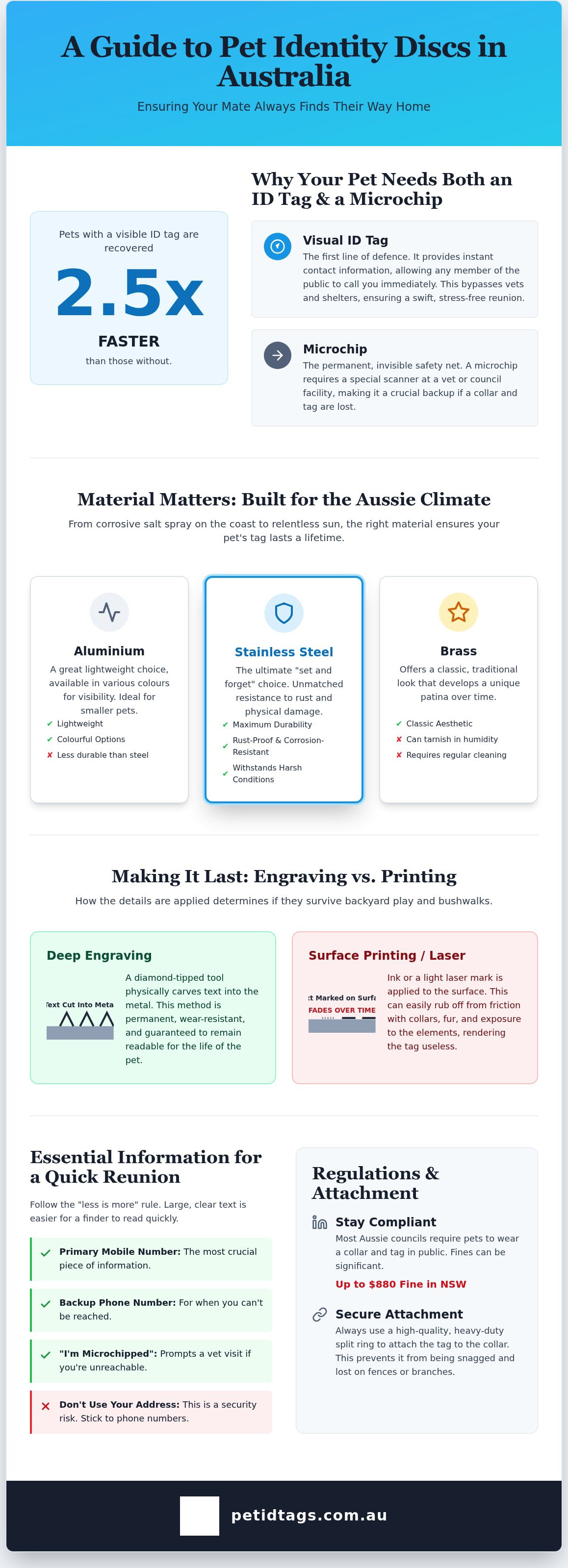
Did you know a lost pet wearing a visible identification tag is recovered 2.5 times faster than one without? In the harsh conditions of the Aussie bush or the salty air of our coastlines, choosing the right pet identity discs australia provides is about more than just a name; it's a vital lifeline. You want the confidence that if your mate slips through the gate or wanders off-leash, they have a clear, readable way back to you.
It's common to feel frustrated when cheap materials corrode in salt water or the engraving becomes unreadable after only a few months of wear. This 2026 guide promises to help you choose a durable, legal, and silent identity disc that ensures your pet always finds their way home in the Australian climate. You'll discover how to achieve lifetime durability while staying on the right side of local council regulations and avoiding heavy fines.
We'll examine the specific benefits of high-grade stainless steel, explain current registration requirements across the states, and show you how to eliminate annoying jingling noises for good. By the end of this article, you'll have the facts needed to secure your pet's safety with a professional-grade solution that lasts a lifetime.
Key Takeaways
- Understand why high-grade stainless steel is the "set and forget" choice for resisting corrosion in salty coastal environments and the harsh Aussie sun.
- Learn how to choose pet identity discs australia recommends for maximum visibility, acting as the essential visual partner to your pet's permanent microchip.
- Discover the technical difference between deep engraving and surface printing to ensure your mate's contact details don't rub off during backyard play or bushwalks.
- Master the "less is more" rule for contact information to keep font sizes large, readable, and effective for rapid recovery.
- Identify the most secure attachment methods to prevent your identity disc from catching on fences or branches and becoming lost.
The Essential Role of Pet Identity Discs in Australia
A pet identity disc is the most efficient tool for a swift homecoming. When a dog wanders out of a suburban gate or gets spooked during a bushwalk, the person who finds them is usually a neighbour. Without a visible tag, that neighbour has few options. They must either hold the pet, wait for a ranger, or transport the animal to a local vet. A clear, readable disc allows for an immediate phone call, bypassing the stress of the local pound entirely. The role of pet ID tags is to provide this instant link between a lost animal and its owner, ensuring the safety of adventurous Aussie dogs and providing much-needed peace of mind for their families.
Microchip vs. ID Tag: Why You Need Both
While microchipping is a legal requirement across all Australian states, it remains an invisible safety net. A microchip requires a specialised scanner, usually only found at veterinary clinics or council facilities. This creates a significant delay in the recovery process. In contrast, pet identity discs australia owners rely on act as a "visual partner" to the chip. By providing your phone number on a durable tag, you empower any member of the public to help your mate. For a deeper look at how these two systems work together, read our guide on Pet Tag vs Microchip Australia: Why Your Pet Needs Both in 2026. The time saved by a single phone call can be the difference between a quick reunion and an overnight stay in a strange facility.
Australian Council Regulations and Compliance
Staying compliant with local laws is a key responsibility for every pet owner. Most Australian councils mandate that dogs and cats wear a collar with an identification marker whenever they are in a public place. In jurisdictions like New South Wales, the fine for a dog not wearing a collar and tag in public can reach up to $880. These regulations aren't just about revenue; they're designed to reduce the burden on animal shelters and ensure lost pets are returned quickly. Using high-quality pet identity discs australia makes certain that your contact details remain legible despite the sun and scrub. A durable disc ensures you avoid unnecessary fines while providing the ultimate security for your pet.
Choosing the Right Material for the Australian Climate
Australia’s environment is notoriously tough on hardware. Relentless UV rays and corrosive salt spray often cause inferior metals to fail within a single season. Many owners discover that cheap plastic alternatives snap in the cold or become brittle under the sun. Selecting high-quality pet identity discs australia requires a material that can withstand these extremes while remaining perfectly legible. Using "mystery metals" like zinc alloys usually leads to disappointment, as the plating wears away to reveal a core that corrodes quickly when exposed to red dust or humidity.
Stainless Steel: The Ultimate Heavy-Duty Choice
For most Aussie dogs, stainless steel is the professional choice. It is the only material that truly offers "set and forget" durability. If your mate loves a surf at the beach or a run through the salty air of the coast, stainless steel provides unmatched rust-resistance. It doesn't rust. It's also physically strong. This metal won't bend or snap during high-energy play or thick bush trekking. For a deeper dive into why this metal is the industry standard, see our Stainless Steel Dog Tags Australia: The 2026 Ultimate Buyer’s Guide to Durable ID. This material ensures the tag lasts the lifetime of the pet, regardless of the terrain.
Aluminium and Brass: Colour and Lightweight Options
Not every pet needs a heavy-duty steel disc. For smaller breeds like Chihuahuas or indoor cats, lightweight aluminium is an excellent alternative. It prevents unnecessary neck strain while still providing a solid surface for engraving. High-grade aluminium tags also come in various vibrant colours, which can help a neighbour spot a lost pet from a distance. Brass is another classic option, offering a traditional look that ages with a unique patina. However, brass requires more frequent cleaning to prevent tarnish in humid climates.
Regardless of the metal you choose, ensure the finish is designed for longevity. Following RSPCA advice on pet identification, a physical tag remains a vital recommendation alongside a microchip. A quality tag acts as an immediate signal that a pet is owned and cared for. If you're looking for a reliable solution, you can browse our range of durable pet identity discs to find a match for your pet's lifestyle. Choosing the right material today prevents a frantic search tomorrow.
Engraving vs. Printing: Why Your Pet’s ID Might Fade
Many pet owners assume that any tag is better than none. This isn't true if the information is unreadable when it matters most. Surface-level printing or thin laser marking often fails when exposed to the abrasive Aussie scrub. Friction is the primary culprit. When a tag rubs against a collar buckle or a secondary council registration disc, it creates a constant "eraser effect." This mechanical wear grinds away the ink or the shallow surface mark until your phone number eventually disappears. A faded tag is as useless as no tag at all in an emergency; it provides a false sense of security while leaving your pet vulnerable.
It's vital to distinguish between laser marking and genuine deep mechanical engraving. Laser marking uses a beam to discolour the surface of the metal. While it looks crisp initially, it doesn't remove much material. In contrast, mechanical engraving uses a physical bit to carve deep into the disc. This difference is critical for pet identity discs australia users who need a permanent solution. If the marking isn't deep enough to feel with a fingernail, it's likely to wear off under the pressure of daily "zoomies" or active outdoor exploration.
The Longevity of Deep Engraving
Deep mechanical engraving involves physically carving into the metal. This method creates deep grooves that remain legible even if the surface of the disc becomes heavily scratched or scuffed during a bushwalk. Deep engraving is the gold standard for pet safety because it survives physical wear that would destroy a printed tag. You can learn more about the science behind this in our article Why Pet ID Tags Fade: The Truth About Durability in the Aussie Sun. When you choose pet identity discs australia, prioritising depth over aesthetics ensures your contact details stay visible for years.
Smart Tags and QR Technology
Technology has introduced new ways to keep pets safe. Smart tags use QR codes or NFC chips to link to an online profile. This allows you to include far more information than a standard disc, such as medical needs or multiple contact numbers. One of the biggest benefits is the ability to update your details instantly without buying a new tag. If you move house or change your mobile number, you simply log in and edit the profile. For a comprehensive look at these options, check out our Smart Pet Tags Australia: The 2026 Guide to Next-Gen Pet Safety. These next-gen solutions work alongside traditional engraving to provide a multi-layered approach to pet security.
What to Put on Your Pet’s ID Disc: An Australian Checklist
When customising your tag, the "Less is More" rule is the most important principle to follow. Cramming too much information onto a small metal surface forces the engraver to reduce the font size. If a neighbour needs a magnifying glass to read your mobile number, the tag has failed its primary purpose. The goal for pet identity discs australia owners rely on is to provide clear, actionable data that leads to a phone call within seconds of your pet being found. Prioritise readability over a lengthy biography.
The Information Hierarchy
Your primary mobile number is the absolute priority. Always include the area code if you travel between states, though a standard Australian mobile number is usually sufficient for local recovery. The pet's name is often included, but some owners prefer to use the space for a more urgent message like "I am lost" or "I am microchipped." Including the word "microchipped" is a smart tactical move. It signals to a finder that even if the tag is lost later, there is a permanent record of ownership. For a comprehensive breakdown of wording options, see our Pet ID Tag Engraving Ideas: The Ultimate 2026 Australian Checklist.
Privacy is a common concern for many Aussie families. You don't need to include your full street address. In fact, doing so can be a security risk. Including your suburb is a better alternative. It tells the finder whether the pet has just slipped out from around the corner or if they've wandered from further away. This helps the person who finds your mate decide whether to walk them home or call you for a pickup.
Secondary Details for Extra Security
If your pet has specific needs, use the reverse side of the disc for critical medical alerts. Phrases like "Needs Insulin," "I am Deaf," or "Extreme Allergies" can be life-saving if your pet is found by someone who intends to keep them overnight. A second "backup" phone number is also highly recommended. If you're out of range or your phone is flat while you're searching the neighbourhood, having a partner's or friend's number on the tag provides a vital second point of contact.
In states like South Australia, a registration disc with a specific number is mandatory. However, these council discs are often flimsy and prone to falling off. Adding your council registration number directly onto your durable pet identity discs australia ensures you remain compliant even if the official plastic tag goes missing. Once you've decided on your details, you can order your custom engraved tag to ensure your mate's safety is never left to chance.
Secure Attachment: Keeping the Disc on the Collar
Even the highest-quality pet identity discs australia provides won't protect your pet if they're lying in the dirt after a morning run. Many owners overlook the attachment method, yet it's frequently the "weakest link" in pet identification. A standard, flimsy split ring made from thin wire can easily stretch or catch on a branch during a high-energy bushwalk. Once that ring is compromised, your pet's vital contact information is gone. Ensuring a secure fit is essential for pets involved in "hard yakka" around the farm or those who love to explore thick coastal scrub. A robust attachment ensures that the tag remains in place regardless of how rough the play gets or how dense the undergrowth becomes.
The Benefits of Quick Clips and Rubit Clips
Traditional split rings are notorious for being difficult to manage, often leading to broken fingernails and frustrated owners. Modern alternatives like quick clips and Rubit clips have revolutionised how we manage pet ID. These clips allow you to move tags between different collars or harnesses with a simple, secure mechanism. This is particularly useful for active dogs that use different gear for swimming, walking, and home life. Using a stainless steel clip offers significant durability advantages over standard wire rings, as they're built to withstand the physical pressure of a dog pulling or snagging. These clips are designed to be "set and forget" solutions that won't fail when your pet is most active. For a detailed comparison of these attachment methods, read our Dog Tag Quick Clip Australia: The 2026 Guide to Secure Pet ID Attachment.
Silent Tags and Reducing the Jingle
The constant "clink-clink" of metal tags hitting each other or a collar buckle can be a major disturbance, especially at night. For owners who find this noise annoying, there are several practical solutions available. You can use rubber tag silencers that fit around the edge of the disc to dampen the sound effectively. Alternatively, choosing a specific attachment position on the collar can minimise friction and noise significantly. Some owners prefer to mount the tag flush against the collar strap using specialised clips to eliminate the jingle entirely. This keeps the tag quiet while maintaining its visibility for anyone who might find your pet. You can find more tips on noise reduction and proper fitting in our guide on How to Attach a Dog Tag to a Collar: The 2026 Australian Guide to Secure ID. By prioritising a secure and silent attachment, you ensure your pet identity discs australia stay exactly where they belong: on your mate's collar, ready to bring them home safely.
Secure Your Mate’s Swift Return Home
Choosing the right pet identity discs australia provides is a small investment that delivers immense peace of mind. You now know that deep-engraved stainless steel is the only material capable of surviving the harsh Aussie sun and corrosive salt spray without fading into illegibility. By prioritising a clear mobile number and using a secure attachment like a quick clip, you eliminate the mechanical failures that often lead to lost pets being stuck in local pounds. These simple choices ensure that your contact details remain readable for the life of your pet.
Since 2004, we've focused on providing high-grade, dependable solutions for Australian pet owners. Our Aussie owned and operated business specialises in deep-engraved stainless steel for maximum longevity and reliability. With fast national shipping available across Australia, upgrading your pet’s safety has never been easier. Browse Our Range of Durable Australian Pet Identity Discs today to find a permanent solution for your mate. Your best friend deserves a high-quality lifeline that won't let them down when it matters most.
Frequently Asked Questions
Is it a legal requirement for my dog to wear an ID tag in Australia?
Yes, it's a legal requirement in most Australian states for dogs to wear a collar and tag in public places. While specific rules vary by local council, failing to display identification can result in significant fines. For instance, in New South Wales, the penalty for a dog being "at large" without a tag can reach up to $880. A durable disc ensures you stay compliant with local laws while providing a visual lifeline for your mate.
What is the best material for a pet identity disc that won’t rust?
High-grade stainless steel is the superior choice for rust-resistance in the Australian climate. Unlike cheaper "mystery metals" or plated alloys, stainless steel doesn't corrode when exposed to salt spray or humidity. This makes it the ideal "set and forget" material for beach-loving dogs and active explorers. It maintains its structural integrity and remains perfectly readable for the lifetime of your pet, even after years of exposure to the elements.
Should I put my pet’s name on their identity disc?
Including your pet's name is entirely optional and depends on your personal preference for privacy. While it helps a finder build rapport with a lost animal, some owners prefer to use that space for urgent messaging like "I am lost" or "I am microchipped." The absolute priority for any pet identity discs australia provides is a clear mobile number. Focus on large, readable font sizes for your contact details to ensure the fastest possible recovery.
How do I stop my pet’s ID tag from jingling?
You can eliminate the "clink-clink" sound by using rubber tag silencers or choosing specific attachment accessories. Tag silencers fit snugly around the edge of the disc to dampen impact noise against other tags or collar buckles. Alternatively, using a specialised quick clip can help position the tag more securely. Some owners also choose to mount tags flush against the collar strap to prevent movement entirely, ensuring a silent experience during midnight "zoomies" or quiet household hours.
Can I just rely on a microchip instead of an identity disc?
No, a microchip shouldn't be your only form of identification. While microchips are a legal necessity, they're invisible and require a specialised scanner only found at vets or shelters. An identity tag acts as a vital "visual partner" that allows any neighbour to call you immediately. Statistics from Victoria show that pets with visible tags are recovered 2.5 times faster than those without, preventing unnecessary and stressful trips to the local pound.
What information is essential to engrave on a cat’s ID tag?
The most essential information for a cat's tag is your current mobile number, including the area code. If your cat is strictly an indoor pet, adding "Indoor Cat" provides an immediate alert to finders that the animal shouldn't be outside. Including "I am microchipped" is also beneficial as it signals permanent ownership. Because cats are agile, ensure the tag is lightweight aluminium to avoid neck strain and use a breakaway collar for their safety.
How often should I replace my pet’s identity disc?
You should replace an identity disc immediately if the engraving becomes difficult to read or if your contact details change. While cheap printed tags may fail within six months, a high-quality stainless steel disc is designed to last for the lifetime of your pet. Periodically check the attachment ring for signs of wear or stretching. Replacing the tag or the attachment clip every few years ensures the connection remains secure during vigorous outdoor activities or bush trekking.
What is the difference between laser engraving and traditional engraving?
Laser marking typically creates a surface discolouration that can wear off over time due to friction against other tags. Traditional mechanical engraving uses a physical bit to carve deep grooves into the metal. This deep engraving is the gold standard for pet identity discs australia because the information remains legible even if the tag's surface gets scratched. Mechanical engraving ensures that your mate's contact details survive the abrasive effects of red dust, sand, and daily wear.