

Your dog's ID tag isn't a business card; it's a high-speed recovery tool designed to get them home before they ever reach a local pound. While every Aussie dog must be microchipped by law, a visible tag remains the fastest way for a neighbour to contact you directly. However, many owners struggle with deciding exactly what to put on a dog tag australia to ensure a quick return without compromising their own privacy. It is a common worry, especially when you want to protect your home address while still providing enough detail for a stranger to help.
We understand that your dog is part of the family and their safety is your top priority. This 2026 pet safety guide provides a definitive checklist of what to engrave on your dog's tag to guarantee a lightning-fast reunion. You will learn how to balance security with data protection, why stainless steel is the gold standard for the Australian coast, and how to ensure your contact details never fade. From bushwalks to beach trips, we will help you choose a durable solution that keeps your mate safe and your mind at ease.
Key Takeaways
- Prioritise your mobile number as the primary contact point to ensure a finder can reach you within seconds of a recovery.
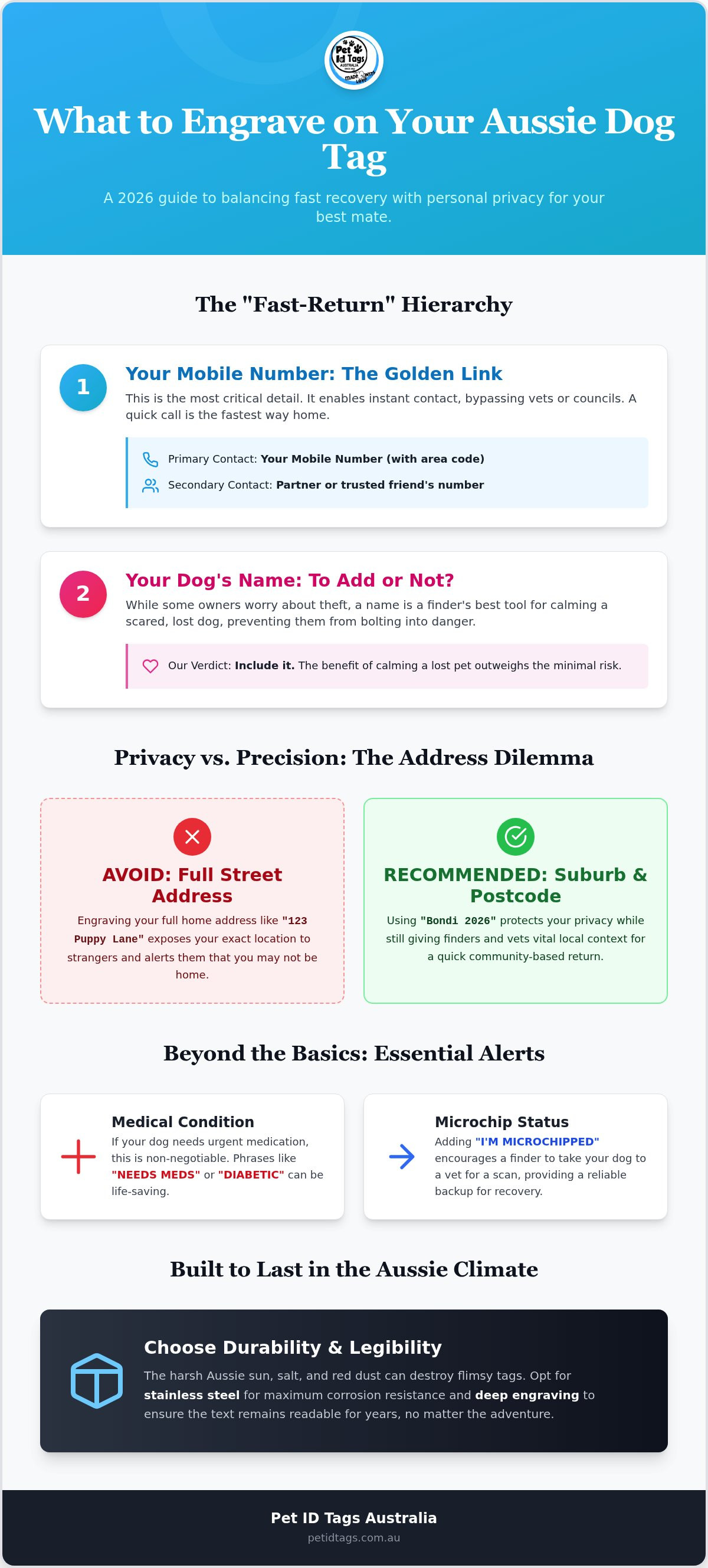
- Protect your privacy by using a "Suburb and Postcode" format instead of a full street address for secure local returns.
- Select durable materials like stainless steel to ensure your engraving survives the harsh Australian sun, salt, and red dust.
- Learn exactly what to put on a dog tag australia regarding medical alerts and microchip status to provide vital context for rescuers.
- Understand how deep-engraving techniques and quick-release clips maintain long-term legibility and simplify collar transitions.
The "Fast-Return" Hierarchy: Essential Info for Every Aussie Dog Tag
When a stranger finds a wandering dog, they usually make a snap decision within the first 10 seconds. They either call the owner directly or hand the pet over to a vet or council ranger. To ensure your pet stays out of the pound, your tag must be a functional tool that prioritises speed. Deciding what to put on a dog tag australia comes down to a clear hierarchy of information that anyone can read at a glance, even if the dog is moving or stressed. A well-organised tag reduces the friction of the recovery process, turning a stressful encounter into a quick reunion.
The Primary Contact: Why Your Mobile Number is King
A mobile number is the most critical piece of data on any tag. It allows for an instant connection, bypassing the need for professional scanners or council database lookups. If you often travel across state lines or enjoy road trips with your dog, always include the area code. This prevents any confusion for a finder who might be using a landline or a different carrier. Your mobile number acts as the golden link between a lost pet and home.
During a "lost dog" scenario, your phone etiquette is just as important as the engraving. Ensure you answer every incoming call, even those from private or unknown numbers. Many finders will call from a work phone or a public place. Including a secondary contact number, such as a partner or a trusted friend, provides a vital safety net. This ensures that if you are in a mobile dead zone or stuck in a meeting, the finder has an alternative person to call immediately.
The Dog’s Name: To Engrave or Not to Engrave?
There is a persistent debate regarding whether to include your dog's name on their ID. Some owners fear that knowing the name makes "dog-napping" easier by allowing a thief to lure the animal away. In practice, this is largely a myth. Most opportunistic thefts occur based on the dog's breed or value rather than the name on their collar. In fact, knowing a dog's name is often a finder's best tool for calming a frightened animal. Being able to call a dog by name can prevent them from bolting into traffic or acting out of fear.
If you have genuine privacy concerns, you can explore different Pet tag materials and information to find a layout that works for you. Some owners choose to put "Scan My Chip" or "I am Friendly" on the front of the tag, while keeping the specific name and phone numbers on the back. For those who frequently swap between different gear, using a dog tag quick clip australia ensures that this essential identification moves seamlessly from a beach harness to a walking collar without any fuss.
Privacy vs. Precision: Why Suburbs Trump Street Addresses in Australia
Deciding what to put on a dog tag australia requires a careful balance between recovery speed and personal security. In previous decades, engraving a full street address was the standard practice. However, modern pet owners are increasingly privacy conscious. A full address on a collar tells a stranger exactly where you live and, more importantly, that you might not be home if your dog is out wandering. For most urban and suburban residents, providing your house number and street is often overkill.
Privacy matters. Your dog's tag should provide just enough data to facilitate a return without exposing your home life. Transitioning to a "Suburb and Postcode" format is a smarter alternative that maintains security while remaining highly effective for local reunions. Most lost dogs are found within a few kilometres of their front gate. A suburb name gives a finder enough context to know if the dog is a local or if they have wandered from further afield.
The "Local Return" Strategy
Finders often feel a stronger sense of community when they know a dog is a neighbour. Seeing a familiar suburb name on a tag signals that the pet belongs nearby. This often encourages a finder to take a more personal approach. They might post a photo in a local community Facebook group or walk the dog around the block to see if anyone recognises them. This direct community action is far faster than waiting for a council ranger to arrive.
Postcodes serve a practical purpose for shelters and vets too. If a dog is handed in, the postcode helps staff immediately identify which regional council database to check. It streamlines the administrative side of recovery without requiring you to broadcast your exact front door location to every passerby. For those who want high visibility without the clutter, choosing custom-engraved tags with clear, bold text is the best way to ensure this information is readable at a distance.
Understanding Australian ID Laws
It is essential to remember that a personalised ID tag is a supplement to, not a replacement for, official requirements. Most Australian councils require dogs to wear a specific registration tag issued upon payment of annual fees. These tags link directly to the council's internal systems. While these are legally mandatory, they rarely include your phone number, which is why a secondary tag is vital for a fast return.
A well-designed tag ensures that even if council offices are closed, a finder can still reach you. You can learn more about how these different layers of identification work together in our guide on Understanding Australian Pet Identification Laws. While the suburb-only approach works for most, a full address still makes sense for those on rural properties where the next neighbour might be ten kilometres away. Similarly, for senior dogs with cognitive issues who may wander significantly further, more precise location data can be a lifesaver.
Durability and Legibility: Choosing Materials That Won’t Fade
The Australian environment is notoriously unforgiving on pet gear. Between the relentless UV rays of the outback and the corrosive sea salt of our coastal towns, a standard pet tag faces constant physical stress. When you are deciding what to put on a dog tag australia, the material you choose is just as vital as the information itself. A tag that becomes unreadable within six months is a safety failure. You need a solution that remains legible through beach trips, bushwalks, and backyard play.
Many mass-produced tags rely on surface-level laser marking or simple printing. While these look sharp on the shelf, they quickly succumb to "jingle wear" where the metal rubbing against other tags or the collar ring grinds away the text. Deep engraving is the only way to ensure permanent protection. If you can't feel the grooves of the letters with your fingernail, the information is at risk of fading. High-quality tags use precision mechanical engraving to cut deep into the metal, ensuring your contact details survive for years. Spotting a low-quality tag is easy; if the text feels smooth to the touch, it won't last the season.
Stainless Steel: The Ultimate Aussie Choice
For most owners, stainless steel is the gold standard. It is incredibly hard, rust-proof, and virtually indestructible. This makes stainless steel dog tags australia the best choice for dogs that spend time in the surf or rolling in red dust. Unlike softer metals, stainless steel won't bend or snap under pressure. It resists the deep scratches that can obscure text over time. Stainless steel is the most reliable material for permanent ID.
Aluminium: Lightweight and Colourful
Aluminium offers a different set of benefits, primarily its weight. It is an excellent option for smaller breeds, puppies, or cats who might find a heavy steel tag uncomfortable. Because aluminium can be anodised in various shades, it allows for high-visibility colours that stand out against a dog's coat. However, you must prioritise high-contrast engraving. A silver-on-silver effect is difficult to read in low light.
We recommend choosing darker tag colours with deep, bright engraving to ensure the text pops. To prevent the "fade" from constant sun exposure, look for high-grade anodised coatings that are specifically treated for UV resistance. This ensures your choice of what to put on a dog tag australia remains clear and actionable for any finder. Whether you choose the strength of steel or the lightness of aluminium, the goal is a tag that stays readable until the moment it's needed most.
Beyond the Basics: Medical Alerts and "Microchipped" Messaging
A phone number is only the first line of defence. While your contact details facilitate the initial connection, secondary information ensures the finder understands how to handle your pet safely. Choosing what to put on a dog tag australia often involves deciding which medical or behavioural details are essential for a stranger to know. This context can be the difference between a calm neighbour holding your dog or a panicked finder calling the council immediately.
Dietary warnings and behavioural notes are increasingly common on modern tags. If your dog has a sensitive stomach, a simple "Do Not Feed" instruction prevents a well-meaning stranger from giving them treats that could cause illness. For pets with severe health risks, "Severe Allergies" carries more weight and urgency. Similarly, the debate over offering a "Reward" on a tag continues. While it can motivate a finder to act quickly, it can also attract opportunistic individuals. Most experts suggest that a clear medical need is a stronger motivator for genuine dog lovers to help.
The Microchip Reminder
All dogs in Australia must be microchipped by law, but a finder has no way of knowing if your dog is chipped just by looking at them. Including the phrase "I am Microchipped" on your tag is a vital backup. If a finder cannot reach you via phone, this simple line encourages them to take the dog to a local vet or shelter rather than giving up. It provides immediate peace of mind that a permanent ID exists. Always ensure your puppy id tag australia details are backed up by an updated profile on the national registry. A tag tells the finder who to call; the microchip ensures they have a fallback if the tag is lost.
Wording Templates for Special Needs
Space on a tag is limited, so precision is key. Use short, punchy phrases that are easy to read at a glance. If your dog has a condition that affects their behaviour, clear communication prevents misunderstandings. Consider these high-impact templates:
- "I am Deaf" - prevents a finder from thinking the dog is being disobedient.
- "Needs Daily Meds" - creates a sense of urgency for a quick return.
- "Anxious - Do Not Grab" - protects both the finder and the dog from a fearful reaction.
Utilising the back of the tag for these secondary details keeps the front clear for your primary mobile number. For more inspiration on phrasing, you can view our Pet ID Tag Engraving Ideas. Providing this extra layer of information ensures your dog receives the right care while they are away from home. To secure your pet’s safety with a professionally engraved solution, explore the range at Pet ID Tags Australia today.
Designing Your Tag: How Pet ID Tags Australia Ensures Permanent Protection
Designing a tag is about more than just aesthetics; it is about engineering a recovery tool that works when it matters most. At Pet ID Tags Australia, we focus on technical precision to ensure your contact details remain visible for the life of your pet. While deciding what to put on a dog tag australia, you should consider how that information is applied to the metal. Our deep-engraving process uses mechanical cutters to carve deep into the material, creating a permanent mark that cannot be rubbed away by friction or collar wear. This physical depth is what separates a professional safety tool from a decorative accessory.
Versatility is another key design factor for active Aussie dogs. Many pets use different gear for walking, swimming, or training sessions. Using a dog tag quick clip australia allows you to move your pet's ID between different collars or harnesses in seconds. This ensures that even if you swap a standard leather collar for a rugged swimming harness, your dog is never left without their essential identification details. It eliminates the frustration of struggling with traditional split rings and ensures the tag is always where it needs to be.
The Smart Tag Advantage
For owners who want next-generation security, smart pet tags australia offer a powerful hybrid solution. These tags combine traditional deep engraving with a unique QR code, providing two layers of protection. If a finder scans the code, they are directed to an unlimited digital profile containing multiple phone numbers, medical history, and vet details. A significant benefit of this technology is the real-time GPS notification sent to your phone the moment the tag is scanned, giving you an immediate location for your pet's recovery. This is a massive leap forward in pet safety, providing more data than a standard tag could ever hold.
The Pet ID Tags Australia Promise
Choosing a local specialist means you aren't waiting weeks for international shipping or settling for inferior materials. Our Australian-based team understands the specific challenges of the local climate, from coastal salt to extreme heat. We use high-grade stainless steel and aluminium, ensuring every tag meets our strict no-fade standard. By choosing a local provider, you receive fast delivery and a product built specifically for the needs of active Aussie dogs. When you consider what to put on a dog tag australia, remember that the quality of the engraving is just as important as the words themselves. Design your durable Australian dog tag today!
Secure Your Mate’s Future with Smarter Identification
Effective pet recovery relies on striking a balance between visibility and security. By prioritising your mobile number and adopting a "Suburb and Postcode" format, you ensure a fast local return while protecting your personal privacy. Including medical alerts or microchip status provides essential context for finders, turning a potential pound trip into a quick reunion. Deciding what to put on a dog tag australia is a vital step in responsible pet ownership that provides genuine, long-term peace of mind.
Secure your mate’s safety with a custom-engraved Stainless Steel Dog Tag. Our products are deep-engraved for lifetime legibility and sent via fast shipping from our Australian workshop. We have been trusted by thousands of Aussie pet owners since 2004 to provide durable, reliable identification solutions. Taking a few minutes to update your dog's tag today ensures they are always protected, whether you are exploring the local park or the rugged bush. Your best friend deserves a safety net that never fades.
Frequently Asked Questions
Is it a legal requirement to have a dog tag in Australia?
Yes, it's a legal requirement across all Australian states and territories. Every dog must be registered with their local council and wear the official registration tag when in public. While specific rules vary between jurisdictions, failure to comply can result in significant fines, sometimes reaching $5,000. Personalised ID tags are the best way to supplement these official tags, ensuring a finder can reach you directly without needing council intervention.
Should I put my dog’s name on their ID tag?
Including your dog's name is usually beneficial. It allows a finder to calm a stressed animal by speaking to them familiarly, which can prevent the dog from bolting. While some owners worry about theft, most opportunistic dog-napping is based on breed value rather than name tag knowledge. If you have privacy concerns, you might consider putting the name on the back of the tag or using a phrase like "I am Friendly" instead.
Do I need a dog tag if my pet is already microchipped?
Yes, a physical tag is essential even if your pet is microchipped. Microchips are internal identifiers that require a professional scanner at a vet or shelter to read. A visible tag is the only way a neighbour can contact you immediately. Combining both methods creates a dual layer of protection, ensuring your dog has a permanent backup if their collar or tag is ever lost during an escape or bushwalk.
What is the best material for a dog tag that won’t rust or fade?
Stainless steel is the superior material for the harsh Australian climate. It is rust-proof, salt-resistant, and incredibly hard, making it ideal for dogs that frequent the beach or the bush. Unlike plastic or soft metals, high-grade stainless steel won't bend or snap. When combined with deep-engraving techniques, it ensures your contact details remain legible for the life of the pet, regardless of their activity level or environment.
How much information can I realistically fit on a standard dog tag?
Most standard tags comfortably fit four to five lines of text. For maximum legibility, limit each line to approximately 15 to 20 characters. When deciding what to put on a dog tag australia, prioritising your mobile number and suburb is more effective than trying to squeeze in a full street address. If you have extensive medical notes, consider a larger tag or a smart tag that links to a comprehensive digital profile.
Should I put my home address on my dog’s tag?
For most urban pet owners, a full street address isn't necessary. Using your suburb and postcode provides enough information for a local return while maintaining your personal privacy. A full address is only recommended for rural properties or for senior dogs who may wander long distances. In suburban areas, providing your mobile number is the fastest way to get your dog home safely without broadcasting your exact house location to strangers.
What should I put on a tag for a dog with medical conditions?
Use clear, high-impact phrases to alert finders to special needs. Effective examples include "I am Deaf", "Needs Daily Meds", or "Severe Allergies". These instructions create a sense of urgency and ensure the finder handles your pet appropriately. When choosing what to put on a dog tag australia for a medical alert, place the most critical health information on the front of the tag to ensure it's seen immediately by any rescuer.
How often should I check or replace my dog’s ID tag?
You should inspect your dog's tag every six to twelve months. Look for signs of wear where the metal may have thinned at the attachment point, or surface scratches that might obscure the engraving. If the text is becoming difficult to read, it's time for a replacement. High-quality deep-engraved tags last much longer than surface-printed versions, but regular checks ensure the attachment ring remains secure during rough play or coastal adventures.