
What if your pet's best chance of getting home isn't the high-tech microchip under their skin, but the simple piece of metal hanging from their collar? While a microchip is a vital legal requirement, it remains invisible to the neighbour who finds your dog wandering the street. You likely already know the gut-wrenching anxiety of a gate left open or a collar slipping during a walk. Relying solely on a vet visit for scanning can delay a reunion by hours or even days. High-quality lost pet prevention tags bridge this gap by providing an immediate, readable link back to you.
We understand that you want a solution that survives the harsh Australian sun and the roughest scrub. This guide explores how the right identification strategy ensures your mate is returned home safely and swiftly. You will discover the essential differences between physical tags and digital chips, the latest 2026 state regulations, and why choosing the right material is the difference between a permanent safeguard and a faded, useless disc. We will help you move past jingling, unreadable hardware toward a durable, professional standard of protection that provides true peace of mind.
Key Takeaways
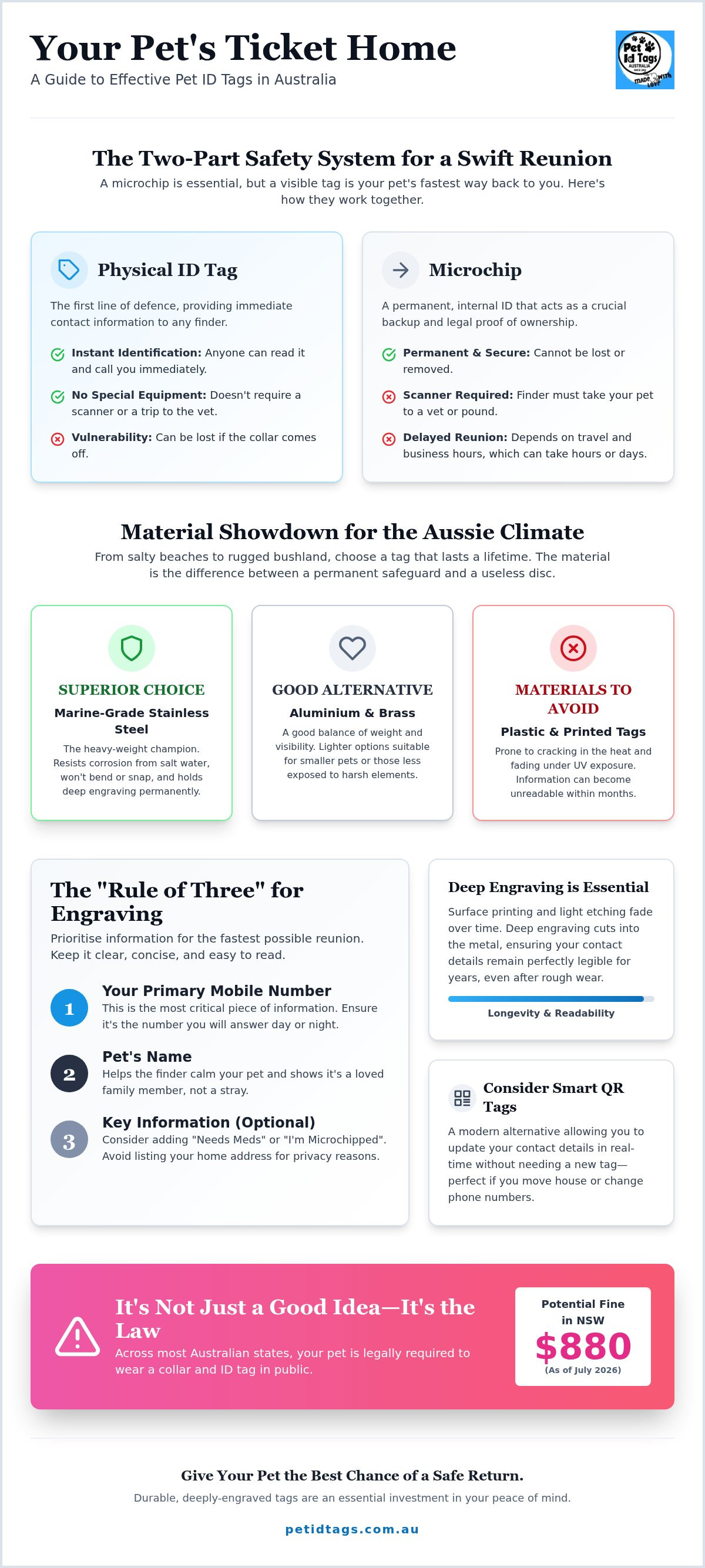
- Marine-grade stainless steel is the superior choice for the Australian climate, resisting corrosion from salt water and rough bushland.
- High-quality lost pet prevention tags act as a critical visual tool, allowing finders to contact you instantly without needing a trip to the vet.
- Modern QR code smart tags offer a dynamic alternative to traditional engraving, allowing you to update your contact details in real time.
- Use the "Rule of Three" to prioritise your mobile number over your home address, ensuring the fastest possible reunion.
- Deep-engraving techniques are essential for permanent legibility, preventing your pet's vital information from fading in the harsh sun.
Lost Pet Prevention Tags: The First Line of Defence for Your Pet
A lost pet scenario is often a race against time. While many owners rely on internal technology, high-quality lost pet prevention tags remain the most effective visual recovery tool available. They serve as a clear signal that a pet is loved and has a home nearby. Without a visible tag, a well-meaning neighbour might hesitate to approach a wandering dog, unsure if they are dealing with a friendly local or a nervous stray. A readable tag changes the psychology of the encounter. It transforms a stressful situation into a simple phone call. It empowers the finder to act immediately rather than waiting for someone else to step in.
We are seeing a growing preference for silent or jingle-free options among Australian households. Owners are moving away from the constant metallic clink of traditional hardware. Modern designs, such as those using silicone silencers or specific quick-clip attachments, provide the same level of security without the noise. This is particularly useful for active dogs that spend their days running through the bush or sleeping at their owner's feet. It keeps the pet comfortable while ensuring they are always identifiable.
The Vital Link: Tags vs. Microchips
Security is about redundancy. Relying solely on a microchip is a common mistake. While microchips provide permanent identification, they are passive. A finder cannot read a microchip with their smartphone. They must secure the animal, find a vehicle, and drive to a vet or council facility during business hours. This vet scanner hurdle is a significant barrier to a swift return. In contrast, Pet ID tags offer an immediate return to owner (RTO) solution. By having both, you ensure that if the collar is lost, the chip remains; but if the pet is found by a neighbour, the tag gets them home in minutes. You can explore this further in our guide on Pet Tag vs Microchip Australia: Why Your Pet Needs Both in 2026.
Australian Legal Requirements for Pet ID
Identification isn't just a safety choice; it's a legal obligation across most Australian states. In New South Wales, for example, failing to have your dog wear a collar and tag in public can result in a fine of up to $880 as of July 2026. Beyond the financial penalty, the risk of your pet entering the pound system is high. Unidentified pets face longer stays in shelters, which increases their stress levels. A clear, durable tag is your pet's ticket out of the pound and back to your backyard. It ensures that the authorities can contact you the moment your mate is found, avoiding unnecessary fees and anxiety.
Selecting Durable Materials for the Australian Lifestyle
Australia's outdoors aren't kind to pet gear. From the red dust of the outback to the salty spray of the Gold Coast, your pet's identification needs to be rugged. Standard plastic tags often crack in the heat. Printed versions lose their text within months due to extreme UV exposure. When choosing lost pet prevention tags, the material is your first decision point. It determines whether your contact details will still be readable in three years or three weeks. We focus on materials that withstand the elements because a tag that fades is a tag that fails.
Avoid the trap of "cheap" imports. These often use inferior alloys that corrode quickly or plastic that becomes brittle in the sun. Investing in professional-grade materials means you aren't constantly replacing gear. You can view our range of Australian-tested tags to find a material that fits your pet's specific lifestyle.
Stainless Steel: Built for the Bush and the Beach
Stainless steel is the undisputed heavy-weight champion for active dogs. It's essentially "set and forget" security. Unlike softer metals, it doesn't bend or snap under pressure. For dogs that love the surf, marine-grade steel is essential to prevent rust. It also houses the essential information for pet ID tags without the risk of the lettering wearing down from friction against a collar. If you want the most reliable protection, our Stainless Steel Dog Tags Australia: The 2026 Ultimate Buyer’s Guide to Durable ID covers everything you need to know about this high-performance material.
Aluminium and Brass: Balancing Weight and Visibility
Aluminium offers a lightweight alternative without sacrificing too much strength. It's the ideal choice for toy breeds or indoor cats who find steel too heavy. The main advantage of aluminium is the variety of vibrant colours. A bright red or blue tag stands out against a thick coat, making it easier for a finder to spot the ID. However, the quality of the engraving is vital. Surface-level etching on aluminium will eventually rub off. You need deep, precision engraving that bites into the metal. This ensures the lost pet prevention tags remain functional even if the surface gets scratched during a backyard scuffle or a trek through the scrub.
Smart Tags vs. Traditional Engraving: Which is Better?
Choosing the right recovery tool involves weighing modern convenience against old-school reliability. Lost pet prevention tags have evolved significantly. We no longer rely solely on a simple metal disc with a single phone number. We now have access to QR codes that link to cloud-based profiles. However, the best solution isn't necessarily a choice between one or the other. It's about layering your protection to ensure your pet is never truly lost. A hybrid approach provides the best of both worlds, combining instant digital access with a fail-safe physical backup.
How Smart Pet Tags Work in a Crisis
Smart tags use a unique QR code that anyone with a smartphone can scan. This is a game-changer for recovery. Instead of a finder struggling to read a scratched tag, they get instant access to a dynamic online profile. You can update this profile in real time. If you're on holiday or your pet is staying with a sitter, you can change the contact details without buying a new tag. This tech reduces friction for the finder, offering a "scan to call" feature that connects them to you immediately. Some systems even send you an automated email with a GPS location alert the moment the tag is scanned. To understand how to integrate this into your pet's routine, see our Smart Pet Tags Australia: The 2026 Guide to Next-Gen Pet Safety.
Traditional Engraving: The Reliable Classic
Despite the digital shift, physical engraving remains the gold standard for reliability. It doesn't require a mobile signal, a data plan, or a charged battery. This reliability is why the ASPCA position on pet ID consistently highlights visible tags as the fastest route home. We recommend deep mechanical engraving over surface-level laser marking. Laser etching merely discolours the surface and can wear away over time. Deep engraving actually carves your information into the metal, ensuring it survives years of scratching and rolling. This is a critical consideration when you realise Why Pet ID Tags Fade: The Truth About Durability in the Aussie Sun. A deeply engraved tag stays legible even after years of exposure to harsh UV rays and salt air.
The ultimate setup for lost pet prevention tags in 2026 is to use both. A high-quality stainless steel tag with your primary mobile number provides the essential "no-tech" backup. A secondary smart tag can then house more complex information, such as medical conditions, dietary requirements, or secondary emergency contacts. This dual-layered strategy ensures that no matter who finds your mate, they have the tools to get them home safely.
Maximising Recovery Success: What to Put on Your Tag
Engraving your pet's identification is an exercise in strategic communication. You have a small surface area to convey the most critical details. Effective lost pet prevention tags don't just list data; they prioritise the fastest route to a reunion. Many owners make the mistake of including their home address, but in a crisis, your mobile number is far more valuable. If your pet escapes, you won't be sitting at home by the landline; you'll be out in the neighbourhood or the bush searching. A mobile number allows a finder to reach you the second they secure your mate.
We recommend following the "Rule of Three" for your engraving layout. This ensures the most vital information is readable at a glance. Your primary mobile number should be the largest, most legible item on the tag. Follow this with a secondary contact number, such as a partner or a reliable mate, in case you are out of range or your battery dies. Finally, include a brief line of critical information. This might be "I am microchipped" or a specific medical alert like "Needs Meds". This third line provides the finder with immediate context regarding the urgency of the situation.
Privacy is a common concern for modern pet owners. Some choose to omit their pet's name from the tag to prevent "pet-napping" or to stop a stranger from easily befriending and leading the animal away. While this is a personal choice, your contact details must remain non-negotiable. If you're unsure how to fit everything on a smaller disc, you can browse our selection of double-sided tags to expand your available space.
Optimal Information Layout for Small Tags
Legibility is the difference between a quick phone call and a trip to the pound. On smaller lost pet prevention tags, you must prioritise text size. Avoid cramming five lines of text onto a 20mm disc. Use the front for the primary name and number, and save the back for secondary details. This tiered approach keeps the most important data clear even if the tag is slightly weathered. For a comprehensive breakdown of what to include, check out our Pet ID Tag Engraving Ideas: The Ultimate 2026 Australian Checklist.
Attachment and Hardware: Preventing Tag Loss
The best engraving in the world is useless if the tag falls off in the scrub. Most standard split rings are the "weakest link" in pet safety. They are prone to stretching or catching on branches. We suggest upgrading to a heavy-duty attachment or a quick clip. These provide a more secure connection to the collar and allow you to swap the ID between different harnesses easily. You can find more information on secure attachments in our Dog Tag Quick Clip Australia: The 2026 Guide to Secure Pet ID Attachment.
Trusting Pet ID Tags Australia for Your Pet’s Safety
Choosing the right identification is a responsibility we take seriously. As a local Australian business, we understand the specific challenges your pet faces in our unique environment. Whether it's the abrasive sand of a coastal walk or the dense scrub of the hinterland, our lost pet prevention tags are designed to stay put and remain readable. We've spent years perfecting our craft to ensure that we aren't just selling a product, but providing a reliable recovery tool. We don't settle for surface-level marking. We prioritise deep, precision engraving that withstands the test of time and activity.
Our commitment to material science ensures that every tag leaving our workshop is prepared for the unique rigours of the Australian landscape. We know that a tag is only useful if it's still attached when it matters most. This is why we focus on high-grade metals and secure attachment points. We help you organise your pet's security with absolute confidence, knowing that you've chosen a professional standard of protection. Our national e-commerce platform is built for efficiency, allowing you to secure your mate's safety from any corner of the country with fast, dependable delivery.
The Pet ID Tags Australia Quality Guarantee
We believe in craftsmanship that lasts. Our stainless steel options represent the pinnacle of durability, ensuring your contact details remain legible for years, not just months. We test our products against harsh UV rays and salt air to guarantee they won't fail when your pet needs them most. This "set and forget" security is the core of our business. By choosing us, you're supporting a specialist team dedicated to pet safety and local quality standards. We don't cut corners. Every tag is inspected for depth and clarity to ensure it meets our rigorous benchmarks for physical strength and permanence.
Ready to Secure Your Best Mate?
Protecting your mate shouldn't be a complicated process. Our streamlined online store makes it easy to customise your order in just a few steps. You can choose from our range of lost pet prevention tags and bundle them with other essential gear for a complete safety solution. Many of our customers choose to pair their new tags with our personalised dog collars or custom dog harnesses to ensure their pet is identifiable from every angle. We also offer Smart Pet Tags for those who want to add a digital layer to their recovery strategy. Once your order is placed, our team moves quickly to engrave and dispatch your items across Australia.
Secure Your Pet’s Future Today
Protecting your mate requires more than just hope; it demands a proactive strategy. You now understand how high-quality lost pet prevention tags serve as the fastest link between a finder and a safe return. By prioritising marine-grade materials and specialised engraving, you ensure your contact details survive the harsh Australian sun and rugged scrub. Whether you opt for the permanent reliability of stainless steel or the dynamic nature of a smart tag, the objective is a swift reunion that bypasses the need for a vet scanner.
Pet ID Tags Australia brings over 20 years of experience in pet identification to every piece we craft. Our specialised deep-engraving technology ensures your information remains legible long after inferior products have faded. With thousands of five-star reviews from Australian pet owners, we pride ourselves on delivering solutions that truly work in our local conditions. It's a simple step that provides lasting security for your household. Browse our range of durable, Aussie-proof Pet ID Tags and enjoy the peace of mind that comes with professional-grade protection.
Frequently Asked Questions
Do lost pet prevention tags really work better than microchips?
Lost pet prevention tags work faster than microchips because they enable immediate recovery without specialised equipment. While a microchip is a vital, permanent backup required by law, it stays invisible until a vet or council officer scans it. A visible tag allows a neighbour to call you the moment they find your mate wandering. This speed is essential for reducing the time your pet spends alone and stressed on the street.
What is the most durable material for a pet ID tag in Australia?
Marine-grade stainless steel is the most durable material for our local conditions. It resists corrosion from salt water and doesn't snap or bend during a run through the scrub. Unlike plastic or thin aluminium, stainless steel handles the abrasive nature of sand and red dust. This makes it the premier "set and forget" choice for active dogs that spend their days at the beach or in the bush.
Should I put my home address on my dog’s ID tag?
Prioritising your mobile number over your home address is a more effective recovery strategy. In a crisis, you're likely out searching the neighbourhood, not sitting at home by a landline. Providing two mobile numbers ensures a finder can reach you anywhere. Omitting your address also protects your privacy and prevents strangers from knowing exactly where your pet lives, which is a sensible precaution for many owners.
How do I stop my pet’s ID tag from jingling and making noise?
You can eliminate noise by using silicone silencers or high-quality pet tag quick clips. These accessories prevent the metal-on-metal contact that causes constant jingling. Some owners also choose to attach the tag flush against the collar or harness to keep it steady. This keeps the environment quiet while ensuring your pet remains fully protected and identifiable at all times, whether they're sleeping or sprinting.
Can I use a smart tag if my pet already has a traditional tag?
Using a hybrid approach with both a smart tag and a traditional engraved tag provides the highest level of security. The traditional tag offers a reliable, "no-tech" backup that works without a mobile signal or data. The smart tag provides a dynamic profile for medical alerts or secondary contacts. Together, they ensure that anyone who finds your pet has multiple ways to facilitate a safe return to your home.
What happens if my pet’s ID tag becomes unreadable?
An unreadable tag is a significant security risk that requires immediate replacement. If the engraving has faded or the surface is too scratched to read, a finder has no way to contact you directly. This is why we emphasise deep mechanical engraving for all lost pet prevention tags. It ensures your information remains functional even after years of exposure to the harsh Australian sun and rough outdoor play.
How often should I check or replace my pet’s identification tags?
We recommend checking your pet's identification every six months as part of their routine care. Look for signs of wear on the attachment ring and ensure the text is still clear and legible. If you've moved house or changed your mobile number, you must update the tags immediately. Regular inspections prevent a situation where your pet escapes with outdated information or a hardware failure that leads to a lost tag.
Are QR code pet tags safe to use in terms of data privacy?
QR code tags are highly secure because you manage the information through a private online profile. You decide exactly what details the public sees when they scan the tag. If your pet is found, you can even hide certain information once they're safely home. This level of control makes them a safe, modern addition to your pet's recovery toolkit without compromising your personal data security.