

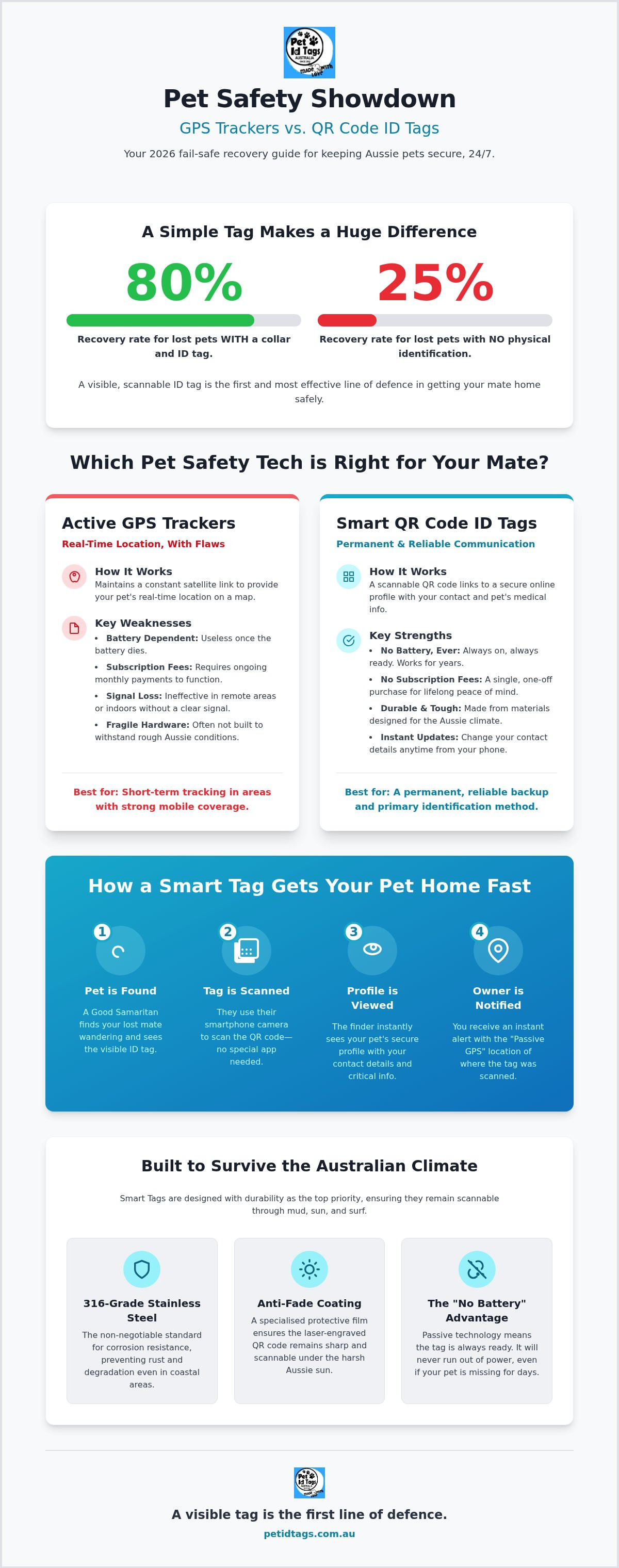
Recent data shows that 80% of lost dogs with a collar and tag are successfully recovered, compared to just 25% for those with no physical identification. In the rugged Australian outdoors, relying on a single safety measure isn't just risky; it's often ineffective. Choosing between gps pet trackers vs qr code id tags is a decision that balances real-time precision against long-term reliability. You likely feel the constant worry of a pet wandering off in a remote area or a busy suburb. It's frustrating to think that a flat battery or a failed signal could be the only thing standing between you and a safe reunion.
We understand that you want a dependable, professional solution that doesn't involve endless monthly subscription fees or fragile hardware. This 2026 safety guide breaks down the critical differences between active tracking and smart digital tags to help you build a fail-safe recovery strategy. We will examine how GPS technology handles the Australian climate, why QR tags offer a permanent backup, and how to ensure you receive instant notifications the second your pet is found by a neighbour or a stranger. Our goal is to provide the clarity you need to keep your pet secure 24/7.
Key Takeaways
- Identify why 316-grade stainless steel is the non-negotiable standard for pet tags in the corrosive Australian climate.
- Evaluate the performance of gps pet trackers vs qr code id tags to choose between real-time tracking and battery-free reliability.
- Learn how to maintain a 24/7 safety net for your mate without the burden of expensive monthly subscription fees.
- Understand the technical differences between NFC and QR code recovery methods to ensure anyone can help your pet home.
- Discover the simple steps to activate a secure digital profile that allows you to update contact details instantly from your phone.
What is a Smart Pet ID Tag and Why Does Your Mate Need One?
A smart pet tag is a scannable tool providing finders with instant access to recovery data. It functions as a digital bridge between a traditional collar tag and the internal data of a microchip. While a microchip requires a specialised scanner at a vet clinic, a smart tag uses QR codes or NFC technology to link directly to an online pet profile. This means your contact details are always current. If you change your mobile number or head off on a holiday, you can update your information instantly via your phone without ever needing a new tag.
Deciding between gps pet trackers vs qr code id tags often comes down to how you want a finder to interact with your pet. A smart tag provides a visible, immediate way for anyone with a smartphone to help. It's a professional, no-nonsense approach to pet safety that prioritises speed and accessibility. When evaluating gps pet trackers vs qr code id tags, remember that one provides location while the other provides communication.
The Evolution of Pet Identification in Australia
Identification has evolved from basic hand-stamped aluminium discs to laser-engraved 316-grade stainless steel. In 2026, the modern Aussie pet owner is moving toward digital-first safety solutions that offer more than just a name. Smart tags now play a vital role in local "lost pet" community social media groups. They allow owners to share a direct link to a pet's profile, providing real-time updates and essential medical facts to the people on the ground. This shift reflects a broader commitment to using reliable, high-grade materials that survive the harsh Australian climate while embracing digital efficiency. This focus on durability mirrors the high standards found in the professional sector, where companies like Imagin Products Ltd specialise in manufacturing high-quality photo ID cards and name badges.
Visible vs. Invisible Security
A visible tag remains the first line of defence. Even though microchipping is a legal requirement, it is an invisible form of security that relies on professional intervention. A smart tag empowers any person with a smartphone to become an immediate rescuer. By scanning the tag, a finder can bypass the stress of a trip to the vet and contact you directly. While GPS tracking technology is excellent for finding a pet's general location, the smart tag is what actually gets them home. It reduces the "time to home" by providing instant, actionable data to the Good Samaritan who finds your mate wandering the street.
How Smart Tags Work: QR Codes, NFC, and Passive GPS
Smart tags leverage existing mobile technology to turn a standard collar into a digital hub. Understanding the mechanics of gps pet trackers vs qr code id tags helps you appreciate the simplicity of digital identification. QR codes are the universal standard. Almost every Australian with a smartphone knows how to point their camera and open a link. NFC (Near Field Communication) offers an even faster "tap and go" experience. It is similar to paying for a flat white at your local café. These technologies provide a reliable way for a finder to access your pet's profile without needing specialised equipment or professional training. This same digital efficiency is currently transforming the retail landscape, where ESLtags, Corp. provides advanced electronic shelf labels to improve price accuracy and customer communication.
Passive GPS is a key feature that often gets confused with active tracking. Unlike active units that maintain a constant satellite link, passive systems rely on the finder's phone. When someone scans the tag, the system uses that phone's GPS coordinates to send a "ping" to the owner. Privacy controls are built into this process. You can manage exactly what information is visible to the public. Your home address remains private unless you specifically choose to share it during an active search. This ensures your security is never compromised while you look for your mate.
A reliable lost pet recovery service starts with hardware that survives the backyard. Every Pawzee Smart Tag features a 316-grade stainless steel core. This material provides physical durability against scratching, biting, and rough play in the scrub. A specialised protective film coating is applied to the surface to prevent the QR code from fading under the intense Australian sun. The "No Battery" advantage is the most significant benefit here. Passive tech is inherently more reliable than active trackers because it never runs out of power. It is always ready, even if your pet has been missing for several days. If you need a durable, battery-free solution, explore our range of Smart Pet Tags built for local conditions.
Understanding Passive GPS Notifications
When a stranger scans your fur baby's tag at the local park, the system springs into action. You receive an instant alert on your phone with the precise location of the scan. This real-time data is critical during the first hour a pet goes missing. It provides a starting point for your search and confirms that someone has found your mate. When comparing gps pet trackers vs qr code id tags, the passive notification system offers a distinct benefit. It works anywhere there is a mobile signal, without the need for the tag itself to maintain a satellite lock or a massive internal battery. This creates a high-speed recovery loop that connects you with the finder in seconds.
Smart Tags vs. GPS Trackers: A 2026 Comparison
Choosing between gps pet trackers vs qr code id tags requires an understanding of how active and passive technologies perform in real-world Australian conditions. Active GPS trackers provide real-time location data via satellite. This sounds ideal for a wandering pet, but it comes with significant operational demands. These units require frequent battery charging and a consistent cellular signal to function. If your pet disappears into a valley or a dense urban "canyon" where signals struggle, the tracker may fail to provide an accurate location just when you need it most.
Smart QR tags offer a different type of security. They don't use batteries and don't require a satellite link. Instead, they rely on a finder scanning the tag to initiate contact. When comparing the lifetime cost of gps pet trackers vs qr code id tags, the difference is stark. Most GPS trackers in Australia operate on a subscription model to cover data usage. For example, a Tractive GPS subscription starts from A$8 per month on a two-year plan, while Pawfit plans can range from A$12.85 to A$14.70 per month. Over several years, these fees add up to hundreds of dollars. A Pawzee tag involves a single investment with no ongoing subscription fees, making it a more sustainable choice for many Aussie families.
Why Smart Tags are the "Missing Link"
Many owners rely solely on microchips, but these are often a dead end if your contact details aren't up to date in the national database. If you've moved house or changed your mobile number, the chip might lead nowhere. A smart tag allows you to update your profile instantly from your phone. Unlike traditional engraved tags that only have room for a name and one phone number, a digital profile can host full medical records, dietary requirements, and secondary contact details. To understand how these tools work together, read our guide on Pet Tag vs Microchip Australia: Why Your Pet Needs Both in 2026. This multi-layered approach ensures your mate is protected even if one system fails.
The Reliability Factor
Reliability is where passive technology truly shines. A GPS tracker is only as good as its last charge. If your pet goes missing in the middle of the night and the tracker battery is at 5%, your window for recovery is closing fast. A smart tag is the perfect fail-safe backup. It's always "on" and ready to be scanned, regardless of how long your pet has been away. While some global brands hide additional costs behind "premium" profile features, the Australian standard should be a straightforward, no-subscription model. This ensures that the recovery of your pet never depends on a credit card payment or a battery percentage.
Aussie-Proofing Your Pet: Durability in Harsh Conditions
The Australian environment is a punishing testing ground for pet hardware. Intense UV radiation and extreme temperatures can render cheap identification useless in a single summer. When comparing gps pet trackers vs qr code id tags, physical resilience is just as critical as the technology inside. A GPS unit with a cracked casing or a dead battery is as ineffective as a faded plastic tag. To ensure your mate remains identifiable, you must choose materials that resist the bleaching effects of the sun. Learn more about Why Pet ID Tags Fade: The Truth About Durability in the Aussie Sun to understand how UV protection preserves scannable data.
For coastal pets, saltwater and sand are constant threats. Many generic accessories claim to be "waterproof," but they often fail to account for the corrosive nature of the Pacific and Indian Oceans. 316-grade stainless steel is non-negotiable for any dog that loves the surf. It provides superior corrosion resistance compared to standard aluminium or low-grade steel. Whether your pet is bush-bashing through the scrub or rolling in the sand, the QR code must remain legible and unscratched. High-quality smart tags use protective layers to ensure the digital gateway stays open, even after years of rough play. This physical longevity is a key factor when weighing up gps pet trackers vs qr code id tags for long-term safety.
Stainless Steel vs. Plastic Smart Tags
Plastic and silicone smart tags often warp or become brittle when exposed to the extreme Australian heat. A warped tag can distort a QR code, making it impossible for a finder's phone to focus and scan correctly. We prioritise 316-grade stainless steel because it maintains its structural integrity regardless of the temperature. High-contrast engraving ensures the code is readable in low light or harsh midday glare. Regular maintenance involves a quick wipe to remove red dust or salt crust, keeping the tag centre-stage and functional on the collar.
Silent and Secure Attachments
The constant jingle of metal on metal can be frustrating for both you and your pet. Attaching your smart tag correctly ensures it stays secure without the noise. For a comprehensive walkthrough on the best methods, see How to Attach a Dog Tag to a Collar: The 2026 Australian Guide to Secure ID. Using Pet Tag Quick Clips allows you to transfer the ID between harnesses and leads in seconds. This ensures your pet is never without their recovery profile during a walk. If you are ready to upgrade your pet's security with hardware that lasts, explore our range of Australian-made Stainless Steel Dog Tags today.
Setting Up Your First Smart Pet ID Profile
Activating your digital recovery system is a straightforward process that provides immediate peace of mind. While the technical debate between gps pet trackers vs qr code id tags often focuses on hardware, the real value lies in the quality of the data you provide to a potential finder. A well-configured profile acts as a 24/7 advocate for your pet. It ensures that anyone who scans the tag has the exact information needed to keep your mate safe until you arrive.
Follow these five steps to activate your Pawzee Smart Tag and secure your pet's digital identity:
- Step 1: Scan the unique code. Use your smartphone camera to scan the code on your new tag. This will initiate the activation process instantly.
- Step 2: Create a secure account. Register your details on our platform. We ensure there are no hidden credit card requirements or surprise subscription fees.
- Step 3: Upload vital stats. Provide a clear, recent photo of your pet along with their breed, age, and general temperament.
- Step 4: Add emergency contacts. Include your mobile number, a secondary family member, and the contact details for your local vet.
- Step 5: Perform a test scan. Attach the tag to your pet's collar and scan it yourself. This allows you to see exactly what a finder sees and verify that the "passive GPS" ping reaches your phone correctly.
When weighing up gps pet trackers vs qr code id tags, remember that the tag is only as effective as the information it carries. Digital profiles allow for a level of detail that traditional engraving simply cannot match.
Critical Information to Include
Your pet's profile should go beyond basic contact numbers. Include specific medical alerts if your dog requires daily medication for a heart condition or has severe allergies. Temperament notes are equally important. Let the finder know if your cat is shy and likely to hide, or if your dog is "spicy" with strangers and should not be approached with other pets. For more inspiration on what data to prioritise, check our Pet ID Tag Engraving Ideas: The Ultimate 2026 Australian Checklist.
Keeping the Profile Updated
The greatest advantage of a smart profile is its flexibility. You can change your contact details instantly while on holiday or if you are moving house. There is no need to buy a new tag or wait for a locksmith to engrave metal. You can also add "Reward if Found" notes during an active search to incentivise a quick return. For those in pet-friendly rentals, a well-maintained digital profile can even serve as a "pet resume" to demonstrate responsible ownership to landlords and property managers.
Securing Your Mate's Future in the Great Outdoors
Choosing the right recovery system for your pet involves balancing high-tech tracking with long-term reliability. We have explored how durable materials like 316-grade stainless steel survive the harsh Australian sun while digital profiles offer a flexible alternative to traditional engraving. When comparing gps pet trackers vs qr code id tags, the most effective solution is often the one that remains functional when batteries fail or signals drop. A smart tag ensures that any finder can contact you instantly without needing a subscription or a charger. This creates a permanent link between your pet and their home.
With over 20 years specialising in Australian pet safety, we understand exactly what it takes to keep your best mate secure. Our Pawzee Smart Pet Tags are built for the scrub and the surf, offering a professional recovery solution with no ongoing fees. It's time to provide your pet with a safety net that works 24/7 in every corner of the country. Upgrade your best mate to a Pawzee Smart Pet Tag today and enjoy the peace of mind that comes from proven, dependable protection. Your pet deserves a fail-safe way home.
Frequently Asked Questions
Do smart pet tags have a monthly subscription fee in Australia?
No, Pawzee Smart Pet Tags do not require a monthly subscription fee. Unlike many active units you encounter when comparing gps pet trackers vs qr code id tags, our technology is passive. Once you purchase the tag, you own the profile and the recovery service for life. This removes the frustration of ongoing costs and ensures your pet's safety never depends on a recurring credit card payment or a data plan.
Will a smart tag work if my dog goes swimming in the ocean?
Yes, our smart tags are designed specifically for the Australian lifestyle, including beach days and saltwater swimming. We use 316-grade stainless steel, which is the professional standard for marine environments. This material resists the corrosion and rust that often destroys cheaper aluminium or plastic alternatives. The QR code and internal tech remain fully functional even after frequent exposure to the surf, sand, and coastal elements.
What happens if the person who finds my pet doesn’t have a smartphone?
While most Australians carry smartphones, we include a unique web address on every tag as a reliable backup. A finder can simply type this URL into any computer or tablet browser to access your pet's profile. This ensures that even without a camera-enabled phone, a Good Samaritan can still view your contact details, medical alerts, and emergency instructions to help your mate get home safely.
Is my personal information safe on a smart pet tag profile?
Your privacy is a primary concern, and you have complete control over what information is visible to the public. You can choose to hide your home address and only display your mobile number or your vet's details. The system is designed to facilitate a safe reunion without compromising your personal security. You can even toggle specific information on or off depending on your current needs.
Do smart pet tags have a battery that needs charging?
No, smart tags do not contain a battery and never need charging. This is a significant advantage when evaluating gps pet trackers vs qr code id tags for long-term reliability. While GPS trackers can die within days, a smart tag is always "on" and ready to be scanned. This removes the risk of your pet going missing with a dead device, providing a permanent safety net that works 24/7.
Can I use a smart tag alongside a normal engraved dog tag?
Absolutely, many owners use a smart tag as a high-tech layer alongside their traditional engraved discs. While an engraved tag provides immediate visual identification, the smart tag offers a deeper digital resume with medical facts and multiple contacts. Using both creates a comprehensive security system. We recommend using a Pet Tag Quick Clip to keep all your tags organised and easy to transfer between different collars.
Does a smart tag replace the need for a microchip in Australia?
No, a smart tag does not replace a microchip. Microchipping remains a legal requirement for dogs and cats in all Australian states and territories. However, a smart tag is a vital supplementary tool. While a chip requires a visit to a vet or council pound for scanning, a smart tag allows any member of the public to contact you instantly. It is the fastest way to facilitate a recovery.
How do I update my phone number on the tag if I move house?
You can update your contact details instantly by logging into your secure online profile from any device. There is no need to buy a new tag or wait for a locksmith to re-engrave metal. Whether you are moving house permanently or just heading off on a holiday, you can change your phone number, address, or emergency contacts in seconds. This ensures your pet's recovery data is always current.