

The long-standing debate over whether a collar or a harness is better for your dog is actually a false choice. While many owners feel pressured to pick just one, the professional standard for safety in Australia often involves using both together. When comparing a dog collar vs harness australia, it's clear that both tools serve distinct, essential purposes for your mate's wellbeing. You likely worry about your dog pulling and choking on a standard lead, or worse, backing out of a loose collar in a busy car park. It is equally frustrating when gear perishes quickly under the harsh Aussie sun.
We agree that your walking experience should be calm, secure, and fully compliant with local council laws. This guide promises to clear up the confusion by comparing how different gear suits various breeds and temperaments. We will look at the best setups for heavy pullers, explain the legal requirements for visible ID tags, and highlight which materials withstand intense salt and UV exposure. By the end, you'll have the confidence to kit out your dog with durable gear that offers total peace of mind.
Key Takeaways
- Understand the functional divide between collars for permanent identification and harnesses for mechanical control during exercise.
- Learn why a personalised collar is a legal necessity for meeting Australian council requirements regarding visible ID tags.
- Discover how a custom harness provides superior physical support for pullers and protects dogs from potential tracheal or neck injuries.
- Resolve the dog collar vs harness australia dilemma by implementing a hybrid system that offers maximum safety and gear redundancy.
- Identify the most durable materials designed to survive the unique challenges of the Australian climate, from salt spray to high UV exposure.
The Great Aussie Debate: Dog Collar vs Harness in 2026
Deciding on a dog collar vs harness australia is a fundamental safety choice for every owner. It isn't just about style; it's about selecting the right tool for your dog's specific anatomy and lifestyle. A traditional personalised dog collar is a simple band that rests around the neck. Its primary purpose is to hold identification and provide a point for quick restraint. A custom dog harness is a more complex piece of equipment that secures the dog around the torso. This design shifts the point of control from the delicate throat to the sturdy chest and shoulders.
This choice has significant implications for your mate's long-term spinal health. Constant tension on a collar can strain the neck and even cause tracheal collapse in certain breeds. In the harsh Australian climate, your choice must also account for durability. Our intense UV rays, red dust, and coastal salt spray will quickly perish inferior materials. Reliable gear must withstand these elements while keeping your dog secure. When evaluating a dog collar vs harness australia, you need to weigh up daily convenience against long-term physical support.
The Core Differences at a Glance
The main difference lies in the physics of restraint. A collar applies pressure to a small area of the neck, which contains the windpipe and thyroid gland. A harness distributes that same force across the ribcage. While a collar is perfect for a quick toilet break or a calm stroll, a harness is superior for mechanical control. It allows you to guide a pulling dog without the risk of choking. Additionally, you must consider council compliance. Most Australian states require dogs to wear a collar with an ID tag in public, making the collar an essential part of your daily kit regardless of which lead attachment you prefer.
Why One Size Does Not Fit All Aussie Breeds
Anatomy should always dictate your gear. Flat-faced or brachycephalic breeds, such as Pugs, face higher risks of breathing difficulties when wearing a collar under tension. These dogs should almost exclusively use a harness for exercise. High-energy working breeds, like Kelpies or Border Collies, often need the extra security of a harness to prevent them from slipping out during an unexpected bolt. Life stage also matters. Puppies are still developing their skeletal structure and benefit from the gentle support of a harness. Senior dogs with arthritis often find that a harness provides better stability on uneven trails. Regardless of the breed, a professional fit is the only way to prevent chafing and ensure the gear performs as intended during an emergency.
The Classic Dog Collar: Essential for ID and Council Compliance
A high-quality collar is the baseline of responsible pet ownership. While the dog collar vs harness australia debate usually centres on leash manners, the collar remains the primary home for stainless steel dog tags australia. Most Australian local councils legally mandate that every dog must wear a collar and a visible identification tag while in a public place. This is a non-negotiable requirement for compliance and safety. A comfortable, well-fitted collar provides a "set and forget" solution that ensures your mate is always identifiable, even if they slip out of the house unexpectedly.
However, the simplicity of a collar comes with specific safety considerations. For dogs that lunge or pull excessively, a collar can put undue pressure on the throat and cervical spine. It is a tool for identification first and restraint second. If you own a high-energy breed that hasn't mastered loose-lead walking, using a collar as your only point of control may lead to long-term health issues. You should focus on finding a secure attachment point for your tags that won't perish or snap during a sudden burst of energy.
Materials Matter: Leather vs Synthetic in the Aussie Sun
The Australian climate is notoriously harsh on pet gear. Our intense UV exposure and frequent beach trips mean that material choice is critical for longevity. Traditional leather offers a classic look but requires regular maintenance to prevent cracking in salt air. In contrast, high-grade synthetic materials often provide superior resistance to moisture and fading. Choosing personalised dog collars australia allows for instant visual identification from a distance, adding an extra layer of security. Always inspect the buckle and D-ring for signs of corrosion or metal fatigue. A weak point in these components can lead to a total gear failure when you least expect it.
The Role of Identification and Rapid Recovery
Visible identification is the fastest route home for a lost dog. While microchipping is mandatory, it requires a vet or a council ranger with a scanner to facilitate a reunion. A collar is the first thing a neighbour looks for if they find your dog wandering. By combining a traditional engraved tag with smart pet tags australia, you provide multiple ways for a rescuer to contact you immediately. This is especially vital for young pets; a clear puppy id tag australia ensures that your new mate can be returned before they even reach a shelter. For maximum security, consider kitting out your pet with a set of durable stainless steel tags that won't rust or fade over time.
The Modern Dog Harness: Superior Control and Physical Support
A harness is more than just a walking accessory; it's a precision tool for mechanical control. While a collar remains the legal standard for identification, a harness is the professional choice for active management and physical safety. Unlike a collar, which concentrates force on the throat, a harness distributes pressure across the sturdy chest and ribcage. When comparing a dog collar vs harness australia, the harness is the clear winner for dogs prone to collapsing tracheas or those recovering from previous neck injuries. It removes the risk of choking and protects the delicate cervical spine from sudden jolts.
Choosing a high-quality harness also provides a nearly escape-proof solution for dogs that tend to back out of traditional collars when spooked. However, you must remain mindful of the intense Australian summer heat. Heavy, non-breathable gear can lead to rapid overheating during midday walkies. It is vital to prioritise lightweight materials that allow for maximum ventilation without sacrificing the structural integrity of the gear. A well-designed harness should feel secure without being restrictive or excessively bulky.
Front-Clip vs Back-Clip: Choosing Your Control Level
The position of the lead attachment point fundamentally changes how you guide your dog. Front-clip harnesses are particularly effective for training pullers. When your dog lunges forward, the front attachment point gently redirects their momentum back toward you. This makes it significantly harder for them to use their full body weight against the lead. Back-clip harnesses are better suited for dogs that have already mastered loose-lead walking. They keep the lead away from the dog's feet and ensure no pressure reaches the neck. Always look for a harness design that allows for a full, unrestricted range of motion in the shoulders to prevent long-term gait issues or joint discomfort.
Customisation and Comfort for Active Walkies
Off-the-shelf gear often fails to account for the diverse range of Aussie breeds. A custom dog harness australia provides a tailored fit that prevents the painful chafing often seen with generic straps. For dogs living in humid or coastal areas, breathable mesh is a superior choice over thick padding that tends to hold moisture and salt. One major gap in harness safety is identification. While the harness provides control, it can sometimes obscure a collar and its tags. Integrating a dog tag quick clip australia allows you to swap your mate's ID tags onto the harness D-ring in seconds. This ensures they stay visible and secure throughout the entire walk, meeting council requirements without compromising on comfort.
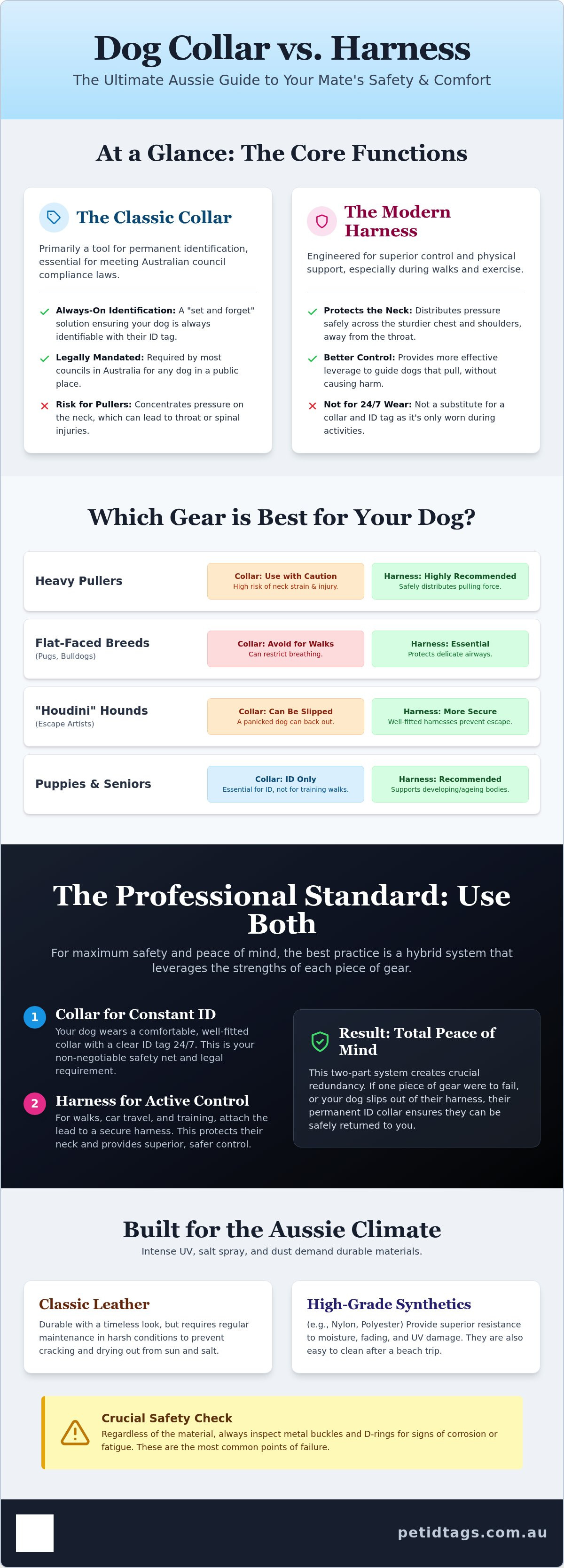
Decision Matrix: Which Gear Suits Your Dog’s Lifestyle?
Your dog's daily routine should dictate your gear selection. While the general dog collar vs harness australia debate provides a foundation, the final choice depends on breed size, energy levels, and specific health requirements. A working dog on a rural property has vastly different needs than a toy breed living in a city apartment. Selecting the wrong equipment can lead to discomfort, gear failure, or even long-term physical strain.
During the "Puppy Phase," your priority is skeletal protection and habituation. Puppies have soft, developing bones. A harness is essential for those early walks to prevent neck trauma when they inevitably lunge at a passing bird. Simultaneously, they must wear a collar at home to get used to the sensation of an ID tag. For the "Senior Dog," the focus shifts to joint support. Many older dogs suffer from arthritis or hip dysplasia. A harness with a sturdy handle allows you to assist them over obstacles or into the car without putting pressure on their limbs.
If you own an "Adventure Dog," your gear must be Aussie-proof. This means choosing heavy-duty, waterproof materials that won't rot after a swim at the beach or a hike through the bush. You need hardware that resists rust and straps that don't become abrasive when caked in red dust. Reliability in the field is paramount when you're kilometres away from the nearest vet.
Best Choice for Specific Aussie Dog Profiles
- The Puller: A front-attaching harness is a non-negotiable choice. It provides the mechanical leverage needed to redirect a strong dog without causing the choking associated with collars.
- The Small Breed: Protecting the delicate neck is vital. Lightweight harnesses prevent pressure on the trachea, which is a common vulnerability in breeds like Chihuahuas or Pomeranians.
- The Calm Walker: If your dog has mastered loose-lead walking, the simplicity of a personalised collar is often sufficient. It's easy to put on and provides a permanent home for essential ID.
Safety Checklist Before You Head Out
Before every walk, perform a quick gear audit. Use the "Two-Finger Rule" to ensure collars and harnesses are snug but not restrictive; you should be able to fit two fingers comfortably between the strap and your dog's skin. Check your pet id tag engraving ideas to ensure your contact details are still legible and haven't been scratched away by rough play. Finally, verify that attachment points like dog tag quick clips are securely fastened to the D-ring. For gear that stands up to the toughest Australian conditions, explore our range of durable stainless steel tags and custom gear today.
The Safety-First Solution: Why Most Aussie Paws Need Both
The hybrid approach isn't just a preference; it's a safety standard. When you stop viewing the dog collar vs harness australia debate as a binary choice, you unlock a superior level of security for your mate. The most effective system involves keeping a personalised collar on your dog 24/7 for permanent identification, while reserving a custom harness specifically for exercise and training. This provides critical redundancy. If a harness buckle fails or your dog manages to slip their collar during a spooked moment, you still have a secondary point of contact or a visible ID tag to ensure a rapid recovery. This "Double Security" method is the professional benchmark for walking dogs in unpredictable environments.
Organising your gear shouldn't be a chore. A streamlined kit allows you to transition from the lounge room to the trail in seconds. Investing in high-quality, durable equipment might cost more upfront, but it prevents the frequent replacement of perished gear. In the long run, professional-grade materials save you money and provide the peace of mind that your dog is secure in all conditions, from the coastal breeze to the dusty outback. A well-maintained kit is a reliable kit.
Organising Your Dog’s Walking Kit
Efficiency is key to a consistent walking routine. Many owners struggle with moving identification between different sets of gear, which often leads to dogs being walked without tags. Using a dog tag quick clip allows you to swap your mate's ID from their house collar to their walking harness instantly. This ensures they are never in public without visible contact details. For the best results, stainless steel dog tags are the premier choice for Australian conditions. Unlike aluminium or plastic, high-grade steel resists the corrosive effects of sea salt and won't snap during high-intensity play. Remember to rinse all gear with fresh water after a beach run or a muddy session at the local park to remove grit and salt that can degrade stitching over time.
Final Verdict: Putting Your Pet’s Safety First
The final verdict is clear: visible identification is your dog's ticket home. Regardless of whether you prefer a collar or a harness for lead control, your dog must be identifiable at all times. It's a good habit to regularly audit your gear for physical integrity. Look for signs of fraying and investigate why pet id tags fade to ensure your contact information remains sharp and legible under the punishing Australian sun. Don't wait for a gear failure to upgrade your setup. You can secure your mate's safety with our range of personalised collars and harnesses designed specifically for the rugged Aussie lifestyle.
Equip Your Mate for a Safer Future
Choosing between a dog collar vs harness australia doesn't have to be a compromise. By adopting a hybrid system, you ensure your dog remains council-compliant with 24/7 identification while enjoying the mechanical control and physical support of a harness during exercise. This dual approach provides the redundancy needed to keep your pet secure in any environment, from busy suburban streets to remote coastal tracks.
At Pet ID Tags Australia, we bring over 20 years of expertise to every piece of gear we craft. We specialise in high-grade stainless steel tags designed to withstand the harshest salt and sun. You can rely on our fast national shipping to get your personalised orders delivered straight to your door. Secure your mate’s safety with our durable range of personalised tags and gear!
Take the guesswork out of pet safety and invest in equipment that lasts a lifetime. Your mate deserves the best protection possible.
Frequently Asked Questions
Is a harness better than a collar for a puppy?
A harness is generally the safer choice for puppies during exercise as it protects their developing skeletal structure. Puppies often lack lead manners and can cause themselves injury by lunging against a standard collar. Using a harness distributes force across the chest, preventing tracheal damage. You should still introduce a lightweight collar at home. This helps your pup habituate to the sensation of wearing gear before they need to carry a permanent ID tag.
Can a dog wear a collar and a harness at the same time?
Wearing both a collar and a harness simultaneously is the professional standard for maximum safety. This hybrid approach provides essential redundancy if one piece of gear fails or if your dog manages to slip out of their harness. In the dog collar vs harness australia debate, using both ensures your dog remains identifiable via their collar tags while you maintain mechanical control through the harness during your daily walkies.
Do Australian laws require dogs to wear a collar?
Most Australian local councils legally require dogs to wear a collar and a visible identification tag in public places. While specific regulations vary between states, a collar is the primary tool for meeting these compliance standards. Even if you prefer walking your dog on a harness, they must still wear a collar to display their registration and contact details. Check your specific council's website to ensure you meet all current local requirements.
What is the safest way to walk a dog that pulls?
The safest method for walking a heavy puller is using a front-attaching harness. This design allows you to steer the dog from their centre of gravity, gently redirecting their momentum back toward you whenever they strain against the lead. It eliminates the choking sensation caused by collars and provides much better leverage than a back-clip harness. Pairing this with consistent positive reinforcement training is the most effective way to manage pulling long-term.
Will a harness encourage my dog to pull more?
A harness won't inherently make your dog pull, but certain designs can trigger an opposition reflex. Traditional back-clip harnesses, originally designed for sled dogs, can encourage some dogs to lean into the pressure and pull harder. If you find this is the case with your mate, switching to a front-clip harness usually resolves the issue. It provides the mechanical feedback needed to discourage pulling without causing any physical discomfort or neck strain.
How do I attach an ID tag to a dog harness securely?
You should attach your ID tag to the harness D-ring using a high-quality split ring or a dedicated quick clip. This ensures the tag remains visible and secure throughout the walk. Many owners find that a quick clip is the most practical solution for moving tags between a house collar and a walking harness. Ensure the attachment point is made of durable metal that won't snap if your dog brushes against a fence or bush.
Is it okay for my dog to wear a collar all day at home?
It is perfectly fine for your dog to wear a collar all day, provided it is well-fitted and comfortable. A permanent collar ensures your dog is always identifiable if they accidentally escape through an open gate. You should regularly check the skin underneath for any signs of irritation or hair loss. Ensure you can still fit two fingers under the strap to prevent it from becoming too tight as your dog moves or grows.
What information should be on my dog’s ID tag in Australia?
At a minimum, your dog's ID tag should include your current mobile phone number and your dog's name. Including a second contact number is a wise backup. Many Australian councils also require you to display a valid registration tag or number. If your dog has specific medical needs or is microchipped, adding "I'm Microchipped" can alert a rescuer to take your dog to a vet for scanning if they are found wandering.