

Table of Contents
- What to Look for in an Escape-Proof Cat Harness
- How to Measure Your Cat for a Harness
- Common Reasons Cats Back Out of Harnesses
- How to Train a Cat to Walk on a Leash
- How to Stop a Cat from Backing Out of a Harness
- Cat Identification Tags for Outdoor Safety
- Safety Tips for Walking Your Cat
- Frequently Asked Questions
What to Look for in an Escape-Proof Cat Harness
Finding the right best cat harness for escape artists means understanding what actually keeps a cat secure. Most cat owners discover too late that a poorly designed harness becomes a liability when their cat panics or decides to back out. At Pet ID Tags Australia, we've helped thousands of pet owners prevent escapes by focusing on the specific design features that matter most.
The fundamental difference between a standard harness and an escape-proof design comes down to pressure distribution and closure points. A cat's body is uniquely flexible, they can compress their ribcage and slip through openings that seem impossibly tight. An effective harness eliminates gaps where a determined escape artist can wriggle free by using multiple adjustment points and a design that accounts for feline anatomy.
Harness Design: Vest-Style vs. H-Style vs. Step-In
Three primary harness designs dominate the market, each with distinct advantages for escape-prone cats.
Vest-style harnesses distribute pressure across the entire torso, reducing the concentrated force that can trigger panic in anxious cats. The broader chest plate prevents many cats from backing out because pressure is spread rather than focused at the shoulders. However, vest-style harnesses require multiple adjustment points to dial in a secure fit.
H-style harnesses feature two separate loops, one around the neck and one around the girth, connected by straps across the back. This design creates natural anchor points difficult for cats to slip out of, especially when both loops are snug. The H-configuration naturally prevents backing out because both loops work together to contain the cat's body. The tradeoff is that H-style harnesses can feel restrictive to unfamiliar cats, potentially triggering initial resistance during training.
Step-in harnesses require the cat to step into leg holes before fastening. This design minimises contact with the cat's face, which many cats prefer, but introduces a critical vulnerability: if leg holes aren't snug enough, a determined cat can step back out just as easily as stepping in. Step-in designs work best for calm cats already comfortable with harnesses.
For escape-prone cats, H-style or well-fitted vest-style designs offer the most security. Pet ID Tags Australia's personalised harnesses use a vest-style construction with multiple adjustment points specifically engineered to prevent backing out whilst maintaining comfort for all-day wear.
Secure Fit and Adjustment Points
The difference between a harness that holds and one that fails often comes down to how many places you can tighten it. Multiple adjustment points (ideally 4-6 across the harness) mean you can dial in a fit that's snug everywhere without creating pressure points that cause discomfort.
Measure three critical points on your cat: neck circumference (loosely, at the base of the neck), girth (the widest part of the ribcage just behind the front legs), and the distance from neck to girth. Between sizes, always size up, a harness that's too tight will cause chafing and panic, making your cat more likely to struggle free.
The best adjustment systems use velcro straps or quick-release buckles positioned so you can tighten them without removing the harness. Velcro straps allow for infinite fine-tuning, whilst buckles offer speed and reliability but less precision.
Material Durability and Comfort
A harness that causes chafing or discomfort will be rejected by your cat. Breathable, padded mesh materials distribute pressure evenly and reduce irritation during extended wear. Reflective stitching makes your cat visible during low-light walks and provides visual confirmation that the harness is secure. Heavy-duty stitching and reinforced seams matter because a harness that tears mid-walk is useless. The D-ring attachment point where the leash clips on should be reinforced and stainless steel to prevent rusting.
How to Measure Your Cat for a Harness
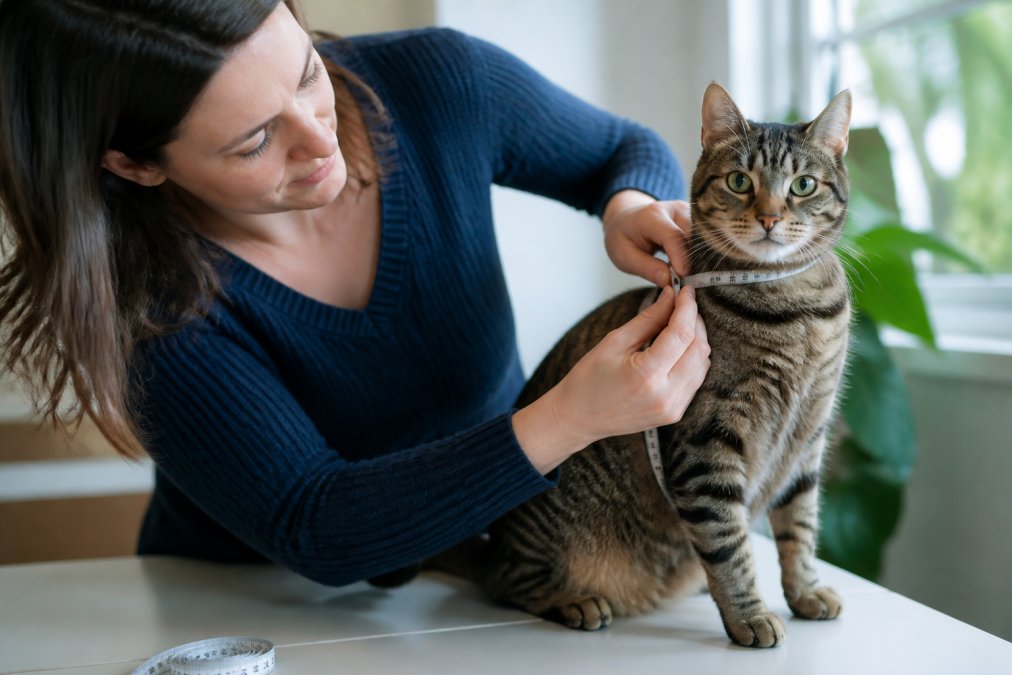
Accurate measurement is the foundation of harness security. An ill-fitting harness, even one with excellent design, will fail because gaps allow escape. Take measurements when your cat is relaxed.
Measure the neck circumference by wrapping a soft measuring tape loosely around the base of the neck, where the harness neck loop will sit. You should be able to slide one finger underneath the tape comfortably. Most cats need between 20-30 cm neck circumference.
Next, measure the girth by wrapping the tape around the widest part of the ribcage, just behind the front legs. This is the most critical measurement for preventing backing out. A snug girth measurement is essential because a loose girth is the primary escape route for cats that back out.
Finally, measure the distance from the base of the neck to the girth measurement point. Record all three measurements and compare them to the size chart provided by the harness manufacturer. If your cat falls between sizes, choose the larger size and use the adjustment points to dial in a snug fit.
Common Reasons Cats Back Out of Harnesses
Understanding why your cat backs out helps you select a design that prevents the behaviour. The reasons fall into two categories: physical escape and anxiety-driven escape.
Physical escape happens when the harness has loose adjustment points or a design flaw that leaves space between the harness and the cat's body. Cats can compress their ribcage and wriggle backwards if there's even a small gap at the girth or neck loop. This is entirely preventable with proper measurement and a well-designed harness with multiple adjustment points.
Anxiety-driven escape occurs when a cat becomes frightened and struggles so hard that they slip backwards through the harness. This often happens on the first walk or in high-stress environments. The solution isn't a tighter harness (which increases panic) but rather a harness design that distributes pressure evenly so the cat feels less restricted, combined with gradual training that builds confidence.
Some cats also back out because they've learned they can. If your cat escaped once, they'll try again. This reinforced behaviour is harder to break than a first-time escape, so prevention through a secure harness from the start is critical.
How to Train a Cat to Walk on a Leash
Training your cat to accept a harness and leash is a multi-week process requiring patience and positive reinforcement. Start indoors where your cat feels safe.
Week 1: Harness Familiarisation. Let your cat see and sniff the harness without putting it on. Leave it near their favourite spots so they become accustomed to its presence. Reward any interaction with treats.
Week 2: Short Indoor Wearing. Put the harness on for 5-10 minutes at a time whilst your cat is indoors, then immediately remove it and offer treats. Do this several times a day. Your cat will learn that wearing the harness leads to rewards.
Week 3: Leash Introduction. Attach the leash whilst the harness is on, but don't pull or guide. Let your cat move freely around the house with the leash dragging.
Week 4: Gentle Guidance. Begin gently guiding your cat with the leash, rewarding compliance with treats. Use a lightweight leash and move slowly. Never drag or force your cat.
Week 5: Outdoor Exposure. Start with very short outdoor sessions in a quiet, low-stress environment. Keep sessions under 5 minutes and gradually extend them as your cat becomes confident.
Throughout training, use treats and positive reinforcement exclusively. Punishment or force will make your cat associate the harness with fear, making escape attempts more likely when your cat panics.
How to Stop a Cat from Backing Out of a Harness
If your cat is already backing out of a harness, take two immediate actions: verify the fit is correct, and choose a harness design that eliminates the escape route your cat has discovered.
Step 1: Recheck Measurements. Measure your cat again using the three-point system. Many cats that seem to be escaping are actually wearing harnesses that were never fitted correctly. Tighten all adjustment points until the harness is snug but not restrictive, you should be able to slide only one finger underneath any strap.
Step 2: Switch to an H-Style Design. If your cat is backing out of a vest-style or step-in harness, an H-style design eliminates the primary escape route because the neck loop and girth loop work together.
Step 3: Add a Backup Clip. Some escape-artist owners use a second leash clipped to the back D-ring of the harness as a safety measure. This doesn't prevent backing out but does prevent a complete escape if it happens.
Step 4: Gradual Retraining. If your cat has successfully backed out once, go back to Week 2 of the training process to rebuild positive associations before attempting outdoor walks again.
Cat Identification Tags for Outdoor Safety
A harness keeps your cat secure during walks, but identification tags ensure they can be reunited with you if they do escape. Even the most escape-proof harness can fail, and a frightened cat can slip their collar or harness unexpectedly.
A deeply engraved ID tag with your current phone number is your best defence against permanent loss. Unlike printed tags that fade, laser-engraved tags remain legible for years. Pet ID Tags Australia uses deep laser engraving that resists fading and scratching, ensuring your contact information remains readable.
Include your phone number as the primary contact, it's faster than people looking up your address. If you've moved or changed numbers recently, update your tags immediately.
Consider attaching the ID tag to the harness itself rather than relying solely on a collar. Alternatively, use both: a tag on the harness and a tag on a collar worn underneath, providing redundancy.
Safety Tips for Walking Your Cat
Walking a cat on a harness requires different strategies than walking a dog. Cats are prey animals by instinct, and outdoor environments trigger different responses.
Choose quiet environments for early walks. Busy streets and crowded areas are overwhelming for cats. Start in quiet residential areas and gradually introduce busier environments as your cat becomes confident.
Watch for signs of stress. A cat that's crouching, tail tucked, ears back, or freezing is in distress. Stop the walk immediately and return home.
Never leave your cat unattended on a harness and leash. Always supervise outdoor harness time.
Use a harness with a D-ring attachment point. The leash should clip to a reinforced D-ring, not directly to the harness material.
Check the harness before every walk. Verify that all straps are tight and there are no signs of wear or damage.
Bring water and take breaks. Cats overheat more easily than dogs. Bring a collapsible water bowl and take frequent breaks in shaded areas.
Have a backup plan if your cat escapes. Keep a recent photo of your cat on your phone, know the location of local shelters and vets, and have your phone number on your cat's ID tag and harness.
Choosing the best cat harness for escape artists requires balancing security, comfort, and your individual cat's temperament. An H-style or well-fitted vest-style harness with multiple adjustment points will prevent most backing-out escapes, but the harness is only part of the solution. Proper measurement, gradual training, and consistent supervision during outdoor time create the complete safety system your escape-prone cat needs.
Pet ID Tags Australia's personalised harnesses combine secure design with durable construction and custom identification printing, giving you peace of mind that your cat is both contained and identifiable. Pair your harness with a deeply engraved ID tag to ensure that even if the unexpected happens, your cat can be reunited with you quickly. Start with the right equipment, invest time in training, and your cat can safely experience the outdoors without the constant fear of escape.
| Feature | Vest-Style | H-Style | Step-In |
|---|---|---|---|
| Escape-Proof Rating | High (with multiple adjustments) | Highest | Moderate |
| Comfort for Anxious Cats | Excellent | Good | Fair |
| Ease of On/Off | Good | Moderate | Excellent |
| Adjustment Precision | High (4-6 points) | Moderate (2-3 points) | Low (1-2 points) |
| Best For | Most cats, especially anxious ones | Confirmed escape artists | Calm, cooperative cats |
Frequently Asked Questions
Which cat harness is the most escape-proof?
Vest-style harnesses can offer a secure design when they distribute pressure across the chest and shoulders, making it harder for cats to wriggle free. Look for harnesses with multiple adjustment points, a snug girth measurement, and reinforced stitching. The key is ensuring the harness fits snugly, two fingers should fit under the straps, but not more. Some harnesses also feature velcro straps in addition to buckles, providing additional security.
How do I measure my cat for a secure harness fit?
Measure three points: neck circumference (loosely around the base of the neck), girth (around the widest part of the chest just behind the front legs), and if possible, belly circumference. Write down all measurements in centimetres. For a secure fit, aim for a snug measurement, closer to the minimum measurement for their size range, but not so tight it restricts breathing or movement. If between sizes, choosing the larger size and using adjustment points to achieve a snug fit is generally recommended, as a loose harness can be an escape risk.
Can cats escape from harnesses?
Yes, many cats can escape from poorly fitted or low-quality harnesses, especially those with anxiety-based escape behaviour or strong wriggle responses. Cats are naturally flexible and can sometimes back out of harnesses if they're not designed correctly or fitted properly. Escape artists often exploit gaps at the neck or chest, or use their hind legs to push the harness backward. Choosing a well-fitted harness with multiple adjustment points and using positive reinforcement training significantly reduces escape risk.
What cat harness is recommended by veterinarians?
Veterinarians often recommend harnesses that distribute weight evenly across the chest and shoulders, reducing strain on the neck and trachea. They typically prioritise harnesses with adjustable straps at multiple points, breathable mesh or padded material for comfort, and secure buckles or velcro closures. A harness paired with an ID tag, whether engraved or smart, is also recommended for outdoor safety. Consulting with your vet can help determine the best fit for your individual cat's anatomy and behaviour.
Where can I find escape-proof cat harnesses?
Escape-proof cat harnesses are available through pet retailers, online pet suppliers, and specialist pet ID companies. Pet ID Tags Australia offers personalised harnesses and ID tag combinations designed for secure outdoor use. When shopping, prioritise harnesses with positive customer reviews from owners of escape artists, check for multiple adjustment points, and look for products that come with sizing guides. Always verify the harness fits your cat's specific measurements before purchasing.
This article was written using GrandRanker