
Table of Contents
- Why Custom Engraved Cat Tags Matter for Pet Safety
- Cat Identification Tag Requirements: What the Law Says
- What to Put on a Cat Tag: Contact Details That Actually Help
- Engraved vs Laser Etched Cat Tags: Which Lasts Longer?
- Best Custom Engraved Cat Tags: Our Top Picks
- Choosing the Right Tag Size, Material and Noise Level
- Cleaning and Maintaining Your Cat's ID Tag
- Conclusion
Last Updated: August 27, 2026
Every year, thousands of cats go missing because finders have no way to contact the owner (ASPCA survey on lost pets). A custom engraved cat tag is the simplest, most reliable solution. At Pet ID Tags Australia, we've spent over 20 years engraving identification tags for cats and dogs, and the one thing reunited pet owners tell us most is: "I'm so glad she was wearing her tag."
This guide covers everything you need to choose the right engraved cat tags: what the law requires, what information to include, which materials last longest, and which options suit noise-sensitive cats.
Quick Picks:
- Best Overall: Aluminium Bone Tag, lightweight, colourful, and comfortable from $17.90
- Best for Durability: Stainless Steel Bone Tag, scratch-resistant and corrosion-resistant from $19.90
- Best Complete Set: Cat Collar with Engraved Tag, Australian-made, safety-release buckle, from $29.00
- Best for Changing Details: Smart QR Code Tag, updatable digital profile, from $34.90
Why Custom Engraved Cat Tags Matter for Pet Safety
A personalised cat ID tag is the fastest way for a stranger to reunite a lost cat with its owner. Microchips require a scanner; a visible tag with a phone number means anyone can make contact immediately.

Custom engraved cat tags are more reliable than printed alternatives. Deep laser engraving cuts permanently into the tag surface, producing lettering that won't peel, fade, or wash away. A quality engraved tag remains readable for the life of the cat.
A tag engraved with your current mobile number and a second contact cuts the time between "found" and "home" dramatically. For escape-artist cats who bolt at open doors, that speed matters.
Cat Identification Tag Requirements: What the Law Says
Cat identification requirements are set at the state and territory level, not federally, so rules vary depending on where you live.
Most states and territories require cats to be microchipped and registered with the local council. Many also require cats to wear a collar with an ID tag when outside. According to NSW companion animals legislation overview, cats in New South Wales must be microchipped and registered, and local councils may set additional requirements around collar identification.
Check your local council's requirements, because some explicitly require a visible ID tag on the collar in addition to a microchip. Even where it isn't legally mandated, wearing a tag is widely recommended by vets and animal welfare organisations.
What to Put on a Cat Tag: Contact Details That Actually Help
The most important piece of information is a current mobile number where you can be reached immediately. A phone call gets results faster than any other method.
Here's what to include, in order of priority:
- Your mobile number, the number you answer, not a landline
- Your cat's name, helps the finder build trust with a nervous animal
- A second contact number, useful if you're travelling or temporarily unreachable
- Your suburb or postcode, optional, but helps gauge whether the cat has wandered far
A standard small cat tag holds two to four lines of engraving. Prioritise the phone number above everything else.
Engraved vs Laser Etched Cat Tags: Which Lasts Longer?
Diamond-tip engraving uses a rotating cutting tool to physically carve lettering into the tag surface. On anodised aluminium, the engraving cuts through the coloured surface to reveal the base metal beneath, producing crisp white lettering.
Laser engraving uses a focused laser beam to mark the surface. On stainless steel and anodised aluminium, laser engraving produces precise, permanent results with fine detail and excellent scratch-resistance.
Both methods produce permanent markings that outlast printed or stamped alternatives. Avoid any tag described as "printed" or "filled." For everyday cat wear, both engraving methods on quality materials will outlast a cheap printed tag many times over. Cat nutrition guide.
| Method | Best Material | Scratch Resistance | Readability |
|---|---|---|---|
| Diamond-tip engraving | Anodised aluminium | Good | High contrast |
| Laser engraving | Stainless steel, aluminium | Excellent | Crisp and fine |
| Printing / epoxy fill | Any | Poor | Fades quickly |
Pet ID Tags Australia uses precision engraving on all Pawzee tags, producing lettering that holds up through weather, water, and daily wear.
Best Custom Engraved Cat Tags: Our Top Picks
Choosing the right tag comes down to your cat's size, activity level, and how often your contact details change.
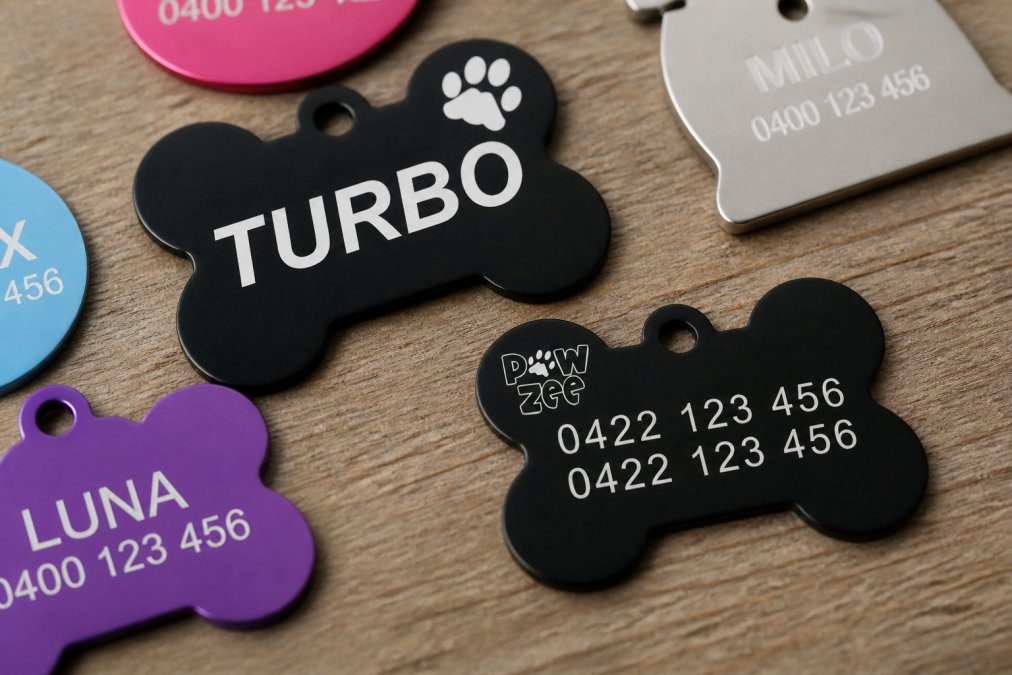
Aluminium Bone Tags, Lightweight and Colourful
The Pawzee Aluminium Bone Pet ID Tag at $17.90 is our most popular choice for cats. Crafted from lightweight anodised aluminium, these tags weigh almost nothing on a cat's collar, a genuine consideration for smaller breeds and kittens. The anodised finish comes in black, blue, and pink, with precision engraving producing crisp white lettering that remains readable in low light.

Each tag includes a durable split ring for easy collar attachment and can be personalised with your cat's name, mobile number, and optional second contact.
Best for: Cats of all sizes, kittens, owners who want a colourful tag that won't weigh down a lightweight collar.
Available in black, blue, and pink, all $17.90.

Stainless Steel Tags, Maximum Durability
For cats that spend time outdoors, the Stainless Steel Bone Pet ID Tag at $19.90 is the harder-wearing choice. Stainless steel is corrosion-resistant and scratch-resistant. These tags are polished to a bright finish and deeply engraved on both sides, your cat's name on the front, contact details on the back.
Best for: Active outdoor cats, owners who want a tag that genuinely lasts years without re-ordering.
Cat Collar with Engraved Tag, Complete Safety Set
The Cat Collar with Pet Tag at $29.00 is the smartest option for new cat owners or anyone replacing a worn collar and tag.
This Australian-made set includes a 10mm adjustable nylon webbing collar (16-26cm) paired with a quality anodised aluminium tag engraved on both sides. The collar features a two-part safety-release buckle with an elastic section, a critical safety feature for cats, because it allows the collar to break free if caught on a branch or fence. A stainless steel D-ring secures the tag, and a matching bell is included.
Best for: New cat owners, anyone who wants a matched set, and owners of outdoor cats who need the safety-release buckle.
Smart QR Code Tag, Updatable Digital Identification
The Pawzee Smart Pet ID Tag at $34.90 solves a problem traditional engraved tags can't: what happens when your contact details change.
The tag carries a scannable QR code linked to your cat's digital profile. Anyone who finds your cat can scan the code with a standard smartphone camera and immediately access your current contact details. You update the profile online whenever your number or emergency contacts change, without ordering a new tag.
Best for: Tech-aware owners, renters, people whose contact details change regularly, or anyone who wants to include extended information beyond what a physical tag can hold.
Choosing the Right Tag Size, Material and Noise Level
The right tag size depends on your cat's collar width and neck size. Most adult cats suit a small to medium tag. A tag that's too large will swing and knock against surfaces, creating noise and potential irritation.
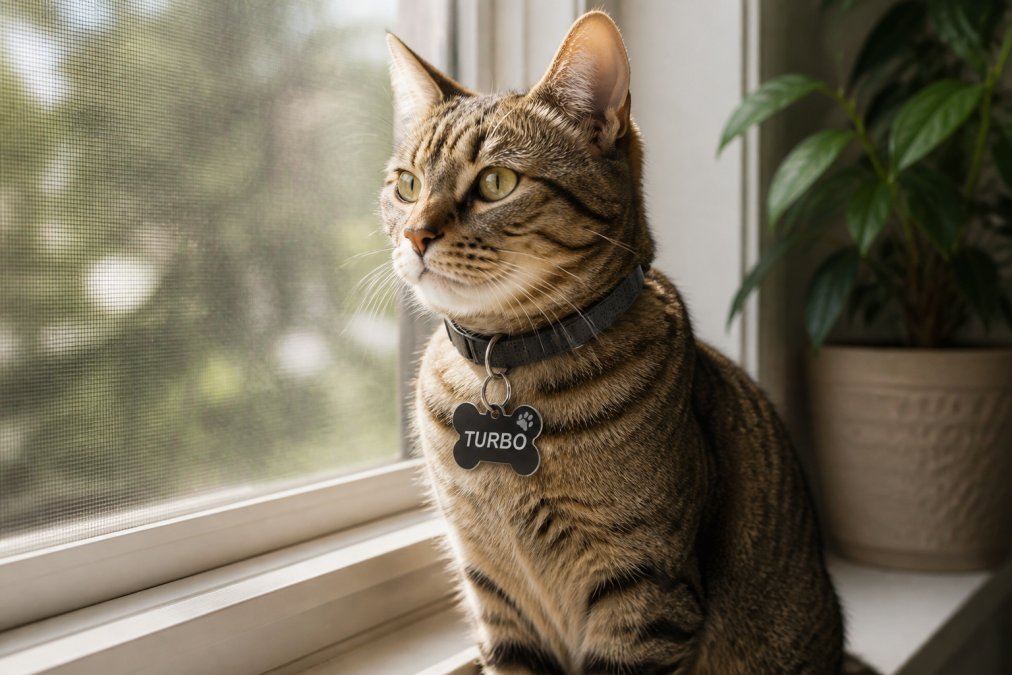
Silent Tag Solutions for Noise-Sensitive Cats
Tag noise is a genuine issue for many cat owners. Some cats find it stressful, particularly at night or in quiet environments.
Practical fixes include:
- Choose lightweight aluminium over stainless steel. Less mass means less noise on impact.
- Use a tag silencer or rubber sleeve. These slip over the tag and dampen sound significantly.
- Attach the tag to a fabric loop on the collar rather than directly to the D-ring, which reduces metal-on-metal contact.
- Opt for a collar with a recessed tag pocket. Some cat collars hold the tag flat against the collar body, eliminating swing entirely.
The Cat Collar with Pet Tag set is designed with a stainless steel D-ring attachment that keeps the tag close to the collar, reducing the pendulum effect that causes most tag noise.
Material Safety: What to Avoid on a Cat Collar
Material safety matters more for cats than dogs, because cats groom themselves constantly and may lick or chew collar attachments.
Stainless steel and anodised aluminium are both safe for pet wear. They don't leach metals under normal conditions and are non-toxic if mouthed. Avoid tags made from cheap zinc alloys or unspecified metals, which can contain lead or cadmium.
Also avoid tags with enamel coatings that are cracked or chipping. The Pawzee range uses anodised aluminium and food-grade stainless steel.
Cleaning and Maintaining Your Cat's ID Tag
A well-maintained tag stays readable for years.
For anodised aluminium tags:
- Wipe with a damp cloth and mild dish soap
- Rinse with clean water and dry immediately
- Avoid abrasive cleaners or steel wool
For stainless steel tags:
- Wipe with a damp cloth; stainless steel is highly resistant to water and mild soap
- For stubborn grime, use a soft toothbrush with warm soapy water
- Dry thoroughly to prevent water spots
Check the split ring regularly. If it's bent, corroded, or showing signs of fatigue, replace it before the tag detaches.
Inspect the engraving every six months. Deep laser engraving on quality materials should show no degradation, but confirm the lettering remains fully legible, particularly the phone number.
For the smart QR code tag, wipe the QR code surface gently with a soft cloth. Scratches across the code pattern can make it harder for a scanner to read.
Finding the right engraved cat tags shouldn't take hours of research. The core choice is simple: aluminium for lightweight everyday wear, stainless steel for maximum durability, or the complete collar-and-tag set if you're starting from scratch. Pet ID Tags Australia has been making these decisions easier for over 20 years, with deep laser engraving, fast dispatch from our Adelaide workshop, and a 30-day satisfaction guarantee on every order. Over 100,000 pets are wearing our tags, with a 4.91-star rating from 4,828 verified reviews. Shop engraved cat tags today and give your cat the identification they deserve.
Frequently Asked Questions
What information should be included on a cat ID tag?
A cat ID tag should include your current phone number as the priority detail, this is what a finder will use immediately. Add a second contact number if space allows. Your pet's name helps anyone approaching a nervous cat to do so calmly. A suburb or postcode is optional but useful. You do not need a full street address; a mobile number is far more practical for quick reunions. Most custom engraved cat tags offer two-sided engraving, giving you enough room for all essential details.
Are engraved cat tags better than printed ones?
Yes. Printed or stamped tags rely on surface coatings that wear away within months, especially when exposed to water, scratching, and daily movement against a collar. Deep laser engraving cuts directly into the material, creating permanent markings that remain readable for the life of the tag. Pet owners who have gone through two or three cheap printed tags in a year consistently find that a properly engraved cat tag from a specialist supplier holds its legibility far longer and costs less over time.
Do cats need to wear ID tags if they are microchipped?
Microchipping is mandatory for cats in most Australian states and territories, but a microchip alone is not enough for a quick reunion. A chip requires a scanner to read, something most members of the public do not carry. A visible custom engraved cat tag lets anyone who finds your cat contact you immediately, without needing to locate a vet or shelter. Wearing both a microchip and an ID tag gives your cat the best chance of getting home fast.
How do I choose the right size tag for a cat collar?
Most cats suit a small tag, roughly 25 mm to 28 mm in diameter or length. A tag that is too large adds unnecessary weight and can snag on branches or fencing, which is a real risk for outdoor cats. Lightweight anodised aluminium tags are the most comfortable choice for cats because they weigh only a few grams. Check that the tag's split ring fits your collar's D-ring before ordering. Pet ID Tags Australia's small-sized tags are designed specifically with cats and small breeds in mind.
What are the most durable materials for cat identification tags?
Stainless steel is the most durable option, offering scratch resistance, corrosion resistance, and a long service life even with daily outdoor exposure. Anodised aluminium is the best choice for lightweight comfort, the anodised finish is weather-resistant and holds engraved lettering clearly, though it is slightly softer than steel. Avoid tags made from zinc alloy or plated metals, as the plating can flake and the base metal may corrode quickly. For cats that spend time outdoors, stainless steel tags from Pet ID Tags Australia start at $19.00.
This article was written using GrandRanker