

Table of Contents
- Why Your Pet Needs ID: The Critical First Step
- Instant Identification When Your Pet Goes Missing
- What to Put on a Dog ID Tag
- Microchip vs. ID Tag: Why You Need Both
- Pet Microchipping Requirements and Benefits
- How to Find a Lost Pet: Your Action Plan
- Durability Matters: Choosing Tags That Last
- Smart Tags and Modern ID Solutions
- Frequently Asked Questions
Last Updated: September 2, 2026
Why Your Pet Needs ID: The Critical First Step
Your pet doesn't plan to go missing. But when a door opens unexpectedly or a gate latch fails, a single moment can separate your companion from home. At Pet ID Tags Australia, we've helped reunite thousands of lost pets with their owners, and the difference between a quick reunion and weeks of heartbreak almost always comes down to one thing: proper identification.

A pet needs ID because identification is the fastest way to get your pet home if they're lost. Without it, even a friendly stranger who finds your dog or cat has no way to contact you. With it, reunion can happen within hours instead of days or weeks.
This guide covers everything you need to know about why your pet needs ID, what information to include, and how different identification methods work together to keep your pet safe. Whether you're a new pet owner or looking to upgrade your current setup, understanding identification requirements and options will give you genuine peace of mind.
Instant Identification When Your Pet Goes Missing
When your pet goes missing, every minute counts. A collar with a visible ID tag allows anyone, a neighbour, a passer-by, or a local business owner, to contact you immediately without needing special equipment or knowledge. This is the fastest possible reunification method.

Visible identification works because it requires no technology, no scanning, and no delay. Someone finds your pet, reads your phone number, and calls. Within minutes, your pet could be heading home. This immediate response time is why visible ID tags remain the most critical safety tool for any pet.
The psychological impact of a lost pet is profound. Pet owners often experience genuine distress, sleepless nights, and anxiety about their companion's safety. Knowing your pet has clear identification, and that you've done everything to enable a quick reunion, reduces that anxiety significantly. You've taken concrete action. You've prepared for the worst-case scenario.
What to Put on a Dog ID Tag
Your pet ID tag should contain information that enables immediate contact while protecting your pet's safety. The right details are the difference between a quick reunion and a lost case that goes cold.
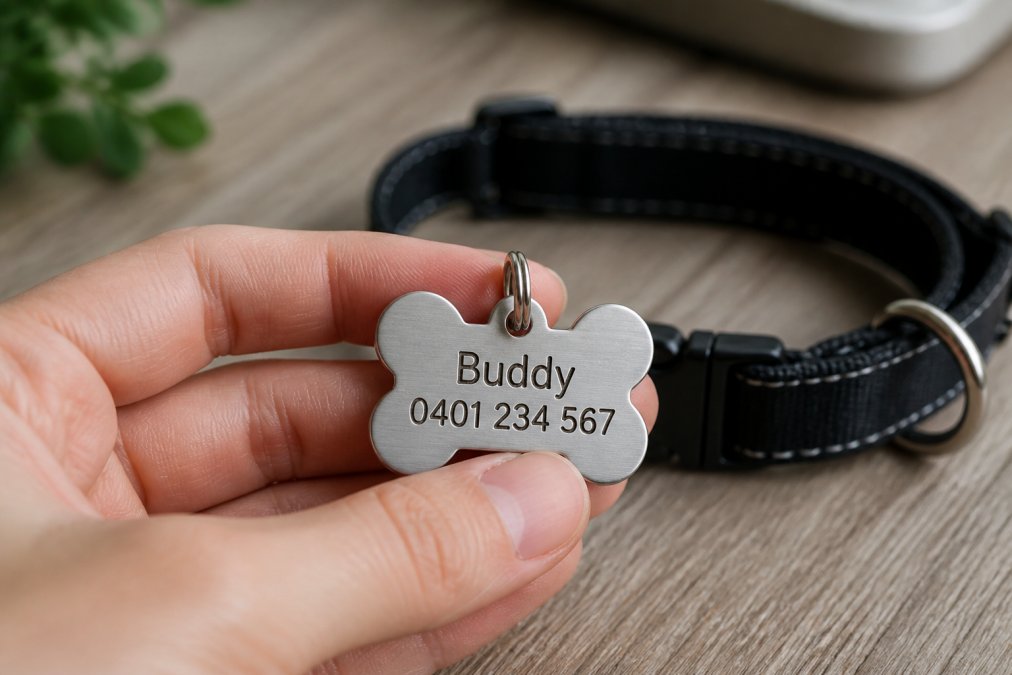
Essential Information
Your pet's name is the first detail to include. It identifies your pet specifically and allows a finder to address your pet by name, which builds trust and makes handling easier. A pet that responds to their name is easier to secure and less likely to bolt.
Your phone number is the critical contact detail. Use the number you answer most reliably, typically your mobile. This is the single most important piece of information on the tag because it enables direct contact with you. Without it, the tag is useless.
Your name (optional but helpful) can be included if space allows. It confirms that the tag belongs to a specific person, not just a pet. Some finders feel more confident calling if they know the owner's name.
A secondary contact number (optional) provides a backup if your primary number is unavailable. This might be a partner's number, a family member's, or a work number. If you're travelling or in an accident, a second contact dramatically increases the chance someone can reach you.
Information to Avoid
Your address should generally not appear on a collar tag. A tag that includes your address creates a security risk, a lost pet's location reveals when your home is empty. This information is better stored in a microchip registry or digital profile, where it's protected.
Unnecessary details clutter the tag and make it harder to read quickly. Pet age, weight, medical conditions, or personality traits can be included in a microchip registry or digital profile, but they don't belong on the physical tag itself.
Cryptic abbreviations or shorthand that only you understand defeat the purpose. A finder needs to understand the information immediately. Write your phone number in full, use clear abbreviations (e.g., "Mob" for mobile), and avoid inside jokes or codes.
Microchip vs. ID Tag: Why You Need Both
The most common question is whether you need both a microchip and an ID tag. The answer is yes, they serve different purposes and work together to maximise your pet's chances of coming home.
A microchip is permanent identification that's scanned at shelters and veterinary clinics. It's a tiny device implanted under your pet's skin, about the size of a grain of rice. It contains a unique number linked to your contact information in a registry database. If your pet is found and taken to a shelter or vet, scanning the microchip reveals your details instantly.
An ID tag is visible identification that works immediately, without any scanning or technology. It's read by anyone who finds your pet, a neighbour, a passer-by, someone at a local café. It enables direct contact within minutes.
The critical difference is this: a microchip only helps if your pet reaches a shelter or vet clinic. An ID tag helps if anyone, anywhere finds your pet. A tag enables the fastest possible reunion. A microchip is the safety net if your pet is found by someone who takes them to a professional facility.
Together, they create a two-layer system. A pet with both has maximum protection. A pet with only a microchip might go unidentified if found by someone who doesn't take them to a clinic. A pet with only a tag might be reunited quickly, but has no backup if the tag is lost or damaged.
Pet Microchipping Requirements and Benefits
Microchipping is a straightforward procedure performed by any veterinarian. A vet injects a microchip under your pet's skin, usually between the shoulder blades. The procedure takes seconds and causes no more discomfort than a standard injection. Most pets don't even notice it.
After implantation, you must register the microchip with a national registry database. This registration links your pet's microchip number to your name, address, and phone number. When a shelter or vet scans your pet, they access this database and find your details.

The key benefit of a microchip is permanence. Unlike an ID tag, which can be lost, damaged, or removed, a microchip is embedded in your pet's body. It can't be separated from your pet. It remains readable for the entire life of your pet.
However, microchip registries require active maintenance. If you move house or change your phone number, you must update your registration details. Many lost pets go unidentified because their microchip information is outdated. A microchip is only as useful as the registry information attached to it.
How to Find a Lost Pet: Your Action Plan
If your pet goes missing, the first hours are critical. A structured action plan increases the chance of a quick reunion significantly.

Step 1: Search your immediate area. Check nearby bushes, under porches, and in any sheltered spot where a scared pet might hide. Many lost pets are found within a few houses of home, hiding rather than running.
Step 2: Contact local shelters and animal control. Call every shelter, pound, and animal welfare organisation within a 10-15 kilometre radius. Provide a detailed description and your contact number. Ask them to call you immediately if a matching pet is brought in.
Step 3: Post on social media. Share photos and details on local community groups, lost pet networks, and pet-specific social media pages. Include your pet's name, description, the location where they went missing, and your phone number. Ask people to share the post widely.
Step 4: Create and distribute physical posters. Print clear posters with a large photo, your pet's name, a description, and your phone number. Post them in high-traffic areas: parks, shops, community notice boards, veterinary clinics, and local businesses.
Step 5: Contact local veterinary clinics. Call every vet within the area where your pet might have travelled. Provide details and ask them to watch for your pet or any information about sightings.
Step 6: Check lost pet databases. Register your pet on national lost pet websites and databases. These sites aggregate lost pet reports and help finders connect with owners.
Step 7: Keep searching. Continue checking shelters, posting updates, and following up on leads. Many pets are found days or weeks after going missing, sometimes in unexpected locations.
The faster you act, the higher your chances of recovery. Many owners who find their pets credit the immediate action in the first 24 hours as the deciding factor.
Durability Matters: Choosing Tags That Last
A pet ID tag that fades, peels, or becomes unreadable is as useless as no tag at all. Durability directly affects whether your tag will still be readable months or years later, when your pet actually goes missing.
Many cheap tags fade within months. Engraving wears away, paint peels, or the surface becomes so scratched that text is illegible. A finder might see there's a tag but can't read the phone number. Your pet remains unidentified.
Quality tags use deep laser engraving, which cuts the information into the material itself rather than printing it on the surface. This means the text is permanent, it can't fade, peel, or wear away. Even if the tag is scratched or weathered, the engraved information remains readable.
Pet ID Tags Australia uses deep laser engraving on anodised aluminium, which resists corrosion and maintains readability for years. The Black Aluminium Bone Pet ID Tag - Personalised Engraved is designed specifically for durability, with engraving that lasts.
Material choice matters. Aluminium is lightweight, durable, and resistant to rust. Stainless steel is heavier but equally durable. Plastic tags are cheaper but degrade quickly in sunlight and weather. Brass can tarnish and become unreadable.
Smart Tags and Modern ID Solutions
Smart tags represent the newest evolution in pet identification. These tags combine traditional ID with QR codes or Bluetooth technology, creating a digital layer of protection alongside physical identification.
A QR code tag displays a scannable code that links to your pet's digital profile. When someone finds your pet and scans the QR code with their smartphone, they're directed to a webpage with your contact details, your pet's medical information, and photos. This combines the speed of visible identification with the depth of information available in a microchip registry.
The Smart Pet ID Tag - QR Code Dog & Cat Identification Tag from Pet ID Tags Australia includes a QR code linked to your pet's digital profile. If your pet goes missing, anyone with a smartphone can access your information instantly. You can update your pet's profile, adding new contact details, medical alerts, or recent photos, without replacing the tag.
Bluetooth-enabled smart tags offer real-time location tracking. If your pet goes missing, you can track their location via a smartphone app. Some systems also send alerts if your pet leaves a designated safe zone. These tags are particularly useful for pets that are prone to wandering or escape.
However, smart tags have limitations. QR codes require someone to have a smartphone and think to scan the code. Bluetooth tags require the finder to have the app or understand how to use it. For pets found by someone without a smartphone or technical knowledge, a traditional visible ID tag remains the fastest solution.
The best approach combines methods: a visible ID tag for immediate identification, a microchip for permanent backup, and a smart tag for additional features. This layered approach maximises your pet's chances across every possible scenario.
Losing a pet is one of the most stressful experiences a pet owner can face. The good news is that proper identification dramatically improves the chance of a quick reunion. A visible ID tag, a microchip, and a backup contact method create a comprehensive safety system. Pet ID Tags Australia has spent over 20 years helping pet owners protect their companions with durable, reliable identification. The Harness with Dog Tag Combo and Personalised Reflective Dog Collar with Name & Phone Number combine secure restraint with clear identification, giving your pet maximum protection in a single product. Start with a quality ID tag today, it's the single most important investment you can make in your pet's safety.
Frequently Asked Questions
What information should I include on my pet's ID tag?
Include your pet's name and your phone number. Some owners add a secondary contact number. The most critical detail is your contact number, a finder needs to reach you quickly. Keep the engraving clear and legible; deep laser engraving ensures the information remains readable even after years of wear.
Is a microchip enough, or does my pet still need an ID tag?
No, microchips and ID tags serve different purposes and work best together. A microchip requires a scanner, which a stranger may not have immediately. An ID tag is visible and allows instant contact without equipment. Many lost pets are reunited within hours because someone saw the tag and called the owner. Microchips are the permanent backup if a collar is lost. Use both for complete protection.
What should I avoid putting on my dog's ID tag for safety?
Avoid your home address if you're concerned about burglary while you're away. Don't list your pet's medical conditions unless critical (like 'diabetic'). Skip your email address, a phone number is faster for reunification. Avoid decorative information that reduces space for your contact details.
How do I know if my pet ID tag will stay readable over time?
Look for tags made from durable materials like anodised aluminium with deep laser engraving. Cheap stamped tags fade and peel within months; laser-engraved tags remain legible for years. The Black Aluminium Bone Pet ID Tag uses deep laser engraving that resists fading and scratching, maintaining readability through daily wear.
This article was written using GrandRanker