

Did you know that between 9% and 23% of lost dogs are reunited with their families as a direct result of wearing a physical ID tag? While microchipping is a legal requirement across the country, knowing exactly what to put on a pet id tag australia is the fastest way to ensure a friendly neighbour can call you the moment they find your wandering mate. Most owners worry about fitting enough information onto a small disc or feel uneasy about sharing their home address with strangers. It's a common concern, but getting the engraving right can mean the difference between a quick phone call and an expensive trip to the council pound.
This 2026 guide provides a definitive blueprint for engraving a tag that is both council-compliant and highly effective for a rapid recovery. You'll discover which contact details are essential for a fast return, how to navigate privacy concerns, and why choosing durable materials like stainless steel is vital for surviving the harsh Australian climate. We'll help you create a permanent safety net that gives you total peace of mind every time you head out for a walk.
Key Takeaways
- Prioritise your current mobile number and your pet's name to ensure a finder can contact you instantly and keep your pet calm.
- Apply the "10-Second Rule" to your engraving layout, ensuring the most critical details are large enough to be read quickly and clearly.
- Select a material suited to your pet's activity level, opting for rugged stainless steel for outdoor adventurers or lightweight aluminium for cats.
- Discover exactly what to put on a pet id tag australia to remain compliant with local council expectations while protecting your personal privacy.
- Adopt a dual-protection strategy by pairing a permanent microchip with a visible, durable ID tag for the fastest possible return home.
What to Put on a Pet ID Tag in Australia: The Essential Checklist
When deciding what to put on a pet id tag australia, you must view the tag as a high-speed recovery tool rather than just a decorative accessory. The goal is to provide a complete stranger with the exact information they need to return your pet within minutes. While microchips are a vital permanent record, a physical tag is the only way for a member of the public to contact you without needing a trip to a vet or shelter. This Pet ID tag overview highlights that while designs vary, the core function is always about clear, accessible communication. In the Australian context, where pets often wander into bushland or busy suburban streets, every second counts.
The Non-Negotiables: Contact Details That Work
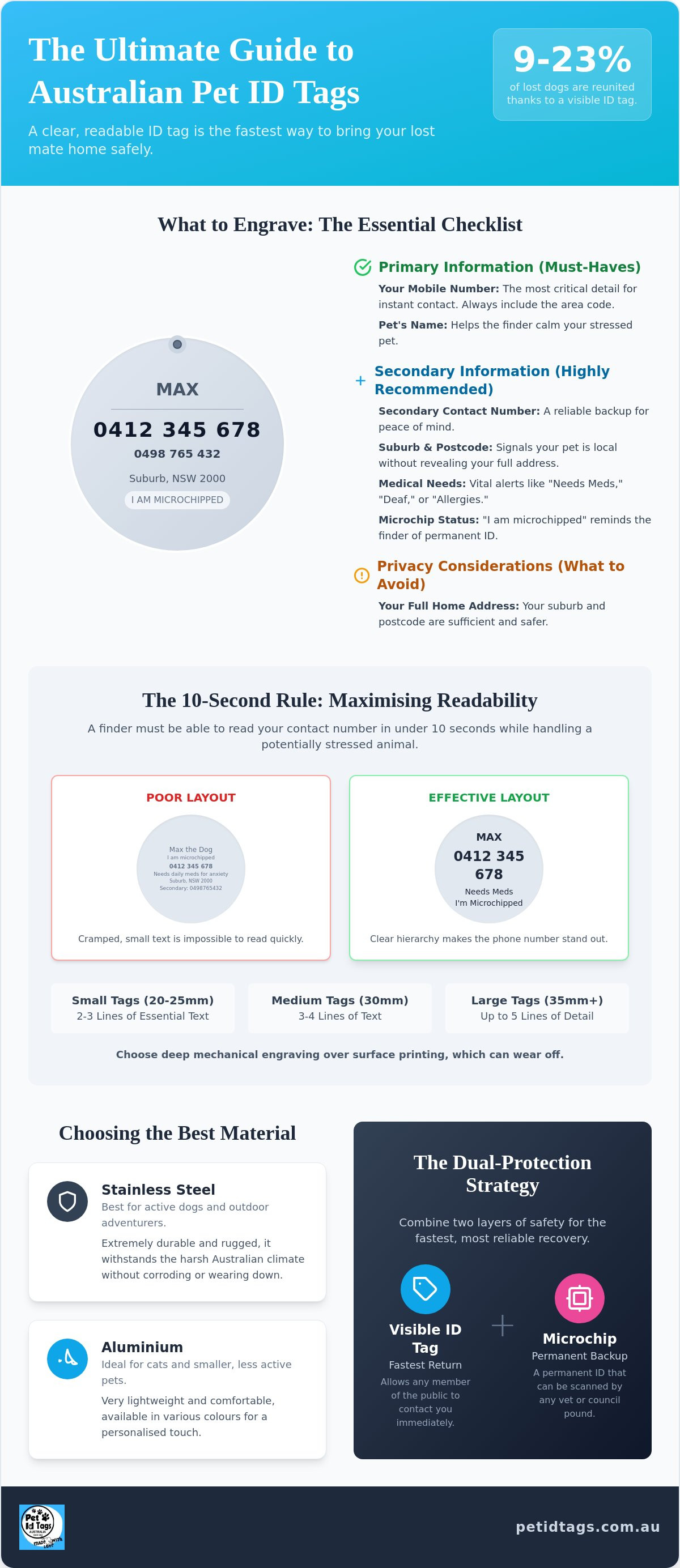
Your current mobile phone number is the absolute priority. It's far more effective than a landline because you'll likely be out searching the neighbourhood if your pet goes missing. A mobile ensures you can be reached instantly, regardless of where you are. If you frequently travel across state lines, always include the area code to avoid any confusion for the finder. Including a secondary contact number is a smart backup strategy. If you're in a mobile dead zone or your battery dies during the search, having a partner's or a friend's number engraved ensures the finder has a second point of contact to facilitate a safe return.
Contextual Info: Pet Name and Location
There is often a debate among Australian pet owners about whether to include the pet's name. The primary benefit is that it allows a stranger to calm and secure a stressed animal more easily. However, some owners worry this could increase the risk of theft. Generally, the safety benefit of a calm pet outweighs the potential risk. For physical addresses, privacy is a valid concern. You don't need to engrave your full street address. Including just your suburb and postcode is often enough to signal to a finder that the pet lives nearby. For more inspiration on how to balance these details, you can explore our pet id tag engraving ideas for specific layout examples.
Critical Alerts and Microchip Status
If your pet has a medical condition, this should be noted on the tag. Short phrases like "Needs Meds," "Deaf," or "I'm Blind" are highly effective. These alerts prompt a finder to act with extra care and may discourage them from feeding the pet something that could cause an allergic reaction. If space permits, adding "I am microchipped" serves as a useful reminder that your pet has a permanent identification system as a backup. This combination of immediate contact info and critical health data creates the strongest possible safety net for your pet.
Prioritising Readability: How to Layout Your Engraving
A pet tag is only as good as its legibility. When considering what to put on a pet id tag australia, you must apply the "10-Second Rule." A finder should be able to identify your contact number within ten seconds of securing your pet. If they have to squint or find a magnifying glass while holding a wriggly or stressed animal, the tag has failed its primary purpose. High-contrast, clear layouts are essential for rapid recovery in the field.
Hierarchy of information is the key to a successful layout. The most critical detail, usually your primary mobile number, should occupy the largest font size available. Less urgent information, such as a secondary contact or your suburb, can be smaller. This visual guide helps a finder focus on the specific number that gets your pet home fastest. Deep mechanical engraving is superior to surface printing for long-term legibility. While surface-printed tags might look crisp initially, the text can rub off after a few months of scratching against a metal collar ring. Deep engraving carves the details into the metal, ensuring they remain readable for the life of the tag.
Tag size dictates your character limits. You can't fit a novel on a 20mm disc. For the best results, follow these general guidelines:
- Small Tags (20-25mm): Stick to 2 or 3 lines of essential text.
- Medium Tags (30mm): Comfortably handle 3 to 4 lines.
- Large Tags (35mm and above): Allow for up to 5 lines of detailed information.
Overcrowding a small tag with too much text reduces the font size to an unreadable level. It's always better to have three clear, bold lines than five cramped, illegible ones. For a durable solution that stays readable through every bush walk and beach trip, consider our Stainless Steel Dog Tags.
Front vs. Back: Making the Most of Two Sides
Maximise your available space by splitting details across both sides of the tag. Put your pet’s name and your primary mobile on the front for instant identification. Use the back for backup numbers, medical alerts, or your suburb. Splitting the information this way prevents the tag from appearing cluttered and ensures each line remains distinct and easy to scan at a glance.
Choosing Font Styles for Clarity
Sans-serif fonts are the gold standard for pet safety. These clean, block-style letters don't have the small decorative strokes that can blur together if the tag gets scratched or dirty. Avoid script or "fancy" fonts; while they might look stylish, they are notoriously difficult to read in low light or from a distance. Tag shape also affects text alignment. Circular tags offer the most consistent space for centred text, whereas bone-shaped tags have narrow ends that often force text to be smaller or more cramped in the middle.
Selecting the Best Material to Protect Your Information
Choosing the right material is just as vital as deciding what to put on a pet id tag australia. If the tag corrodes or the text wears away, the most accurate contact details become useless. In our local environment, pets face unique challenges that can quickly destroy inferior products. From the corrosive salt air of the coast to the abrasive red dust found in rural areas, your pet's identification needs to be built for endurance. The material you choose acts as the protective vault for your recovery data.
Material hardness directly dictates engraving depth. A harder metal allows for a deeper, more permanent mark that resists the "buffing" effect caused by a tag constantly rubbing against a metal collar ring. In contrast, softer materials might look bright and colourful initially, but they can lose their legibility within months if the pet is active. For any owner prioritising long-term safety, the physical durability of the tag is a non-negotiable factor.
Stainless Steel: The Heavy-Duty Choice
Stainless steel is the gold standard for active Australian dogs. It is an incredibly dense and hard-wearing metal, making it the "set and forget" option for busy owners. These stainless steel dog tags australia are specifically engineered to resist rust and tea-staining, even if your dog spends every weekend at the beach. Because the metal is so tough, the engraving process carves deep into the surface. This ensures that your phone number remains readable even after years of bush walks, swims, and backyard wrestling matches. It is the most reliable way to ensure your contact information survives the elements.
Lightweight Aluminium for Small Breeds and Cats
Aluminium is a popular alternative when weight is the primary concern for your pet’s comfort. For a small kitten or a toy breed like a Chihuahua, a heavy steel tag might be too bulky. Aluminium tags are exceptionally light and come in a wide variety of vibrant colours. However, it's important to understand the trade-off. Aluminium is a much softer metal than steel. Over time, friction will cause the metal to thin, and the engraving may eventually become shallow. To keep aluminium tags readable, you should inspect them every few months for signs of significant wear. They are an excellent choice for indoor cats or pets that lead a less rugged lifestyle, provided you stay vigilant about their condition.
Standout Pet ID Tags for Australian Conditions
Selecting the right hardware is the final step in securing your pet's safety. While you now know exactly what to put on a pet id tag australia, the physical format of that information determines how well it performs in an emergency. Different pets require different solutions. A high-energy kelpie working on a rural station needs a far more rugged setup than a pug that rarely leaves the suburban backyard. Matching the tag type to your pet's daily routine ensures that your contact details remain accessible when they are needed most.
Our Stainless Steel Dog Tags remain the best-seller for a reason. They offer the ultimate in durability and are virtually indestructible under normal Australian conditions. For households with multiple animals, Aluminium Dog Tags provide an excellent way to colour-code your pets, making it easy to identify which collar belongs to whom at a glance. If you want to combine safety with a touch of personality, Crystal Bling Pet Tags offer that extra "pizazz" without compromising on the depth of the engraving or the quality of the metal base.
The "Fail-Safe" Setup: Smart Tags Meets Engraving
The 2026 gold standard for pet safety is a "fail-safe" setup that combines traditional deep engraving with a Smart Pet Tag. While a standard tag provides an instant phone number, a smart tag features a QR code that links to a full digital profile. This allows a finder to see your pet's medical history, dietary requirements, and even multiple backup contacts just by scanning the tag with a smartphone. One of the greatest advantages is the ability to update your contact details online instantly. If you are on holiday or move house, you can change the information in the digital portal without the need to purchase and wait for a new physical tag.
Essential Accessories: Collars and Quick Clips
Your identification strategy shouldn't rely on a single point of failure. A personalised dog collar serves as a brilliant visual backup. If a tag is lost during a brush encounter, having your phone number embroidered directly onto the collar ensures your pet isn't left anonymous. Additionally, using Pet Tag Quick Clips allows you to swap tags between different harnesses and collars in seconds. This hardware is designed to be as strong as the tag itself, preventing the common problem of weak split rings stretching or snapping during vigorous play. To secure your pet's future today, browse our full range of durable Australian pet tags.
Finalising Your Pet’s Safety Strategy in Australia
Finalising your safety strategy involves more than just a one-off purchase. It is an ongoing commitment to your pet's security. While you now understand what to put on a pet id tag australia, the effectiveness of that information depends entirely on accuracy and maintenance. A tag that features an old phone number or has become illegible due to years of neglect is a broken safety net. Successful recovery relies on a dual-layer system where physical identification and digital records work in tandem to ensure your pet is never truly lost.
One of the most common mistakes owners make is trying to cram too much information onto a single tag. When you attempt to include full addresses, multiple names, and long medical descriptions, the font size must be reduced to fit the space. This makes the tag nearly impossible to read in a high-pressure situation. Stick to the essentials to ensure clarity. Additionally, you should conduct a "tag audit" every six months. Check the attachment ring for signs of stretching and ensure the engraving hasn't been obscured by "tag jingle" or abrasive red dust. If you have moved house or changed your mobile provider, update both your physical tags and the national microchip registry immediately.
Tag vs Microchip: Why You Need Both
Australia operates on a dual-identification system. While microchipping is a national legal requirement, it is a passive system that requires a scanner and a trip to a vet or shelter. A physical tag is an active recovery tool that any neighbour can use. For a full breakdown of how these two systems complement each other, read our guide on pet tag vs microchip australia. A visible tag signals that your pet is a beloved family member rather than a stray. This often encourages immediate help from the public, potentially saving your pet a stressful night in the local pound or a costly council intake fee.
Council Compliance and Privacy
Council regulations aren't just suggestions; they are strictly enforced across the country. In Brisbane, failing to register your dog can result in a fine of $345, while in Randwick, a dog found without a collar and tag can attract an on-the-spot fine of $180. Victorian owners should also be aware that state government levies on registration fees are doubling to $9.00 from July 2026. Staying compliant is about more than avoiding fines. It's about ensuring the system works. You can balance your personal privacy with the need for safety by providing only a mobile number and your suburb. This gives a finder enough context to help without compromising your specific home location. Run through your final checklist of contact details, material choice, and font clarity before you order your next custom tag to ensure total peace of mind.
Secure Your Pet's Future Today
Ensuring your mate gets home safely doesn't have to be complicated. By focusing on high-contrast layouts and durable materials, you provide a clear path for any finder to reach you instantly. Remember that while a microchip is the legal backup, a physical tag is the frontline tool for a rapid reunion. You now have the definitive blueprint for what to put on a pet id tag australia to remain both council-compliant and practically protected.
We apply over 20 years of expertise in Australian pet safety to every product we create. Our deep engraving technology ensures lifetime readability; meanwhile, our high-quality 316 Stainless Steel options are built to withstand the harshest coastal conditions. Don't leave your pet's safety to chance with inferior materials that fade or snap. Shop our collection of deeply engraved, durable Pet ID Tags here to give your pet the protection they deserve. It's the simplest way to gain total peace of mind every time you head out for an adventure together.
Frequently Asked Questions
Is it a legal requirement for dogs to wear ID tags in Australia?
Yes, it is a legal requirement in every Australian state and territory for dogs to wear a collar and tag in public. Fines for non-compliance are strictly enforced by local councils. For example, the minimum on-the-spot fine in Randwick, New South Wales, is $180. In Brisbane, failing to have your dog registered and tagged can result in a penalty of $345.
Should I put my pet’s name on their ID tag?
Yes, including your pet's name is highly recommended for safety. It allows a stranger to call the animal by name, which helps to calm a stressed pet and makes them much easier to secure. While some owners have privacy concerns, the immediate benefit of a peaceful recovery usually outweighs the potential risks associated with sharing the name.
How much information can I fit on a small pet tag?
A small tag typically fits two to three lines of text comfortably before the font becomes too small to read. When deciding what to put on a pet id tag australia, you should always prioritise your mobile number. Overcrowding a small surface forces the engraving to be shallow and cramped, which significantly reduces legibility for a finder in the field.
Can I just put "Microchipped" on the tag instead of my phone number?
No, you shouldn't rely solely on a "Microchipped" label. While it is a useful secondary note, it forces a finder to take your pet to a vet or shelter to access your contact details. Including your mobile number on the tag allows for an instant reunion in the street, saving your pet from a stressful and potentially expensive trip to the pound.
What is the best material for a dog tag that won’t fade or scratch off?
316 Stainless Steel is the superior material for long-term durability. It is a dense metal that resists the corrosive effects of salt water and red dust common in the Australian environment. When paired with deep mechanical engraving, the text won't fade or scratch off like surface-printed alternatives. It remains readable for the life of the tag, even on active dogs.
Do I need to put my full street address on my dog’s tag?
No, a full street address isn't necessary for a safe return. Most Australian owners find that engraving their suburb and postcode provides enough context for a finder to know the pet is local. This approach protects your home privacy while still giving the finder the essential information they need to assist your pet or drop them back home.
How often should I replace my pet’s ID tag?
You should audit your pet's tag every six months for signs of physical wear. Replace the tag immediately if the text becomes shallow or if your mobile number changes. Regular checks are especially important for aluminium tags, as they are a softer metal and can wear down faster than stainless steel options during vigorous daily activity.
Can I use a smart tag instead of a traditional engraved tag?
You can use a smart tag, but it's most effective when used as a supplement to traditional engraving. A QR code provides a detailed digital profile, but a simple, engraved phone number is still the fastest way for a stranger to call you. Combining both technologies creates a fail-safe system that ensures your pet's recovery in any situation.