

Imagine your diabetic Border Collie slips his lead during a sunset walk at Noosa. He is found quickly, but without his insulin, every hour he is missing becomes a critical medical emergency. If he is wearing high-quality medical alert pet tags Australia, a stranger can act immediately to save his life. You shouldn't have to worry about your pet's health being compromised just because they aren't by your side. It is a heavy burden for any owner of a pet with chronic conditions or severe allergies.
This guide will show you how to select and customise the most reliable medical alert tags to ensure your pet remains protected during any emergency on Australian soil. We will examine the best materials for our harsh climate, from rust-proof stainless steel that survives the surf to smart digital profiles that store a complete medical history without weighing down smaller breeds. You will learn how to prioritise durability so that essential information never fades under the intense Aussie sun, giving you total peace of mind during every walk or holiday.
Key Takeaways
- Learn why immediate visibility of health conditions is the critical factor in what vets call the "Golden Hour" of pet recovery.
- Discover the specific medical abbreviations Australian vets recognise and how to fit vital health data onto a durable surface.
- Understand why stainless steel is the superior choice for medical alert pet tags australia, especially for pets that spend time in the surf or sun.
- Explore how the next generation of QR code smart tags allows you to store an unlimited digital medical history that you can update instantly.
- Identify the correct tag size and attachment methods to ensure your pet's ID remains secure and legible without being too heavy for small breeds.
What is a Medical Alert Pet Tag and Why is it Vital in Australia?
A medical alert tag is a front-line communication tool for non-verbal pets. Unlike a standard nameplate, these specialised ID tags feature a recognisable medical symbol and specific health data to inform a finder of a pet's urgent needs. When choosing medical alert pet tags australia, you are providing a voice for a pet that cannot explain their own epilepsy, heart condition, or severe allergy. It is a critical layer of safety that ensures your pet's health isn't left to chance if they wander off.
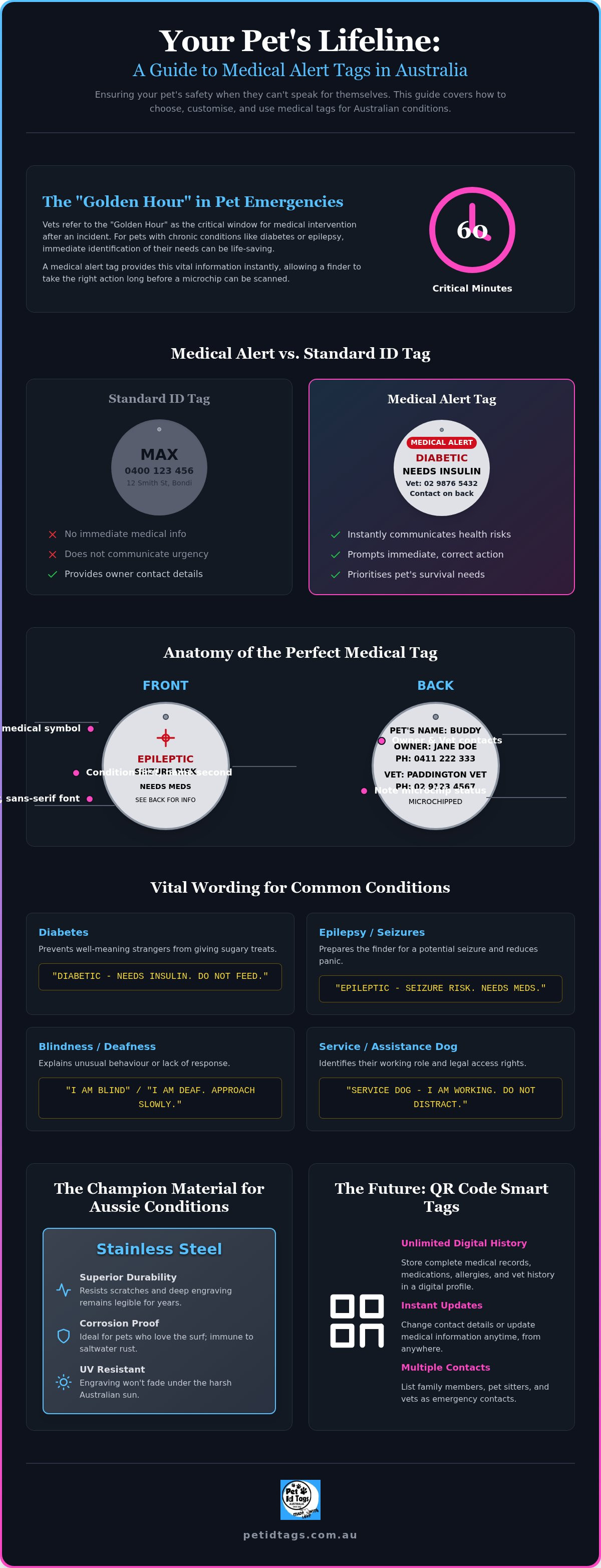
Vets often talk about the "Golden Hour" in emergency medicine. This is the narrow window of time where medical intervention is most likely to prevent a permanent or fatal outcome. For a diabetic dog or a cat prone to seizures, every minute spent at a local park without medication is dangerous. Immediate visibility of their condition allows a Good Samaritan to bypass the usual steps and seek professional veterinary help right away.
While microchipping is a legal requirement across all Australian states, it is a "passive" form of ID. It requires a ranger or vet with a specific scanner to access any data. A Pet tag acts as an "active" alert. It communicates life-saving facts to anyone who finds your pet, long before they reach a facility with scanning equipment. For service animals, these tags also serve a legal purpose, helping to identify the animal's role and specific requirements under Australian disability and access regulations.
The Difference Between Standard ID and Medical Alerts
The primary distinction lies in visual hierarchy and symbolism. Medical alert tags typically feature the universal caduceus symbol or a bold red medical cross to signal priority. On these tags, medical data must come before the pet's name. If a finder sees "DIABETIC - NEEDS INSULIN" at the top of the tag, the urgency is established instantly. Standard tags focus on the owner's contact details, but a medical tag focuses on the pet's immediate survival requirements.
Why Aussie Pets Need Extra Protection
The Australian environment is particularly harsh on pet accessories. Between the intense UV radiation that fades cheap printing and the saltwater that corrodes inferior metals, a medical tag must be exceptionally durable to remain legible. During an Aussie summer, the risk of heatstroke or rapid dehydration is significantly higher for pets on certain medications. If your pet is lost, a clear medical alert ensures they are prioritised for water and cooling, or taken straight to a vet clinic rather than waiting in a council pound where their condition might be missed.
Common Conditions and What to Engrave on Your Pet’s Tag
Engraving a medical tag requires a strategic approach to limited space. You have only a few square centimetres to communicate life-saving instructions. The most effective medical alert pet tags australia prioritise the medical condition over the pet's name. While the Australian Veterinary Association emphasises microchipping for permanent ID, the tag is what tells a finder how to keep your pet alive in the minutes following their discovery. Use the front for the medical alert and the back for secondary contact details and your suburb.
Clarity is your priority. Avoid decorative fonts that are hard to read at a distance or in low light. Stick to bold, sans-serif lettering. If your pet has multiple conditions, use the phrase "NEEDS MEDS" as a universal call to action. This immediately signals to a ranger or vet that there is an underlying health issue requiring professional attention. You can find more layout inspiration in this guide to pet id tag engraving ideas.
Specific Wording for Common Ailments
Different conditions require different responses from a stranger. For a diabetic pet, the tag should read "DIABETIC - NEEDS INSULIN" followed by "DO NOT FEED." This prevents well-meaning finders from giving treats that could spike blood sugar levels. For epilepsy, use "EPILEPTIC - SEIZURE RISK." This prepares the finder for a potential medical event and reduces panic. If your pet is blind or deaf, a simple "I AM BLIND" or "I AM DEAF" explains erratic behaviour or a lack of response to verbal commands, preventing the finder from assuming the pet is aggressive or untrained.
Service and Assistance Dog Identification
For working dogs, the tag is a tool for public access as much as safety. Clearly labelling the tag with "SERVICE DOG" or "ASSISTANCE DOG" helps business owners recognise your pet's legal right to enter premises. Including "DO NOT DISTRACT" or "I AM WORKING" is also helpful to manage public interaction while you are out. These tags must be exceptionally durable to withstand daily work. We recommend choosing high-quality stainless steel tags with deep precision engraving to ensure these critical messages never wear off during your pet's service life.
Stainless Steel vs. Other Materials for Australian Conditions
Material choice for medical alert pet tags australia isn't just about aesthetics; it's a matter of long-term survival. In our climate, a tag must withstand extreme UV radiation, abrasive red dust, and high humidity. Stainless steel stands as the gold standard for durability and legibility. Unlike aluminium, which oxidises and turns a dull grey over time, high-grade stainless steel maintains its structural integrity and polish. Aluminium is a relatively soft metal. The constant friction against a collar or a secondary registration tag will eventually blur the engraving, rendering life-saving medical data unreadable within months.
While silicone or plastic tags are often marketed for their silent properties, they frequently fail the "active dog" test. In the thick scrub of the Australian bush, these materials are prone to snagging, cracking, or tearing away from the collar entirely. For a pet with a chronic condition, a lost tag is a lost lifeline. Deep diamond engraving on a metal surface is far superior to surface-level laser marking. It carves the information into the metal itself, ensuring the text remains visible even if the tag suffers surface scratches from outdoor adventures.
The Saltwater Challenge: Beach-Ready Tags
Coastal living is a hallmark of the Aussie lifestyle, but salt air is ruthless on pet accessories. For beach-loving dogs, 316-grade stainless steel is essential because of its superior corrosion resistance. It won't rust or pit even with daily swims in the surf. Beyond durability, stainless steel is non-porous and hygienic. It doesn't harbour bacteria or odours after a muddy walk, making it easy to clean with a quick rinse. As highlighted in the RSPCA emergency preparedness guide, clear and permanent identification is a cornerstone of pet safety. Understanding why pet id tags fade is the first step in ensuring your medical alert remains legible for the life of your pet.
Weight and Comfort for Smaller Pets
Owners of small breeds or cats often worry that steel is too heavy for their pet's neck. However, choosing the right gauge allows you to balance physical strength with daily comfort. A smaller diameter stainless steel tag provides the same level of protection without the bulk of traditional "military-style" plates. For a noise-free experience, using dog tag quick clips allows the tag to sit flat and reduces the "jingle" that can irritate sensitive ears. While an aluminium tag might last a year in a high-friction environment, a deep-engraved stainless steel tag is a permanent solution that will likely outlast the collar it's attached to.
Smart Tags: The Next Generation of Medical Alert Technology
Traditional engraving is limited by the physical surface area of the tag. For many pets, a name and phone number are sufficient, but for those with chronic illnesses, the space is often inadequate. Smart tags solve this problem by using a QR code that links to a comprehensive digital profile. When looking for medical alert pet tags australia, these digital solutions provide an unlimited repository for medical data that can be updated in real-time. If your pet's insulin dosage changes or they develop a new allergy, you can modify the profile instantly without purchasing a new tag.
One of the most significant safety features of a smart tag is the instant notification system. When a finder scans the QR code with their smartphone, the owner receives an immediate alert. If the finder's phone has location services enabled, this alert often includes a GPS map pin of where the tag was scanned. This provides a layer of security that traditional metal tags cannot match, turning a passive ID into an active tracking tool. It's a proactive way to manage your pet's safety during those first few critical minutes they are missing.
We recommend a hybrid approach to pet safety. A smart tag should still feature a visible medical symbol, such as a caduceus, to signal immediate priority to a finder. This visual cue ensures that a stranger knows to scan the tag for urgent health information rather than assuming it is a standard nameplate. By combining deep-engraved metal with a digital hub, you can manage multiple contacts, including your vet, a trusted neighbour, and yourself, in one accessible location. Protect your pet with a modern solution by browsing our range of smart medical alert tags.
When to Choose a Smart Tag Over Traditional Engraving
Smart tags are ideal for pets with complex medication schedules or those that require specific handling during a seizure. They are also essential for owners who travel frequently across Australia. If your pet gets lost in a different state, a digital profile can provide the contact details of your local vet and any specialists your pet sees. You can explore the future of pet safety with smart tags to see how these devices are evolving to meet modern needs.
Setting Up a Lifesaving Digital Profile
Your digital profile should be as thorough as possible. Include the specific name of medications, precise dosages, and your vet's after-hours contact number. Temperament notes are also vital; if your pet is fearful of strangers or prone to biting when stressed, this information protects both the pet and the finder. Ensure the QR code on the tag is high-contrast and clear. A blurred or faded code is useless in an emergency. The digital interface should also offer a one-tap calling button so the finder can reach you without manually typing in your phone number.
Finding the Right Fit: Sizes, Attachments, and Maintenance
Selecting the correct size for medical alert pet tags australia is a balance between visibility and comfort. A tag that is too large can catch on furniture or become a nuisance for a toy breed, while a tag that is too small might hide critical medical instructions in a dense coat. As a general rule, match the tag diameter to your pet’s collar width. For cats and small breeds like Chihuahuas, a 20mm to 25mm tag is usually ideal. Medium breeds like Kelpies or Border Collies typically suit a 30mm tag, while larger breeds should opt for 35mm or larger to ensure the text remains legible from a standing distance.
Maintenance is just as important as the initial purchase. We recommend performing a "Legibility Check" every six months. Inspect the engraving for any buildup of dirt or red dust that might obscure the letters. If your tag features a red medical alert symbol, keep it bright and visible by cleaning it with mild soap and water. Over time, friction from other tags can cause surface wear; ensuring the medical alert remains the most prominent feature on the collar is essential for your pet's safety.
Secure Attachment Methods
The standard split ring is the most common point of failure for active dogs. These rings can stretch or bend during vigorous play, causing the tag to drop off in the scrub or at the beach. Using a quick clip provides a much more secure connection and allows you to swap tags between different collars or harnesses effortlessly. It's also wise to practice "double-tagging" by keeping your medical alert on a separate ring from council registration tags. This prevents the metal-on-metal clinking that accelerates wear and ensures the medical data isn't obscured by bulky registration plates.
Why Choose Pet ID Tags Australia?
We are an Aussie-owned and operated specialist with over two decades of experience in pet safety. Since 2004, we've focused on providing local pet owners with identification solutions that survive the unique challenges of the Australian landscape. Our precision engraving is designed to be deep and permanent, ensuring your pet's medical needs are clear even after years of exposure to sun and salt. We understand that medical needs are often urgent, which is why we prioritise fast shipping across the country. You can protect your mate with a custom medical alert tag today and gain the peace of mind that comes from professional-grade protection.
Secure Your Pet's Future with Professional Protection
Protecting a pet with a chronic condition requires a communication tool that remains legible in the harshest conditions. You now understand that high-grade 316 stainless steel is the professional choice for durability, especially for beach-loving dogs that frequent the surf. By prioritising specific medical instructions and using secure attachment methods like quick clips, you significantly increase the chances of a safe return during an emergency. These medical alert pet tags australia are a small investment that provides a permanent voice for your non-verbal companion.
We have been trusted by Aussie pet owners since 2004 to deliver high-quality, dependable identification. Our tags are deep-engraved for lifetime legibility, ensuring your pet's vital health data never fades under the intense summer sun or rubs off during play. Order your durable Stainless Steel Medical Alert Tag today and enjoy the peace of mind that comes from professional-grade safety. Your pet counts on you to be their advocate; make sure their ID is as resilient and reliable as the bond you share.
Frequently Asked Questions
Do I really need a medical alert tag if my dog is microchipped?
Yes, a medical tag is essential because a microchip is a passive ID that requires a ranger or vet with a scanner. A finder can read a physical tag instantly, allowing for immediate medical intervention during those first critical minutes. This visual alert ensures that life-saving information is accessible to anyone who finds your pet, regardless of whether they have specialised equipment.
What is the most important information to put on a medical pet tag?
The most critical data is the specific medical condition followed by a clear call to action, such as "DIABETIC - NEEDS INSULIN." Prioritise this over the pet's name to establish urgency. Including a primary mobile number is also vital. For complex conditions, consider using medical alert pet tags australia that feature a QR code to link to a full digital medical history.
Can medical alert tags be used for cats as well as dogs?
Absolutely. Medical alert tags are highly recommended for cats, especially those with chronic conditions like hyperthyroidism or severe food allergies. Since cats are often smaller, choose a lightweight stainless steel tag in a 20mm diameter. This provides the necessary durability without being too heavy or bulky for a feline's neck, ensuring they stay protected if they slip outdoors or escape during a move.
How do I stop my pet’s medical tag from jingling and making noise?
You can eliminate noise by using a pet tag quick clip, which allows the tag to sit more securely against the collar. Another option is a silicone tag silencer that fits around the edge of the metal. These solutions prevent the constant clinking against other tags, which is especially helpful for noise-sensitive pets or owners who prefer a quieter household during the night.
Is stainless steel better than plastic for medical tags?
Stainless steel is significantly better than plastic for long-term safety. Plastic tags can become brittle under the harsh Australian sun and are prone to snapping or cracking if caught on a branch. Stainless steel is virtually indestructible and allows for deep engraving that won't wear off. It's the most reliable material for ensuring your pet's medical status remains legible for its entire life.
What should I do if my pet’s medical condition changes?
You must replace a traditional engraved tag as soon as a medical condition or dosage changes to avoid dangerous misinformation. If you use a smart tag, you can simply log into your digital profile and update the details instantly. Keeping this information current is the owner's responsibility and is the only way to ensure a finder can provide the correct assistance in an emergency.
Are these tags waterproof for dogs that love to swim?
High-grade 316 stainless steel tags are completely waterproof and highly resistant to corrosion from saltwater. This makes them the perfect choice for dogs that enjoy swimming at the beach or playing in the surf. Unlike cheaper metals or plated options, stainless steel won't rust or pit, ensuring the medical alert symbol and text stay bright and readable even after daily exposure to the ocean.
How long does it take to get a custom medical tag in Australia?
Local Australian engraving services typically process and ship custom medical alert pet tags australia within one to three business days. Depending on your location, delivery usually occurs within a week via standard post. Choosing a local specialist ensures you receive a high-quality product quickly, which is critical when your pet has an urgent medical need that requires immediate and professional identification.