
If your pet slipped their lead during a walk today, would the person who finds them be able to call you in sixty seconds, or would they have to wait for a vet clinic to scan a microchip the next morning? It's a stressful scenario that every responsible owner shares. You likely understand that while a microchip is a vital backup, it's a silent one. A visible, legible tag is what gets your pet home before the sun goes down.
Many owners worry that their current ID is fading under the harsh Australian sun or find the constant jingling of metal tags a daily frustration. With over 130,000 pets entering Australian shelters annually, a significant portion of those stays could be avoided with clearer identification. This guide explores how the right lost pet prevention tags act as your pet's first line of defence to guarantee they return home safely and quickly.
We'll preview the most durable materials for the 2026 climate, explain how to stay compliant with local council laws, and help you find the peace of mind you deserve during every off-lead adventure.
Key Takeaways
- Understand the "Golden Hour" of recovery and why a visible tag is the fastest way to get your pet home before they ever reach a shelter.
- Learn how to select materials that withstand the Australian sun and salt, ensuring your lost pet prevention tags remain readable for years.
- Discover the benefits of smart tags, which allow you to update your contact details instantly via a digital profile without needing a new physical tag.
- Find out the essential data points to engrave, balancing local council requirements with the need for a finder to contact you immediately.
- Explore secure attachment solutions that prevent your pet's ID from being lost during off-lead exercise or rough play in the bush.
The First Line of Defence: Why Visible ID Tags Are Essential
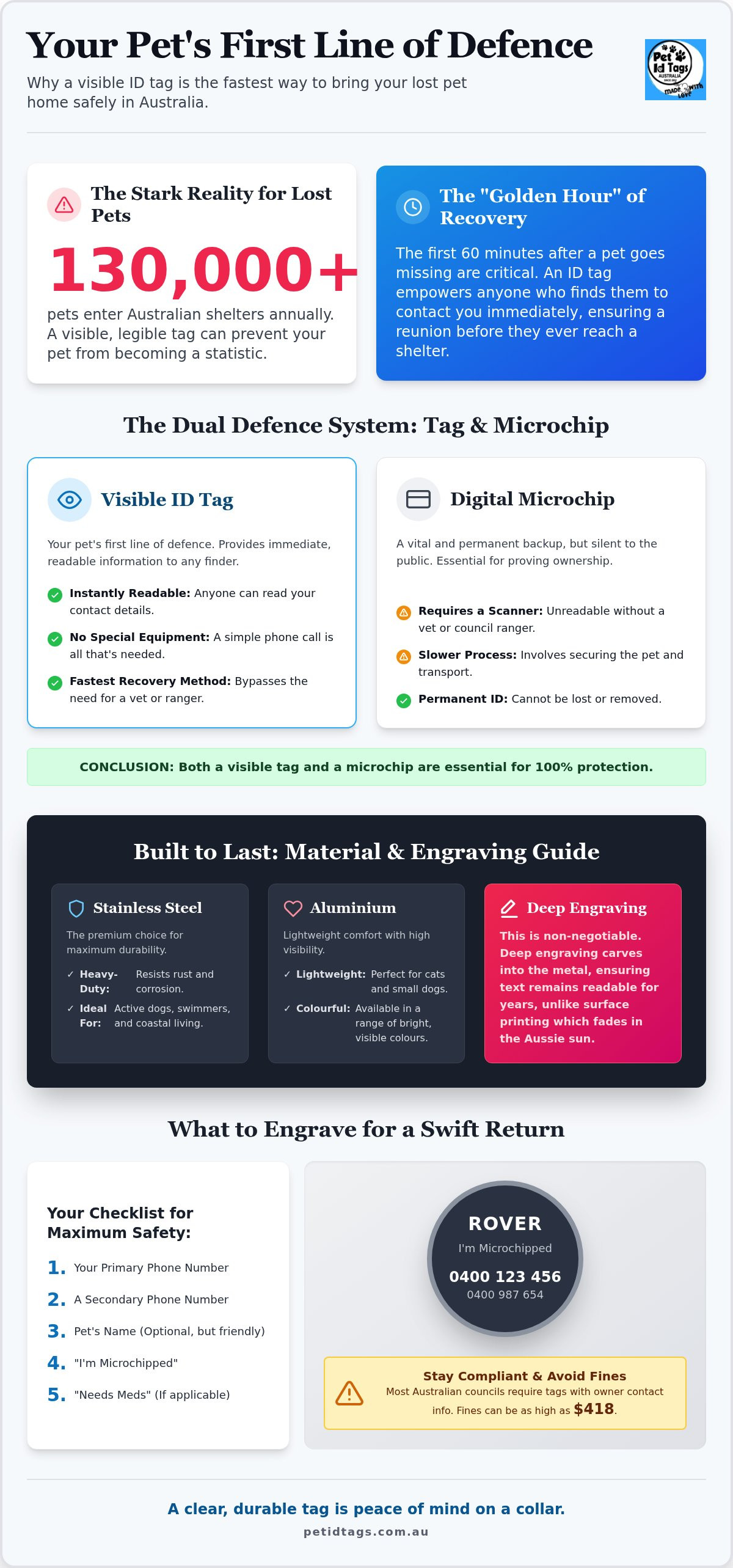
A high-quality identification tag is more than just a piece of metal; it is the immediate visual link between a lost animal and their family. While modern technology offers various tracking solutions, lost pet prevention tags serve as the first line of defence in the real world. They provide a clear, readable signal to any passerby that a pet has a home and a person waiting for them. This visibility is crucial during the "Golden Hour" of pet recovery. This refers to the critical first sixty minutes after a pet goes missing, when the chances of a local, community-based reunion are at their highest. If a neighbour can read your phone number directly from a collar, your pet avoids the stress of a night in the pound.
In 2026, visible identification remains the most efficient method for reuniting pets with their owners because it bypasses the need for specialised equipment or third-party intervention.
Visual ID vs. Digital Microchips
Relying solely on a microchip creates a bottleneck in the recovery process. While a chip is a permanent, internal record, it is essentially silent to the average person who finds your dog in the park. A stranger cannot read a microchip. They must secure the animal, find transport, and locate a vet or council ranger with a compatible scanner. This process takes time and resources that many well-meaning citizens might not have. The Role of Traditional Pet Tags is to provide that data instantly. When you use both a chip and a physical tag, you achieve 100% coverage. You can read more about why this dual approach is vital in our guide on Pet tag vs microchip Australia.
The Legal Requirement for Aussie Pets
Beyond safety, there's a matter of compliance. Most Australian councils require dogs and cats to wear a collar and tag inscribed with the owner's contact details whenever they're in a public place. Failing to meet these standards can lead to significant fines. For instance, some local councils have set fines for failing to register a pet as high as $418 for the 2026-2027 period. High-quality lost pet prevention tags help you stay on the right side of local laws while protecting your bank account from pound release fees. With over 130,000 pets entering Australian shelters every year, a readable tag is your best tool to ensure your pet isn't just another statistic. Always ensure you update your details immediately if you change your mobile number or move house to maintain this protective barrier.
Choosing the Right Material for Long-Term Readability
The Australian environment is notoriously tough on hardware. Intense UV radiation and corrosive salt air often cause cheap tags to fail within months. If the text wears away, the tag is useless. Choosing the right material for lost pet prevention tags is a technical decision that directly impacts your pet's safety. Deep engraving is the only way to ensure permanent legibility. Unlike surface printing or laser etching, deep engraving carves information into the metal. This ensures the data remains readable even after years of rough play and exposure to the elements.
When selecting a tag, consider your pet's lifestyle and size. The best material for a coastal-dwelling Labrador will differ from what works for an indoor cat. Here is a quick guide to the most durable materials available in 2026:
- Stainless Steel: The premium choice for large, active dogs and coastal living.
- Aluminium: The ideal lightweight solution for cats, small dogs, and high-visibility colour.
- Deep Engraving: A non-negotiable feature for all materials to prevent text fading.
Stainless Steel Dog Tags: The Heavy-Duty Choice
For dogs that spend weekends at the beach or trekking through the bush, stainless steel is the premium option. It offers unmatched resistance to rust and corrosion. Whether your mate is a regular swimmer or a rough-and-tumble explorer, this material maintains its integrity. It's physically strong and won't bend or snap under pressure. This durability is a core part of following a responsible pet ownership guide, ensuring your contact details remain accessible in any weather. You can explore our detailed breakdown of Stainless steel dog tags Australia to see why it remains the gold standard for active pets.
Aluminium Tags for Comfort and Visibility
Smaller breeds and felines need a different approach. Aluminium is significantly lighter than steel, making it ideal for pets that find heavy tags uncomfortable. It doesn't jingle as loudly, which is a relief for quiet households. One of the biggest advantages of aluminium is the variety of vibrant colours available. A bright tag helps identification stand out against dark or thick fur. When selecting a tag, ensure the size matches your pet's frame. A tag that is too large can catch on furniture, while one that is too small might be hard to spot in an emergency. If you want a lightweight solution that doesn't compromise on quality, our high-grade aluminium range provides the perfect balance of style and function.
Smart Pet Tags: The Next Evolution in Lost Pet Prevention
Traditional engraved tags have been the standard for decades. However, the rise of smart technology has introduced a more dynamic layer to lost pet prevention tags. Unlike a static piece of metal, a smart tag acts as a gateway to a digital profile that you control. This means if you change your mobile number or go on holiday, you can update your contact details instantly without ordering a new tag. It's a flexible solution for modern pet owners who value speed and adaptability. You can even find innovative options from Curb Samaritan that use QR-code stickers to enable secure, anonymous text alerts if your pet is found.
Privacy is another major advantage. You might not want your full home address engraved for everyone to see. With a smart tag, you choose exactly what information is visible to a finder. When a finder scans the QR code on your pet's tag, the system can send you an immediate notification, often including a GPS location based on the scanner's phone position. This provides a real-time lead that traditional tags simply cannot offer.
The recovery process is straightforward for any stranger with a smartphone. They simply scan the code, view your pet's secure profile, and tap a button to call you. This is particularly useful for pets with complex needs. You can store medical alerts, dietary requirements, or even behavioural notes that a finder needs to know immediately. For a deeper dive into the technical specs, check our Smart pet tags Australia guide.
Traditional vs. Smart Tags: Which Should You Choose?
One common concern with pet tech is battery life. Unlike GPS collars that require frequent charging, smart tags are passive devices. They don't have batteries and won't fail when you need them most. They're as reliable as a standard tag but with significantly more data capacity. However, they do rely on mobile reception to access the digital profile, which is something to consider if you live in a remote area.
The ultimate setup for 2026 is a hybrid approach. We recommend a tag that features your pet's name and your primary phone number deeply engraved, alongside a QR code for the digital profile. This ensures that even in areas with zero reception, a finder can still reach you. If they are in a 5G zone, they get the full benefit of the medical data and GPS alerts. It's the most reliable way to use lost pet prevention tags to ensure a rapid recovery regardless of where your pet wanders.
What Information Should You Engrave for Maximum Safety?
Deciding what to carve into your pet's ID is a balance between providing enough data for a quick return and keeping the text large enough to read. The primary goal of lost pet prevention tags is to facilitate an immediate phone call. In a high-stress situation where a stranger finds a roaming dog, they need to see a number clearly without squinting. Overcrowding a small surface area with too many lines of text often leads to a smaller font size, which can become illegible over time. Focus on the most critical details first.
If you travel frequently with your pet, including a secondary contact number is a strategic move. This ensures that if you are out of range or your phone is flat, a friend or relative can take the call. Additionally, for pets with chronic conditions, a brief note like "Needs Meds" can be a lifesaver. It signals to the finder that time is of the essence, prompting them to act with more urgency than they might for a healthy animal.
The Essential Engraving Checklist
Your engraving should serve as a clear directive for the finder. We recommend following a structured approach to ensure nothing vital is missed. You can find more inspiration in our Pet ID tag engraving ideas guide. At a minimum, your tag should include:
- Pet's Name: This helps the finder calm the animal and build trust during the recovery process.
- Primary Mobile Number: Always include the area code if you are crossing state lines or travelling.
- "I am Microchipped": This informs the finder that a permanent record exists and acts as a deterrent to potential thieves who know the pet is easily traceable.
Privacy vs. Safety: What to Leave Off
There is an ongoing debate among Aussie pet owners regarding home addresses. In 2026, many professionals suggest leaving the full address off for privacy reasons. A phone number is usually sufficient for a rapid reunion. Similarly, your own name takes up valuable space that could be used for a second phone number or a medical alert. By prioritising direct contact methods, you keep your personal data secure while ensuring your pet has the best chance of a swift recovery. If you're ready to secure your pet's future, you can order your deep-engraved tags here to ensure permanent legibility.
Secure Attachment: Preventing Tag Loss Before It Happens
A high-quality tag is only as effective as the hardware that keeps it attached to your pet. Many owners invest in premium lost pet prevention tags but overlook the split ring or clip that secures them. If a tag falls off during a vigorous bushwalk or a rough-and-tumble session at the dog park, it cannot do its job when your pet actually wanders off. Standard split rings are often the primary failure point. Over time, these rings can stretch or lose their tension; this is especially common if they catch on low-hanging branches or thick undergrowth. Ensuring the tag remains secure is a critical part of your pet's safety strategy.
For working breeds or large, active dogs, the force exerted during play can easily snap or deform a flimsy attachment. You need hardware that matches the durability of the tag itself. A secure connection provides peace of mind during off-lead exercise, knowing that your pet's primary link home is locked in place.
Quick Clips and Secure Fasteners
One of the most practical solutions for active owners is the use of heavy-duty fasteners. These are designed to withstand significant pull force without failing. If you frequently switch between different harnesses for walks and collars for home use, a dedicated clip is a game-changer. It allows you to move your pet's ID instantly while maintaining a secure connection. You can read more about selecting the right hardware in our guide to the best Dog tag quick clip Australia has to offer.
Stopping the Jingle: Silent Tag Solutions
The constant clinking of metal tags can be a major household annoyance; it also signals a risk of the tags rubbing together and wearing down the engraving. You can organise multiple tags by using silence-focused attachments or by choosing a different approach altogether. Integrated identification is a rising trend for 2026. By using Personalised dog collars Australia, you remove the need for hanging hardware entirely. The information is embroidered or engraved directly onto the collar strap. This silent, secure method ensures that your lost pet prevention tags or integrated details stay exactly where they belong, no matter how fast your mate runs.
Securing Your Pet's Future for Every Adventure
Rapid recovery depends on the immediate visibility and permanent legibility of your pet's identification. By choosing high-grade materials like stainless steel and prioritising deep engraving, you ensure your contact details survive the toughest Aussie conditions. High-quality lost pet prevention tags bridge the gap between a lost pet and a swift reunion, acting as a reliable shield when microchips alone cannot provide an instant answer. Every detail, from the data you engrave to the secure attachment hardware you choose, works together to protect your mate during their daily explorations.
Since 2004, we've helped thousands of Aussie pet owners maintain this vital safety net with precision craftsmanship and dependable results. Our tags are deep-engraved for lifelong readability and are supported by fast shipping across Australia. Don't wait for an emergency to discover your pet's ID has faded or fallen off. Take the proactive step to guarantee they always have a clear ticket home. Browse our range of durable, Aussie-made pet ID tags today and enjoy the peace of mind that comes from professional-grade protection.
Frequently Asked Questions
Do I really need an ID tag if my pet is already microchipped?
Yes, a visible tag is essential because it enables a finder to reach you instantly. While microchips are a vital permanent backup, they require a trip to a vet or council facility for scanning. This delay can turn a quick reunion into an overnight stay at a shelter. High-quality lost pet prevention tags ensure that anyone with a phone can return your pet within minutes of finding them.
What is the most durable material for a dog that loves the beach?
Stainless steel is the gold standard for pets that spend time in salt water. Unlike cheaper metals that rust or pit when exposed to the ocean, high-grade stainless steel maintains its structural integrity and finish. It is physically tougher than other materials, ensuring the tag remains legible even after years of beach trips and bushwalks. This durability makes it the most reliable choice for active Australian dogs.
What should I put on my pet’s ID tag to keep them safe?
You should prioritise your mobile number, the pet's name, and a "microchipped" label. Including an area code is a smart move if you travel between states. Some owners also add a secondary contact number or a brief medical alert like "Needs Meds" if the pet has health issues. Keep the information concise to ensure the font size remains large enough for a stranger to read quickly in low light.
Can I use a smart tag alongside a traditional engraved tag?
Using a hybrid system provides the most comprehensive security for your pet. A traditional engraved tag offers immediate contact details even in areas with no mobile reception. Adding a smart tag allows finders to access digital profiles with medical data or dietary needs via a QR code. This combination ensures that you benefit from both physical durability and modern digital features, creating a robust safety net for your mate.
How do I stop my dog’s ID tags from jingling all the time?
You can eliminate noise by using personalised collars where the identification is embroidered or engraved directly onto the strap. Another option is using a quick clip to keep the tag securely positioned or choosing a silent tag silencer. These methods prevent metal-on-metal contact, which is the primary cause of jingling. Silent solutions are perfect for indoor environments where constant noise can be a distraction for the entire household.
Are aluminium tags strong enough for large, active dogs?
Aluminium is a durable, lightweight option, but stainless steel is the superior choice for heavy-duty use. Large breeds that engage in rough play or bush exploration exert significant force on their gear. While aluminium is excellent for its weight advantage and vibrant colours, stainless steel provides the physical strength needed to resist bending or snapping. We generally recommend steel for any dog that regularly tests the limits of their accessories.
How often should I check or replace my pet’s identification tag?
You should inspect your pet's identification hardware at least once a month. Check the split ring or clip for signs of stretching or weakness, as these are common failure points. Look closely at the engraving to ensure the text hasn't been obscured by scratches or dirt. Regular maintenance prevents the tag from being lost before an emergency happens, ensuring your mate always has their primary ticket home securely attached.
Will the engraving on my pet’s tag fade over time?
Surface-etched or printed tags will eventually fade due to friction and UV exposure. However, deep engraving carves the information into the metal itself, ensuring it remains readable for the life of the tag. This process is specifically designed to withstand the harsh Australian climate. Choosing deep-engraved lost pet prevention tags means you won't have to worry about your contact details disappearing when they are needed most during a recovery.