

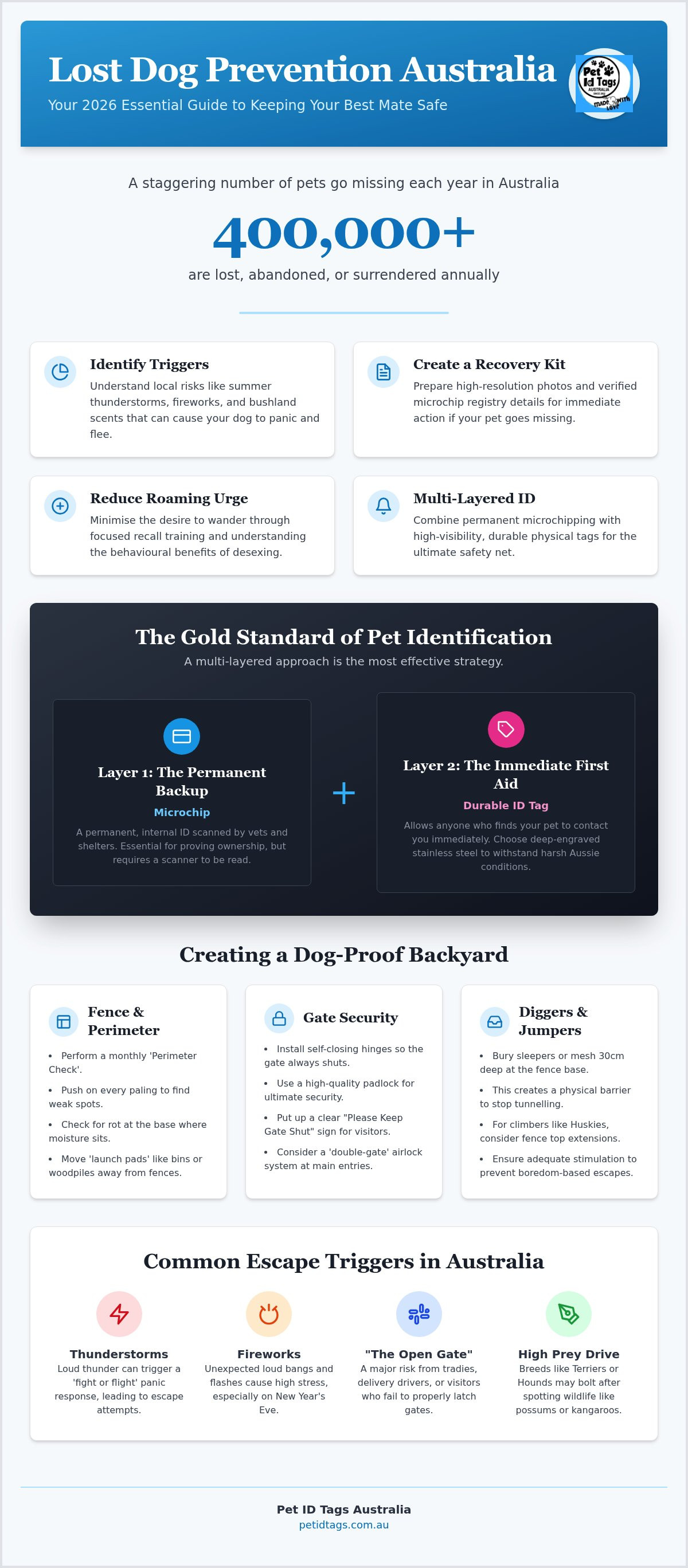
Over 400,000 animals are lost, abandoned, or surrendered across Australia every single year. It's a staggering figure that underscores the constant risks our pets face in both suburban and rural environments. Whether it's a sudden summer thunderstorm spooking your mate or a tradie accidentally leaving the side gate unlatched, the threat of a missing pet is a genuine source of anxiety for any owner. Effective lost dog prevention australia requires more than just luck; it demands a proactive and durable approach to safety.
We understand that you want absolute peace of mind regarding your dog's security. You need a system that remains functional even in the harshest conditions, from a secure backyard to identification that won't become unreadable after a run through the scrub. This 2026 essential guide provides the most effective strategies and high-quality gear to keep your best mate safe and prevent the heartbreak of a lost dog. We will preview the latest in smart tag technology, explain the current state registration requirements, and show you how to choose hardware that survives the toughest Australian conditions.
Key Takeaways
- Identify common local triggers like summer thunderstorms and bushland scents to better fortify your home's perimeter against escape attempts.
- Master the essentials of lost dog prevention australia by using a multi-layered approach that combines permanent microchipping with high-visibility physical identification.
- Discover why professional-grade materials like deep-engraved stainless steel provide a permanent safety solution that survives the harsh Aussie bush.
- Minimise the urge to roam through focused recall training and by understanding the behavioural benefits of desexing your pet.
- Prepare a rapid recovery toolkit including high-resolution photos and verified registry details to ensure immediate action during high-stress events.
Why Do Dogs Go Missing? Understanding the Australian Context
Even the most loyal kelpie or pampered pug can find themselves on the wrong side of the fence. Identifying why pets wander is the first step in effective lost dog prevention australia. Often, it isn't a lack of loyalty but a series of environmental or biological triggers that override their training. We see it happen every day. A dog spots a scent, hears a noise, or simply finds an unexpected exit, and suddenly they are blocks away from safety.
The "Open Gate" syndrome is a major contributor to missing pet reports in suburban areas. This happens when a tradie comes to fix a tap, a delivery driver leaves a parcel, or a visitor fails to click the latch properly. It only takes a few seconds for a curious dog to slip through. Boredom and separation anxiety also play significant roles. If a dog isn't mentally stimulated, they'll often create their own entertainment, which frequently involves finding a way out of the yard to explore the neighbourhood.
Environmental Triggers in Australia
The Australian summer storm season is a peak period for animal shelters and rescue groups. The sharp crack of thunder and the static in the air can trigger an intense "fight or flight" response. This panic often leads to pets jumping high fences or digging under gates they've never challenged before. Similarly, New Year's Eve and local community fireworks displays create a high-stress environment. Understanding dog behavior during these events is crucial for keeping them grounded. We also see a spike in lost dogs when families move to a new house or stay in an unfamiliar holiday rental. The lack of familiar boundaries makes it incredibly easy for a dog to become disoriented and lose their way back to a temporary home.
Breed-Specific Roaming Tendencies
Some dogs are simply built for the chase. High-prey drive breeds, such as Sight Hounds or various Terriers, can bolt in a heartbeat if they spot a stray kangaroo or a possum skittering across a fence line. In these high-adrenaline moments, even reliable recall training can fail as instinct takes over. Then there are the "Houdini" breeds. Certain working dogs and Huskies are notorious for their ability to climb chain-link fences or systematically dismantle a loose paling. These dogs don't just wander; they actively problem-solve their way out of confinement. Recognising these specific traits allows you to tailor your lost dog prevention australia strategies to your dog's unique personality and physical capabilities.
Securing Your Property: Creating a Dog-Proof Backyard
A secure yard is your primary line of defence. While we often focus on what happens once a dog is out, effective lost dog prevention australia starts with ensuring they never leave the property. Most escapes aren't planned; they're opportunistic. A loose paling or a gate that doesn't quite latch is all a curious mate needs to go wandering. You should perform a "Perimeter Check" at least once a month. Walk the entire length of your fence and apply pressure to every individual paling. Check for rot at the ground level where moisture sits, as this is where wood often fails first.
For the determined diggers, a standard fence isn't enough. You can reinforce the base by burying heavy-duty sleepers or galvanised wire mesh at least 30 centimetres deep. This creates a physical barrier that stops them from tunnelling out. Similarly, jump-proofing requires a critical look at your yard's layout. Many dogs don't jump the fence from a standing start; they use "launch pads" like wheelie bins, woodpiles, or garden benches positioned too close to the boundary. Move these items to the centre of the yard to remove the height advantage.
Gate security is often the weakest link. We recommend installing self-closing hinges and a high-quality padlock. This ensures that even if you forget to click the latch, gravity does the work for you. It's a simple, set-and-forget upgrade that provides immediate peace of mind.
The Tradie and Delivery Factor
Unexpected visitors are a major risk. If your property allows for it, set up a double-gate "airlock" system at your main entry point. This ensures there's always one closed barrier between your dog and the street, even when a delivery driver is at the door. Clear signage is also vital. A simple "Please keep gate shut" sign acts as a constant reminder for tradies and visitors who might not be as pet-conscious as you are. Many owners now use smart doorbells to monitor entry points, allowing them to check if a gate was left open after a service call-out.
Safe Enclosures for High-Stress Times
During extreme weather or local fireworks, the safest place for your dog is inside the house. Create a dedicated "safe zone" in a central room away from windows to dampen the sound of thunder. If your dog spends long periods outside while you're at work, a purpose-built dog run offers a secondary layer of containment within your yard. For added security during supervised outdoor play or training sessions, using a personalised dog harness ensures they stay comfortably under your control. Even in a secure yard, it's wise to ensure they're wearing a durable stainless steel tag just in case the unthinkable happens.
The Gold Standard of ID: Microchips and Durable Tags
While microchipping is a legal requirement in most Australian states, it is only half of the safety equation. A microchip is an invisible form of security. It requires a vet or a ranger with a specialised scanner to read the data. This creates a delay in the recovery process. The true backbone of lost dog prevention australia is the combination of a permanent microchip and a high-visibility physical ID tag. A physical tag provides an immediate "Visual ID" advantage. It allows a neighbour or a passerby to call you the moment they find your dog, often resolving a stressful situation in minutes rather than hours.
The information you choose to include on a tag is critical. At a minimum, you should list two different phone numbers. Including a clear alert such as "I am Microchipped" serves as a secondary warning to anyone who finds your dog that permanent identification is also in place. However, the most important factor is legibility. Many owners opt for cheap plastic or surface-printed tags that quickly succumb to the brutal Australian sun. When the text fades or the plastic snaps, your dog's best chance of a quick return vanishes. You need a solution that remains readable through years of exposure to UV radiation, salt water, and rough play.
Why Stainless Steel is the Ultimate Choice
When it comes to longevity, material selection is everything. We recommend stainless steel dog tags for their extreme resistance to the elements. Unlike softer metals, stainless steel doesn't corrode when exposed to salt spray or beach sand. The key is deep-engraving. While surface printing or laser marking can wear away over time, deep-engraving physically carves the information into the metal. This prevents the "faded tag" problem entirely. While aluminium is light, stainless steel offers a lifetime of readable security. It is a "set and forget" safety measure that ensures your contact details are always available when they are needed most.
Next-Gen Security: Smart Pet Tags
As we move into 2026, technology is playing a larger role in lost dog prevention australia. Many owners are now upgrading to smart pet tags that utilise QR codes for rapid recovery. When a finder scans the tag with a smartphone, they are instantly directed to a digital profile containing your dog's medical needs, temperament, and multiple contact points. Some systems even send a GPS location ping to your phone the moment the tag is scanned. However, even with these digital advances, the engraved vs printed pet tags debate remains vital. A smart tag should always be backed up by a deep-engraved phone number to ensure your dog can be identified even in areas with poor mobile reception.
Training and Lifestyle: Reducing the Urge to Roam
Prevention isn't just about the physical barriers we discussed earlier. It's also about your dog's mental state and their response to your commands. A dog that is bored, frustrated, or driven by hormones is far more likely to test the limits of your backyard security. Integrating specific training techniques into your daily routine is a cornerstone of lost dog prevention australia. It builds a reliable bond that ensures your mate stays by your side even when distractions arise. To help strengthen this bond, you can find out more about professional training and walking services that focus on safety and engagement.
The most powerful tool in your arsenal is a rock-solid recall. Training your dog to come back every single time you call is a non-negotiable safety skill. Start in a low-distraction environment and use high-value rewards like premium pet treats to reinforce the behaviour. Similarly, mental stimulation is vital for preventing boredom-based escapes. Dogs that aren't challenged often turn to digging or fence-climbing for entertainment. Using puzzle toys and interactive feeders keeps their minds occupied and reduces the desire to go searching for excitement elsewhere.
Lead Safety and Management
Even the most well-trained dog should only be off-lead in designated, secure areas. High-distraction environments like busy parks or street corners present too many variables for total safety. We advise caution with retractable leads. These often provide a false sense of control and can break under the tension of a sudden bolt. For owners who use multiple sets of gear, a dog tag quick clip is an essential accessory. It allows you to swap your durable ID tag between different collars or harnesses in seconds, ensuring your dog is never without identification regardless of the activity.
The Importance of Desexing
Biological drives are a leading cause of roaming behaviour in Australia. Statistics consistently show that intact males are significantly more likely to wander in search of a mate compared to desexed dogs. By desexing your pet, you effectively remove the hormonal urge to roam, making them more content to stay within their home boundaries. Beyond lost dog prevention australia, desexing offers long-term health benefits, including a reduced risk of certain cancers. We recommend consulting your local vet to determine the best timing for the procedure based on your dog's specific breed and development. Keeping your mate safe is a full-time commitment. Ensure they are always wearing a personalised dog collar with deep-engraved details to guarantee a swift return if they ever do manage to slip away.
Preparing for the Unexpected: Your Rapid Recovery Toolkit
Even with the most robust fences and focused training, life remains unpredictable. A gate can be left ajar by a meter reader, or a dog might find a way out during a particularly severe storm. Being prepared for these specific moments is the final, vital pillar of lost dog prevention australia. Proactive preparation ensures that if your mate does go missing, you aren't wasting precious time trying to find old photos or contact numbers. You can act immediately with a clear head.
Your recovery toolkit should be ready well before you ever need it. Ensure you have current, high-resolution photos of your dog from both the front and side profile. These are essential for identifying unique markings or coat patterns that a standard description might miss. You must also verify your microchip registry details. A microchip is a permanent link, but it's completely useless if it's connected to an old mobile number or an address you left three years ago. Finally, pre-emptively join local "Lost and Found" social media groups for your specific suburb. Having these resources at your fingertips can shave hours off the recovery time.
The First 60 Minutes: An Action Plan
The first hour after a dog goes missing is critical. Don't panic; follow a structured plan to maximise your chances of a quick return. First, perform a thorough search of your home and immediate neighbourhood. Check under beds, behind sheds, and inside garages. Sometimes they are closer than you think. Second, contact your local Council and every vet clinic within a ten kilometre radius. Finders often drop pets at the nearest vet rather than waiting for a ranger. Third, post to those social media groups you joined. Include a clear photo, the exact location where they were last seen, and your best contact number. Speed and visibility are your greatest assets in these early stages.
Why Traditional ID Wins in a Crisis
While digital recovery tools are advancing, traditional identification remains the most effective way to get a dog home. This is due to the "Good Samaritan" factor. Most people who find a wandering dog aren't rangers or vets; they are neighbours. Their first instinct is to check the collar for a phone number. If they can call you instantly, your dog stays off the street and out of the pound system. This early protection is especially important for young pets. Using a high-quality puppy id tag ensures your newest family member is protected from the very first day they arrive home. For lost dog prevention australia to be truly effective, that tag must be securely attached and the engraving must remain legible regardless of the weather. A durable, deep-engraved tag is the simplest and most reliable insurance policy you can provide for your best mate.
Securing Your Mate's Future with Proactive Safety
Effective lost dog prevention australia is built on a foundation of multiple layers. By reinforcing your backyard perimeter, maintaining consistent recall training, and ensuring your contact details are always current, you significantly reduce the risk of a missing pet. These practical steps transform a stressful "what if" into a manageable system of security that works even when you aren't home. Consistency is key; a small check of a gate latch today can prevent a heartbreak tomorrow.
High-quality hardware is the final, essential piece of this safety puzzle. You need identification that withstands the unique challenges of the Australian climate. With over 20 years of local expertise, we specialise in precision deep-engraving that never fades. Whether your dog is navigating thick scrub or a coastal beach, our tags remain perfectly legible and securely attached. We provide fast, local shipping across Australia to get your safety system up to speed immediately. Secure your mate with a durable Stainless Steel ID Tag today. You've done the hard work of building a safe home; now ensure your dog always has a reliable way back to it.
Frequently Asked Questions
What is the most common reason dogs get lost in Australia?
The most common reasons for dogs going missing are opportunistic escapes through unsecured gates and fear-based flight during environmental triggers. In the Australian context, this often involves a gate left open by a tradie or a dog jumping a fence during a sudden summer thunderstorm. These events bypass standard training, making physical property security the first line of defence in lost dog prevention australia.
Is a microchip enough to find my lost dog?
A microchip is a vital permanent identification method, but it isn't enough on its own. A microchip is invisible and requires a vet or ranger with a specialised scanner to read the data. This creates an unnecessary delay. A physical ID tag allows a neighbour to contact you the moment they find your dog, providing the fastest possible recovery without the need for professional intervention.
What should I put on my dog’s ID tag for the best chance of recovery?
For the best chance of a quick return, your dog's tag should include at least two current phone numbers and a clear "I am microchipped" alert. This informs the finder that permanent ID is also available. If your dog has a medical condition or is anxious, adding a brief note like "Needs Meds" or "I am Nervous" provides critical context for the person who finds them and ensures they are handled correctly.
Do I need to register my dog with the local Council?
Yes, dog registration is a mandatory legal requirement across most Australian states and territories. While microchipping is a national identification system, council registration is a local government requirement that funds animal management services. Fees vary significantly; for the 2026 period, registration for a desexed dog typically ranges from $15 to $55, though it is currently free in the City of Melbourne and costs $69 in the City of Sydney.
How often should I check my dog’s ID tag and collar?
You should inspect your dog's ID tag and collar at least once a month. Look for signs of wear on the buckle and ensure the engraving on the tag remains deep and legible. Cheap materials often fade or snap under the harsh Australian sun. Checking for physical integrity ensures your mate's primary safety system is always functional and ready for an emergency.
Can a GPS tag prevent my dog from getting lost?
A GPS tag is a useful tracking tool, but it doesn't actually prevent a dog from escaping. These devices rely on battery life and mobile signal, which can fail in remote areas or during extended periods away from home. GPS should always be viewed as a secondary layer of security that complements a permanent microchip and a durable, deep-engraved physical tag.
What do I do if I find a lost dog in my neighbourhood?
If you find a wandering dog, your first step should be to check their collar for a physical ID tag. This is the most efficient way to contact the owner directly. If the dog has no tag, take them to a nearby veterinary clinic or contact your local council ranger. They can scan for a microchip and begin the formal recovery process through the relevant state registry.
Why do dogs run away during thunderstorms?
Dogs often bolt during thunderstorms due to an intense panic response triggered by loud noises and changes in barometric pressure. This "fight or flight" instinct can drive even a calm dog to jump high fences or dig under gates to find a safe hiding spot. Understanding this behaviour is a key part of lost dog prevention australia, requiring owners to provide a secure indoor space during extreme weather events.