
A pet tag isn't just a fashion accessory; it's a critical safety device that must remain legible under the harshest Australian conditions. If your dog gets lost, that small piece of metal is the only thing standing between a quick phone call and a stressful trip to the local pound. You likely know the frustration of tags that fade after a few trips to the beach or thin materials that jingle incessantly with every step. It is a common headache for owners who find their contact details have vanished under the intense sun or corroded in the saltwater.
In this guide, we settle the engraved vs printed pet tags debate by looking at what actually lasts in 2026. You will learn why the choice between surface printing and deep laser engraving determines whether your pet’s ID remains readable when it matters most. We will break down the durability of stainless steel, the risks of printed alternatives, and how to ensure your dog stays compliant with council regulations to avoid hefty on-the-spot fines. It is about more than just aesthetics; it is about the peace of mind that comes from a permanent, no-nonsense safety solution.
Key Takeaways
- Understand the technical difference between surface-level ink and deep physical indentations to make a reliable safety decision for your dog.
- Compare engraved vs printed pet tags to see why deep laser etching is the only method that survives the harsh Australian sun and corrosive saltwater.
- Discover why a high-grade stainless steel tag can provide over a decade of use, whereas printed designs often fade or peel within months.
- Learn how to maintain permanent legibility to ensure your dog remains compliant with local council regulations and stays identifiable in an emergency.
- Identify the specific materials and attachment methods that prevent annoying jingling while keeping your pet’s ID secure during bush walks or beach runs.
Understanding the Basics: What Is the Difference?
Selecting Pet identification tags often feels like a simple choice between a bone shape or a circle. However, the technical reality of the marking process is far more important for your dog's safety. The primary difference in the engraved vs printed pet tags debate lies in how your contact information is bonded to the tag material. Engraving is a subtractive process that creates physical indentations in the metal. Printing is an additive process where ink or dye is applied to the surface. One is a permanent structural modification; the other is a decorative layer that sits on top.
This marking method dictates the "legibility lifespan" of the ID. For Australian pets, this lifespan is tested daily by high UV levels, abrasive sand, and corrosive salt water. If the marking method is weak, the tag will eventually fail. A tag that cannot be read in an emergency is just a piece of scrap metal. Your dog's safety relies on the text surviving years of friction against collars and the elements. We believe a tag should last the life of the pet, not just a single season.
How Engraving Works: Deep Etching vs. Surface Scratching
Not all engraving is equal. Traditional rotary engraving uses a mechanical bit to scratch the surface, which can sometimes be shallow. Modern deep laser etching is the professional standard for durability. This process uses a high-intensity laser to vaporise the metal, creating a dark, high-contrast mark that sits deep below the surface.
We focus on Stainless Steel Dog Tags because of the material's extreme hardness. Unlike softer metals, stainless steel allows for deep-etched marks that won't "mush" or wear down over time. Because the information is physically carved into the industrial-grade steel, it is impossible for the text to rub off. It remains clear even after years of constant movement and contact with other hardware. This is the no-nonsense choice for owners who value long-term reliability over temporary trends.
How Printed Tags Are Made: Sublimation and UV Coating
Printed tags are manufactured using heat-pressed ink (sublimation) or ultraviolet light (UV printing). These methods allow for unlimited colours and intricate patterns. While they look impressive on a shop shelf, they have a built-in shelf life. The ink relies on a thin polymer or clear coat for protection.
This top layer is highly vulnerable to environmental grit and the constant "sandpaper" effect of a dog's coat. Once the protective coating is breached by a scratch or UV degradation, the ink underneath begins to flake. In the Australian sun, the bond between the ink and the tag can break down rapidly. This often results in a tag that becomes unreadable within six to twelve months, leaving your pet without a reliable way home if they ever wander off. While the initial look is vibrant, the functional safety of the tag diminishes the moment it leaves the package.
The Case for Engraved Pet Tags: Built for the Australian Scruff
When comparing engraved vs printed pet tags, the decision usually comes down to environment. For a dog living in the Australian suburbs or rural bushland, a tag is not a decorative trinket. It is a rugged piece of safety equipment. The primary advantage of engraving is its permanence. Because the text is physically carved into the metal, it becomes a structural part of the tag. It cannot peel, flake, or rub off during a high-speed run through thick scrub or a session of backyard wrestling. This fundamental difference in engraved vs printed pet tags ensures your pet is never left without a voice, even years after the tag was first attached.
A professional, deep-etched finish stays crisp and legible regardless of how active your dog is. While printed designs might look vibrant on day one, they quickly lose their clarity under the pressure of daily wear. Veterinary experts emphasize the importance of visible ID tags for immediate recovery, and only engraving provides the high-contrast, permanent marking required for rapid identification in an emergency. Investing in Stainless Steel Dog Tags Australia ensures the metal itself doesn't pit or corrode, keeping the information sharp for the long haul.
Durability in Harsh Conditions
The Australian climate is notoriously tough on pet accessories. Saltwater acts as a powerful solvent for many printed inks, causing them to blur and eventually disappear. Sand and grit act like sandpaper, grinding away at the surface of the tag every time your dog moves. Engraving bypasses these issues entirely. Deep engraving ensures that even if the tag is scratched, the internal shadow of the letter remains readable. This resilience is essential for several reasons:
- Resistance to corrosive sea spray and salt air.
- Immunity to the high UV levels that bleach printed dyes.
- Protection against constant friction from D-rings and collar hardware.
Maintenance and Longevity
Maintaining an engraved tag is remarkably simple. You can scrub away mud, grease, or salt build-up with warm soapy water without any fear of damaging the contact details. There are no delicate coatings to protect or inks to preserve. This ease of care is why long lasting pet id tags are the smarter financial choice. While a printed tag might require replacement every six months due to fading, a high-quality engraved tag often lasts a decade or more. For dogs that spend more time in the surf than on the sofa, choosing high-grade Stainless Steel Dog Tags provides the ultimate security and the best long-term value.
The Truth About Printed Pet Tags: Style vs. Longevity
Printed tags often dominate social media feeds with their vibrant colours and intricate patterns. It's easy to see why owners are drawn to them; they offer a level of customisation that traditional metal cannot match. However, when evaluating engraved vs printed pet tags for real-world safety, aesthetics must take a backseat to utility. The primary issue is that printed designs are essentially a layer of ink sitting on a substrate. In the harsh Australian environment, this layer is under constant attack from external forces.
The visual appeal of these tags is undeniable in a studio photo, but that beauty is often fleeting. While many manufacturers claim their products are durable, the reality is that ink cannot compete with the structural integrity of metal. When you choose a tag, you aren't just buying a nameplate; you're buying an insurance policy for your pet's return. A tag that looks great on day one but becomes a blank disc by day 200 has failed its only job.
The UV and Friction Problem
The Australian sun is particularly brutal on chemical pigments. High UV levels break down the molecular bonds in printed inks, causing colours to shift and fade significantly within a few months. Even tags marketed as "UV stable" often struggle with the intensity of a Queensland summer or a Perth heatwave. This degradation is accelerated by mechanical friction. Every time your dog shakes their head or trots along, the tag strikes the metal D-ring of the collar. This repetitive impact acts like a tiny hammer, chipping away at the printed surface until the text becomes a blurred mess.
This physical deterioration creates a dangerous situation. A tag that has faded into an unreadable state is useless during a critical escape. The importance of pet identification cannot be overstated, yet many owners only realise their printed tag has failed when it is already too late. Relying on a marking method that can literally rub off puts your dog at unnecessary risk. In the engraved vs printed pet tags debate, the science of wear and tear clearly favours the permanent indentation of engraving.
When (if ever) is a printed tag okay?
There are specific scenarios where a printed tag might suffice. If your pet is strictly an indoor cat or a dog that only wears a "Sunday best" collar for supervised photoshoots, longevity is less of a concern. They also work well as temporary IDs for short-term holiday stays where you might need to list a local caravan park address for a week or two.
However, for everyday safety, a printed tag should never be the primary source of information. If you prefer the look of modern tech, consider smart pet tags australia as a secondary layer of protection. These offer digital depth while still requiring a permanent, engraved foundation to ensure your contact details remain readable regardless of how much sun or salt they encounter. It is about building a safety system that works in the real world, not just in a photo.
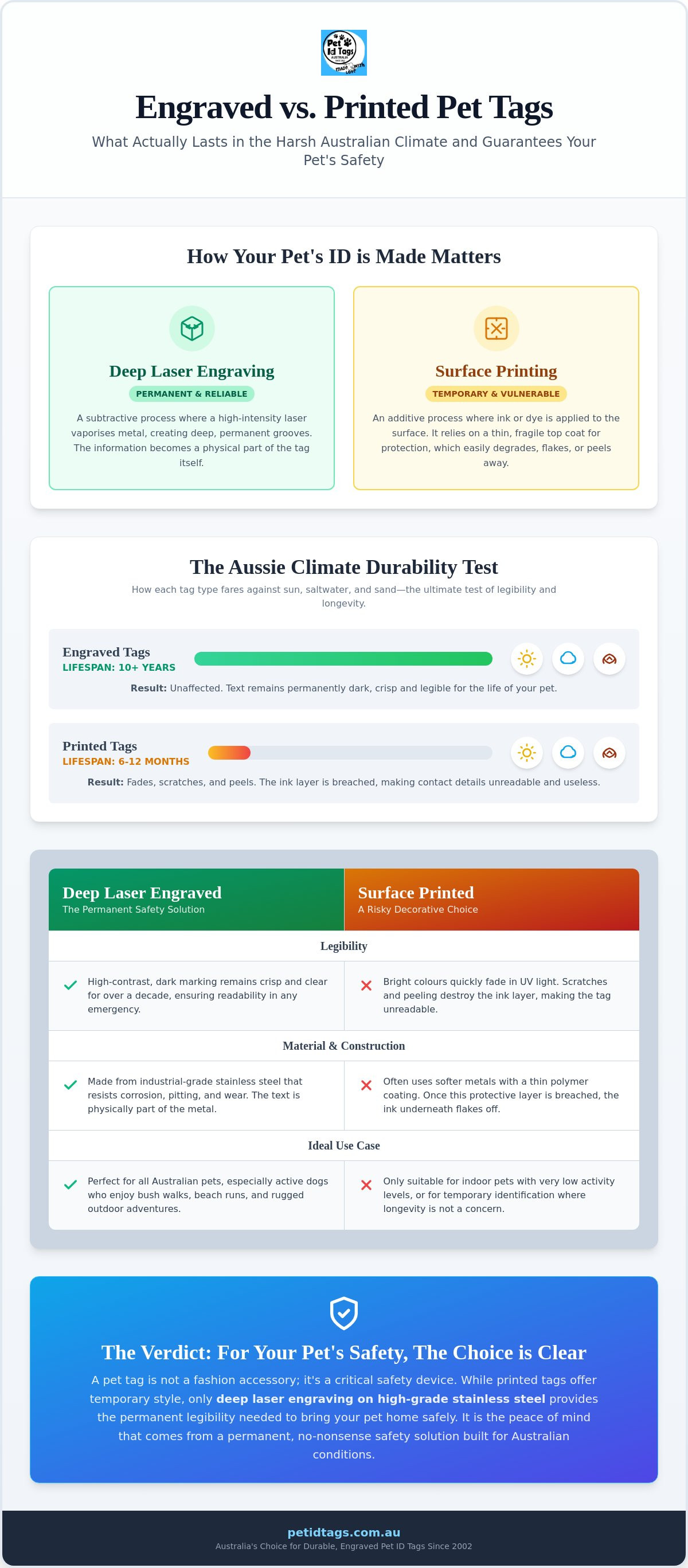
Side-by-Side Comparison: Durability, Legibility, and Value
Choosing between engraved vs printed pet tags comes down to a choice between short-term flair and long-term function. One is a professional safety tool; the other is a decorative trinket. When we look at the data from over 20 years of manufacturing, the performance gap is significant. A tag that looks impressive in a shop window often fails when it meets the reality of an active Australian dog. To help you make an informed decision, we have broken down the primary differences in performance and value below.
- Safety Rating: Engraved (High/Reliable); Printed (Low/Temporary).
- Functional Lifespan: Engraved (5 to 10+ years); Printed (6 to 12 months).
- Legibility: Engraved stays clear through physical depth; Printed fades or peels as the top coat degrades.
- Customisation: Engraved offers a classic, professional aesthetic; Printed allows for full-colour graphics and photos.
- Maintenance: Engraved requires zero upkeep; Printed requires careful cleaning to avoid stripping the ink.
Legibility Under Pressure
Imagine your dog has wandered off during a summer storm. A neighbour or a council ranger finds them, soaked and shivering. In these low-light, high-stress conditions, a printed tag that has begun to fade or peel is nearly impossible to read. Engraving provides a distinct advantage here because it offers tactile readability. Even if the surface is covered in mud or water, the physical indentations remain clear. For the best results, you should follow a few pet id tag engraving ideas to ensure the most critical information is prioritised and easy to scan in an emergency.
The "Jingle" and Material Choice
The material you choose directly impacts how deep the engraving can go. We specialise in Stainless Steel Dog Tags because the material is hard enough to hold a deep-etched mark without warping. Aluminium is a lighter alternative that is excellent for smaller breeds, though it is slightly softer. Regardless of the material, the way you attach the tag matters. Using a quick clip is a smart way to reduce the constant friction between the tag and the collar D-ring. This simple addition helps preserve the finish of your tag and eliminates that annoying metal-on-metal jingling during midnight wanderings.
If you value the safety of your pet and want a solution that won't require replacement every few months, we recommend investing in a permanent solution. You can browse our full range of durable, high-contrast Stainless Steel Dog Tags to find a style that fits your dog's personality while guaranteeing their safety for years to come.
Making the Right Choice for Your Pet’s Safety
The decision between engraved vs printed pet tags is ultimately a choice about safety standards. While a printed tag might offer temporary visual flair, only deep engraving provides the permanent legibility required to bring a lost pet home. We have seen thousands of tags over the years and the results are consistent. Surface-level markings eventually fail under the pressure of the Australian lifestyle. A tag is your pet's first line of defence. While microchipping is a legal requirement across all Australian states, a visible, readable tag is the fastest way for a neighbour or ranger to contact you without needing a scanner.
Before you head out for your next walk, take a moment to inspect your dog's current identification. If the text is fading, the edges are peeling, or the material has worn thin, the tag is no longer doing its job. Use this final checklist to ensure your pet is properly protected:
- Material: Choose high-grade Stainless Steel or Aluminium for corrosion resistance.
- Marking Method: Ensure the text is deep-etched into the metal, not just printed on top.
- Attachment: Use a secure split ring or a specialised quick clip to prevent loss.
- Accuracy: Verify that your phone number and council registration details are current.
Why We Choose Deep Laser Engraving
Pet ID Tags Australia has been a trusted institution since 2004. With over 20 years of specialised experience, we have refined our process to focus exclusively on what works in real-world conditions. Our commitment to deep laser engraving is a no-nonsense choice for safety. We refuse to compromise on legibility for the sake of fleeting fashion trends. This dedication to craftsmanship is backed by our "Happiness Guarantee," ensuring that every tag we produce meets the high standards required for permanent pet safety. We use industrial-grade technology to vaporise the metal surface, creating a high-contrast mark that remains clear for the life of the tag.
Next Steps for Your Pet
Upgrading your dog's ID is a small investment that provides significant peace of mind. Whether you have an active kelpie that loves the bush or a maltese that prefers the suburban pavement, your tag should be built to last. Take the time to choose a material and style that fits your dog's specific lifestyle. Ensure your contact details are up to date and deeply etched into a material that won't fail when it matters most. You can browse our range of durable Stainless Steel and Aluminium tags today to find a permanent safety solution for your pet.
Secure Your Mate’s Future with Permanent Identification
Choosing the right ID is about more than just a name; it is about ensuring your dog can always find their way home. We have seen that while printed designs offer temporary colour, they cannot withstand the relentless Australian sun and surf. Deep laser engraving remains the professional standard because it creates a physical mark that is impossible to rub off. When weighing up engraved vs printed pet tags, the choice for long-term safety and legibility is clear. A tag that survives the scruff is a tag that saves lives.
With 20+ years of engraving expertise, we have already helped protect over 100,000 Australian pets. We don't just sell tags; we provide a Happiness Guarantee on every personalised order to ensure your peace of mind. Check your dog’s tag today and make sure their voice hasn't faded away. Protect your mate with a deeply engraved tag that never fades and rest easy knowing their ID is built to last.
Frequently Asked Questions
Do engraved dog tags eventually wear down?
High-quality engraved tags are designed to last for the life of your pet, though they can experience minor surface wear over many years. When comparing engraved vs printed pet tags, the physical depth of the engraving is what ensures legibility. While soft metals like brass might smooth out over a decade, industrial-grade Stainless Steel Dog Tags hold their deep-etched markings indefinitely. It's a permanent safety solution that resists the friction of daily activity.
Can I get a colourful pet tag that is still engraved?
Yes, you can achieve a vibrant look without sacrificing the permanence of engraving by choosing anodised Aluminium Dog Tags. These tags feature a hard, colourful outer layer that is then laser-etched to reveal the silver metal underneath. This provides the visual appeal of a bright tag while ensuring the contact details are physically carved into the material. It's a far superior alternative to surface-printed designs that eventually peel or flake off.
Why did my printed pet tag become unreadable so quickly?
Printed tags fail rapidly because the ink sits on the surface and is vulnerable to UV degradation and mechanical friction. In the Australian climate, intense sun exposure breaks down chemical pigments within months. Additionally, the constant contact between the tag and your dog's collar hardware acts like sandpaper, grinding the ink away. This is the primary risk in the engraved vs printed pet tags debate, as a printed tag can become a blank disc without warning.
Is laser engraving better than traditional diamond-tip engraving?
Laser engraving is the superior choice because it offers higher contrast and greater precision than traditional diamond-tip methods. While a diamond tip scratches the surface, a high-powered laser vaporises the metal to create a dark, permanent mark. This results in text that is much easier to read from a distance or in low-light situations. It's the most reliable way to ensure your pet’s information remains legible through years of outdoor adventures.
What is the best material for a dog that loves the beach?
Stainless steel is the undisputed champion for coastal dogs due to its exceptional resistance to saltwater corrosion. Unlike cheaper metals or printed plastics, 316-grade stainless steel won't pit, rust, or degrade when exposed to the ocean. It's a rugged, no-nonsense material that survives the abrasive nature of sand and salt air. For dogs that spend their weekends in the surf, a deep-etched stainless steel tag is the only reliable choice for permanent safety.
Does the law in Australia require a specific type of tag?
While specific laws vary by local council, most Australian jurisdictions legally require dogs to wear a collar and tag in public. These tags must typically display the owner's contact information and the council registration number. Failure to comply can result in heavy penalties; in Queensland, as of July 2024, the on-the-spot fine for non-compliance is $863. A permanent, engraved tag ensures you stay compliant and avoid penalties caused by unreadable or missing identification.
Can I engrave both sides of a stainless steel tag?
Yes, engraving both sides is a standard practice that allows you to include more information without cluttering the design. Owners often place the pet's name on the front and multiple emergency contact numbers or medical alerts on the back. Because stainless steel is a dense and durable material, engraving both sides doesn't compromise the structural integrity of the tag. This double-sided approach maximises the utility of the tag while maintaining high legibility.
How much information can fit on an engraved tag without losing clarity?
A standard-sized tag can comfortably fit a pet's name and up to three lines of text, such as two phone numbers and a microchip ID. To maintain maximum clarity, it's best to keep the information concise. Overcrowding a tag with too much text can result in smaller font sizes that are harder for a stranger to read quickly. Prioritising your most current mobile number ensures the fastest possible reunion if your pet wanders off.