
You’re three kilometres into a weekend bushwalk when you notice the silence. Your dog is still by your side, but the familiar jingle of their ID tag has vanished. Even more frustrating is finding a tag months later only to realise the name and contact number have been scrubbed flat by sand, salt, and constant wear. Most standard options aren't engineered for our local conditions, which is why choosing durable engraved pet tags is essential for any active owner. It’s a common frustration, but your pet's safety shouldn't depend on a piece of metal that fails within months.
We understand that a tag is more than an accessory; it's a professional tool for pet recovery. This 2026 guide will show you how to choose identification that remains legible and securely attached, regardless of the environment. We will examine the technical differences between deep mechanical engraving and surface marking, compare high-grade stainless steel against lightweight alternatives, and look at the latest smart tech and fail-safe clips currently available in Australia. You will gain the peace of mind that comes from knowing your contact details are permanent and your pet is always protected.
Key Takeaways
- Discover why 316-grade stainless steel is the superior choice for resisting the harsh combination of Australian saltwater and intense UV exposure.
- Learn the technical difference between surface laser marking and deep diamond-tip engraving to ensure your durable engraved pet tags remain legible for years.
- Identify why the attachment is often the weakest link and how to secure your tag with heavy-duty split rings or professional quick-release clips.
- Understand how to integrate modern Smart Pet Tags with traditional physical ID for a comprehensive, fail-safe recovery plan.
- Find the ideal identification solution tailored to your pet's specific lifestyle, whether they are a coastal swimmer or a backyard adventurer.
Why Your Pet's ID Tag Fails: The Aussie Durability Challenge
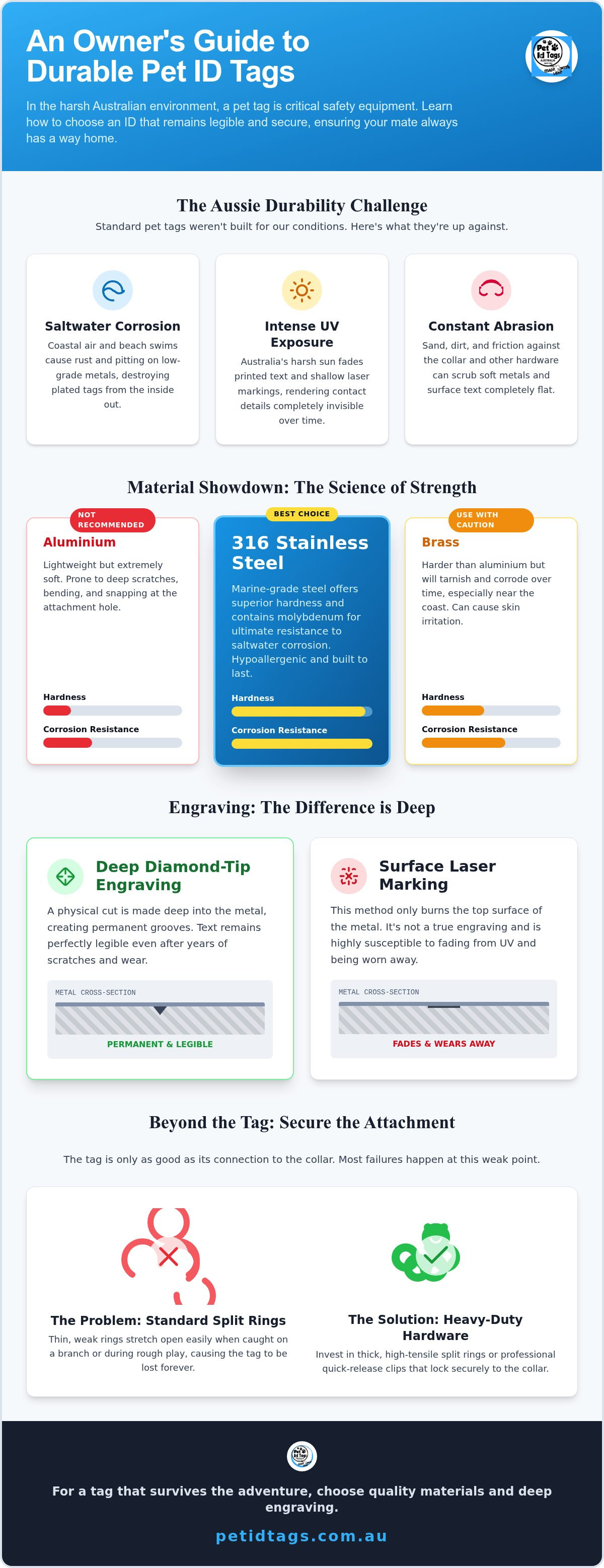
In the Australian environment, a pet tag isn't just a decoration; it's a piece of critical safety equipment. Durability here means surviving 40-degree heat, corrosive saltwater at the beach, and the abrasive red dust of the outback. Many owners settle for tags that look great on the shelf but fail in the field. Authentic durable engraved pet tags must withstand constant friction against a collar and the chemical stress of the elements without losing their legibility. Beyond safety, visible ID is a legal requirement in most states. For example, in New South Wales and Western Australia, dogs in public must wear a collar with a tag showing owner details. If that tag fails, you aren't just losing a piece of metal; you're losing your pet's voice when they need it most.
The Hidden Risks of Unreadable Tags
A faded tag is functionally equivalent to no tag at all. If your pet wanders off, the first person to find them will look at their collar. If the text is shallow or printed, years of UV exposure can bleach the information until it's invisible. High contrast between the metal and the engraving is vital for quick identification in low light or stressful situations. Our guide on why pet id tags fade details how the intense Australian sun breaks down surface-level markings. Without deep, physical engraving, you’re essentially gambling with your pet's path home. A professional-grade tag ensures that even after years of wear, the contact number remains deeply etched into the material.
Common Failure Points: From Split Rings to Soft Metals
Most tag failures happen at the connection point or due to poor material choice. Soft metals like brass or low-grade aluminium are prone to thinning at the hole where the ring attaches. This leads to the tag simply snapping off during a high-energy "zoomie" session or a rough playdate at the park. Standard split rings are another culprit; they often stretch open if caught on a branch or fence, dropping the tag instantly. The Science of Strength suggests that material selection is the primary factor in hardware longevity. In pet hardware terms, material fatigue is the progressive structural damage that occurs when a metal is subjected to repeated stress, eventually leading to a complete break. Choosing "fashion" tags often means sacrificing this structural integrity for a temporary aesthetic that won't survive a single Australian summer. Investing in durable engraved pet tags made from high-tensile materials is the only way to ensure the ID stays exactly where it belongs.
The Science of Strength: Why Stainless Steel Wins for Durability
When selecting durable engraved pet tags, the material's physical properties dictate how long the information remains readable. Stainless steel is the industry benchmark for a reason. On the Vickers hardness scale, which measures a material's resistance to indentation, stainless steel significantly outperforms common alternatives like aluminium or brass. While aluminium is soft and prone to deep gouges that can obscure text, high-grade steel maintains its surface integrity even after years of clinking against other collar hardware. It is the most dependable choice for owners who want a "set and forget" solution.
For dogs that spend their weekends at the beach, 316-grade stainless steel is mandatory. This is often referred to as marine-grade steel because it contains molybdenum, an element that provides superior resistance to pitting and corrosion in saltwater environments. Standard "chrome-plated" tags often rust from the inside out once the surface is scratched; solid stainless steel is corrosion-resistant all the way through. Choosing the Right Durable Tag involves looking past the initial shine and considering how the metal will react to your local environment, especially in coastal Australian regions.
Owners sometimes worry about the weight of steel. However, modern manufacturing allows for precision-cut tags that are thin enough for comfort while retaining extreme tensile strength. It is also a hypoallergenic material. If your pet has sensitive skin or suffers from "collar rub," the clean, non-reactive surface of steel is far less likely to cause irritation than nickel-plated or brass options. This combination of strength and safety makes it the primary recommendation for active breeds.
Stainless Steel vs. Aluminium Dog Tags
The choice usually comes down to your pet's lifestyle. Stainless steel is the ultimate material for longevity, resisting the scratches that typically plague active bushwalkers. Aluminium has its place, particularly for puppies or small cats that require the lightest possible load. It also allows for vibrant anodised colours. However, if your dog is a high-energy adventurer, the hardness of steel is the only logical choice to prevent the tag from thinning and eventually snapping at the attachment hole.
The "Silent" Benefit of High-Quality Steel
There is a functional advantage to the density of steel that many owners overlook. Because steel is heavier and more solid than aluminium, it produces a deeper, less intrusive "clink" rather than a high-pitched, tinny jingle. This density also means it withstands the constant friction of moving against a metal D-ring without wearing down. For a comprehensive look at your options, our stainless steel dog tags australia pillar provides deep buying advice for every breed. You can explore our range of stainless steel dog tags to find a permanent identification solution for your mate.
Comparing Engraving Methods: Diamond Tip vs. Laser vs. Printing
While many retailers claim to offer "engraved" identification, the process used to mark the metal determines whether the text lasts for a decade or disappears within a single season. True durable engraved pet tags rely on mechanical depth rather than surface-level aesthetics. Modern marking techniques generally fall into three categories: mechanical diamond-tip engraving, laser marking, and surface printing. For an active Australian pet, the choice between these methods is the difference between a permanent safety tool and a temporary accessory that fails when your pet needs it most.
Mechanical diamond-tip engraving is the gold standard for longevity. This process involves a precision stylus physically removing metal to create deep, permanent grooves. In contrast, many "laser engraved" tags are actually laser marked; a process that uses heat to change the colour of the surface or fuse a ceramic powder to the metal. While laser marking looks sharp and high-contrast initially, it lacks depth. Over time, the constant friction of the tag rubbing against a collar D-ring or a second ID tag can literally "buff out" the text, leaving you with a blank piece of metal.
Why Depth Matters for Long-Term Readability
Deep engraving is specifically designed to survive the physical scuffs and scratches that occur during a dog's daily life. When a tag is deeply etched, the information remains legible even if the surface of the metal becomes dull or scratched from contact with sand and grit. Diamond-tip engraving is essentially "carving" into the metal, ensuring the text is a structural part of the tag rather than a surface addition. Some manufacturers use "in-filling" to add colour to these grooves, but even if the paint eventually wears away, the deep mechanical groove remains perfectly readable. Surface-printed or enamel-only tags are the highest risk for active pets, as the entire layer of information can chip off or peel away after exposure to salt water and UV rays.
Essential Information to Include
The durability of your tag is only useful if the information remains clear and easy to read at a glance. To maximise readability, you must balance the amount of text with the size of the tag. Overcrowding a small tag with a full home address often results in a font size so small it becomes difficult for a stranger to read in an emergency. Prioritising your mobile phone number and any critical medical alerts is the most effective strategy. This aligns with the RSPCA emergency preparedness guide, which emphasises that a visible ID tag with a current mobile number is a fundamental part of keeping your pet safe. For a comprehensive checklist on how to structure your details, our guide on pet id tag engraving ideas covers everything from postcode inclusion to "I'm microchipped" notifications. Choosing durable engraved pet tags with deep-etched text ensures these vital details stay intact for the life of your pet.
Beyond the Tag: Secure Attachments and Maintenance for Active Pets
Even the most durable engraved pet tags are only as reliable as the hardware connecting them to the collar. We refer to this as the "weakest link" theory. Many owners invest in high-grade stainless steel only to use a flimsy, lightweight split ring that stretches open the first time it snags on a garden fence or a low-hanging branch. A secure attachment is a non-negotiable component of pet safety. If the connection fails, the quality of the engraving becomes irrelevant because the tag is lying in the grass rather than protecting your pet.
Regular inspections are vital for maintaining structural integrity. Every month, take a moment to physically check the attachment point during your pet's grooming or bath time. Look for signs of "elongation" in the split ring or thinning of the metal around the tag's attachment hole. If the ring doesn't snap back to a tight, closed position after being moved, the metal has reached its elastic limit. It’s compromised and needs immediate replacement to prevent the tag from falling off during the next walk.
The Rise of the Dog Tag Quick Clip
For owners who frequently swap between a daily collar, a training harness, or a high-visibility vest, the standard split ring is a major frustration. The constant prying open of the ring causes the metal to lose its tension, which eventually leads to lost ID. A professional-grade quick clip solves this by providing a secure, spring-loaded connection that can be moved in seconds without any tools. It eliminates "split ring stretch" entirely and ensures the tag remains high and dry away from mud. We recommend reading our dog tag quick clip australia guide to understand why this small upgrade is a durability essential for active dogs.
Maintenance Tips for Australian Conditions
Our local environment is notoriously tough on hardware. While 316-grade stainless steel is highly resistant to corrosion, sand and salt can still accumulate within the deep grooves of the engraving. After a trip to the beach, a quick rinse in fresh water is all it takes to keep the details sharp and prevent salt crusting. If your dog is a heavy wrestler at the park, check the edges of the tag for "burrs" or sharp nicks caused by high-velocity impact with other metal hardware. A simple wipe with a damp cloth keeps the surface clear of dirt and grime, ensuring the text remains legible for any stranger who might need to read it. You can shop our range of secure attachment accessories to ensure your pet's ID stays exactly where it belongs.
Choosing the Right Durable Tag for Your Mate's Lifestyle
Selecting the right durable engraved pet tags involves more than just picking a shape or colour. It requires matching the hardware to your pet's daily energy levels and the environments they frequent. For "The Swimmer" who hits the surf every morning, 316-grade stainless steel is the only viable choice to prevent salt-induced corrosion. "The Adventurer" who crashes through thick scrub needs the structural security of deep mechanical engraving paired with a high-tensile attachment. Even for "The Tiny Teacup" breeds, lightweight aluminium offers a dependable solution that provides clear ID without causing neck strain. Investing in a professional-grade tag once is significantly more cost-effective than replacing a cheap, shallow-etched alternative every six months when the details inevitably vanish.
The Smart Tag Advantage
Modern pet safety now relies on a hybrid approach that combines traditional craftsmanship with digital convenience. While deep physical engraving is your primary tool for immediate recovery, smart pet tags australia provide a critical digital backup. These tags allow you to store comprehensive contact details, medical records, and secondary phone numbers in an online profile. If you move house or change your mobile number while on holiday, you can update your details instantly without needing to purchase a new tag. This pairing of a permanent mechanical mark and a dynamic QR code represents the gold standard for pet safety in 2026, ensuring your pet always has a way home.
Supporting Local Expertise
Choosing an Australian-based specialist like Pet ID Tags Australia ensures your gear is specifically engineered for our harsh local climate. Since 2004, we have refined our manufacturing processes to create products that survive the unique combination of intense UV and abrasive dust found in the Aussie backyard. You benefit from local quality control and fast national shipping, avoiding the long wait times and inconsistent standards of overseas retailers. You can browse our Stainless Steel collection to find a permanent identification solution that suits your pet's specific needs.
To ensure your pet's ID setup is truly fail-safe, follow this final checklist:
- Select 316-grade stainless steel for any pet that visits the coast.
- Verify the engraving is deep-etched (diamond-tip) rather than surface-marked.
- Use a heavy-duty split ring or a professional quick clip to prevent the tag from dropping off.
- Integrate a Smart Tag QR code, which can be easily managed via urltiger, as a digital redundancy for your physical details.
- Conduct a monthly physical inspection of the hardware to catch signs of wear early.
By following these steps, you provide your pet with a durable engraved pet tags system that remains legible and secure for years to come.
Ensuring Your Pet's Voice Never Fades
Choosing high-quality identification is a fundamental responsibility for every Australian owner. The combination of 316-grade stainless steel and deep mechanical engraving is the only way to ensure your contact details survive the harsh realities of the Aussie bush and beach. A tag that remains readable after years of wear provides the ultimate peace of mind. It ensures that if the unthinkable happens, your pet has a clear path home. Don't leave their safety to chance with shallow markings or soft metals that fail when they are needed most.
At Pet ID Tags Australia, we have spent over 20 years specialising in local pet safety. Our durable engraved pet tags feature deep diamond-tip engraving that is guaranteed for readability, ensuring your mate's ID never buffs out or fades. We prioritise structural integrity and precision craftsmanship in every piece we produce. With free shipping on all Australian orders, it is easy to secure a professional standard of protection for your pet regardless of where you live.
Shop our range of ultra-durable Stainless Steel Pet Tags today and give your pet the permanent protection they deserve.
Frequently Asked Questions
What is the most durable material for a dog tag?
316-grade stainless steel is the most durable material available for pet identification. It offers a high level of hardness and exceptional resistance to corrosion, making it perfect for dogs that enjoy coastal swimming or bush adventures. Unlike softer metals such as brass or aluminium, steel does not thin out at the attachment point over time. This ensures the tag remains securely fastened and the text stays legible despite years of constant physical activity.
Does diamond-tip engraving ever wear off?
Diamond-tip engraving is a permanent process that physically carves into the metal, meaning it won't ever wear off. Unlike laser marking, which only changes the surface colour, this mechanical method creates deep grooves that survive constant friction and harsh UV exposure. Even if the tag surface becomes scratched from daily play, the structural depth of the engraving ensures your details remain readable. This is why durable engraved pet tags are the gold standard for long-term safety.
Are stainless steel tags too heavy for small cats?
Modern stainless steel tags are precision-manufactured to be lightweight and comfortable for small cats and kittens. While steel is a denser material than aluminium, a small-sized tag typically weighs only a few grams, which won't bother a cat's neck or affect their movement. If your pet is exceptionally tiny, you might consider an aluminium tag for the absolute minimum weight. However, for most adult cats, the longevity of steel provides a superior, lifelong identification solution.
How do I stop my dog’s tags from jingling?
You can effectively stop tags from jingling by using a Pet Tag Quick Clip or a dedicated tag silencer. Quick clips provide a more stable connection to the collar, reducing the excessive movement that creates noise. You might also consider a "slide-on" tag style that sits flush against the collar material. For pets wearing multiple IDs, placing a small rubber gasket between the tags or choosing a denser metal like stainless steel can significantly dampen the high-pitched metallic sound.
Should I get a smart tag or a traditional engraved tag?
The most comprehensive safety plan involves using both a traditional engraved tag and a Smart Pet Tag. A traditional tag provides immediate, offline access to your phone number for anyone who finds your pet. A Smart Tag adds a layer of digital protection, allowing you to store medical alerts and update your contact details instantly through an online profile. Combining these methods ensures your pet is protected by both physical durability and modern, updateable recovery technology.
How often should I replace my pet’s ID tag?
You should only need to replace durable engraved pet tags if your contact information changes or the attachment hardware shows signs of fatigue. High-grade stainless steel is designed to last for the lifetime of your pet without fading. However, it is important to inspect the tag monthly for any thinning around the attachment hole or stretching of the split ring. If the structural integrity of the metal is compromised, replace the tag immediately to prevent it from falling off.
Can I put two phone numbers on a standard-sized tag?
You can easily include two mobile phone numbers on a standard-sized tag by using both the front and back surfaces. Most professional engraving layouts allow for multiple lines of text, which is ideal for providing primary and secondary contact details. To ensure the font remains large and easy to read, we recommend placing the pet's name on the front and the phone numbers on the reverse. Avoid adding long home addresses, as this can make the text too small.
What is the best way to attach a tag so it doesn’t fall off?
The most reliable way to attach a tag is with a heavy-duty split ring or a professional Pet Tag Quick Clip. Standard rings can stretch open if they snag on a fence or branch, causing the tag to drop off. A quick clip offers a secure, spring-loaded attachment that is specifically designed to withstand high levels of activity. Always ensure your attachment hardware is made from a high-quality metal that matches the durability of the tag itself for a fail-safe setup.