

Why do most pet owners settle for a piece of identification that's destined to become an unreadable scrap of metal within six months? With 7.4 million dogs across the country, selecting durable dog tags Australia wide is about more than just aesthetics; it's about ensuring your mate can always find their way home. You've likely dealt with the frustration of "permanent" engraving that fades after a few beach trips or split rings that stretch and snap the moment your dog hits the scrub.
It's a common headache for owners who value reliability over fleeting trends. We agree that an ID tag shouldn't be a temporary fix but a life-long safety tool that survives the salt, sand, and sun. This 2026 guide will show you how to choose high-grade materials and deep engraving techniques that remain legible for the life of your pet. We'll explore the critical differences between marine-grade stainless steel and budget alternatives, the science of secure attachments, and how to navigate local council registration requirements with confidence.
Key Takeaways
- Learn why 316 Marine Grade Stainless Steel is the gold standard for resisting corrosion in harsh Australian coastal environments.
- Understand why deep mechanical engraving is essential for permanent legibility, unlike surface printing that fades under the hot Aussie sun.
- Discover how to prevent tag loss by replacing flimsy split rings with heavy-duty hardware like a Pet Tag Quick Clip.
- Get a practical framework for choosing the most durable dog tags Australia wide based on your pet’s size, energy, and typical outdoor terrain.
- Find out how a high-quality tag should maintain its structural integrity and remain readable for at least five years of rugged use.
Why Durable Dog Tags are Essential for the Australian Lifestyle
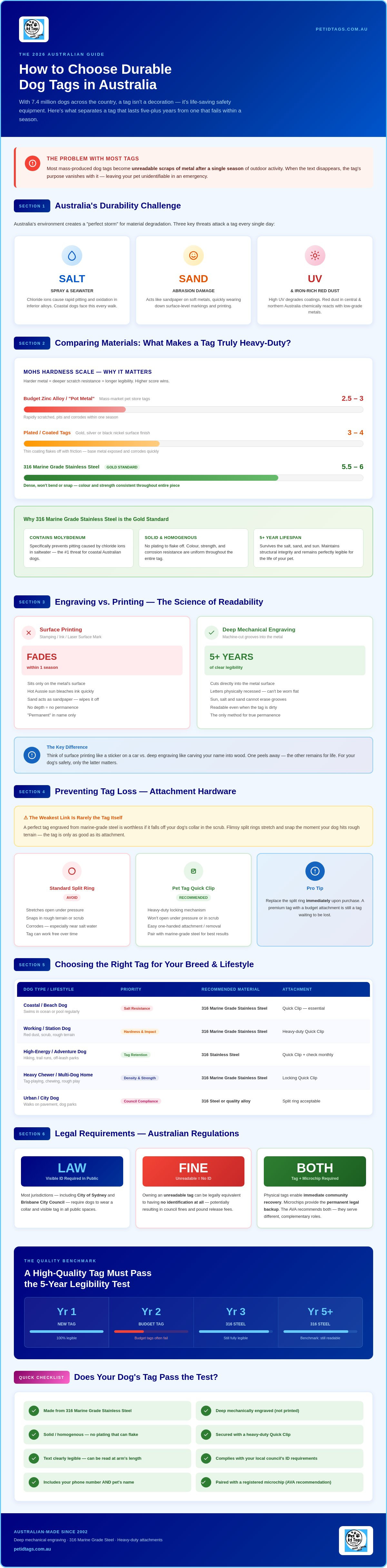
A truly durable dog tag is a piece of safety equipment, not just a decoration. When we talk about durable dog tags australia, we are looking for a solution that maintains its structural integrity and remains perfectly legible for five years or more. Most mass-produced alternatives fail this standard. They often become unreadable scraps of metal after a single season of outdoor activity. When the text disappears, the tag's purpose vanishes with it.
Australia’s environment is notoriously tough on hardware. High UV levels, salt spray, and abrasive red dust create a "perfect storm" for material degradation. If your dog’s tag is illegible during an emergency, it’s as useless as having no tag at all. While microchips provide a permanent record, the role of pet ID tags is to facilitate an immediate, community-led recovery. A clear, readable tag is what keeps your pet out of the pound and brings them home within minutes. It is the first thing a neighbour or ranger looks for when they find a wandering pet.
The Aussie Durability Test: Salt, Sand, and Scrub
Coastal living leads to rapid oxidation in tags made from inferior "mystery metals." These alloys often pit and corrode when exposed to salt air and sea water. For dogs with active, off-leash lifestyles, the physical environment acts like a grinder. Sand is an abrasive that quickly wears down surface-level markings. Fine red dust found in central and northern Australia contains iron oxides that can chemically react with lower-grade metals, making them impossible to clean or read. We distinguish between "fashion tags," which prioritise looks, and "utility tags" designed for working breeds and adventurous pets. A utility tag must survive the scrub and the surf without losing the vital information carved into its surface.
Legality and Safety Standards in 2026
As of July 2026, Australian state and local council regulations remain strict regarding visible identification. Most jurisdictions, including the City of Sydney and Brisbane City Council, require dogs to wear a collar and tag in public spaces. Owning an "unreadable" tag can be legally equivalent to having no identification at all, potentially resulting in council fines. In major cities where pound release fees can be significant, the cost-benefit of a long-lasting tag is clear. A durable tag ensures you stay compliant with local bylaws while providing the fastest path home for a lost pet. For a deeper look at how physical tags work alongside digital records, see our article on Pet Tag vs Microchip Australia: Why Your Pet Needs Both in 2026.
Comparing Materials: What Makes a Dog Tag Truly Heavy Duty?
The foundation of durable dog tags australia lies in the material science behind the metal. Most mass-market tags found in big-box pet stores are manufactured from cheap zinc alloys or "pot metal." These materials sit low on the Mohs scale of mineral hardness, typically around 2.5 to 3. In contrast, 316 Marine Grade Stainless Steel sits significantly higher, usually between 5.5 and 6. This technical difference is why a high-quality tag resists deep scratches while a cheap one becomes a battered, illegible mess within months.
Surface treatments are another common failure point. Many retailers sell "plated" or "coated" tags that look impressive on the shelf. However, these thin layers of gold, silver, or black nickel eventually flake off due to constant friction against the collar or other tags. Once the plating fails, the base metal is exposed to the elements, leading to rapid corrosion. We advocate for solid, homogenous metals where the colour and strength are consistent throughout the entire piece. While physical tags are your pet's front-line defence, the Australian Veterinary Association emphasises that permanent electronic identification remains the essential legal backup for all Australian pets.
Stainless Steel: The King of Longevity
316-grade stainless steel is the gold standard for a reason. It contains molybdenum, an element that specifically prevents pitting and corrosion caused by chloride ions in saltwater. This makes it the only logical choice for dogs that spend their weekends at the beach or swimming in chlorinated pools. It's also the best material for "heavy chewers" or multi-dog households where "tag-playing" is common. Because the metal is so dense, it won't bend or snap under pressure. For a deeper dive into why steel outlasts the rest, see our Stainless Steel Dog Tags Australia: The 2026 Ultimate Buyer’s Guide.
Aluminium and Brass: When to Choose Them
Aluminium is an excellent, durable alternative when weight is a primary concern. It's roughly one-third the weight of steel, making it ideal for smaller cats or toy breeds that shouldn't carry heavy hardware. While softer than steel, high-grade anodised aluminium still offers impressive resistance to the elements. Brass, while traditional and sturdy, is a softer alloy that naturally oxidises. This "patina" can look classic, but it requires regular polishing to ensure the text remains readable. Regardless of the material, always check the gauge; a tag should be at least 1.5mm to 2mm thick to prevent the attachment hole from wearing through over time. You can explore our full range of heavy-duty pet identification to find the right thickness for your breed.
The Science of Readability: Engraving vs. Printing
Legibility is the only metric that matters when a pet is lost. While many providers offer what they call "engraving," there is a massive technical difference between surface-level laser marking and true mechanical carving. Surface laser marking uses a concentrated beam to darken the metal's outer layer. It looks sharp initially, but because it doesn't displace any material, it's vulnerable to being rubbed smooth by "jingle wear." This is the constant friction of the tag against the collar or a council registration disc. For genuine durable dog tags australia, you need a process that physically removes metal to create a permanent recessed groove.
Diamond-tip engraving is the industry's superior method. Instead of burning a mark, an industrial-grade diamond bit carves deep into the substrate. This ensures that even if the tag's surface becomes scratched or weathered by the elements, the information remains trapped in the physical structure of the metal. Font choice also plays a role in safety. We recommend bold, sans-serif fonts. These provide better long-distance legibility for a rescuer who might be trying to read a phone number from a distance without spooking a nervous dog. Adhering to Australia's pet identification standards ensures your pet is recognisable and compliant, whether they are local or travelling internationally.
Why Printed and Plastic Tags Fail
Plastic tags and printed designs are often sold as "cute" alternatives, but they fail the durability test. UV radiation from the Australian sun breaks down the chemical bonds in ink and epoxy. This causes text to fade to white within months. Plastic also becomes brittle in extreme temperatures, leading to a high "snap risk" during high-impact play or while navigating thick scrub. For reliable alternatives and text layouts, check our Pet ID Tag Engraving Ideas: The Ultimate 2026 Australian Checklist.
Depth Matters: Measuring Engraving Quality
You can easily verify the quality of your pet's current ID by using the "thumbnail test." Run your nail across the text; if you cannot feel a distinct, tactile catch in every letter, the engraving is too shallow. Deep engraving is a physical, recessed groove carved into the metal that remains tactile and readable even after years of surface abrasion. When opting for double-sided engraving, we ensure the depth is balanced on both sides. This maintains the structural integrity of the metal, preventing the tag from warping or weakening over time.
Preventing Tag Loss: The Role of Attachment Hardware
Even a marine-grade steel tag is useless if it's lying at the bottom of a creek or lost in a thick paddock. While most owners focus on the tag itself, the attachment hardware is frequently the weakest link in pet identification. Standard split rings are prone to "springing." This happens when the ring catches on a branch or fence, stretching the metal just enough to let the tag slip out. When investing in durable dog tags australia, you must consider how that tag stays connected to your mate's collar during high-energy activity.
One of the most effective ways to reduce mechanical wear is by addressing the "jingle factor." Constant metal-on-metal contact doesn't just erode the engraving; it physically thins the attachment hole of the tag and the ring itself. Using "silent" tags or tag silencers can dampen this vibration, significantly extending the life of the hardware. Proper attachment also depends on your collar type. D-rings are the standard for most leads, but ensure your clip or ring is sized correctly to avoid excessive leverage that can snap lighter components. For those who frequently swap between a house collar and a trail harness, a specialised clip is a safer, more reliable alternative to prying open a split ring every time.
Split Rings vs. Quick Clips
Traditional split rings rely on tension to stay closed, but this tension weakens every time the ring is caught or manually opened. We recommend the Pet Tag Quick Clip as a heavy-duty alternative. These clips are manufactured from high-tensile stainless steel and provide a secure, locking mechanism that won't give way under pressure. They are particularly useful for multi-dog households where "collar wrestling" can easily deform a standard ring. When choosing your hardware, match the weight of the clip to the size of the dog. A heavy clip on a toy breed is cumbersome, while a flimsy ring on a working dog is a recipe for a lost tag.
Maintenance for Lifetime Durability
Durable hardware still requires basic care to perform for five years or more. Salt and grit from beach runs can act like sandpaper inside the engraving grooves and attachment points. We suggest a quick rinse with fresh water after every coastal trip to prevent buildup. Periodically inspect the top hole of the tag for "thinning." If the metal looks like it's wearing through, it's time to replace the hardware before it fails completely. To ensure your entire setup is as rugged as the tag, read our Personalised Dog Collars Australia: The 2026 Ultimate Buyer’s Guide.
Don't risk a lost tag due to a failed ring. Upgrade to our industrial-strength Pet Tag Quick Clips for total peace of mind on your next adventure.
Choosing the Right Durable Dog Tag for Your Breed
Selecting the right identification isn't a one-size-fits-all process. A tag that suits a pampered Pug in a Melbourne apartment won't necessarily survive a Kelpie working a dusty paddock in outback Queensland. When searching for durable dog tags australia, you must evaluate three core factors: your dog’s size, their energy level, and the environment where they spend most of their time. High-energy dogs that crash through the bush require maximum thickness, while smaller pets need a balance of strength and comfort.
Many owners ask about the "Bling vs. Basic" trade-off. They worry that a decorative tag can't be heavy duty. The answer lies in the base material. While we offer Crystal Bling Pet Tags for those who want a touch of style, we ensure the underlying structure is robust. A pretty tag is only a liability if it's made from thin, fragile alloys. If the foundation is solid metal and the engraving is deep, your pet can have both security and style without compromise. Investing in quality now prevents the recurring cost and safety risk of frequent replacements later.
Best Tags for Active and Working Dogs
For breeds like Kelpies, Border Collies, and farm dogs, thick-gauge stainless steel is the only logical choice. These dogs are constantly moving through scrub, mud, and water. You need a tag that won't bend or catch easily. We recommend using a large font with clear, bold text to ensure a stranger can read the contact details quickly, even if the dog is being a bit wiggly. For hunting dogs or those sensitive to noise, "no-jingle" solutions or hushtags are vital. These prevent the constant clinking that can be distracting in the field or annoying during a quiet night at home.
Selecting for Small Breeds and Cats
Smaller frames require a different approach. You must balance durability with a lightweight profile to avoid straining the pet's neck. Aluminium is the hero for smaller breeds and cats. It offers a wide variety of colours and a low weight without sacrificing the necessary strength for daily wear. While it is softer than steel, high-quality anodised aluminium still holds a deep engraving well. It provides a comfortable, long-lasting solution that won't weigh down a toy breed or a feline friend.
At Pet ID Tags Australia, we are committed to providing deep-engraved, marine-grade solutions that stand the test of time. We believe every pet deserves a permanent voice that survives the rugged Australian lifestyle. Browse our range of durable Australian-made dog tags today.
Investing in Your Pet's Long-Term Safety
Choosing the right identification is a simple decision that has a massive impact on your dog’s safety. We’ve explored why marine-grade 316 stainless steel is the only material that truly stands up to the Aussie sun and salt. You now know that deep diamond-tip engraving is the standard for permanent legibility, ensuring your contact details never rub smooth. By pairing these high-quality materials with industrial-strength attachment hardware, you eliminate the weakest links in pet recovery.
We take pride in being an established specialist that has been proudly Australian owned and operated since 2004. Our commitment to craftsmanship means we provide solutions that are guaranteed for legibility, even after years of rugged use. Don't settle for flimsy alternatives that fail when your mate needs them most. Finding durable dog tags australia requires a strict focus on quality and precision.
Secure your pet with Australia’s most durable, deep-engraved dog tags.
Give yourself the peace of mind that comes with knowing your pet always has a permanent way home, no matter where your next adventure takes you.
Frequently Asked Questions
Are stainless steel dog tags better than aluminium for durability?
Stainless steel is the superior choice for sheer physical strength and long-term resistance to wear. While aluminium is an excellent lightweight option for smaller breeds, 316 Marine Grade Stainless Steel offers a higher level of hardness that resists deep scratches and structural warping. If your dog is active in the scrub or spends time at the beach, steel is the most reliable material for durable dog tags australia.
How long should a high-quality engraved dog tag last?
A high-quality tag should maintain its structural integrity and remain perfectly legible for five years or more. Cheap zinc or plastic alternatives often fail within months, but marine-grade materials and deep mechanical engraving are designed for a lifetime of use. Regular inspection of the attachment hardware ensures the tag stays secure for the duration of your pet's life.
Will the engraving on my dog tag wear off over time?
Deep mechanical engraving will not wear off because it physically carves a permanent groove into the metal. Unlike surface-level laser marking or printed text, which can be rubbed smooth by constant friction against other tags, deep diamond-tip engraving remains tactile and readable. This process ensures your contact details survive the abrasive effects of sand, dirt, and constant movement.
What is the best way to attach a dog tag so it doesn’t fall off?
Replacing a standard split ring with a heavy-duty Pet Tag Quick Clip is the most secure attachment method available. Traditional rings can spring open if they get caught on a fence or thick branch, leading to a lost tag. A high-tensile stainless steel clip provides a locking mechanism that withstands significant pressure, ensuring the identification remains connected to the collar D-ring.
Can I get a durable dog tag that doesn’t make a jingling noise?
You can achieve a quiet identification setup by using tag silencers or "hushtags" designed to dampen metal-on-metal contact. These soft covers or specific tag designs prevent the constant clinking noise that some pets and owners find distracting. Reducing this vibration also has the added benefit of decreasing mechanical wear on both the tag's surface and the attachment hardware.
Is a durable dog tag necessary if my pet is already microchipped?
A durable dog tag is essential because it provides the fastest way for a neighbour to contact you without needing a microchip scanner. While microchips are a legal requirement and serve as a permanent backup, a physical tag allows for immediate recovery. This direct line of communication often prevents a trip to the pound and the associated stress and release fees.
How do I clean a stainless steel dog tag to keep it readable?
Cleaning your tag is as simple as using fresh water and mild dish soap to remove salt, grit, and red dust. For deep-engraved tags, a soft-bristled brush can help clear out any debris trapped in the recessed grooves. Rinsing the tag after every trip to the beach is particularly important for preventing the buildup of salt ions that can eventually dull the finish.
What information is essential to include on a durable dog tag for safety?
Your pet's name and at least two current phone numbers are the most critical pieces of information for a quick recovery. Including a secondary number ensures you can be reached even if your primary line is out of range or has a flat battery. Many owners also add "Microchipped" or brief medical alerts to provide finders with vital context for their pet's immediate care.