

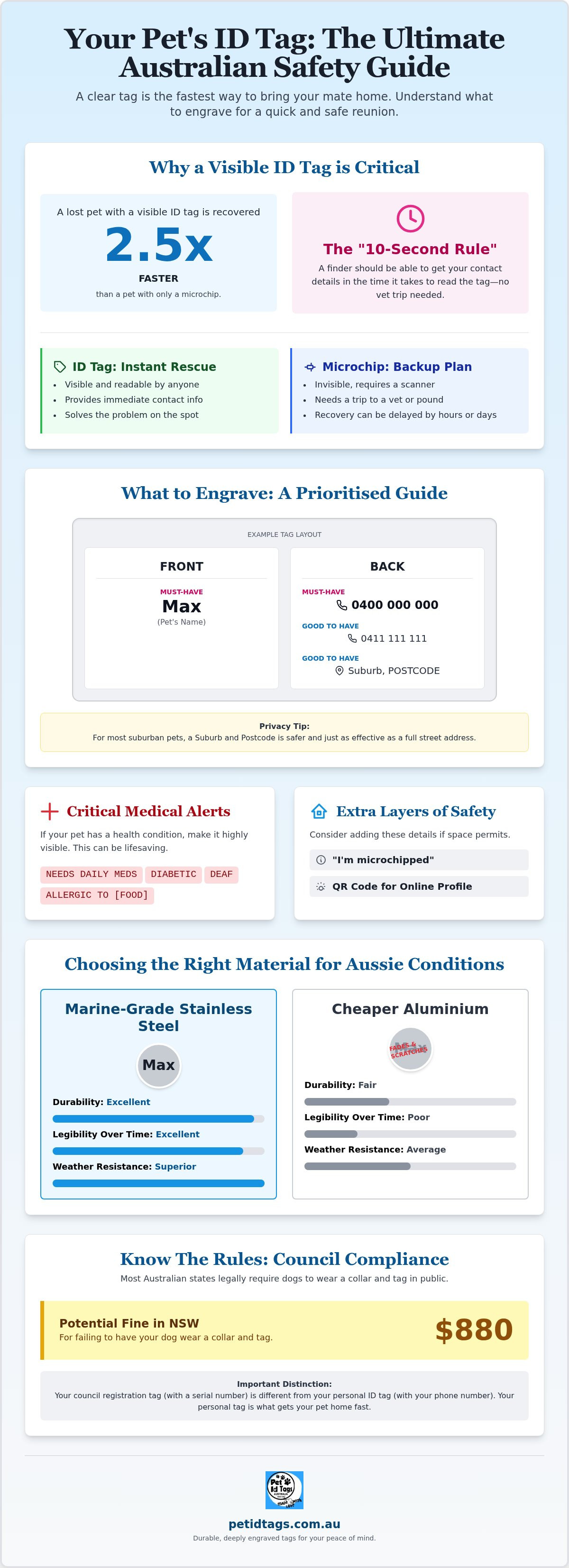
A lost pet with a visible identification tag is recovered 2.5 times faster than one without. While microchips are mandatory in all Australian states, they require a trip to the vet and a scanner to be useful. In contrast, a clear tag offers a 10-second visual solution that can get your mate home before they ever set foot in a pound. Knowing exactly what to put on a pet id tag australia is the difference between a quick reunion and a heartbreaking disappearance.
It's natural to feel protective of your privacy or worry about tags becoming unreadable after a few months of rough play in the backyard. You need a solution that balances personal security with legal compliance. This 2026 essential safety guide provides a prioritised list of details that matter most; ensuring your contact info stays legible regardless of the weather or the harsh Aussie sun.
We'll examine the specific council requirements for various states, explore why marine-grade stainless steel outperforms cheaper alternatives, and share practical engraving tips to maximise safety. By the end of this guide, you'll have total peace of mind that your pet's tag is a durable, legal, and effective tool for their protection.
Key Takeaways
- Understand the "10-second rule" and why a physical tag is the fastest way home, acting as a critical visual partner to your pet's microchip.
- Discover exactly what to put on a pet id tag australia to ensure a finder can contact you immediately without needing a trip to the vet.
- Learn how to effectively communicate medical alerts and use smart QR technology to protect pets with allergies or specific health requirements.
- Compare the durability of marine-grade stainless steel and aluminium to select the best material for active dogs in harsh Australian conditions.
- Master the layout and attachment techniques that prevent your pet's details from fading or getting lost during rough play in the backyard.
The Critical Role of Pet Identification in Australia
The "10-second rule" defines the gold standard of pet safety. When a well-meaning neighbour finds your dog wandering the street, they should be able to identify you in the time it takes to read a small piece of metal. If they can't, that pet usually ends up in a car, headed to a local vet or a council pound for a microchip scan. This process adds hours of stress and unnecessary logistics to a situation that a clear tag could have solved in seconds. Deciding what to put on a pet id tag australia is about more than just aesthetics; it's about providing an immediate path home. Speed saves lives.
While microchips are a legal requirement across the country, they are a passive recovery tool. They require specialised equipment to read. Pet ID Tags act as the active partner in this system, offering a high-visibility solution that anyone can use. By providing clear contact details, you significantly reduce the burden on overstretched animal shelters and local councils. In 2026, we're seeing a shift away from flimsy, printed accessories back toward high-durability, deeply engraved stainless steel. Owners want reliability that survives the Australian elements. It's a return to craftsmanship that prioritises function over fashion.
Australian Pet Identification Laws and Council Rules
Most Australian states mandate that dogs wear a collar and tag in public places. In New South Wales, for example, failing to comply can result in fines of up to $880 as of July 2026. It's vital to distinguish between your council registration tag and your personal ID tag. The registration tag proves your pet is on the local books, but it often only contains a serial number. A personal tag with your mobile number is what actually facilitates a direct return. Relying solely on a microchip can delay a reunion by days if the finder cannot reach a vet during business hours.
The Reality of Lost Pets in the Aussie Landscape
The Australian environment presents unique risks. A sudden summer thunderstorm or a lapse in gate security can see a pet bolting into the bush or busy suburban traffic. In these high-stress moments, a readable tag empowers your community to help. It transforms a "stray dog" into "the dog from three doors down" or "Max, whose owner lives on the next block." This immediate recognition provides immense emotional peace of mind. Knowing what to put on a pet id tag australia ensures that even in the worst-case scenario, your pet has a voice. It's the simplest way to protect your mate.
The Essential Information: What to Put on a Pet ID Tag Australia
Your pet's tag is a compact billboard for their safety. Space is limited, so every character must serve a purpose. When deciding what to put on a pet id tag australia, the primary goal is to facilitate an immediate phone call. This removes the need for a third party, such as a council ranger, to intervene. A well-designed tag provides enough information to get your dog home without compromising your entire family's privacy.
The most critical piece of data is your current mobile phone number. It's the first thing a finder looks for. Including your pet's name is also highly recommended. While some owners worry about the risk of theft, the reality is that a stranger who can call your dog by name is more likely to keep them calm and secure until you arrive. If space permits, a secondary number for a partner or a local vet provides a vital backup if you're out of mobile range or in a meeting. Providing these options increases the speed of recovery significantly.
The Privacy Balance: Suburb vs. Full Address
Including a full street address was once common practice, but it's often unnecessary for suburban pets. Providing just your suburb and postcode gives a finder a clear local cue. They'll know immediately if the dog has wandered from a few streets away or if they've hitched a ride across town. This level of detail is usually sufficient for a neighbour to walk your pet home safely. Full addresses are better reserved for rural properties where the next neighbour might be several kilometres away. As noted by RSPCA Australia, while microchipping is a legal safety net, a visible tag is your first line of defence in any public space.
Mobile Numbers and Area Codes
Legibility is the key to a successful recovery. Format your mobile number with clear spacing, such as 0400 000 000, to make it easy to read at a glance. Avoid cluttered area codes if you are using a standard Australian mobile. Ensure the number you engrave is one that is monitored 24/7. A mobile number remains the undisputed gold standard for pet recovery in 2026 due to its immediate, portable nature. Choosing a high-quality stainless steel tag ensures these vital details remain legible for the long haul, even after years of wear in the Aussie backyard.
Beyond the Basics: Smart Tags, Medical Alerts, and Extra Details
Once you've secured the essential contact details, consider what additional information could save your pet's life in a crisis. Deciding what to put on a pet id tag australia often requires thinking about your pet's unique vulnerabilities. For an elderly dog or one with a chronic health condition, a simple phone number might not be enough to ensure their safety if they're found in a confused or distressed state. Adding specific health indicators provides a finder with the context they need to handle your pet with appropriate care.
Communicating Special Needs Clearly
Communicating health requirements effectively is a priority for many Aussie owners. Use short, high-impact phrases that a stranger can understand at a glance. Practical examples include:
- 'I am deaf' or 'I am blind'
- 'Needs daily meds'
- 'Severe food allergies'
- 'I am anxious'
These details help a finder manage your pet's stress levels and prevent accidental harm, such as feeding a dog with a sensitive stomach. If your pet has complex needs, a dedicated medical tag is often better than trying to squeeze everything onto a single disk. This keeps your primary contact info large and readable, ensuring the most vital information isn't lost in a crowd of text. Ensuring your pet is in a safe and professional environment while you're away also helps manage their stress; for expert boarding services that prioritise security and comfort, check out Noah's Pet Hotel & Spa.
The landscape of pet safety is evolving with the rise of smart pet tags australia. These devices often use QR codes to link to a comprehensive digital profile. This is an excellent way to provide detailed vet information, dietary requirements, or multiple secondary contacts without cluttering the physical tag. The primary benefit is the ability to update your details instantly if you're on holiday or move house. However, a traditional engraved phone number remains the essential fail-safe. Technology can fail or a finder might not have a smartphone handy; the engraved number is your permanent backup.
You might also consider adding the phrase 'I'm Microchipped.' While it doesn't provide immediate contact info, it acts as a deterrent to theft and confirms that the pet is legally registered. Regarding reward offers, they can be a powerful incentive. If you choose to include one, keep it simple. 'Reward for return' is enough. Avoid listing specific dollar amounts, as this can lead to security risks or encourage opportunistic behaviour. Focus on the details that facilitate a safe, fast return. When you're choosing what to put on a pet id tag australia, remember that clarity is your best tool for protection.
Maximising Legibility: Tag Size, Material, and Layout
A tag is only as effective as its readability. Even the most comprehensive list of what to put on a pet id tag australia becomes redundant if the text fades or the material corrodes. In the harsh Australian climate, where UV levels are extreme and coastal salt air is pervasive, the physical construction of the tag is just as important as the information it carries. Deep engraving is the only reliable method for long-term safety. Surface printing or shallow etching often disappears within months of a dog scratching or rolling in the dirt.
Character counts directly dictate the font size. The more text you include, the smaller and harder to read it becomes. For a quick visual scan, aim for a maximum of 15 to 20 characters per line. This ensures the font remains bold and clear enough for a finder to read without squinting. Sizing also depends on the breed. A large working dog needs a robust 38mm tag to match their collar scale, while a cat or toy breed requires a lightweight 20mm or 25mm option that won't impede their movement or cause neck strain.
Stainless Steel: The Gold Standard for Active Pets
For dogs that spend time at the beach or trekking through the bush, stainless steel is the superior choice. This material offers unmatched resistance to salt water corrosion and physical scratching. You can read more about why stainless steel dog tags are the ultimate choice for durability in our detailed guide. High-grade stainless steel is significantly harder than aluminium, which prevents the constant friction of the attachment ring from wearing down the engraving over time. This hardness effectively eliminates the "jingle-wear" that often turns soft metal tags into unreadable silver discs within a year.
Layout Strategies for Small Tags
Effective layout uses every millimetre of available space. The 'Pyramid' layout is a proven technique where the most critical information, like your primary mobile number, sits in the widest centre section of the tag. Use the front for the pet's name and your main number, then utilise the back for secondary details like your suburb or medical alerts. This prevents the finder from becoming overwhelmed by a wall of tiny text. To double your pet's protection, consider pairing an engraved tag with a personalised dog collar. This ensures your contact details are visible even if the tag is accidentally caught and pulled off during play.
Selecting the right combination of material and layout is the final step in securing your pet's future. Don't leave their safety to chance with inferior materials. Shop our range of deeply engraved tags to ensure your mate's details stay legible for life.
Choosing Your Tag: How to Order the Perfect Aussie ID
Ordering your safety gear should be as methodical as the protection it provides. At Pet ID Tags Australia, our customisation process is built for precision and speed. You select your material first, usually deciding between the extreme durability of stainless steel or the lightweight versatility of aluminium. Once you've finalised what to put on a pet id tag australia, you enter your details directly into our engraving interface. We recommend a final double-check for typos; even a single digit error in a mobile number renders the tag useless in an emergency. Use this checklist before hitting 'order':
- Verify every digit of your mobile phone number.
- Check the spelling of your pet's name.
- Ensure the suburb and postcode are correct.
- Confirm you've selected the right tag size for your breed.
Attachment is the most overlooked part of pet safety. Most tags aren't lost because the metal fails; they're lost because the attachment ring stretches or snaps. You can choose between traditional stainless steel split rings or the convenience of dog tag quick clips. Clips are ideal if you frequently swap tags between different harnesses or collars. Regardless of your choice, perform a manual check of your pet’s gear every six months. Look for thinning metal or loose connections that could lead to a lost ID.
The Importance of Secure Attachment
A tag is only as secure as its connection to the collar. Poor quality split rings that pull apart easily are the primary cause of lost identification. Learning how to properly attach a dog tag to a collar ensures it won't be brushed off during a run through thick scrub or a play session at the park. If the constant jingle of metal bothers you or your pet, consider a "silent" setup. Using a rubber silencer or a clip that holds the tag flush against the collar reduces both noise and friction wear on the engraving.
Starting Off Right for New Arrivals
Beyond collar maintenance, keeping your pet's feeding and grooming area tidy is also a priority for many owners; a 360 rotating kitchen tap extender is a practical tool that makes rinsing out bowls or cleaning up after a messy meal much simpler.
Puppies require a specific approach to identification as they grow. For a young dog, puppy id tags made from lightweight aluminium are often the best starting point while they adjust to the weight of a collar. As they mature into active adults, upgrading to a heavy-duty stainless steel version is a wise investment for long-term durability. This shift ensures the tag survives the transition from gentle garden play to high-energy bushwalks. Establishing a safety-first mindset from day one protects your mate for the rest of their life. When you know exactly what to put on a pet id tag australia, you give your pet the best possible chance of a fast, safe return home.
Securing Your Pet’s Future with Precise Identification
Securing your pet's safety requires a balance of legal compliance and practical common sense. By prioritising the 10-second rule, you ensure that a finder can contact you immediately without the need for scanners, vets, or shelters. Remember that material choice is just as vital as the information itself; choosing high-grade stainless steel ensures your mate's details survive the harsh UV rays and salt air of the Australian landscape. This simple piece of metal remains the most effective tool for a fast, stress-free reunion.
Knowing exactly what to put on a pet id tag australia gives you the confidence that your pet has a voice even when you aren't there. With over 20 years of expertise in personalised pet gear, we understand exactly what it takes to keep Aussie pets safe in real-world conditions. Our deep-engraved stainless steel tags are designed to never fade, offering permanent security for even the most active dogs. It's about more than just a name; it's about a lifelong commitment to their protection.
Design your durable, deeply engraved pet ID tag today and take advantage of our fast shipping across Australia. Your pet's safe return is worth the investment in quality craftsmanship and proven reliability.
Frequently Asked Questions
Is it a legal requirement for my dog to wear a tag in Australia?
Yes, most Australian states and local councils mandate that dogs wear a collar and tag in public places. In New South Wales, failing to comply can result in fines of up to $880 as of 2026. While microchipping is a national requirement, the physical tag is often a specific by-law enforced at the local level. Always check with your specific council for the most current regulations regarding registration and identification tags.
Should I put my dog's name on their ID tag?
Including your dog’s name is highly recommended because it helps a stranger build immediate trust with a lost pet. A finder who can call your dog by name can keep them calm and lead them away from traffic or other hazards more effectively. While some owners worry about the risk of theft, the safety benefits of allowing a rescuer to communicate with your pet usually outweigh the potential privacy concerns.
What is the best material for a dog tag that won't fade?
Marine-grade stainless steel is the gold standard for durability in the harsh Australian climate. Unlike aluminium or plastic, high-quality stainless steel resists corrosion from salt water and won't thin out from constant friction against an attachment ring. Deep engraving is superior to surface printing because it physically cuts into the metal; ensuring the text remains legible even after years of scratching and exposure to extreme UV rays.
Do I need a pet tag if my dog is already microchipped?
You definitely need a tag even if your dog is microchipped. A microchip is a passive recovery tool that requires a scanner and a trip to a vet or shelter. When considering what to put on a pet id tag australia, remember that a physical tag allows a neighbour to call you directly. This can result in a reunion within minutes rather than hours or days spent in a pound.
Can I put my full address on my pet's ID tag?
You can include your full address, but it's often unnecessary for suburban pets. Providing your suburb and postcode is usually enough to let a finder know the dog is local. This protects your home's exact location while still giving enough context for a neighbour to walk your pet back to the correct block. Full addresses are generally reserved for rural properties where the next house might be many kilometres away.
What should I put on a cat's ID tag compared to a dog's?
The essential information remains the same: your mobile number is the priority. However, for cats, weight and size are critical factors. You should choose a smaller, lighter tag that won't interfere with their climbing or grooming. Including 'I'm microchipped' or 'Indoor only' can also be very helpful for cats, as finders often assume a roaming cat is just an outdoor pet rather than one that is lost.
How many phone numbers should I include on a pet tag?
Including two phone numbers is the ideal setup for maximum safety. Your primary mobile number should be the most prominent, followed by a secondary number for a partner, friend, or your local vet. This ensures that if you're in a meeting, out of mobile range, or your battery dies, there is still a clear path for a finder to reach someone who can collect your pet immediately.
How do I stop my pet's ID tag from jingling?
You can easily stop the metal-on-metal jingle by using a rubber tag silencer or a specialised attachment. Another effective method is using a clip that holds the tag flush against the collar rather than letting it hang freely. This not only reduces noise but also minimises the friction wear between the tag and the collar's D-ring, which helps keep the engraved text on your pet's ID tag clear and readable for much longer.