

In the harsh Australian sun, a dog tag that looks great on the shelf can become an unreadable piece of scrap metal in under six months. Whether your mate is diving into the salt spray at a local beach or crashing through the thick scrub in the outback, their ID tag is the only thing standing between a quick trip home and a stressful night at the council pound. When weighing up stainless steel vs aluminium dog tags, many owners choose based on a pretty colour or a low price point, but the real test is how that engraving looks after five years of scratches and hard wear.
We understand that you want a tag that stays silent, won't discolour your dog's fur, and remains perfectly legible through every backyard wrestle. This 2026 guide will help you discover which material survives the Aussie bush, beach, and backyard to keep your mate safe for a lifetime. We'll compare durability, weight, and long-term value; ensuring you make an informed choice that protects your pet without sacrificing quality. From avoiding the dreaded "jingle" to preventing rust, we have the practical answers you need to secure your dog’s future and your own peace of mind.
Key Takeaways
- Learn why high-grade stainless steel is the essential choice for beach-going dogs to prevent rust and corrosion from constant salt spray.
- Discover how to evaluate stainless steel vs aluminium dog tags using a "cost per year" approach to ensure the best long-term value for your money.
- Understand the safety benefits of deep mechanical engraving over surface laser marking for keeping contact details legible after years of heavy wear.
- Identify the ideal metal thickness and edge finishing required to keep your mate comfortable and prevent the tag from snapping off during rough play.
- Match your pet's specific lifestyle to the right material, ensuring their ID survives everything from the local park to the thickest Aussie scrub.
Stainless Steel vs Aluminium Dog Tags: The Durability Showdown
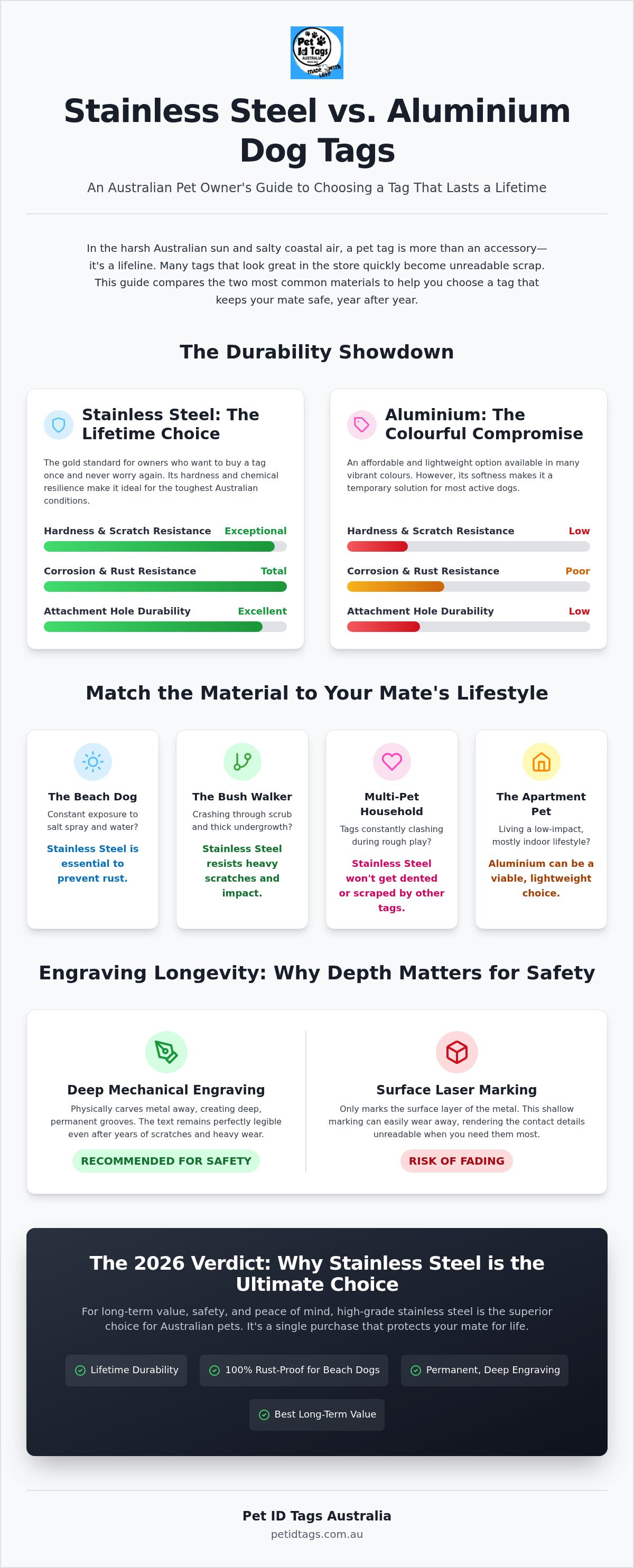
Choosing the right identification for your pet involves more than just picking a pretty shape. The core debate often centres on stainless steel vs aluminium dog tags, as these are the most common materials for pet tags used by Australian owners. While both serve the primary purpose of carrying contact details, their physical properties differ significantly. Aluminium is a soft, low-density metal. It is an affordable entry point and offers a wide range of vibrant colours through anodisation. However, this softness makes it a temporary solution for many. Stainless steel is a dense alloy designed for high-impact environments. It represents the gold standard for owners who want to buy a tag once and never worry about it again.
Hardness and Scratch Resistance
In the backyard or at the park, your dog’s tag is constantly under fire. Sand, grit, and even the metal ring of the collar itself act like sandpaper against the tag's surface. Stainless steel is exceptionally hard, meaning it resists the grinding effect that eventually turns other tags into illegible metal discs. Aluminium is significantly softer. Over time, surface scratches from rough play or contact with other tags can obscure the engraving. For active dogs who spend their days exploring, the hardness of steel is essential to ensure their name and your phone number remain visible for years, not just months.
Corrosion and the Aussie Coastal Factor
Australia’s coastal lifestyle is notoriously tough on metals. Salt air and frequent ocean swims can cause inferior alloys to pit and corrode rapidly. Aluminium tags often oxidise, developing a chalky white residue that ruins the finish and weakens the metal. High-grade stainless steel is non-negotiable for dogs who love the beach. It is naturally resistant to rust and maintains its polished appearance despite constant exposure to salt water. If your mate loves a surf at the local off-leash beach, steel is the only material that won't let you down.
A common concern for owners of smaller breeds like Chihuahuas or Toy Poodles is the weight of the metal. There is a persistent myth that stainless steel is too heavy for small dogs. In reality, a high-quality stainless steel tag weighs only a few grams more than its aluminium counterpart. When you consider the safety benefits, that negligible weight difference is a small price to pay for peace of mind. Most pets don't notice the tag at all, especially when paired with a lightweight quick clip to keep it secure and centred on their collar.
Matching the Material to Your Pet’s Lifestyle
Your dog’s daily routine is the ultimate test of their identification. A tag that thrives in a quiet city apartment will likely fail within weeks on a working farm or at a coastal dog park. When choosing between stainless steel vs aluminium dog tags, you must consider the specific environmental stressors your pet faces every day. Their lifestyle dictates whether a tag remains a life-saving tool or becomes a useless piece of metal.
For the "Beach Dog," salt water is the primary concern. While aluminium is lightweight, it lacks the chemical resilience to withstand constant immersion in brine. For the "Bush Walker," physical impact is the enemy. Dogs crashing through thick scrub or jumping over fences need a tag that won't bend, snap, or snag. Apartment pets living a low-impact lifestyle may find aluminium a viable, lightweight option. However, multi-pet households introduce a unique challenge: tag-on-tag wear. When dogs play, their tags constantly clash together. In this scenario, the harder metal always wins. Soft aluminium tags will quickly become dented and scarred, eventually making the contact details impossible to read.
Environmental Stressors to Consider
High humidity in northern Australia can cause rapid discolouration in many metal alloys. UV rays also take a toll on anodised aluminium, causing vibrant colours to fade into a dull, unappealing grey over a single summer. Stainless steel remains unaffected by the sun. It maintains its professional, polished look regardless of the weather, ensuring your contact information is always presented clearly to anyone who finds your pet.
Activity Levels and Mechanical Wear
One often overlooked failure point is the attachment hole. Because aluminium is a soft metal, the steel split ring used to attach it to the collar acts like a slow-moving saw. Over time, constant movement wears the hole into an oval shape until the tag eventually falls off. The mechanical properties of aluminum and steel confirm that steel is far more resistant to this type of mechanical erosion. Ensuring the tag stays on the collar is the first step in pet safety. Properly learning how to attach dog tag to collar ensures it won't get lost in the undergrowth during a high-energy chase. Investing in high-quality Stainless Steel Dog Tags is the most reliable way to guarantee your mate's ID remains secure and readable for years to come.
Engraving Longevity: Why Depth Matters for Safety
A dog tag is only as effective as the information it carries. If a stranger finds your mate but can't read your phone number because the text has worn away, the tag has failed its only job. When comparing stainless steel vs aluminium dog tags, the physical depth of the engraving is often the deciding factor for long-term safety. Many mass-produced tags use surface-level laser marking, which merely discolours the metal's surface. While this looks crisp on day one, it quickly disappears under the constant friction of a dog's daily life. Deep mechanical engraving actually carves a groove into the metal, ensuring the text remains readable even after years of backyard play and bush adventures.
High-grade stainless steel is the superior canvas for deep engraving because of its incredible density. It allows a specialist engraver to cut deeper into the material without compromising the tag's structural integrity. Aluminium is significantly softer; while it can be engraved, the surrounding metal is more prone to "burring" or wearing down, which eventually swallows the text. This "unreadable tag" risk is the primary reason pets aren't returned to their owners quickly. A surface-etched or printed tag might save you a few dollars today, but it often requires replacement within six months when the text begins to ghost and fade.
The Science of Legibility
Legibility is about more than just deep grooves; it's about contrast and resilience. In low-light conditions, a deep-cut engraving catches the light, making it easier for a concerned neighbour to read your details. Surface markings on aluminium often rely on a thin layer of paint or anodised colour that flakes off or dulls in the harsh Australian sun. You can learn more about why pet id tags fade and how material choice prevents this safety failure. Choosing steel ensures that the contrast between the polished surface and the engraved groove remains sharp for a decade or more.
What Information to Prioritise
Space is limited on any pet ID, so every character must count. For Australian owners, the "Mobile First" rule is essential; include your mobile number as the primary contact to ensure you can be reached instantly, regardless of where you are. Because stainless steel holds fine detail so well, you can often fit more information onto a smaller, more comfortable tag without sacrificing clarity. For a complete breakdown of what to include, check out these pet id tag engraving ideas to maximise your pet's safety. Prioritising depth and clear data is the most reliable way to ensure your mate always finds their way back home.
Key Features to Check Before You Buy
Choosing between stainless steel vs aluminium dog tags is the first step toward securing your pet's safety, but the manufacturing details determine if that tag actually lasts. A tag's structural integrity relies heavily on its physical dimensions. You should look for a metal thickness between 1.5mm and 2mm. Thinner tags, which are common in budget aluminium ranges, are prone to bending or snapping under the pressure of a snagged branch. A thicker tag provides the necessary "heft" to resist mechanical stress while allowing for the deep engraving mentioned earlier in this guide.
Edge finishing is another critical factor often overlooked by pet owners. Lower-quality tags often have sharp, stamped edges that can chafe your dog's skin or cause matting in long-haired breeds. High-quality tags feature a polished, rounded edge that sits comfortably against the neck. Additionally, consider the hypoallergenic properties of the metal. High-grade stainless steel is a medical-grade material that won't discolour your pet's fur or cause the skin irritations sometimes associated with cheap aluminium alloys or nickel-plated alternatives. It is a "clean" metal that remains inert even in humid or wet conditions.
Size and Weight Considerations
Selecting the right diameter is a balance between information density and your dog's comfort. A 25mm round tag is the industry standard for most breeds, providing enough surface area for essential contact details without being cumbersome. While it's true that steel is denser than aluminium, the actual weight difference on a collar is usually less than five grams. Most dogs are completely unaware of the tag once it's attached. For larger breeds, a 30mm tag offers more room for secondary contact numbers or medical alerts, ensuring the most critical data is never cramped or difficult to read.
Attachment Security
The strongest tag in the world is useless if it's lying in the grass at the local park. Most tags come with a standard split ring, but these can stretch and fail over time, especially if your dog is prone to crashing through thick scrub. For a more reliable solution, many Aussie owners are switching to a dog tag quick clip australia. These clips provide a secure, heavy-duty connection that makes it easy to move tags between different harnesses or collars without weakening the hardware. Preventing the "lost tag" scenario starts with choosing the right attachment gear. To ensure your mate is protected for years to come, you can browse our range of high-grade pet ID solutions and find the perfect match for your dog's lifestyle.
Why Stainless Steel is the Ultimate Choice for 2026
When you break down the long-term investment, the debate over stainless steel vs aluminium dog tags becomes a simple matter of economics. Australian pet owners are increasingly moving away from disposable pet products in favour of items that offer true longevity. A "Cost Per Year" analysis reveals that while aluminium tags have a lower initial price point, their tendency to bend, fade, or wear at the attachment hole often necessitates replacement every year or two. In contrast, a high-grade stainless steel tag is a "buy it once" solution. Over a ten-year period, the cost of a single steel tag is significantly lower than the cumulative expense of multiple aluminium replacements.
Beyond the financial savings, there is the undeniable benefit of aesthetic permanence. Stainless steel maintains its high-polish, professional finish despite years of exposure to the elements. It doesn't oxidise or develop the dull, battered appearance common with softer metals. Most importantly, it provides absolute peace of mind. In an emergency situation, you need to know with 100% certainty that your contact details are legible. Choosing steel means your mate's ID will be just as clear in five years as it was on the day it arrived in the mail.
The final verdict is clear. Aluminium remains a viable choice for low-impact indoor pets or as a temporary ID during a holiday. However, for any dog that spends time outdoors, interacts with other pets, or visits the coast, stainless steel is the only material that meets the required safety standards. It is the ultimate choice for owners who value reliability over a low entry price.
The Pet ID Tags Australia Advantage
We specialise in a high-grade stainless steel collection specifically engineered for the active Australian lifestyle. Our commitment to deep, permanent mechanical engraving ensures that your pet’s safety is never compromised by surface wear. Whether your dog prefers a classic round disc, a bone shape, or a heart, our durable steel range offers the variety you want without sacrificing the strength you need. We realise that every pet is unique; that's why we provide a wide selection of shapes designed to withstand the toughest Aussie conditions.
Ready to Secure Your Mate’s Safety?
Upgrading to a premium material is the most practical step you can take to protect your dog. To summarise, stainless steel offers three distinct advantages for 2026: superior mechanical strength, permanent engraving legibility, and the best long-term value for money. Don't wait for your current tag to become unreadable before you make the switch. You can Browse our range of durable Stainless Steel Dog Tags here to find a permanent safety solution that will last your mate a lifetime.
Secure Your Mate's Future with a Permanent ID
The safety of your pet depends on an ID tag that remains legible long after the day it's first attached. When evaluating stainless steel vs aluminium dog tags, the superior choice for active Australian dogs is clear. Stainless steel provides the essential hardness to survive abrasive sand, thick scrub, and the corrosive effect of salt water. It's a "buy it once" investment that ensures your phone number never ghosts or fades away.
Our collection is built for strength and long-lasting identification. These tags are resistant to rust and wear in Aussie conditions, meaning they won't discolour your pet's fur or snap off during rough play. Every tag is deep-engraved for permanent legibility, providing the most reliable way to get your mate home quickly if they ever wander off. You don't want to find out a tag is unreadable when it matters most.
Don't leave your pet's security to chance with a temporary solution. Shop our Engraved & Durable Stainless Steel Dog Tags today and give your mate the protection they deserve for a lifetime of adventure. It's the simplest way to ensure you're always just a phone call away.
Frequently Asked Questions
Is stainless steel or aluminium better for a dog tag?
Stainless steel is the superior choice for most Australian dogs due to its exceptional durability and longevity. While aluminium is a lightweight and affordable entry point, it lacks the hardness required to withstand an active lifestyle. Steel resists deep scratches and mechanical wear much more effectively, ensuring your pet’s identification remains readable for a decade or more rather than just a few seasons.
Do stainless steel dog tags rust at the beach?
High-grade stainless steel tags are naturally resistant to rust and corrosion, even with frequent exposure to salt water and sea spray. Unlike lower-quality alloys or chrome-plated metals, they maintain their polished finish and structural integrity after countless coastal swims. This makes them the most reliable option for dogs who spend their weekends splashing in the surf at off-leash beaches.
Are stainless steel tags too heavy for small dogs or cats?
The weight difference between a standard stainless steel tag and an aluminium one is negligible, usually less than five grams. Most small dogs and cats won't notice the difference once the tag is attached to their collar. For toy breeds or feline friends, choosing a 20mm or 25mm steel tag provides maximum safety and durability without being cumbersome or uncomfortable for the pet.
Why does the engraving on my aluminium tag keep fading?
Aluminium is a soft metal, and many budget versions use surface-level laser marking or thin paint. Friction from the collar ring and contact with sand acts like sandpaper, quickly wearing away these shallow marks. When comparing stainless steel vs aluminium dog tags, the density of steel allows for much deeper mechanical engraving that survives years of friction without ghosting or disappearing.
Can I get my stainless steel tag engraved on both sides?
Yes, our stainless steel range is designed to be deep-engraved on both the front and the back. This dual-sided capacity is ideal for Australian owners who need to include multiple contact numbers, a suburb, or critical medical alerts. Because the metal is so strong, engraving both sides does not compromise the tag's structural integrity or lead to bending over time.
What is the most durable dog tag for a dog that swims?
Stainless steel is the most durable choice for dogs that love the water. It handles the chemical stress of salt water and pool chlorine without pitting, oxidising, or developing a chalky residue. For water-loving pets, stainless steel vs aluminium dog tags is a simple choice; steel remains polished and perfectly legible regardless of how many hours your mate spends in the water.
How often should I replace my pet's ID tag?
You should inspect your pet's tag every few months and replace it immediately if the text becomes difficult to read. Aluminium tags often require replacement every 12 to 24 months due to surface wear and hole elongation. A high-quality stainless steel tag is a "buy it once" investment designed to last the life of your pet, provided your contact details remain the same.
Does stainless steel discolour a white dog's fur?
No, high-grade stainless steel is a non-reactive, hypoallergenic material that will not leave grey or green marks on your pet's coat. This type of discolouration is typically caused by the oxidation of lower-quality aluminium or nickel-plated tags when they get wet. Steel remains inert and clean, making it the safest and most aesthetic choice for dogs with light-coloured or sensitive skin.