

A dog tag that wears down until it's unreadable isn't just a waste of money; it's a genuine risk to your pet's safety in a country where local councils can issue fines of over $330 for missing or illegible identification. When deciding between stainless steel vs aluminium dog tags, many owners prioritise a low price or a bright colour, only to find the metal corrodes or scratches within a single season at the beach. You want a solution that won't discolour your dog's fur, won't snap off during a rough bush walk, and won't stop being useful when it matters most.
We'll help you discover which material truly survives the harsh Aussie elements to keep your mate safe for a lifetime. This guide breaks down the technical differences in durability, weight, and engraving depth so you can invest in a tag that remains crystal clear for ten years or more. Whether you have a kelpie working in the scrub or a pug lounging in the backyard, you'll learn how to balance value for money with the ultimate peace of mind.
Key Takeaways
- Understand the fundamental hardness differences when comparing stainless steel vs aluminium dog tags to ensure your pet's ID survives more than just a single season.
- Match your material choice to the Aussie lifestyle, focusing on which metals resist rust at the beach and won't snag or bend during a bush walk.
- Learn why deep-engraving technology is critical for long-term legibility, preventing the common risk of contact details becoming unreadable over time.
- Identify the specific metal thickness and edge-finishing standards required to keep your mate comfortable and safe during heavy play.
- Discover the long-term financial value of a 'buy it once' approach that maintains a professional look while securing your pet's safety for a lifetime.
Stainless Steel vs Aluminium Dog Tags: The Durability Showdown
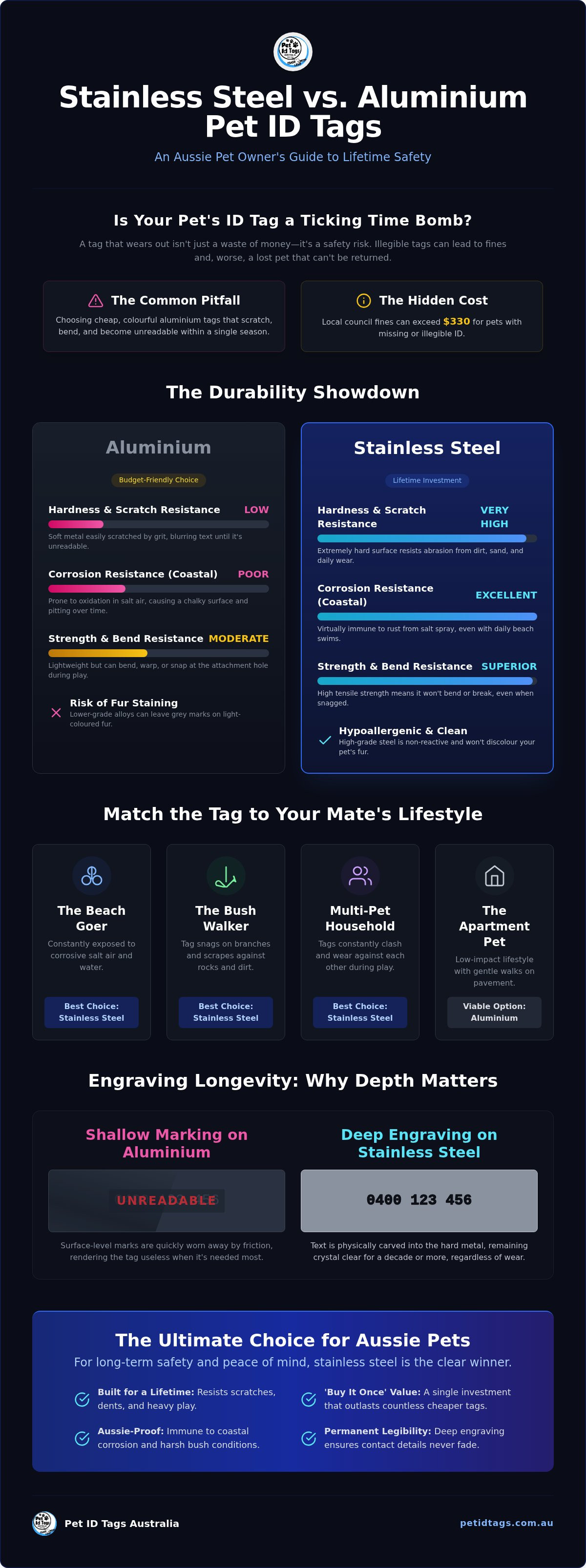
Choosing between stainless steel vs aluminium dog tags often comes down to a choice between immediate cost and long-term reliability. Aluminium serves as an accessible, lightweight entry point. It is easy to colour and cheap to produce, but it lacks the structural integrity required for a lifetime of use. Stainless steel is the industrial-grade alternative. It offers a level of density and hardness that ensures the tag remains intact regardless of how hard your dog plays, a quality often highlighted by metal fabrication experts like donewrightstainless.com. For most Australian owners, the decision rests on whether they want to buy a new tag every year or invest in one that lasts a decade.
Hardness and Scratch Resistance
Stainless steel is significantly harder than aluminium on the Mohs scale. This physical property is vital for pet safety. When a dog plays in the dirt or rolls in the grass, fine particles of silica and grit act like sandpaper against the metal. On a softer aluminium surface, these particles create micro-scratches that eventually blur the engraving until the phone number is unreadable. Stainless steel resists this grinding effect. You can find more details on the durability of common pet tag materials which highlights why harder metals are the preferred choice for active animals in rugged environments.
Corrosion and the Aussie Coastal Factor
For many Australians, the beach is the backyard. Salt air is incredibly aggressive toward metal. While aluminium is often marketed as "rust-proof," it is highly prone to oxidation. This process creates a chalky white powder on the surface and causes the finish to dull and pit over time. High-grade stainless steel is virtually immune to this type of coastal decay. It maintains its polished finish and structural strength even after years of daily salt spray and ocean swims. It won't leave dark grey marks on your dog's fur, a common issue with lower-quality aluminium alloys that begin to break down.
Weight Comparisons and the Small Dog Myth
A common misconception among pet owners is that stainless steel is too heavy for smaller breeds. In reality, the weight difference is negligible for the animal. A standard 25mm stainless steel tag typically weighs only a few grams more than an aluminium one. This minor difference in mass provides a major increase in security. While an aluminium tag can bend or snap at the attachment hole during a rough game of fetch, a steel tag remains rigid. It provides the necessary strength to stay attached to the collar during heavy scrub walks or backyard zoomies.
- Stainless Steel: High density, superior scratch resistance, and zero rust.
- Aluminium: Lightweight and colourful, but prone to bending and surface wear.
- The Verdict: Stainless steel is the "buy it once" solution for active Australian pets.
Matching the Material to Your Pet’s Lifestyle
Your dog's daily routine is the ultimate stress test for their identification. A tag that works for a toy poodle in a Sydney apartment might fail a kelpie working on a Queensland station within months. When weighing up stainless steel vs aluminium dog tags, you must consider the specific environmental "punishment" the metal will endure. Identification isn't a one-size-fits-all accessory; it's a piece of safety equipment that must match your pet's activity level.
If your weekends involve trips to the coast, salt water makes the decision for you. Salt is incredibly corrosive. While aluminium often develops deep pits and a white, chalky oxidation in coastal air, stainless steel remains indifferent to the spray. For the "Bush Walker" profile, physical impact is the primary concern. In heavy scrub, tags often snag on branches or drag through the dirt. The stainless steel vs. aluminum strength profile shows that steel has a much higher tensile strength, meaning it won't bend or snap when caught in the undergrowth.
Multi-pet households face a unique challenge: "tag-on-tag" wear. When two dogs wrestle, their collars and tags constantly clash. This repetitive mechanical impact acts like a small hammer. Over time, softer aluminium tags will deform, and the edges will sharpen, potentially irritating your dog's skin. In these high-energy homes, the density of steel is a clear winner. However, for the quiet "Apartment Pet" who only leaves the house for lead-walks on pavement, lightweight aluminium remains a viable, budget-friendly option.
Environmental Stressors to Consider
Australia's climate is notoriously harsh on materials. High humidity in northern regions can accelerate the discolouration of lower-grade alloys, leading to "grey neck" where the metal rubs off on your pet's fur. Additionally, the intense Aussie sun is a factor. Most aluminium tags are anodised to provide colour, but UV rays eventually break down these dyes. Within a year, a bright red tag can fade to a dull, unreadable pink. Stainless steel avoids this entirely by relying on its natural, polished finish which never fades or peels.
Activity Levels and Mechanical Wear
The most common failure point for any ID is the attachment hole. In what we call the "split ring test," the constant movement of the tag against the metal ring slowly saws through the hole. Because aluminium is a soft metal, this hole eventually elongates and thins until the tag simply falls off. This is the hidden failure mode that leads to lost pets. Heavy-duty dogs require the structural integrity of steel to ensure the hole remains circular and secure for years. Once you've chosen the right material, knowing how to attach dog tag to collar correctly will further reduce the risk of it being lost during play. For a tag that stands up to the most demanding Aussie lifestyles, our stainless steel dog tags provide the permanent security your mate deserves.
Engraving Longevity: Why Depth Matters for Safety
A dog tag is a piece of safety equipment. If the text disappears, the equipment has failed. Many budget options use surface-level laser marking or printing that looks great in the shop but vanishes after a few months of friction against a collar. When comparing stainless steel vs aluminium dog tags, the most critical factor is how deep the metal can be cut without compromising its structural integrity. Deep mechanical engraving actually removes metal to create a permanent groove, ensuring your contact details remain visible for the life of the tag.
Material hardness plays a massive role in how well these grooves hold up. You can read more about engraving longevity on metal to understand how harder materials like stainless steel maintain their legibility far longer than softer alternatives. On an aluminium tag, the metal is so soft that the edges of the engraving can "mush" over time, effectively filling in the letters. Stainless steel provides a crisp, deep channel that resists being flattened by the constant rubbing of other tags or the split ring.
The "unreadable tag" risk is the primary reason lost pets aren't returned quickly. A person who finds your dog in the street won't spend ten minutes trying to decipher a faded etch. They need to see a phone number instantly. Surface-etched tags often fail within six months of active use, especially if your dog enjoys a swim or a roll in the dirt. Deep engraving on a durable steel base ensures that even if the tag gets scratched, the information remains trapped in the metal, protected from surface wear.
The Science of Legibility
Legibility isn't just about the size of the font; it's about contrast and light. On a bright day, a shallow etch becomes invisible due to glare. Understanding why pet id tags fade helps you choose a material that maintains high contrast in the harsh Australian light. Stainless steel provides a natural silver-on-dark contrast that remains readable in low-light conditions, ensuring your mate can be identified at dusk or dawn when many dogs tend to go missing.
What Information to Prioritise
Australian pet owners should follow the "Mobile First" rule. Your current mobile number is the most important piece of data you can provide. Space is limited, especially on smaller stainless steel tags that prioritise strength over surface area. By using these pet id tag engraving ideas, you can organise your contact details to ensure they are the first thing a rescuer sees. Focus on clarity over decorative flourishes to make the job of a helpful stranger as easy as possible.
Key Features to Check Before You Buy
Selecting the right material is only half the battle. The physical construction of the tag determines whether it remains a comfortable, permanent fixture on your dog's collar or becomes a sharp, irritating nuisance. When evaluating stainless steel vs aluminium dog tags, you must look closely at the manufacturing specifications. A high-quality tag isn't just a piece of metal; it is a precision-engineered safety tool designed to withstand thousands of hours of movement and friction.
Metal thickness is the first indicator of quality. For maximum durability, look for tags in the 1.5mm to 2mm range. Many budget aluminium options are significantly thinner, often less than 1mm, which makes them prone to "tacoing" or bending under pressure. A thicker tag provides the necessary depth for deep engraving and ensures the attachment hole doesn't wear through prematurely. Additionally, check the edge finishing. Cheaply stamped tags often have microscopic burrs or sharp edges that can snag on fur or irritate sensitive skin. Quality tags undergo a polishing process to ensure every edge is smooth and rounded.
Hypoallergenic properties are another vital consideration. Some pets develop contact dermatitis from lower-grade metal alloys or the dyes used in anodised aluminium. High-grade stainless steel is the preferred choice for dogs with sensitive skin. It is non-reactive and does not oxidise or leach metallic smells onto the coat. This ensures your mate stays comfortable even during the humid summer months when skin irritation is most common.
Size and Weight Considerations
Matching the tag diameter to your breed's size is essential for both safety and comfort. A tag that is too large for a small breed can interfere with their movement or dip into their water bowl, while a tag that is too small for a large breed may be difficult for a rescuer to read. While steel is denser than aluminium, a well-sized 25mm steel tag is still light enough for almost any dog to wear without noticing. The added weight is a small trade-off for a tag that won't snap or deform during a vigorous backyard play session.
Attachment Security
The best tag in the world is useless if the hardware fails. Most tags come with a standard split ring, but these can stretch open if caught on a fence or thick scrub. Upgrading to a specialized fastener can prevent the "lost tag" scenario entirely. If you frequently swap tags between different collars or harnesses, reading our guide on the dog tag quick clip australia will help you choose a more secure attachment method. To ensure your pet is protected by the highest standards of durability, browse our full range of stainless steel dog tags today.
Why Stainless Steel is the Ultimate Choice for 2026
Deciding between stainless steel vs aluminium dog tags often comes down to a choice between a small upfront saving and a lifetime of security. While aluminium serves as a colourful entry point, the long-term data clearly favours steel as the superior investment for the Australian climate. A "Cost Per Year" analysis reveals that a single stainless steel tag can easily last over ten years, whereas an aluminium tag often requires replacement every twelve to eighteen months due to surface wear or hole elongation. You aren't just purchasing a piece of metal; you're investing in a permanent insurance policy for your dog's identity.
Aesthetic permanence is another factor that sets steel apart. Aluminium tags rely on anodised coatings that inevitably chip, fade, and pit when exposed to grit and salt air. Stainless steel maintains its polished, professional look regardless of how many bush walks or ocean swims your mate enjoys. It doesn't tarnish, it doesn't leave grey marks on white fur, and it doesn't lose its shine. Most importantly, it provides the peace of mind that comes from knowing your contact details will be perfectly readable if your pet ever wanders off in an emergency.
The final verdict is straightforward. If your dog is an active member of the family who spends time outdoors, stainless steel is the only logical choice for 2026. Aluminium remains a viable, budget-friendly option for apartment-bound pets or very senior dogs with minimal activity levels. For the vast majority of Aussie dogs, the physical strength and corrosion resistance of steel provide a level of safety that softer metals simply cannot match.
The Pet ID Tags Australia Advantage
Pet ID Tags Australia specialises in a high-grade stainless steel collection designed specifically for the rugged Australian lifestyle. We understand that a tag needs to survive the scrub, the surf, and the backyard zoomies without failing. Our commitment to deep, permanent mechanical engraving ensures that your contact details are carved into the metal rather than just marked on the surface. We offer a wide variety of shapes and sizes in our durable steel range, ensuring that every breed from a Chihuahua to a Great Dane can have a tag that fits perfectly and lasts a lifetime.
Ready to Secure Your Mate’s Safety?
Upgrading to a premium material is the simplest way to ensure your pet can always be identified. When you choose from our specialised steel range, you are choosing three critical benefits for your dog:
- Unmatched Durability: A tag that won't bend, snap, or corrode in the Aussie elements.
- Permanent Legibility: Deep-cut engraving that remains crystal clear for a decade or more.
- Superior Value: A "buy it once" solution that saves you money on replacements over the long run.
Don't wait until a tag becomes unreadable to make the switch. Ensure your dog's way home is always clearly marked. Browse our range of durable Stainless Steel Dog Tags here and give your mate the protection they deserve.
Secure Your Mate’s Safety with Permanent Identification
Choosing the right ID is a small decision with massive consequences for your pet's security. We've seen that while aluminium offers a lightweight start, it often lacks the structural integrity to survive the grit of the Aussie bush or the salt of our coastlines. High-grade stainless steel remains the gold standard for owners who want to buy a tag once and never worry about it again. It provides the necessary hardness to hold deep, permanent engraving that stays legible regardless of how many backyard zoomies or ocean swims your dog enjoys.
When you compare stainless steel vs aluminium dog tags, remember that durability is the ultimate safety feature. A tag that snaps or fades is a tag that fails when your mate needs it most. By selecting a material built for strength and resistant to rust and wear, you ensure that your contact details are always ready to lead your pet home. Deep-engraved text isn't just a design choice; it's a vital insurance policy for your pet's return.
Shop our Engraved & Durable Stainless Steel Dog Tags and invest in identification that won't let you down. Professional craftsmanship ensures your dog stays protected through every adventure. Your mate deserves a tag as resilient as they are.
Frequently Asked Questions
Is stainless steel or aluminium better for a dog tag?
Stainless steel is the superior choice for any pet that leads an active lifestyle. While aluminium is a lightweight and budget-friendly entry point, it lacks the hardness required to resist scratches and bending. For a tag that remains readable for a decade or more, the physical strength of steel is unmatched. It is the definitive option for owners who want to buy once and ensure their pet's safety permanently.
Do stainless steel dog tags rust at the beach?
High-grade stainless steel dog tags will not rust, even with frequent exposure to salt water and ocean spray. Unlike other metals that pit or develop a chalky oxidation, steel maintains its structural integrity and polished finish in coastal conditions. This makes it the non-negotiable choice for Aussie dogs who spend their weekends at the beach or swimming in local waterways.
Are stainless steel tags too heavy for small dogs or cats?
Stainless steel tags are not too heavy for smaller breeds or cats when sized correctly. A standard 25mm steel tag only weighs a few grams more than an aluminium version, a difference that is unnoticeable to the animal. We offer various diameters to ensure the tag matches the pet's frame without causing discomfort or dragging in the water bowl.
Why does the engraving on my aluminium tag keep fading?
Engraving on aluminium fades because the metal is soft enough to be worn down by daily friction against the collar or other tags. Fine grit and sand act as an abrasive, slowly grinding away the surface layers. When comparing stainless steel vs aluminium dog tags, steel is the better choice because its hardness allows for much deeper engraving that survives years of mechanical wear.
Can I get my stainless steel tag engraved on both sides?
Yes, you can certainly have your stainless steel tag engraved on both sides. The density of the material ensures that deep mechanical engraving can be applied to the front and back without compromising the tag's strength. This is ideal for including the pet's name on one side and multiple emergency contact numbers on the other for maximum safety.
What is the most durable dog tag for a dog that swims?
Stainless steel is the most durable option for dogs that swim regularly. It is completely resistant to the corrosive effects of both salt water and chlorine. While aluminium can oxidise and lose its finish after repeated soaking, a steel tag will retain its shine and legibility. It is the "buy it once" solution for water-loving kelpies, labs, and retrievers.
How often should I replace my pet's ID tag?
You should only need to replace a high-quality stainless steel tag once every ten years or more. However, you should check your pet's ID every six months to ensure the contact details are still perfectly legible and the attachment hole isn't thinning. If you use aluminium, you may find yourself replacing the tag annually as the soft metal wears down and the text becomes blurred.
Does stainless steel discolour a white dog's fur?
High-grade stainless steel will not discolour a white dog's fur. The "grey neck" often seen on light-coated breeds is usually caused by the oxidation of lower-quality aluminium or the presence of nickel in cheap alloys. Because steel is non-reactive and corrosion-resistant, it stays clean and won't leave metallic residues on your pet's coat, even in humid Australian conditions.