

Is a cheap Bluetooth tag enough to save your dog's life, or are you just buying a false sense of security for the Australian suburbs? If you think a standard smart tag is a foolproof way to find your mate in the scrub, you might be betting their safety on a network that simply doesn't exist where you need it most. We all want that ironclad peace of mind that comes from reliable gear, but the debate over smart tags vs gps trackers australia often leaves owners frustrated by dead batteries and confusing monthly subscriptions.
You deserve to know exactly how this technology performs before an emergency happens. This guide clarifies the critical differences between Bluetooth proximity and satellite precision, ensuring you choose the right tool for your pet's specific "roam zone." We will look at why crowd density matters for smart tags and how GPS units handle the vast Australian landscape. From battery longevity to real-world reliability in 2026, we will help you make an informed decision based on durability and function.
Key Takeaways
- Grasp the technical difference between community-reliant Bluetooth and independent satellite tracking to ensure your mate is never truly off the grid.
- Decide between smart tags vs gps trackers australia by matching your pet's primary "roam zone" to local network density and terrain.
- Weigh the long-term utility of a 12-month battery against the high-precision, real-time location updates provided by GPS hardware.
- Discover why a durable physical ID tag is your ultimate backup when tech fails or networks drop out in low-density areas.
- Identify the best form factor for your pet's size to ensure their safety gear is a functional asset rather than a bulky distraction.
Smart Tags vs GPS Trackers: Decoding the Tech for Aussie Pets
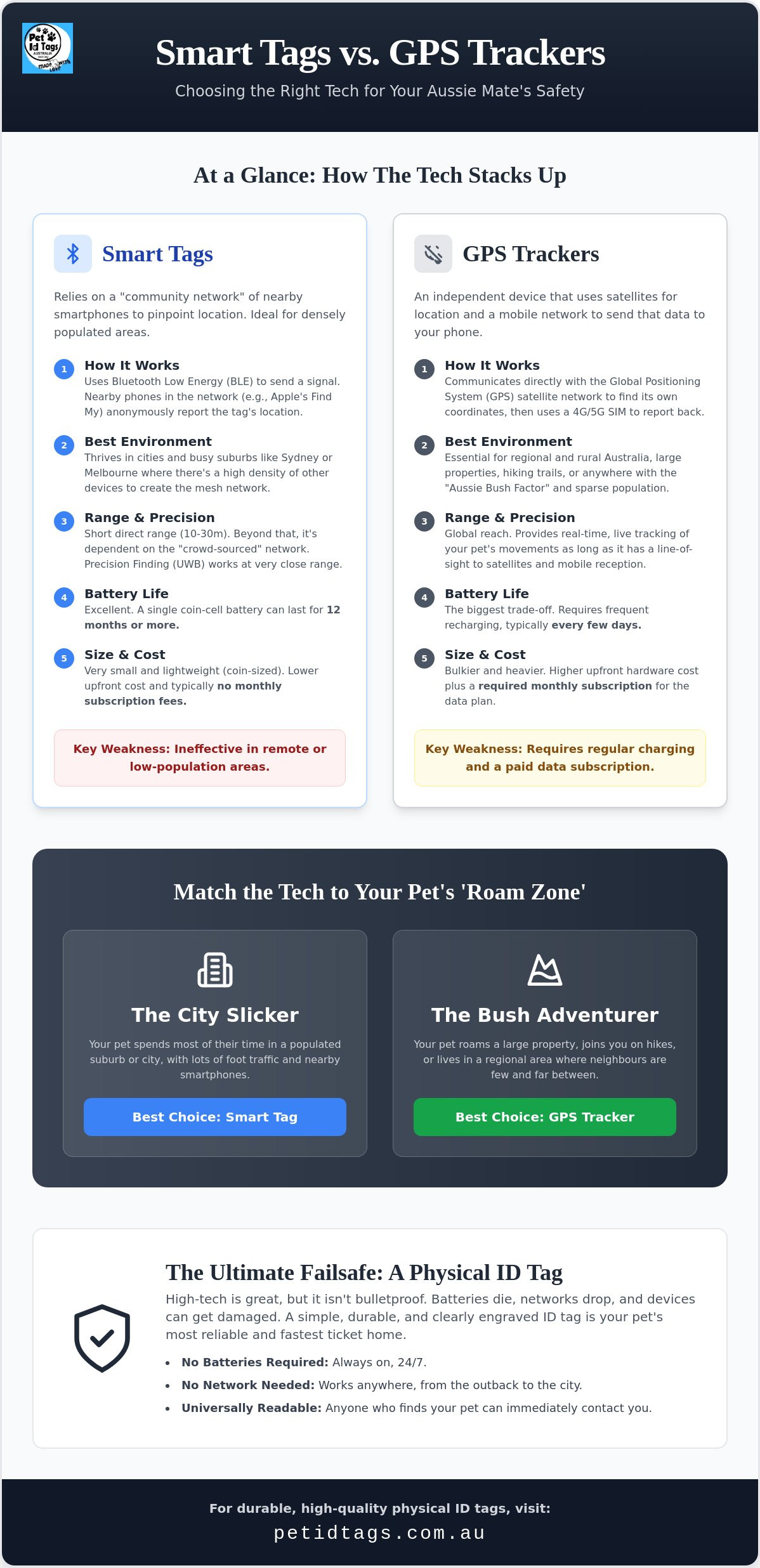
Choosing the right safety gear for your pet requires a clear look at the hardware. The debate over smart tags vs gps trackers australia often comes down to how the device talks to the world. Smart tags are "community-reliant" beacons. They don't have an internal GPS chip or a cellular radio. Instead, they use Bluetooth Low Energy (BLE) to send out a silent signal. This signal is picked up by nearby smartphones, which then relay the location to the owner. It is a clever, low-power solution that works brilliantly in crowded spaces, but it has zero independence.
Conversely, GPS trackers are "independent" powerhouses. These units contain dedicated receivers that communicate with a global network of satellites. This GPS animal tracking technology allows the device to calculate its own coordinates without needing a phone nearby. Once the location is locked, the tracker uses a cellular network to send that data to your phone. This creates the primary trade-off: battery life versus real-time precision. A smart tag can run for a year on a tiny battery, while a GPS unit usually needs a charge every few days because it's doing much heavier lifting.
How Smart Tags Work in the Suburbs
In metropolitan hubs like Sydney or Melbourne, smart tags turn every passing stranger into a search party. They rely on a "Bluetooth Mesh" where millions of devices form a silent network. If your dog wanders into a busy park, their tag pings off every iPhone or Samsung in the vicinity. This is excellent for city dwellers, especially with Ultra-Wideband (UWB) features that provide "precision finding." This tech gives you an arrow on your screen to find a pet hiding in thick garden beds once you are within about 10 metres. However, if your pet ends up in a quiet industrial area at 3 AM, the lack of nearby phones means no location updates.
How GPS Trackers Navigate the Great Outdoors
For regional owners or weekend hikers, the community network is too thin to be reliable. GPS trackers are designed for the "Aussie Bush Factor." By using 4G, 5G, or LTE-M cellular bands alongside satellite signals, these devices work wherever a mobile signal exists. You can see your pet's movement in real-time, even if there isn't another human for kilometres. Most units require an Australian SIM card or a monthly subscription to cover the data costs. While the hardware is often bulkier, the independence it provides is non-negotiable for anyone living outside major city centres. It ensures you aren't left waiting for a stranger to walk past your lost mate.
The Range Reality Check: Bluetooth Mesh vs Satellite Coverage
Understanding the distinction between direct range and network reach is vital for any owner comparing smart tags vs gps trackers australia. A smart tag usually has a direct Bluetooth range of just 10 to 30 metres. Beyond that short distance, you are entirely reliant on the presence of other people's devices to relay a signal. GPS trackers, however, offer global reach by communicating directly with satellites orbiting the Earth. This independence makes a massive difference if your dog decides to chase a kangaroo into the scrub where human foot traffic is non-existent.
Signal interference also plays a role depending on your environment. In high-rise apartment blocks, Bluetooth signals can often bounce around concrete walls effectively; yet, GPS units may struggle with "urban canyons" where tall buildings block the line-of-sight to satellites. Conversely, in open paddocks, GPS is the undisputed king. While a smart tag might only tell you where your dog was 20 minutes ago when a neighbor walked past, a GPS tracker provides a live stream of their movement. This update frequency is the difference between finding your mate in minutes or searching for hours based on an outdated ping.
Crowd-Sourcing Safety: The Power of the Mesh
In metropolitan areas, smart tags are highly effective because of the sheer density of Apple or Samsung users. When you activate "Lost Mode," your tag waits for a compatible smartphone to detect its encrypted signal and update its location on a map. This "passive" tracking relies on the community mesh. If you live in a quiet cul-de-sac or a rural town, the recovery speed drops significantly because there simply aren't enough "pings" to keep the location current. For city dwellers, this tech is often a sufficient first line of defence, especially when paired with a highly visible Smart Pet Tag for immediate identification.
The Satellite Advantage for Adventurous Hounds
If you enjoy remote hiking trails or live on a large regional property, the lack of crowd-sourced data makes satellite coverage non-negotiable. Active "bolters" require the live-map view that only GPS hardware can provide. These units allow you to set up a "Geofence," which is a digital boundary around your yard or campsite. The moment your dog crosses that line, your phone receives an instant alert. While Australian topography like deep valleys or thick rainforest can occasionally delay satellite lock-on times, the independence from cellular towers and passing strangers provides a level of security that Bluetooth simply cannot match. Even with these high-tech tools, ensuring you follow mandatory microchipping laws in Australia remains your primary legal responsibility for pet recovery.
Battery Life, Size, and Durability: The Practical Comparison
Maintenance is the silent killer of many pet safety strategies. When weighing up smart tags vs gps trackers australia, the most immediate physical difference is how often you'll need to interact with the device. Smart tags offer a "set and forget" experience with a battery life that typically lasts 12 months. This is a massive advantage for low-maintenance owners who don't want another gadget on their nightly charging rotation. In contrast, a GPS tracker is a high-performance tool that usually requires a recharge every 2 to 7 days. If you forget to plug it in, the most advanced tracker in the world becomes an expensive piece of plastic exactly when your pet goes missing.
Durability is another area where Australian conditions test these devices to their limits. Between the fine red dust of the interior, the thick mud of the tropical north, and the salt water of our coastal dog beaches, an electronic tracker must be rugged. Most smart tags are built with high ingress protection (IP) ratings, making them resilient against splashes and grit. However, the bulkier housing of many GPS units can sometimes create more "snag points" in thick scrub. While these devices provide a high-tech safety net, they are never a substitute for permanent identification. Understanding how pet microchips work is essential; a chip cannot run out of battery or get lost in the bush, making it the only truly permanent way to link your pet back to you.
Weight and Comfort for Your Mate
Size matters for your pet's daily comfort. A standard smart tag weighs roughly 10 grams, making it suitable for cats and small breeds like a Jack Russell. GPS units are significantly heavier due to their larger batteries and internal antennas. Adding a bulky GPS unit to a small dog's neck can affect their posture and comfort. For a secure fit, many owners prefer mounting these devices onto personalised dog collars Australia. A well-fitted collar prevents the tracker from dangling or snagging on branches during a backyard zoomie or a bush walk.
The True Cost of Ownership in 2026
The financial commitment varies wildly between these two technologies. Smart tags are generally a "one-and-done" purchase. You buy the tag, pair it to your phone, and you're set for the year. This appeals to budget-conscious owners who want a basic layer of protection without recurring bills. GPS trackers involve a higher upfront cost for the hardware plus an ongoing monthly subscription fee to cover cellular data usage. In 2026, these fees are standard for live-tracking features. When deciding on smart tags vs gps trackers australia, you must decide if the peace of mind of a live map is worth the price of a couple of coffees every month.
Choosing Your Kit: A Decision Framework for Aussie Owners
Selecting the right gear isn't about buying the most expensive option; it's about matching the tech to your pet's lifestyle. For the "Suburban Sniffer" who spends their time in fenced backyards and local council parks, a smart tag is usually more than enough. These city-dwelling dogs are constantly surrounded by the community mesh, making recovery fast and simple. Conversely, the "Bush Walker" requires the independence of a satellite connection. If your weekends involve regional trails or camping in the High Country, GPS is non-negotiable. It provides the only reliable way to track a mate who has vanished into the scrub where Bluetooth signals simply don't reach.
For owners of an "Escape Artist," the real-time alerts of a GPS unit can be a game-changer. By setting up a geofence, you get a notification the moment your dog pushes through a loose paling in the fence. This allows you to catch a bolter before they ever reach a busy road. For the "Indoor Cat," smart tags are the superior choice. Their tiny form factor doesn't bother a feline, and the precision-finding features help you locate a cat hiding in the back of a dark wardrobe or under the floorboards. If you're ready to secure your pet's safety with a reliable solution, explore our range of Smart Pet Tags designed for the Australian lifestyle.
The "Roam Zone" Evaluation
Before committing to a high-tech solution, you must evaluate your local environment. We define the "Roam Zone" as the 5km radius around your home where your pet is most likely to be found if they wander off. For those looking to purchase a home in a pet-friendly Melbourne suburb, Your Australian Property Buyers Agents can help you secure a property with the right layout and location for your needs. Check your local 4G/5G coverage maps; if you live in a cellular dead zone, a GPS tracker will struggle to send data to your phone. Similarly, look at your neighbour density. In a new housing estate with thousands of residents, a smart tag network will be incredibly robust. In a rural township with large acreages, the "Find My" network might only ping once every few hours, making smart tags vs gps trackers australia a clear win for satellite tech in those areas.
Privacy and Security Considerations
Modern tracking tech comes with built-in safety features that every owner should understand. Anti-stalking alerts are common in 2026; these notify a stranger if your pet's tag is "following" them for an extended period. While this is a vital human safety feature, it can occasionally alert a well-meaning Good Samaritan that they are being tracked. You should also consider who can see your pet's location. Most reputable apps use end-to-end encryption for location data stored in the cloud. To avoid constant notifications, use the "Safe Zones" feature in your GPS app. This silences alerts while your dog is at home or at a trusted doggy daycare, ensuring you only get pinged when there is a genuine concern.
Why High-Tech Isn’t Bulletproof: The Essential Role of Physical ID
Relying solely on electronics is a gamble that many Aussie pet owners lose when they most need a win. While the debate over smart tags vs gps trackers australia focuses on satellites and Bluetooth mesh, it often ignores the "Dead Battery" Dilemma. If your tracker runs out of juice or loses signal in a regional dead zone, your pet is effectively invisible to your phone. Technology is a powerful tool, but it is not a replacement for the immediate, readable information found on a physical tag. When a stranger finds a lost dog, they won't reach for a charging cable or check for a Bluetooth signal first. They will look for a phone number.
The most reliable safety strategy is a hybrid approach. This involves pairing your high-tech electronic tracker with a durable dog tag that requires no power to function. Think of it as lifetime insurance for your mate. High-quality stainless steel dog tags are particularly effective because they won't rust, snap, or fade under the harsh Australian sun. They provide a permanent point of contact that works 100% of the time, regardless of cellular coverage or battery health.
Engraving vs. Digital Profiles
Digital profiles and QR code tags have gained popularity, but they introduce unnecessary friction. A Good Samaritan might have a dead phone, poor reception, or simply "QR code fatigue." Deep-engraved text is universally readable. It doesn't require a specific app or tech skills to decipher. Your pet id tag engraving ideas should prioritize clarity. Including phrases like "I am Chipped" or "I have a GPS Tracker" can also tell a rescuer exactly how to help. This simple addition ensures that even if your tracker's battery has failed, the person who finds your pet knows that more data is available.
The Ultimate Fail-Safe Setup
True peace of mind comes from a three-pillar safety system. First, ensure your pet's microchip details are up to date. Second, equip them with an electronic tracker suited to their "Roam Zone." Third, use a personalised dog collar or a heavy-duty tag as your primary fail-safe. A physical tag with your current mobile number is the fastest ticket home for any pet. It bypasses the need for vets, scanners, or smartphone apps. When you organise your pet's gear this way, you aren't just comparing smart tags vs gps trackers australia; you are building a redundant safety net that protects them in every possible scenario.
Secure Your Mate’s Future Safety Today
Finding the right balance between smart tags vs gps trackers australia depends entirely on your pet's specific roam zone and your own maintenance habits. While Bluetooth tags offer simplicity for city dwellers, GPS trackers provide essential independence for those exploring the regional bush. The most critical lesson for any owner is that technology works best when backed by a permanent, physical fail-safe. Electronics can fail or run out of charge, but a high-quality, physical tag is always readable and ready to help a Good Samaritan get your pet home fast.
We invite you to browse our range of Smart Pet Tags and high-durability ID solutions to find the perfect fit for your pet's lifestyle. Trusted by Australian pet owners since 2004, we specialise in deep-engraved stainless steel for maximum longevity and clarity. With fast shipping across Australia, you can upgrade your pet’s protection today and enjoy the peace of mind that comes from truly reliable gear. Your mate deserves a safety net that never sleeps.
Frequently Asked Questions
Do AirTags work for pets in regional Australia?
AirTags are generally ineffective in regional Australia because they depend on a dense network of nearby iPhones to relay their position. In the outback or on remote bush trails, the lack of "Find My" devices means your pet's location will not update. For regional safety, a dedicated GPS tracker is the only reliable choice for independent tracking.
Can I track my dog in real-time with a Samsung SmartTag?
You cannot track a dog in true real-time with a Samsung SmartTag. It provides a location snapshot only when it pings off a nearby Galaxy device within the community mesh. If your dog is moving through an area without other Samsung users, you won't see a live path on your map like you would with a satellite-based unit.
How much does a GPS pet tracker subscription cost in Australia?
Subscription costs vary by brand and data requirements. As of July 2026, a Tractive subscription costs $10 per month when billed annually, or $7 per month on a biannual plan. Some units, such as the Elite GPS tracker, retail for $199 with no ongoing subscription fees, though you must provide your own prepaid Australian SIM card for data.
Are GPS trackers too heavy for small cats?
Many GPS trackers are too bulky for small cats and toy dog breeds. Most GPS units weigh upwards of 30 grams, which can cause neck strain or hinder movement for a petite feline. A smart tag usually weighs approximately 10 grams, making it the more practical physical choice for smaller animals that stay within suburban bounds.
What happens to my smart tag if my pet goes into an area with no mobile signal?
If your pet enters a mobile dead zone, a smart tag will stop updating on your phone. While the tag still broadcasts its Bluetooth signal, there must be a nearby smartphone with an active internet connection to relay that signal to the cloud. This is a major limitation when comparing smart tags vs gps trackers australia in remote regional areas.
Is an AirTag better than a microchip for my dog?
An AirTag is never a replacement for a microchip. Microchipping is a legal requirement across Australia and provides a permanent, battery-free identification method that vets and shelters use. An AirTag is a helpful secondary tool, but it can easily be lost, damaged, or run out of power during an emergency.
Do GPS trackers for dogs require a SIM card?
Yes, all GPS trackers require a cellular connection to send location data from the collar to your smartphone. Some brands include an integrated SIM card that is locked to a specific monthly subscription. Others are "SIM-free" devices that allow you to install your own prepaid Australian SIM card from a provider of your choice.
How do I stop my pet’s smart tag from jingling against their metal ID tag?
You can eliminate the jingle by using a silicone tag protector or a specialised collar mount. These holders secure the smart tag flat against the collar strap, preventing it from knocking against a stainless steel ID tag. This setup reduces noise and protects the electronic casing from scratches and impact during daily activity.