
A medication message may seem like a clever way to make a dog less appealing to thieves, but a needs daily medication tag to discourage dog theft isn’t a proven safeguard. It can also cause confusion if the message isn’t true.
It’s understandable to want every practical layer of protection for your furry mate. A tag has limited space, so give priority to information a finder can use straight away, especially a current phone number.
This article explains what a medication message can and can’t do, why truthful wording matters, and how to make your dog’s identification more useful. Visual identification can support a prompt reunion, but no tag can guarantee your dog won’t be taken or lost. Treat it as one part of your dog’s safety plan, not a theft deterrent on its own.
Key Takeaways
- A needs daily medication tag to discourage dog theft is an unverified tactic, not a dependable way to protect your dog.
- Include medication wording only if it accurately reflects your dog’s care needs.
- Choose tag details that help a finder reach you, and keep your contact information current.
- Visual identification can be read directly, while QR codes can link to a digital pet profile.
- When choosing a tag, consider readable engraving and durable materials such as 316-grade stainless steel.
Why owners consider a ‘needs daily medication’ message on a dog tag
It’s unsettling to imagine your dog separated from the family and in someone else’s care. The idea behind a needs daily medication tag to discourage dog theft is to put medication wording on the tag so a potential taker or finder might think the dog needs prompt care.
Some owners discuss this as a possible deterrent, including one forum owner who suggested the wording even though it wasn’t true. That is a personal suggestion, not established guidance or proof that the message prevents theft or speeds up a reunion. The concern comes from wanting to protect a furry family member, but the wording still needs to be accurate and useful.
What does the medication message aim to do?
The proposed logic is that someone who sees the message may assume the dog needs regular treatment and decide not to keep them. A finder might instead take it as a sign that the dog needs prompt help. These are possible reactions, not predictable results. A tag can’t control what another person chooses to do, and an anecdote can’t show that the tactic works.
What should a dog tag do first?
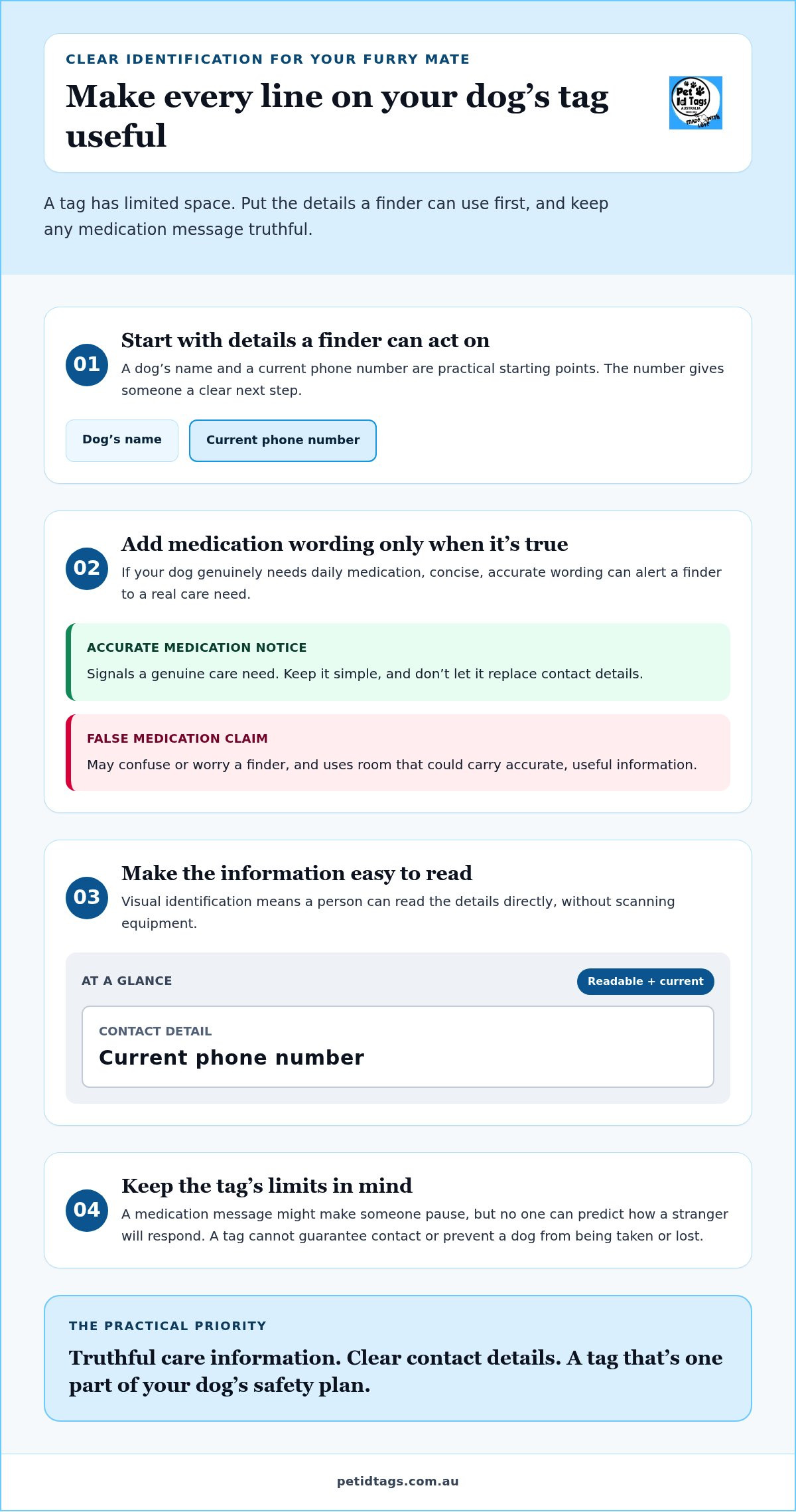
A tag should offer visual identification: information a person can read directly, without scanning equipment. A current phone number gives a finder a practical next step. If your dog genuinely needs medication, concise, accurate wording can also communicate a real care need. Keep the most useful details easy to read, and don’t let a deterrent phrase take the place of contact information.
Accuracy matters because a finder may act on what the tag says. A false medical claim could confuse the situation, while a true message can help explain your dog’s needs. Consider what would actually help someone return your dog or obtain assistance, rather than relying on wording meant to influence a stranger.
For broader background, History and prevention of dog theft provides an overview of the subject. A tag is only one part of keeping a dog safe. Its wording can’t prevent someone from taking a dog or ensure they’ll make contact, so prioritise details that remain useful if your dog is separated from you or needs help.
Can a medication message genuinely discourage dog theft?
A tag message might make someone pause, but there’s no reliable way to predict how a stranger will respond. The idea behind using a needs daily medication tag to discourage dog theft is understandable: an owner hopes the wording makes their dog seem like a less appealing target or encourages a finder to act quickly. That hope doesn’t make the message a dependable safety measure.
The forum suggestion discussed in the previous section is one person’s idea, not research showing that medication wording prevents dogs from being taken or helps them get home. Treat it as a possibility someone has raised, not a proven method. A tag can share information, but it can’t guarantee another person will read it, believe it or respond as the owner hopes.
The possible appeal and its limits
It’s natural to look for another way to protect a much-loved family member. Someone might see a medication message and decide returning the dog is the right thing to do. Someone else might ignore it, misunderstand it or react in a way the owner didn’t intend. Those responses are too unpredictable to rely on in a safety plan.
There’s a difference between attracting attention and deterring theft. A striking phrase may be noticed, but that doesn’t show it changes someone’s behaviour. Don’t treat an anecdote or a plausible theory as proof. If the wording is false, it may create confusion: a finder could worry that the dog needs urgent care or be unsure what assistance is appropriate.
Why accuracy matters when a dog needs medication
Don’t invent a diagnosis or medication need as a scare tactic. It could cause unnecessary concern and make it harder for someone to understand your dog’s actual needs. If your dog has no such care requirement, leave medication wording off the tag. Use the space for truthful details that help someone take a useful next step.
For identification, prioritise legible owner contact information and keep it current. A personalised dog tag gives you a practical way to display details a finder can read, without relying on a claim about your dog’s health. If you’re reviewing your dog’s identification, explore personalised dog tags with readability and accurate information in mind.
Medication wording versus clear dog tag identification
A tag has limited room, so prioritise details that can help a finder identify your dog and contact you. A dog’s name and a current phone number are practical starting points. Add medication wording only if it reflects a genuine care need. A false claim takes up space without giving a finder reliable information.
Use this comparison to decide what each type of information can contribute:
Option: Accurate medication notice. What a finder sees: A genuine care need. Useful purpose: Signals that the dog has a real medication requirement. Limitation: Doesn’t replace contact details or guarantee a particular response.
Option: False medication claim. What a finder sees: Incorrect health information. Useful purpose: None as trustworthy identification. Limitation: May confuse or worry a finder and uses space that could carry accurate details.
Option: Visual identification. What a finder sees: Engraved details readable directly, without scanning equipment. Useful purpose: Makes contact information available at a glance. Limitation: The information must be legible and up to date.
Option: QR codes. What a finder sees: A scannable code linking to a digital pet profile. Useful purpose: Can provide access to additional identification and care information. Limitation: Requires a compatible device and a scan.
For more help deciding what belongs on a physical tag, use these pet ID tag engraving ideas to guide your choices. Keep the message short enough to read clearly. If your dog needs medication, a brief, truthful notice may be useful, but don’t crowd out the number a finder can call.
What information earns space on a physical tag?
Start with your dog’s name and a current phone number that you or another nominated contact can answer. If medication is a genuine part of your dog’s care, include a brief, accurate notice where space allows. Avoid long explanations or extra wording that makes essential details harder to read. The aim is clarity, not fitting every possible detail onto one tag.
How do QR codes and visual identification differ?
Visual identification can be read immediately by someone looking at the tag. QR codes offer another route: scanning can open a digital pet profile with further information. They serve different purposes, so one shouldn’t be treated as a substitute for the other. A smart pet tag guide explains digital identification in more detail.
Whether you choose engraved details, a QR code or both, check that the information is accurate and the contact details still work. Don’t use a needs daily medication tag to discourage dog theft to make an untrue claim. Trustworthy identification gives a finder something useful to act on.
How to make a dog’s tag more useful and trustworthy
A useful tag starts with details a finder can act on, not a phrase intended to influence a stranger. If you’re considering a needs daily medication tag to discourage dog theft, make truthfulness the first test: include a medication notice only if your dog genuinely needs daily care. Then check that the contact details are clear and current.
Choose truthful, high-priority details
Begin with the phone number most likely to reach you promptly. Choose a number you can answer or check regularly, and make sure the person who answers knows your dog may be wearing an ID tag. If daily medication is a genuine need, add a short, accurate notice if there’s room. Leave out invented claims and details that could distract or confuse a finder.
Use this simple process to prepare and check the tag:
- Pick the essential contact number. Use the number that gives a finder the best chance of reaching you. If someone else is a more reliable contact, consider using their number with their agreement.
- Select only useful wording. Include your dog’s name if you want it shown, followed by contact information. Add a concise medication notice only when it reflects your dog’s real care needs.
- Keep the message short. Prioritise details a person can read quickly. Avoid filling the available space with a long explanation, a false claim or information that doesn’t help someone contact you.
- Review the engraving. Read the finished tag at a glance, in ordinary light. Check that the letters and numbers are distinct and that nothing essential is too small or crowded to read.
- Check it in everyday use. Confirm the number is correct, the tag is attached securely to your dog’s collar and the information remains readable. Recheck it whenever your contact number changes.
Check the tag after engraving
Compare the finished engraving with the details you supplied, then read it as if you were a stranger trying to call. Check the number on the tag against the one you currently use. A quick review after a collar change or move can also help catch details that need updating.
Clear, truthful identification supports a practical response if your dog is found, but no wording can guarantee that a dog won’t be taken or lost. For a personalised tag with details chosen around your dog’s identification needs, choose a personalised dog tag.
Choosing a dependable ID tag for your dog
Your dog’s tag should make accurate identification easy for someone who may only have a moment to read it. Clear engraving and a current phone number are more useful than a message designed to suggest a health condition. A needs daily medication tag to discourage dog theft is not a substitute for reliable details, and it should never claim a care need that isn’t real.
Match the tag to everyday identification needs
Think about what your dog wears each day, how much information needs to fit and whether you can read the engraving at a glance. A tag needs room for essential details without crowding them. Material matters too: 316-grade stainless steel is a corrosion-resistant stainless-steel grade used for durable pet tags. It can be a practical choice for everyday identification, though no tag material can prevent theft.
Deep-mill engraving cuts identification into the tag material rather than simply placing information on its surface. The practical aim is clear, readable details that are part of the tag. Pet ID Tags Australia specialises in pet identification, with tags deeply engraved by the business.
Keep identification current over time
A well-made tag is only useful if its information still matches your circumstances. If your phone number changes, update the tag so a finder can reach you. Review any genuine medication wording if your dog’s care needs change, and remove it if it no longer applies. Check the engraving periodically for readability and make sure the tag stays attached to your dog’s collar.
Before choosing, consider these practical points:
- Readability: Can someone make out the number and other essential details at a glance?
- Space: Is there room for accurate contact information without squeezing in extra wording?
- Material: Does the tag material suit your dog’s normal routine and everyday wear?
- Accuracy: Are the contact details and any care message still correct?
Personalisation can help you choose details that matter to your family, but keep legibility first. A dog’s name may be useful to some owners, while others may prefer to reserve tag space for contact details. Whatever you decide, make sure the information is truthful and easy to understand. A clear tag supports identification, but it can’t guarantee your furry mate will be returned or deter someone from taking them.
For a practical identification option, explore personalised dog tags and choose details that help a finder contact you.
Choose identification that earns your trust
Your dog’s tag has a practical job: help someone identify your furry mate and reach you. If you’re considering a needs daily medication tag to discourage dog theft, let your dog’s real care needs guide the wording. A made-up medical message can’t promise protection. Accurate contact details give a finder something useful to act on.
Choose identification that suits your dog’s everyday life and is easy to read. Pet ID Tags Australia has helped identify over 100,000 pets, with over 20 years of engraving experience, 316-grade stainless steel identification and over 3,400 five-star reviews. That experience supports a simple goal: clear identification for the pets who are part of your family.
Give your dog a tag personalised with details a finder can use. Explore personalised dog tags for clear, dependable identification, and take one practical step towards greater peace of mind for you and your furry mate.
Frequently Asked Questions
Should I put ‘needs daily medication’ on my dog’s tag if it is not true?
No. Don’t put false health information on your dog’s tag. A finder might take the claim literally, worry that your dog is unwell or be unsure what care is needed. Use the limited engraving space for accurate, useful details, such as a contact number. If your dog genuinely takes daily medication, keep any notice brief and make sure it reflects their current care needs.
Can a medication message stop someone from taking my dog?
No tag message can guarantee that someone won’t take your dog. The idea that a needs daily medication tag to discourage dog theft might change a person’s decision is anecdotal, not a proven safeguard. A stranger could ignore the message or interpret it differently than you expect. Treat the tag as a way to share identification details, not to control another person’s actions.
What should I put on my dog’s ID tag?
Prioritise information that helps someone identify your dog and reach you. A practical example is your dog’s name and a phone number you check regularly. If space is tight, keep the wording short rather than squeezing in extra details that make the engraving harder to read. Add a medication notice only if it’s true and useful to someone caring for your dog.
Is it safe to put my phone number on my dog’s tag?
A phone number gives a finder a direct way to contact you, but it is visible to anyone who can read the tag. Choose a number you’re comfortable sharing publicly and can answer or check often. Avoid adding extra personal details unless they serve a clear purpose. If you change numbers, update the tag promptly so it doesn’t direct a finder to an old contact.
Are QR-code pet tags better than engraved tags?
Neither option is automatically better; they provide information in different ways. Engraving can show essential details directly on the tag, while QR codes can link to a digital pet profile with more information. For example, you might keep a contact number visible and use the online profile for additional care notes. Keep profile details current, and don’t rely on a scan for every useful detail.
How often should I check my dog’s ID tag?
Check the tag as part of your regular collar check, and again whenever your phone number or your dog’s care needs change. Read the engraving in ordinary light to see whether it’s still easy to make out. Check that the attachment is secure and the tag hasn’t become damaged or detached. If the information is outdated or difficult to read, arrange an updated tag rather than waiting until it’s needed.
Does a dog tag replace other ways of identifying a pet?
No. A tag is one visible way to share information with someone beside your dog, but it can’t guarantee a reunion or replace other identification records you maintain. Keep those records consistent with the details on the tag, especially if your phone number changes. Think of the tag as a convenient everyday contact point, and review your dog’s identification as part of their ongoing care.