

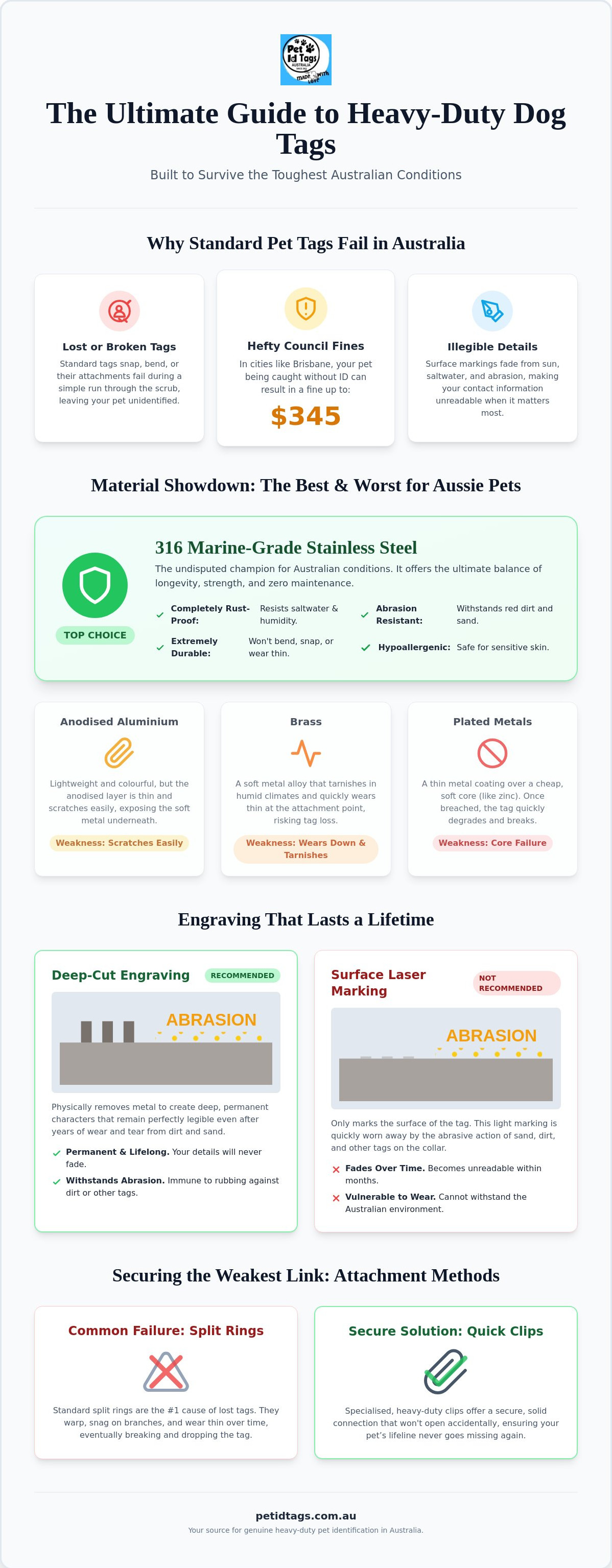
You’re three kilometres into a weekend bushwalk when you notice the silence; the familiar jingle of your dog’s collar is gone, and their ID tag is nowhere to be found. For many owners, this isn't just a hypothetical scenario but a recurring frustration that leads to hefty fines, which can reach $345 in cities like Brisbane if your pet is caught without identification. Finding genuine heavy duty dog tags Australia wide is surprisingly difficult when most "durable" options succumb to rust or lose their legibility after a few trips to the beach.
We understand that you want a solution that works as hard as your dog does. You need a tag that stays attached during a sprint through the scrub and remains readable after years of exposure to saltwater. This 2026 roundup cuts through the marketing fluff to show you which materials and engraving methods truly withstand the elements. We’ll explore the benefits of 316 marine-grade stainless steel, the importance of deep-cut engraving, and the secure hardware setups that ensure your pet’s lifeline never goes missing again.
Key Takeaways
- Learn why 316 marine-grade stainless steel is the superior choice for dogs that frequent the beach or heavy scrub.
- Discover the critical difference between surface marking and deep engraving to ensure your pet's details remain legible for life.
- Identify the common hardware failures that lead to lost tags and how to secure them properly using specialised quick clips.
- Explore our 2026 roundup to find the most reliable heavy duty dog tags australia has available for high-energy pets.
- Understand how specific materials react to the Australian environment so you can make an informed, durable investment in pet safety.
What Defines 'Heavy Duty' Dog Tags in the Australian Environment?
In the harsh conditions of the Australian outback or the salty air of our coastlines, a standard pet tag rarely lasts a season. For a product to earn the title of heavy duty dog tags australia needs to offer, it must go beyond being a thick piece of metal. True durability is a combination of physical thickness and chemical resistance. Many owners mistakenly believe that a bulky tag is automatically a tough one. In reality, the material's ability to resist environmental degradation is what keeps your contact details legible for years.
We recommend a thickness of 2mm as the ideal sweet spot for most breeds. This provides enough structural integrity to prevent bending or snapping during vigorous play without becoming a heavy burden on your dog's neck. Additionally, high UV resistance is vital. Australia's intense sun can cause inferior coatings to peel or fade, turning a once-clear ID into an unreadable piece of scrap in months. A truly heavy-duty solution remains unchanged by the weather, ensuring safety regardless of the season.
The Red Dirt and Saltwater Factor
The Australian environment presents unique challenges that many international products aren't designed to handle. In the Red Centre or rural paddocks, the soil contains high levels of iron oxide and silica. This abrasive dust acts like sandpaper; it slowly grinds away at surface-level laser markings every time your dog runs, rolls, or scratches. This is why choosing engraved dog tags australia owners can rely on for depth is so important. Surface marks simply won't last against the grit.
Coastal living is equally demanding on gear. Saltwater spray is notoriously corrosive, leading to "tea staining" or deep rust on low-grade metals that aren't built for the surf. When comparing common materials used for pet ID tags, it becomes clear that not all metals are created equal. Marine-grade 316 stainless steel is the ultimate Aussie standard because it contains molybdenum, which is an alloy that specifically protects against chloride-induced corrosion. This ensures your tag stays bright and rust-free even after daily swims at the beach.
Mechanical Strength vs. Weight
Building a "bomb-proof" tag requires a focus on solid construction rather than just size. Solid-cast metals are far superior to hollow or plated alternatives. Plated tags often have a soft zinc or plastic core that wears down quickly once the outer layer is breached. This leads to snapped attachment holes and lost tags. However, you must balance this strength with your pet’s comfort. A tag that is too heavy can cause neck strain or skin irritation, especially for smaller breeds or active working dogs.
Identifying the point where a tag becomes too heavy is essential for pet safety. We find that while heavy duty dog tags australia dogs wear should be robust, they should not exceed a few grams for toy breeds. For larger working dogs, the weight is less of a concern than the security of the attachment. The goal is always a secure, permanent ID that your dog forgets they are even wearing. A well-designed tag provides peace of mind without compromising your pet's mobility or health.
Comparing the Toughest Materials: Stainless Steel vs. Aluminium
Selecting the right material for heavy duty dog tags australia requires a clear understanding of how different metals react to our unique environment. While brass offers a traditional, classic look, it's a relatively soft alloy. It tarnishes quickly in humid northern climates and wears down where the tag meets the collar ring. Anodised aluminium provides vibrant colour options and is incredibly light, but it can't match the sheer density of steel. For the vast majority of active pets, we recommend stainless steel dog tags australia owners trust for 90% of active pets because they offer the best balance of longevity, security, and zero maintenance.
Why 316 Marine Grade Stainless Steel is Essential
The science behind 316 stainless steel makes it the undisputed king of pet identification. Unlike standard 304 steel, the 316 grade contains molybdenum. This specific alloy addition is what prevents pit corrosion and "tea staining" in coastal areas. "Hard yakka" working dogs and farm pets need this level of protection. The metal is significantly harder than silver, gold plating, or brass, meaning it won't thin out or snap at the attachment point after years of movement.
While a physical tag is the fastest way for a neighbour to return your pet, it works alongside the technical standards for animal microchips set by the Australian Veterinary Association to ensure your pet is always identifiable. Steel provides a permanent surface for deep engraving that remains legible even if the tag is dragged across concrete or rocks. If you want a tag that lasts the entire life of your dog, 316 stainless steel is the only logical choice. You can browse our range of durable pet identification to see why steel remains our top recommendation.
When to Choose High-Grade Aluminium
There are specific scenarios where high-grade aluminium is the better contender. We call this "lightweight heavy duty." It's the ideal choice for agility dogs, puppies, or toy breeds where every gram of weight matters. Our aluminium tags undergo an anodising process that creates a hardened, protective oxide layer on the surface. This layer is much tougher than standard paint or powder coating, resisting the typical wear and tear of a suburban backyard.
Aluminium also allows for high-visibility colour coding. This can be a safety advantage in the thick Australian bush, making it easier to spot a dog in low light or dense scrub. While it isn't as scratch-resistant as steel, high-grade aluminium is a robust alternative that won't rust or corrode. It provides a reliable, lightweight solution for owners who prioritse comfort and visibility without sacrificing the core requirement of heavy duty dog tags australia.
Engraving Depth: Ensuring Your Pet's ID Never Fades
The durability of the metal is only half the battle. Even the most robust heavy duty dog tags australia has to offer are useless if the contact information becomes unreadable after a few months of wear. Many mass-produced tags rely on surface-level marking that looks crisp when new but fails quickly under pressure. We believe that for a tag to be truly reliable, the engraving must be deep enough to survive the constant friction of a dog's daily life. This is why engraved dog tags australia owners choose must be readable even if the surface is heavily scratched.
You can perform a simple "Legibility Test" on your current tag. Run your fingernail across the text. If you can't feel the distinct ridges of the characters, the engraving isn't deep enough. Deep engraving creates a physical "well" of information. These recessed characters are protected from the abrasive effects of red dirt and sand. Even if the surrounding metal is scuffed or polished by movement, the deep-cut text remains sharp and clear. Investing in heavy duty dog tags australia with this level of precision is the only way to ensure your pet's lifeline stays intact.
Laser Etching vs. Deep Engraving
It’s important to understand the technical difference between laser etching and mechanical engraving. Laser etching is often just a chemical change or a very thin surface mark. It's prone to "polishing off" as it rubs against other collar hardware or the dog's fur. Mechanical engraving actually removes metal from the tag. This process creates permanent, deep-set characters that cannot be rubbed away. Deep engraving is the only way to ensure a long lasting pet id tag that survives years of hard use. Maintaining a legible tag isn't just common sense. Under the NSW legislation on dog identification, owners are legally required to ensure their pet's ID is clear and up to date when in public.
What Information to Include for Maximum Safety
When designing your tag, prioritising the right information is key to a fast return. We recommend leading with at least two different phone numbers. Including a clear "I am microchipped" message can also alert a finder to take the pet to a vet if the tag is damaged. To prevent crowding, keep the layout simple. Crowded text is harder to read, especially if someone is trying to check the tag of a nervous or wiggly dog. Using both sides of a heavy-duty tag is a smart way to separate the pet's name from critical medical data or secondary contact details. This organisation improves readability and ensures the most vital information stands out immediately.
The Weakest Link: Heavy Duty Attachment Methods
Many owners invest in high-quality heavy duty dog tags australia only to lose them within weeks. The culprit is almost always the attachment hardware. A standard split ring is essentially a coiled spring. While it's cheap and easy to manufacture, it's the most common failure point in pet identification. If your dog catches their tag on a branch or a fence, the ring stretches open. Once that metal is deformed, it never returns to its original shape. The tag eventually slides off, often without the owner noticing until they're long gone from the park.
Properly securing a tag requires hardware that can withstand the sudden force of a snag. High-energy dogs that engage in vigorous play or bush-bashing need more than a simple wire loop. We've seen countless "durable" tags lost because the owner relied on the flimsy ring provided in the packaging. Moving toward reinforced shackles or D-links ensures that the connection to the collar is as tough as the tag itself. This simple upgrade prevents the "tag loss" cycle that leads to expensive council fines and unnecessary stress.
Quick Clips and Carabiners
Industrial-style clips provide a much higher level of security than traditional rings. These clips use a spring-loaded gate or a screw-lock mechanism that prevents the attachment from stretching under tension. They're particularly useful for owners who frequently swap tags between a harness and a collar. Moving a tag with a split ring is a chore that often results in broken fingernails and weakened metal. A stainless steel quick clip makes this transition seamless and safe. Unlike plastic alternatives that become brittle and crack in the Australian sun, stainless steel hardware maintains its structural integrity for years. You can secure your pet's ID with our range of quick clips to prevent accidental loss during your next adventure.
Silent Dog Tags: Reducing Jingle and Wear
Constant metal-on-metal contact does more than just create an annoying jingle; it accelerates mechanical wear. When a tag hangs loosely and bounces against a metal D-ring, it acts like a tiny hammer. Over time, this friction can polish away the surrounding metal and degrade the legibility of the engraving. Using tag silencers or specific attachment heights can stop the jingle and protect your investment. There's also a psychological benefit to consider. Many dogs are noise-sensitive. The constant clinking near their ears can be a source of low-level stress during walks. A silent setup provides a calmer experience for your pet while protecting the heavy duty dog tags australia depends on for long-term safety.
Roundup: The Best Heavy Duty Solutions from Pet ID Tags Australia
Pet ID Tags Australia has refined the science of pet identification since 2004. We provide a tested system for pet safety that goes far beyond standard retail options. Our range of heavy duty dog tags australia represents the peak of manufacturing precision. We combine industrial-grade materials with deep-cut engraving to ensure your contact details survive the most extreme conditions. This focus on long-term utility is what builds immediate trust with owners who value reliability over fleeting trends. We don't just sell tags; we provide a professional and dependable solution for pet security.
The Ultimate Stainless Steel Selection
Smart Tags for Modern Durability
Modern safety often requires a multi-layered approach. Our smart pet tags australia range adds a critical digital layer of protection to your pet's collar. These tags combine our signature deep engraving with modern recovery technology. This allows a finder to access a detailed digital profile with a simple scan. We've ensured the protective coatings on these smart tags are resilient against UV rays and moisture. It's a fusion of heritage craftsmanship and 2026 technology that provides a definitive, reassuring resolution to pet safety concerns.
True safety comes from a complete identification system. We recommend pairing your heavy-duty tag with personalised dog collars australia for double security. If a tag is ever caught and lost during a sprint through the scrub, having your phone number embroidered on the collar provides a fail-safe backup. Our commitment to quality materials and local expertise means you can walk your dog with total confidence. We build products that last the life of your pet. You shouldn't have to worry about your dog's safety because of a flimsy tag or faded text. Choosing a high-grade solution is a responsibility we help you manage with ease.
Secure Your Pet’s Future with Australia’s Toughest ID
Your dog deserves an identification system that survives the harshest Australian conditions without compromise. By prioritising marine-grade 316 stainless steel and insisting on deep mechanical engraving, you eliminate the risk of unreadable details or snapped hardware. The right materials and secure attachment methods, such as quick clips, are the only way to ensure your pet's lifeline remains intact during every bushwalk or beach trip.
At Pet ID Tags Australia, we've applied over 20 years of expertise to create heavy duty dog tags australia can rely on for permanent safety. Our products are engineered to resist the abrasive red dirt and corrosive saltwater that quickly destroy standard retail alternatives. We stand by our specialised engraving process, which is guaranteed to remain legible for the life of your pet. Don't wait for a lost tag or a council fine to upgrade your dog's security. Shop our range of Heavy Duty Stainless Steel Dog Tags today and enjoy the peace of mind that comes with professional-grade protection. Your next adventure is waiting, and we’re here to help you prepare for it with confidence.
Frequently Asked Questions
What is the most durable material for a dog tag?
316 marine-grade stainless steel is the most durable material available for pet identification. It offers superior hardness and resistance to physical wear compared to brass or gold-plated alloys. This metal is specifically chosen for its ability to withstand the abrasive nature of the Australian bush and the corrosive effects of coastal salt air, ensuring the tag doesn't thin out or snap over time.
Will stainless steel dog tags rust in saltwater?
High-grade 316 stainless steel will not rust or "tea stain" when exposed to saltwater. This specific grade contains molybdenum; this is an alloy that provides a protective barrier against chloride-induced corrosion. While lower grades like 304 might show signs of pitting over time, marine-grade steel remains bright and structurally sound even after daily swims at the beach.
How do I stop my dog's ID tag from jingling?
You can stop the jingle by using a silicone tag silencer or by adjusting the attachment height so the tag doesn't hit the metal D-ring. Tag silencers fit around the edge of the metal to provide a soft buffer. Alternatively, using a quick clip can sometimes reposition the tag to reduce noise, which is particularly helpful for dogs with noise sensitivities.
What is the difference between laser etching and deep engraving?
Laser etching creates a mark on the surface of the metal, whereas deep mechanical engraving actually removes material to create permanent characters. Surface marks can be polished away by friction against a collar or other tags. Deep engraving creates a recessed "well" for the information, ensuring your contact details remain legible even if the tag is heavily scuffed or worn.
How thick should a heavy duty dog tag be?
A thickness of 2mm is the recommended standard for heavy duty dog tags australia wide. This provides the necessary structural integrity to prevent the tag from bending or snapping at the attachment hole. It's thick enough to allow for deep engraving on both sides without compromising the strength of the metal, yet it remains light enough to be comfortable for most breeds.
Can I put a heavy duty tag on a small dog or puppy?
Yes, you can use a heavy-duty tag for small dogs, but you should choose a smaller diameter or a lighter material like high-grade aluminium. While stainless steel is the toughest, a small anodised aluminium tag provides excellent durability without the weight that might strain a puppy's neck. Always balance the need for strength with the physical comfort and size of your pet.
How do I prevent my dog's tag from falling off the collar?
The best way to prevent a tag from falling off is to replace standard split rings with stainless steel quick clips or reinforced shackles. Standard rings often stretch and deform if they get caught on a branch or fence. A secure, spring-loaded clip or a screw-lock shackle provides a much higher level of mechanical security for active or high-energy dogs.
Is a microchip better than a heavy duty dog tag?
Neither is "better" because they serve different purposes; a dual system is the national standard for pet safety in Australia. A microchip is a permanent, legal requirement that provides a scannable ID if the dog is taken to a vet. However, a physical tag is the fastest way for a neighbour to contact you directly, often returning your pet before they ever reach a shelter. To ensure your pet is fully protected with both a tag and an up-to-date microchip, check out West Gippsland Vet Care.