

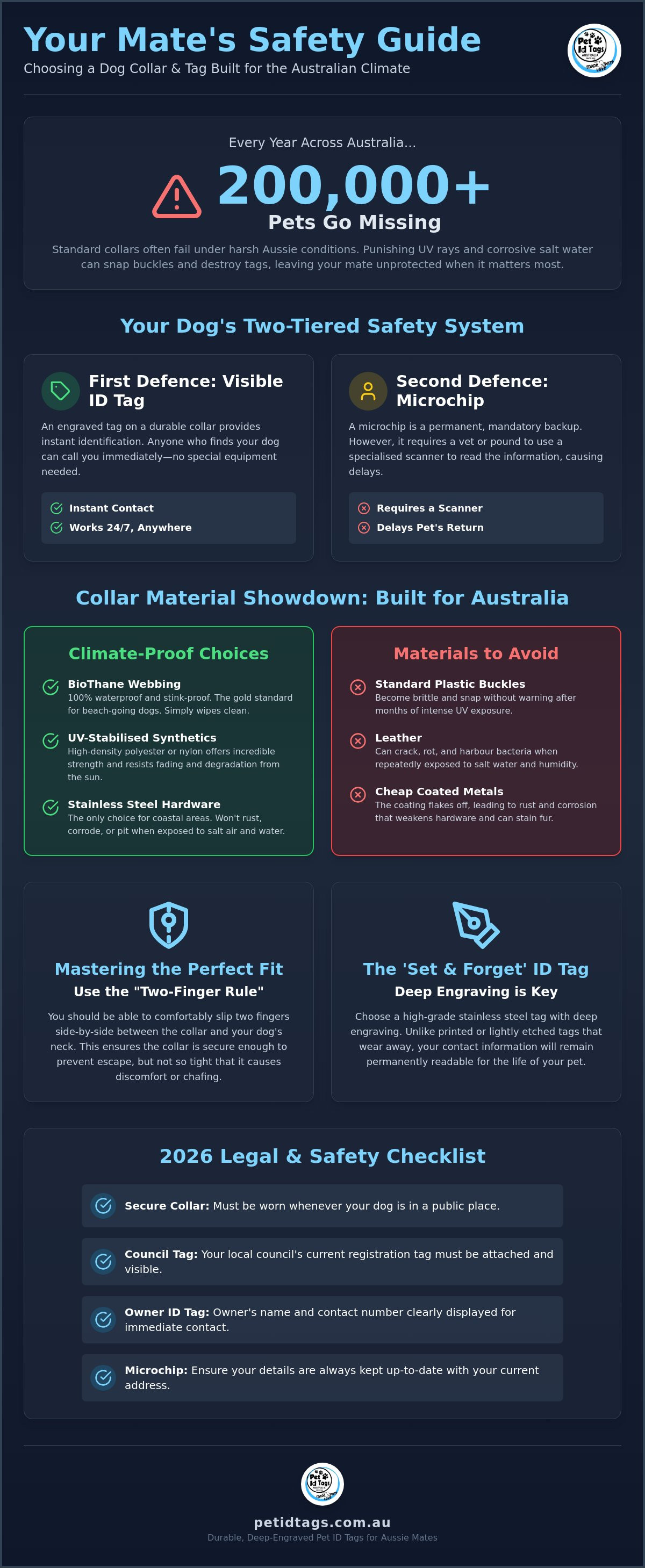
Did you know that over 200,000 pets are lost across Australia every single year? It's a confronting figure for any dog owner. While most of us believe our gear is up to the task, the reality is that a standard dog collar with name tag Australia wide often fails when it matters most. Between the punishing UV rays that snap plastic buckles and the salt water that corrodes cheap metals, your mate's primary safety net can vanish in a single afternoon at the beach.
You likely want a "set and forget" safety solution that stays readable whether your dog is sprinting through red dust or diving into the surf. We understand that true peace of mind comes from gear built for longevity rather than fleeting aesthetic trends. This 2026 safety guide will teach you how to choose the most durable materials to keep your mate safe in our harsh environment. We'll also cover the latest 2026 legal requirements for council tags and recent state-wide collar bans to ensure your dog remains protected and compliant.
Key Takeaways
- Understand the legal requirements for council registration and why a physical collar remains the primary foundation for your dog's safety.
- Identify the best materials for the Australian climate, focusing on UV-resistant synthetics that won't rot or smell after exposure to salt water and red dust.
- Discover how to select the right dog collar with name tag Australia wide for your specific lifestyle, from lightweight urban walking gear to heavy-duty adventure kits.
- Master the "two-finger rule" and precise measurement techniques to ensure a secure fit that prevents escapes without causing discomfort.
- Learn why pairing a high-grade collar with deep-engraved stainless steel tags creates a permanent, "set and forget" identification solution for your mate.
The Legal and Safety Role of Dog Collars and Tags in Australia
A high-quality dog collar serves as the primary anchor for both identification and physical restraint. While many owners focus on the aesthetic appeal of a new accessory, the structural integrity of a dog collar with name tag australia wide is what determines your pet's safety during a crisis. It's the only piece of equipment that stays with your dog 24/7, providing a permanent platform for the contact details that could one day save their life.
Relying solely on a microchip is a common mistake. While microchipping is a mandatory legal prerequisite across all Australian states, it requires a specialised scanner to read. If your dog slips out of the gate and is found by a neighbour, a visible tag allows for an immediate phone call. Without that visible ID, your mate might spend an unnecessary night in a pound or shelter. A collar is your first line of defence, offering a low-tech, high-reliability solution that works instantly without the need for professional intervention.
Australian Council Regulations and Pet Safety
In 2026, the legal landscape for pet ownership remains strict across the country. Most Australian local councils mandate that dogs wear a collar with a council-issued registration tag whenever they are in a public place. While specific regulations regarding fees or requirements can vary between different local government areas, the fundamental need to register your pet and display a tag remains crucial to avoid penalties. Furthermore, many Australian jurisdictions often legally require you to display the owner's name and contact number alongside the council tag. Having a clear understanding of dog collar types and materials helps you choose gear that won't rot or snap when council rangers or helpful strangers need to read those vital details.
The Safety First Mindset for Dog Owners
Choosing a collar based on "fashion" often leads to disaster in the harsh Australian climate. Flimsy plastic buckles can become brittle after months of intense UV exposure, leading to sudden snaps near busy roads. We prioritise structural integrity over fleeting trends because a collar's primary job is security. High-quality hardware and reinforced stitching prevent accidental "break-outs" when your dog lunges or pulls. For an Australian dog, a safety-rated collar is the non-negotiable foundation that secures their identity and your peace of mind.
Selecting Materials for the Australian Climate: UV, Salt, and Scrub
Australia's environment is notoriously hard on pet gear. A standard dog collar with name tag australia wide faces a daily assault from extreme UV levels, abrasive red dust, and corrosive salt spray. Choosing the right material isn't just about how it looks on the first day; it's about how the hardware and webbing hold up after three years of coastal living. If you want a dog collar with name tag australia based dogs can rely on, you must prioritise materials engineered for the local climate.
Synthetic webbing remains the industry workhorse for good reason. High-density polyester and nylon offer incredible tensile strength, making them ideal for dogs that pull. However, not all synthetics are equal. Cheap dyes fade rapidly under the Australian sun, and low-grade nylon can become stiff and abrasive when clogged with sand. While leather is a classic choice, it often struggles in humid northern climates or frequent salt water immersion. Without constant conditioning, leather can crack or harbour bacteria, leading to skin irritation for your mate.
Waterproof and Odour-Resistant Options
That lingering "wet dog smell" is rarely just the dog. It's often the result of absorbent collar materials like cotton or cheap neoprene trapping moisture and bacteria. For dogs that live in the surf, BioThane has become the modern gold standard. It's a polyester webbing with a TPU or PVC coating that makes it 100% waterproof and stink-proof. It provides the look of leather with the durability of a polymer. If your dog is a frequent swimmer, choosing an easy-clean material ensures you aren't replacing gear every six months.
UV Resistance and Colour Longevity
The Australian sun is a silent killer for pet safety gear. Intense UV radiation can cause standard plastic buckles to become brittle and snap without warning. When selecting a collar, look for UV-stabilised materials and heavy-duty hardware. Stainless steel is the only choice for coastal regions because it won't rust or pit when exposed to salt air. This durability is crucial because your gear must remain functional to meet NSW companion animal registration requirements and similar laws nationwide.
Ensuring your dog’s ID is always visible starts with a foundation that won't fail. Investing in personalised dog collars made from high-grade materials ensures your contact details stay exactly where they belong.
Matching Collar Types to Your Mate’s Lifestyle
Choosing the right dog collar with name tag australia wide depends heavily on your daily routine. A dog that only leaves the house for a stroll around the block has different requirements than a Kelpie working on a rural property or a Staffy frequenting local bush trails. You need to match the collar's width and weight to your dog's neck size and pulling power to prevent strain or accidental escape. A collar that is too thin for a powerful breed can snap under pressure, while one that is too heavy for a toy breed can cause long-term discomfort.
For the daily block walk, urban gear should be lightweight and comfortable. For well-trained dogs, a simple flat collar is the standard choice. However, if your weekends involve off-leash play or dense scrub, you need adventure gear. This means heavy-duty webbing and reinforced D-rings that can withstand sudden lunges or snagging on branches. You can find a range of high-quality dog accessories online australia wide that cater to these specific environments.
The Martingale Collar: Control Without Choking
The Martingale collar is a specialised tool designed for dogs with slim heads, such as Greyhounds or Whippets. These breeds can often "back out" of standard collars because their necks are wider than their heads. A Martingale provides a gentle tightening mechanism that prevents the collar from slipping off without the harshness of a choke chain. Many Australian trainers recommend these for escape artists because they offer control without the risk of injury. It's vital to stay informed on welfare standards, such as the RSPCA position on pronged collars. As of 2026, prong collars are banned in several states, including New South Wales, where possession can result in significant penalties of up to 400 penalty units.
Flat Collars vs. Training Harnesses
While a flat collar is the default for most, there are times when you should transition to a dog harness australia based owners prefer for high-energy dogs. If your mate is a heavy puller, a harness distributes pressure across the chest rather than the windpipe. This reduces the risk of tracheal damage during training. For those early morning or late evening walks, look for collars and harnesses with reflective stitching. This small detail significantly increases visibility under streetlights or car headlamps. It's a simple way to add an extra layer of safety during low-light conditions in suburban areas.
Achieving the Perfect Fit for Comfort and Security
Achieving the ideal fit for a dog collar with name tag australia wide is a balance between security and comfort. A collar that is too loose can slip over your dog’s ears during a sudden lunge, while one that is too tight can cause physical distress or skin damage. Don't rely on generic weight charts, as neck circumferences vary wildly even between dogs of the same breed. Precision is the key to safety.
Follow these four steps to ensure your gear is fitted correctly:
- Measure precisely: Use a soft tape measure at the base of the neck where the collar naturally sits. If you don't have a tape measure, use a piece of string and measure it against a ruler.
- Apply the two-finger rule: Once the collar is buckled, you should be able to slide two fingers comfortably between the material and your dog’s neck. This ensures the collar is snug enough to stay on but loose enough to prevent choking.
- Check for skin tension: Ensure the collar doesn't pinch the skin or restrict breathing when your dog is sniffing the ground or panting.
- Inspect hardware: Perform a weekly check for hairline cracks in plastic buckles or thinning of the metal D-ring where the lead attaches.
Preventing Skin Irritation and Matting
Poorly fitted collars or low-grade linings often lead to "collar sores" on sensitive dogs. Moisture trapped beneath a thick, absorbent collar can cause bacterial growth and hotspots. For long-haired breeds, a collar that is too tight will cause painful matting and hair breakage around the neck. We recommend removing the collar during supervised indoor time to let the skin breathe. This simple habit prevents long-term skin issues and keeps your mate comfortable—a focus on skin health shared by professional suppliers like Tatt Lab who provide medical supplies for the tattoo industry.
Adjustability and Growth Room
Puppy owners must remain particularly vigilant. A young dog can outgrow their gear in a matter of weeks, making regular adjustments a necessity. Look for collars with high-quality sliders that won't "creep" or loosen under the tension of a pulling dog. Reliable hardware ensures the adjustment stays exactly where you set it, even during high-energy play. Australian owners should perform a physical fit-check at least once a week to account for weight fluctuations or seasonal coat changes.
Upgrade your mate's safety by choosing personalised dog collars that offer both durability and adjustable comfort for any life stage.
Integrating Your Dog Collar with Personalised Name Tags
A durable collar is only half the safety equation. Without readable identification, even the most expensive dog collar with name tag australia based kit fails its primary mission. The real security comes from the synergy between a high-grade collar and stainless steel dog tags australia owners trust for their permanence. While aluminium tags may offer bright colours, they often scratch and become illegible within months of exposure to sand and grit. Deep-engraved stainless steel remains the gold standard because it survives the physical friction of an active dog's life.
For many owners, the constant "jingle" of metal tags is a daily annoyance. You can solve this by using silicone tag silencers or choosing specific attachment methods that keep the tag flush against the collar webbing. This doesn't just reduce noise; it reduces the mechanical wear on the tag's attachment hole, extending the life of your identification system. A quiet tag is a more secure tag, as it experiences less vibration and friction over time.
Essential Information for Your Dog’s Name Tag
While microchips provide a permanent record, they require a scanner and a trip to the vet or council pound. A physical tag offers immediacy. If your dog is found by a neighbour, your mobile number is right there for an instant return. We recommend including your dog’s name and at least one current mobile number. Including a secondary number or "Microchipped" text provides extra layers of security. In 2026, smart tags featuring QR codes have become increasingly popular. These allow you to update your contact details instantly via a digital profile without needing to engrave a new physical tag if you change your phone number or move house.
Attaching Tags Securely for Active Dogs
The method you use to secure the ID to the dog collar with name tag australia wide is critical. Standard split rings are common, but they can stretch and fail if caught on a branch or fence. For dogs that spend time in the bush, a more secure option is essential to prevent the tag from being ripped off. You can learn how to attach a dog tag without a split ring to ensure it stays put during rough play. Using high-quality quick clips or carabiners can also make it easier to move tags between different collars or harnesses.
Always attach both the lead and the ID tag to the primary D-ring. This ring is the strongest point of the collar, designed to take the full force of a lunging dog. Ensure the tag doesn't hang too low. A long-hanging tag is more likely to get caught in thick scrub or between decking boards, which can lead to injury. Keep the profile compact to ensure your mate stays safe and identified, no matter where your Australian adventures take you.
Securing Your Dog’s Safety in the Great Outdoors
Choosing the right gear is about more than just aesthetics; it's a commitment to your dog's long-term safety. By prioritising UV-stabilised materials and ensuring a precise fit, you eliminate the risks of gear failure in our harsh environment. A physical tag remains the fastest way for a stranger to return your mate, providing a vital layer of protection that works instantly without the need for a microchip scanner.
Investing in a high-quality dog collar with name tag australia wide ensures you can walk, swim, and explore with absolute confidence. Our gear has been hand-engraved in Australia since 2004, featuring durable stainless steel hardware as standard. Having earned the trust of over 100,000 Australian pet owners, we understand that reliability is the only metric that matters when your mate's safety is on the line.
Secure your mate’s safety with a premium collar and tag from Pet ID Tags Australia. Give your dog the protection they deserve and enjoy the peace of mind that comes with gear built for the real world.
Frequently Asked Questions
Is it better for a dog to wear a collar or a harness in Australia?
A collar is the essential foundation for carrying a dog collar with name tag australia based identification 24/7. However, a harness is often better for training or high-energy dogs that pull, as it distributes pressure across the chest rather than the neck. Many owners choose to use a collar for permanent ID and a harness specifically for exercise and walks.
What is the most durable material for a dog collar in the Australian sun?
BioThane and UV-stabilised polyester are the most durable materials for the intense Australian sun. These materials resist the brittleness and fading caused by high UV levels that often destroy cheaper synthetics. Pair these with stainless steel hardware to ensure the fittings don't rust or corrode in coastal areas where salt spray is a constant factor.
Should I take my dog’s collar off at night?
Removing the collar at night is recommended to allow your dog's skin to breathe and prevent hair matting. This break reduces the risk of moisture build-up and bacterial "hotspots" under the webbing. Only do this if your home is fully secure and your dog is microchipped as a secondary safety measure in case of an emergency escape.
How tight should a dog collar be?
You should be able to fit two fingers comfortably between the collar and your dog's neck. This "two-finger rule" ensures the gear is snug enough to prevent slipping over the head without being restrictive or causing distress. Check the fit weekly, especially for puppies or dogs with thick coats that may change significantly with the seasons.
Do Australian laws require dogs to wear collars indoors?
There are no specific Australian laws requiring dogs to wear collars while inside your private residence. Legal mandates for council registration tags and identification typically apply only when the dog is in a public place or off your property. However, keeping a collar on indoors is a helpful safety precaution if your dog is a known escape artist.
What information is legally required on an Australian dog tag?
Every Australian state requires a council-issued registration tag to be displayed in public. Additionally, many jurisdictions, such as Victoria and parts of Queensland, legally require a tag showing the owner's name and current contact details. We recommend including at least one mobile number on a dog collar with name tag australia wide to ensure a quick return if your mate is lost.
How often should I replace my dog’s collar?
Inspect your gear every few months and replace it at the first sign of structural failure. Look for fraying webbing, hairline cracks in plastic buckles, or thinning metal D-rings. Depending on whether your dog is an urban walker or a coastal adventurer, a high-quality collar typically lasts between one and three years before it requires replacement for safety.
Are personalised dog collars better than plain ones?
Personalised collars with embroidered names or engraved plates offer a superior safety backup compared to plain versions. If a hanging ID tag is lost in thick scrub, a personalised collar ensures your contact details remain attached to the dog. This dual-layered approach to identification provides maximum peace of mind for owners of active Australian dogs.