
Table of Contents
- Why Choose a Custom Dog Collar Over a Generic One?
- Best Materials for Dog Collars: Leather, Velvet, and More
- Dog Collar Sizing Guide: Getting the Right Fit
- Engraved Pet Identification: What to Include on the Collar
- Safety Features and Legal Requirements for Pet Identification
- Conclusion: Find the Right Custom Dog Collar
- Frequently Asked Questions
Last Updated: September 6, 2026
A custom dog collar is more than a fashion statement; it is a primary safety tool that carries your pet's identification and your contact details every single day. While generic store-bought options serve a basic purpose, a personalised collar is tailored to your dog's specific neck size, material needs, and identification requirements. At Pet ID Tags Australia, we have spent over 20 years helping pet owners understand that the right collar balances durability, comfort, and clear engraved pet identification.

The decision between a custom dog collar and a generic one comes down to fit, materials, and legibility. Generic collars are mass-produced in standard sizes that often sit incorrectly on breeds with thick necks or narrow heads. A custom option is measured to your dog's exact neck circumference, uses materials chosen for your climate and your pet's activity level, and features contact details that are deeply engraved rather than printed on a flimsy plate that fades within months.
Why Choose a Custom Dog Collar Over a Generic One?
The biggest advantage of a custom dog collar is that it fits properly and stays put. A collar that is too loose can slip over a dog's head during a sudden pull, which is precisely the moment a dog is most likely to bolt. A collar that is too tight causes chafing and matting in long-haired breeds. Custom options are cut and stitched to your dog's measurements, so the collar sits comfortably at the top of the neck where it cannot slip off.

Durability is the second major reason to go custom. Mass-produced collars often use bonded leather or thin nylon that cracks and frays within a year. Handmade collars constructed from top grain leather are hard-wearing and built to last, with the leather softening and moulding to your dog's neck over time. The hardware matters just as much. A quality collar uses a solid metal buckle and a d-ring that will not bend or snap under pressure, which is essential for a dog that pulls on the lead.
Best Materials for Dog Collars: Leather, Velvet, and More
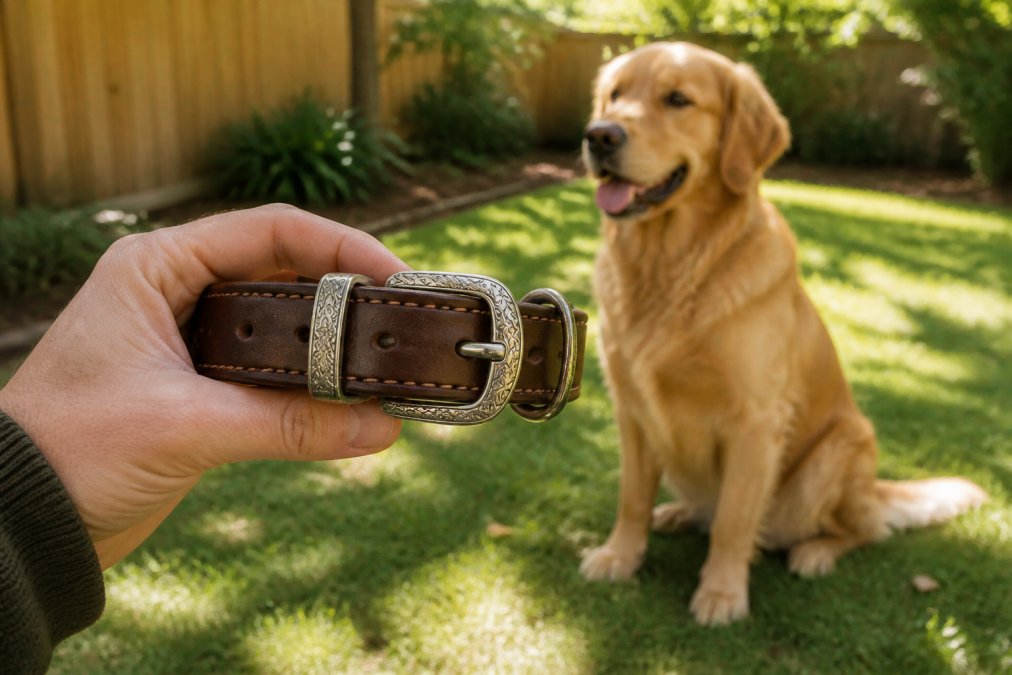
The best material for a dog collar depends on your dog's lifestyle, coat type, and any skin sensitivities. Leather remains the most popular choice for daily wear because it is strong, comfortable, and ages beautifully. Velvet offers a soft, padded option for dogs with sensitive skin or fine coats that are prone to rubbing. Biothane and vegan leather alternatives suit dogs that swim frequently, as these materials are weather-resistant and easy to rinse clean.
Leather: Durability and Comfort
Top grain leather is the gold standard for a custom dog collar. It is cut from the strongest layer of the hide, making it resistant to stretching and tearing. A well-made leather collar is also surprisingly comfortable; it softens with wear and conforms to the dog's neck without digging in. For a daily collar that will be worn for years, leather is difficult to beat. It is also the best canvas for personalisation, accepting deep engraving or embossing that remains readable for the life of the collar.
Velvet: Style with a Soft Touch
Velvet collars are ideal for small breeds, puppies, and dogs with sensitive skin. The plush, padded lining distributes pressure evenly and prevents the hair loss that can occur with rougher materials. While velvet is not as rugged as leather for heavy outdoor use, a quality velvet collar is still durable for everyday walks. Many owners choose velvet for the aesthetic appeal, pairing a soft-touch collar with an engraved metal buckle that carries the dog's details directly on the hardware.

Material Allergy Awareness: Choosing Hypoallergenic Options
Most collar guides stop at aesthetics and durability, but a significant number of dogs suffer from contact dermatitis triggered by their collars. If your dog constantly scratches at their neck, develops red, inflamed skin, or loses hair in a band around the throat, the collar material itself may be the culprit. Common irritants include nickel in buckles, chromium used in some leather tanning processes, and synthetic dyes in brightly coloured nylon.
For dogs with confirmed sensitivities, the safest choices are:
- Chrome-free or vegetable-tanned leather: This tanning process avoids the chromium salts that can cause allergic reactions in a subset of dogs. Vegetable-tanned leather is also more breathable than its chrome-tanned counterpart.
- Unbleached, undyed cotton or hemp: These natural fibres are the least likely to provoke a reaction, though they are less durable than leather or nylon and may need more frequent replacement.
- Solid brass or stainless steel hardware: These metals are far less likely to cause contact dermatitis than nickel-plated buckles. Look for a collar that specifies the buckle metal rather than simply saying "metal."
Before committing to a full custom collar, ask the maker for a small swatch of the material to test against your dog's skin for a few days. A reputable maker will happily provide a sample, as they would rather you confirm compatibility than receive a return weeks later.
Dog Collar Sizing Guide: Getting the Right Fit
Getting the right fit is the single most important step in choosing a custom dog collar. A properly fitted collar should be snug enough that you cannot slip more than two fingers underneath, but loose enough to move freely without choking. The collar should sit high on the neck, just behind the ears and below the jaw, where the neck is narrowest, preventing it from slipping forward over the head.
Measuring Neck Circumference for Different Breeds
To measure your dog's neck circumference, use a soft fabric measuring tape. Wrap it around the middle of the neck where the collar will naturally rest, keeping it snug but not tight. Record this measurement and add 2 to 5 centimetres for comfort, depending on your dog's coat thickness. Breed-specific sizing matters because neck shapes vary significantly. Greyhounds and whippets have narrow heads that slip through loose collars easily, so they need a smaller, closer fit. Bulldogs and pugs have thick necks and require a wider collar to distribute pressure. For puppies, measure every few weeks, as they grow rapidly.
Fitting Guide for Specific Neck Shapes
A generic circumference measurement is only half the battle. The shape of your dog's neck and head determines whether a collar will stay put or become an escape risk. Here is how to adjust your fitting approach for the most common anatomical extremes:
Sighthounds (Greyhounds, Whippets, Italian Greyhounds): These breeds have a head that is narrower than their neck, meaning a standard collar can easily slip forward and over the skull when the dog lowers its head or pulls backward. For these dogs, the collar must sit at the very top of the neck, directly behind the skull, where the neck is at its widest. You may need to size down from what a neck circumference chart suggests, as the goal is a fit that is snug enough to catch on the base of the skull. A martingale-style custom collar, which tightens slightly when the dog pulls, is often the safest choice for this anatomy, but a well-fitted standard buckle collar can work if the measurement is taken at the correct point.
Brachycephalic breeds (Bulldogs, Pugs, French Bulldogs): These dogs have thick, muscular necks that are often as wide as their heads, making collar escape less of a concern. The bigger issue is pressure distribution. A narrow collar on a thick neck concentrates force on a small area, which can exacerbate breathing difficulties common in these breeds. Choose a wider collar (at least 3 to 5 centimetres, depending on the dog's size) to spread pressure across a larger surface. The fit should be slightly looser than the two-finger rule suggests, as these breeds are prone to skin fold dermatitis and need airflow under the collar.
Long-haired breeds (Collies, Huskies, Golden Retrievers): A thick coat adds apparent bulk to the neck, but that bulk compresses when the dog lies down or shakes. A collar fitted snugly over a full coat can become dangerously tight once the coat mats or compresses. Measure your dog after a fresh groom, not at the peak of a winter coat, and add an extra centimetre to your usual allowance. Check the fit regularly, as seasonal coat changes can alter the effective neck size by a centimetre or more.
The Two-Finger Test: Why It Is Not Always Enough
The two-finger rule is a useful starting point, but it fails for dogs with very thick or very fine coats. For a smooth-coated dog, two fingers may allow too much slack, creating an escape gap. For a thick-coated dog, two fingers may not account for coat compression. A more reliable check is to attempt to slip the collar over the dog's head. If it passes over the skull with minimal resistance, it is too loose. If it catches firmly behind the ears, the fit is correct for most breeds.
Engraved Pet Identification: What to Include on the Collar
Engraved pet identification is the difference between a stranger returning your dog and your dog ending up in a shelter. At minimum, your custom dog collar should include your pet's name and your mobile phone number. This is the most effective combination because a phone number allows an immediate call. Consider adding a secondary number, such as a partner or family member, in case you miss the first call.
The engraving method matters for longevity. Surface printing and stamped plastic tags wear away quickly, leaving an unreadable surface within months. Deep laser engraving cuts into the material itself, so the details remain legible even after years of scratching and exposure to the elements. A collar with the pet's name and your contact details engraved directly on the buckle or a metal plate means the identification cannot fall off or be lost, unlike a dangling tag that can snag and detach.
Safety Features and Legal Requirements for Pet Identification
A custom dog collar must balance security with safety. Look for a quick-release buckle that breaks away under extreme pressure to prevent choking if the collar snags on a branch or fence. The tensile strength of the material and stitching should be strong enough for daily wear, but the buckle should be the designed weak point that releases in an emergency. A d-ring for attaching the lead should be welded, not just bent into shape, so it cannot open under strain.
Beyond the collar itself, legal requirements for pet identification apply separately to the tag. The collar is the carrier for these tags, and it is your responsibility to ensure both are in place. A microchip is the permanent backup, but a visible custom dog collar with your contact details is the fastest way for someone to reach you on the spot.
| Feature | Why It Matters | What to Look For |
|---|---|---|
| Quick-release buckle | Prevents choking if snagged | Releases under firm pressure |
| Welded d-ring | Holds the lead securely | Solid metal, no gaps or seams |
| Deep engraving | Keeps ID readable for years | Laser-cut, not surface printed |
| Reflective stitching | Visibility at night | Thread that catches headlights |
| Correct fit | Prevents escape and chafing | Two fingers fit under the collar |
Conclusion: Find the Right Custom Dog Collar
Choosing the right custom dog collar means balancing material, fit, and identification to match your dog's specific needs. Start with an accurate neck measurement, select a material suited to your dog's coat and lifestyle, and ensure the collar carries deeply engraved contact details that will not fade. A collar is an investment in your pet's safety, and quality materials and hardware will outlast several cheap replacements.
Pet ID Tags Australia has crafted durable, personalised pet accessories for over 20 years, combining local craftsmanship with fast delivery from our Adelaide workshop. Our leather collars are made in Australia from top grain leather, and our luxury velvet collars feature engraved buckles so your pet is always identifiable. With deep laser engraving for long-lasting readability and a 30-day satisfaction guarantee, you can order with confidence. Get started with Pet ID Tags Australia and give your dog a collar that is as safe as it is stylish.
Frequently Asked Questions
What information should be engraved on a custom dog collar?
Your dog's name and your phone number are the most important details for a custom dog collar. Including your surname can also help if someone tries to contact you through social media. Avoid adding your home address for safety reasons. If your dog has a medical condition, a short note like 'On medication' can be helpful, but keep it brief to ensure the engraving is legible.
How do I ensure a custom dog collar fits my dog correctly?
Use a soft measuring tape to measure your dog's neck circumference where the collar naturally sits, usually at the base of the neck. Add two to three centimetres to this measurement for comfort. You should be able to fit two fingers comfortably between the collar and your dog's neck. Always check the brand's specific sizing guide, as sizes can vary between manufacturers.
Are personalised dog collars durable enough for active dogs?
Yes, if you choose the right material. Top-grain leather is hard-wearing and develops a nice patina over time, making it a good choice for most dogs. For very active or water-loving dogs, you might consider a material like biothane, which is weather-resistant. A quality custom collar with secure stitching and solid hardware will outlast several cheap generic replacements.
Why is it recommended to include contact details on a dog collar instead of just a tag?
Having contact details engraved directly on the collar provides a backup form of identification. Tags can sometimes become detached or unreadable over time. An engraved collar ensures your information is always visible, even if the tag is lost. This redundancy is a key part of effective pet safety, increasing the chances of a quick reunion if your dog escapes.