

Table of Contents
- Why Every Pet Needs a Proper ID Tag
- What to Put on a Dog Tag: The Essential Details
- Legal Requirements for Dog Tags in Australia
- Durable Pet Tag Materials: Comparing Your Options
- Engraved vs Printed Tags: Why Depth Matters
- Smart Tags: A Modern Layer of Protection
- Keeping Tags Quiet and Maintaining Them
- Conclusion: Choose a Tag That Lasts
- Frequently Asked Questions
Last Updated: September 5, 2026
Why Every Pet Needs a Proper ID Tag
A pet id tag is the single most effective tool for bringing a lost dog or cat home, serving as an immediate, collar-based line of communication that requires no batteries or technical knowledge to use. When a stranger finds a wandering pet, the first thing they look for is a tag with contact information, and having one can mean the difference between a quick reunion and days at a shelter. At Pet ID Tags Australia, we've spent over two decades engraving identification tags.

Many owners assume a microchip is enough, but a chip only helps once a vet or shelter scans the animal. A visible pet id tag lets anyone who finds your pet contact you on the spot.
What to Put on a Dog Tag: The Essential Details
Knowing what to put on a dog tag comes down to balancing enough information for a reunion with keeping the text legible at a glance. The essentials are your pet's name, your mobile phone number, and ideally a secondary contact such as a home number or a partner's mobile. Adding your suburb or council area helps a finder recognise whether the pet is from nearby.
Addresses are less useful than they once were, since people rarely carry the details to visit a home, and full addresses crowd the engraving space. A microchip number is worth including if space allows. Keep the font size readable: on a standard small tag, a name plus a ten-digit mobile number is the practical limit.
Legal Requirements for Dog Tags in Australia
Pet identification law in Australia is not uniform; it is a patchwork of state and territory legislation enforced by local councils. Understanding the specific rules in your area is critical, because a tag that satisfies one council may be insufficient in another. The table below outlines the primary legislation and registration tag requirements for dogs in each state and territory. Note that these are statewide frameworks, your local council may impose additional bylaws.
| State/Territory | Primary Legislation | Dog Registration Tag Required? | Key Detail |
|---|---|---|---|
| New South Wales | Companion Animals Act 1998 | Yes | Lifetime registration; tag must be worn at all times in public. |
| Victoria | Domestic Animals Act 1994 | Yes | Annual or lifetime registration; tag colour changes yearly in some councils. |
| Queensland | Animal Management (Cats and Dogs) Act 2008 | Yes | Registration is lifetime; tag must display the registration number. |
| Western Australia | Dog Act 1976 | Yes | Annual registration; tag colour changes each year. |
| South Australia | Dog and Cat Management Act 1995 | Yes | Annual or lifetime registration depending on council. |
| Tasmania | Dog Control Act 2000 | Yes | Annual registration; tag must be worn. |
| Australian Capital Territory | Domestic Animals Act 2000 | Yes | Lifetime registration; tag required. |
| Northern Territory | Animal Welfare Act 2024 | Yes | Registration and tag required; specific council rules apply. |
Companion animal registration guidance confirms that enforcement and administration sit at the local government level. A council registration tag is not a substitute for a personalised pet id tag, it typically carries only a registration number and council contact details. A finder must call the council during business hours to trace the owner, which can delay a reunion by hours or days.
Penalties for failing to register or tag your dog vary, but fines commonly range from $200 to $800 depending on the state and whether it is a first offence. Some councils also require cats to be registered and identified, particularly in urban areas.
Before ordering a tag, check your local council's website for specific bylaws. If you move between states, re-check the requirements.
Durable Pet Tag Materials: Comparing Your Options
Choosing the right material determines whether your pet id tags remain readable after months of swimming, digging, and rubbing against fences. Stainless steel is the benchmark for longevity, resisting rust, scratching, and the wear that quickly destroys cheaper alternatives. Anodised aluminium offers a lightweight, colourful option that suits smaller pets, though it is softer than steel.

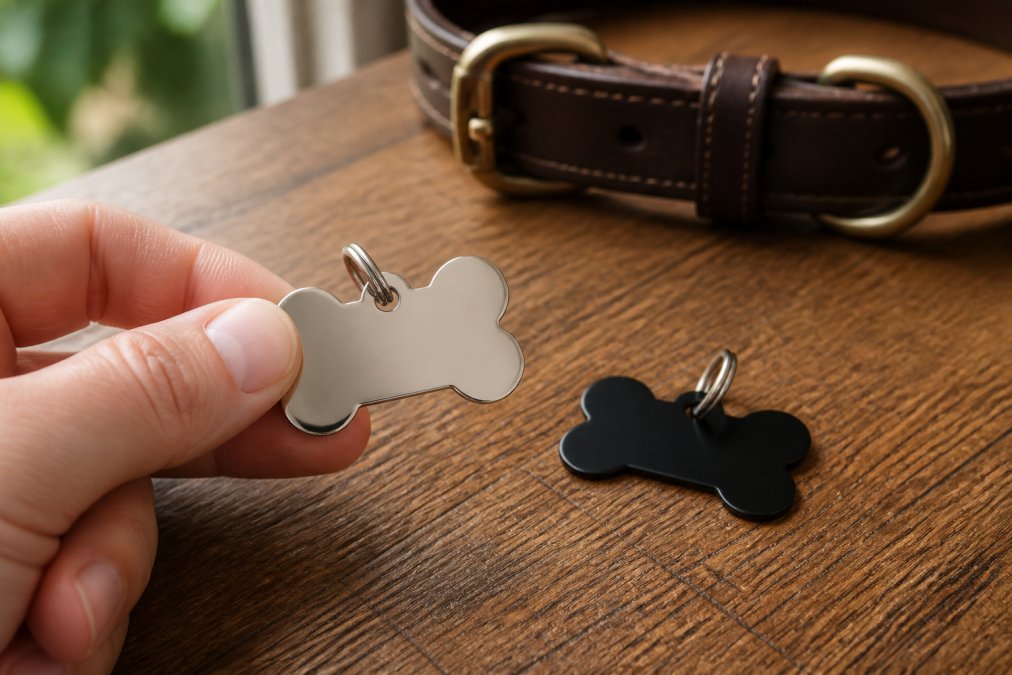
The table below summarises how the main options compare for everyday Australian pet owners.
| Material | Durability | Weight | Best For | Typical Price |
|---|---|---|---|---|
| Stainless Steel | Excellent, rust-proof | Moderate | Active dogs, long-term use | $19.90 |
| Anodised Aluminium | Good, weather-resistant | Very light | Cats, small dogs | $17.90 |
| Acrylic/Plastic | Low, scratches easily | Lightest | Fashion-focused owners | Varies |
| Enamel Finish | Moderate | Moderate | Style with some wear | Varies |
Stainless Steel vs Anodised Aluminium
The real difference between stainless steel and anodised aluminium comes down to trade-offs between weight and hardness. Stainless steel is the better choice for boisterous dogs that spend hours at the park, because it resists the scratches and bending that ruin softer metals. Anodised aluminium is roughly half the weight, making it the preferred option for cats and toy breeds.
For a busy family dog that needs a tag to last for years, our recommendation at Pet ID Tags Australia is the Stainless Steel Bone Pet ID Tag - Personalised Engraved, priced at $19.90. It carries the deep engraving that keeps details legible far longer than printed alternatives. For a kitten or a small dog that dislikes weight, the Black Aluminium Bone Pet ID Tag - Personalised Engraved at $17.90 keeps the tag comfortable while still offering reliable identification.

Engraved vs Printed Tags: Why Depth Matters
Engraved tags win over printed ones because the information is cut into the metal itself, so it cannot peel, fade, or wash away over time. Printed tags apply ink to the surface, and within months of rubbing against collars and doorways, that ink begins to wear off. Laser engraving creates a recessed mark that remains legible even as the surrounding surface develops a patina.
Deep engraving also survives the scratches that come with an active lifestyle. A tag dragged through gravel or scraped along a concrete path will lose its printed surface quickly, but an engraved tag keeps its details intact for years. This is why we use deep laser engraving on every tag we produce in our Adelaide workshop.
Smart Tags: A Modern Layer of Protection
A smart pet id tag adds a scannable QR code or NFC chip that links to a digital profile holding your pet's details, medical notes, and multiple contact numbers. This is useful when your circumstances change, because you can update the online profile without buying a new tag.
The Smart Pet ID Tag - QR Code Dog & Cat Identification Tag at $34.90 combines this digital convenience with a durable physical tag. It is particularly valuable for escape-artist pets, since the profile can include notes about behaviour, such as whether the animal is nervous or needs medication. A smart tag does not replace a traditional engraved tag; it works alongside it as a redundant layer of protection for owners who want maximum peace of mind.
Keeping Tags Quiet and Maintaining Them
The two most common reasons owners stop using a pet id tag are the constant jingle and the gradual fading of the engraving. Both are solvable with the right approach.
Noise Reduction Solutions
The classic metal-on-metal clatter comes from the tag striking the collar buckle, a food bowl, or a hard floor. The simplest fix is a rubber or silicone tag silencer, a small sleeve that wraps around the tag and holds it snugly against the collar. These are widely available for under $10 and reduce the noise by roughly 80%.
Another option is a collar with a built-in tag pocket, such as those made by Ruffwear or local Australian brands like EzyDog. These collars have a zippered compartment that holds the tag flat against the fabric, eliminating noise entirely. The trade-off is that the tag is not immediately visible.
For cats, a breakaway collar with a lightweight aluminium tag is the standard recommendation. The breakaway mechanism releases under pressure, preventing the cat from getting caught on branches or fences. The tag itself should be as small and light as possible, a 2 cm diameter aluminium tag weighs around 4 grams.
Cleaning and Replacement Tips
Engraved tags accumulate dirt, skin oils, and moisture, which can obscure the lettering over time. Cleaning is straightforward, but the method depends on the material.
Stainless steel tags: Wash with warm water and a drop of mild dish soap, using a soft toothbrush to work into the engraved grooves. Rinse thoroughly and dry with a microfiber cloth. For stubborn grime, a paste of bicarbonate of soda and water applied with a soft cloth works well. Avoid steel wool or abrasive pads, which will scratch the surface and dull the finish.
Anodised aluminium tags: These are more delicate. Use only a damp cloth with mild soap, then dry immediately. Do not use bicarbonate of soda, vinegar, or any abrasive cleaner, these will strip the coloured anodised layer and expose the bare metal underneath.
Acrylic and plastic tags: Wipe with a damp cloth only. Solvents and alcohol-based cleaners can cloud or crack the material.
Beyond cleaning, inspect the split ring that attaches the tag to the collar at least once a month. Split rings bend open gradually with repeated stress, and a tag can drop off without you noticing. Squeeze the ring closed with pliers if it shows any gap.
When to Replace a Tag
A tag should be replaced when the engraving becomes difficult to read at arm's length, or when the metal shows deep scratches that obscure the letters. For stainless steel tags under normal daily wear, expect three to five years of legibility. Anodised aluminium tags typically last one to two years for active dogs. Acrylic tags may need replacement every six to twelve months.
If your phone number or address changes, order a new tag immediately, do not wait for the old one to wear out. A tag with outdated contact information is worse than none, as it directs finders to a dead end.
Conclusion: Choose a Tag That Lasts
The best protection for your pet combines a deeply engraved, durable tag with correct local registration and a backup layer such as a smart tag. Cheap printed tags fail within months, leaving your pet unidentified exactly when identification matters most.
At Pet ID Tags Australia, every tag is crafted with deep laser engraving and backed by a 30-day satisfaction guarantee, with fast shipping from our local Adelaide workshop. With over 100,000 happy pets wearing our tags and a 4.91 rating from 4,828 verified reviews, you can trust that your companion is protected. RSPCA guidance on pet identification reinforces that visible identification is the fastest route to reuniting lost pets with their families.
Shop the full range of dog and cat tags today and give your pet the durable identification they deserve.
Frequently Asked Questions
What legally needs to be on a pet tag in Australia?
While requirements vary by state and council, most Australian jurisdictions mandate that dogs wear a tag showing the owner's name and address or phone number. Many councils also issue a registration tag that must be attached. Check with your local council for specific rules, but including your pet's name, your surname, and a current phone number covers most legal obligations and helps ensure a safe return.
Are engraved pet tags better than printed ones?
Yes, deeply engraved tags are far more durable than printed ones. Printing sits on the surface and can scratch or peel within months. Laser engraving cuts into the material itself, so the information remains readable for years even with daily wear. This is why durable pet tag materials like stainless steel are paired with deep engraving for long-term reliability.
How do I update my pet's details if I move or change phone numbers?
If your contact details change, you will need a new tag with the updated information. A tag with outdated details is worse than no tag, as it can delay reuniting with your pet. Some smart tags allow you to update your digital profile instantly without buying a new physical tag, which is a practical advantage if you move frequently.
This article was written using GrandRanker