

A high-quality dog harness is a critical safety investment, yet many owners are still using gear that fails the first time it hits salt water or a summer heatwave. Choosing the right dog harness in Australia is about more than just aesthetics; it's about preventing neck strain and ensuring your dog doesn't escape when startled. We know how frustrating it is to deal with rusted buckles after a trip to the coast or seeing your mate suffer from hotspots caused by thick, non-breathable fabrics.
You deserve gear that offers total security and long-term durability without compromising on comfort. This guide helps you discover the ideal harness style for your dog’s breed and lifestyle with our expert comparison of safety, comfort, and durability. We'll examine the latest 2026 design trends, highlight the best materials for the Australian climate, and show you how to find a secure, escape-proof fit that integrates identification for complete peace of mind on every walk.
Key Takeaways
- Understand how a harness protects your dog's spinal health while providing superior control in busy local parks and suburbs.
- Compare the mechanical advantages of step-in, overhead, and no-pull designs to find the best fit for your dog's temperament.
- Identify the specific features of a dog harness australia dogs need to stay cool and secure during summer walks.
- Master the step-by-step measuring process to guarantee a secure, escape-proof fit that eliminates hotspots and chafing.
- Explore the benefits of custom gear that integrates identification for faster recovery and total peace of mind.
Why the Right Dog Harness is Essential for Australian Walks
Walking your dog in local parks or through busy suburban streets requires gear that performs under pressure. While traditional collars were once the standard, many owners now realise that a dog harness australia residents choose must prioritise spinal health and physical control. A harness shifts the point of contact from the delicate neck to the stronger chest and shoulders. This change reduces the risk of injury while giving you the leverage needed to guide an excited dog through crowded areas. Whether you are trekking through the bush or strolling along the pavement, the right harness provides a level of security a collar simply cannot match.
Collars vs. Harnesses: The Safety Debate
The primary risk with collars is concentrated neck strain. When a dog pulls, the thin strap of a collar puts direct pressure on the trachea and cervical spine. For many breeds, this leads to chronic coughing or even tracheal collapse. A Dog harness overview shows that by distributing force across the ribcage, you protect these vulnerable structures. This is especially vital for brachycephalic breeds like Pugs or French Bulldogs, who already face respiratory challenges. For total security, it's worth reading our guide on Pet Tag vs Microchip Australia to see how physical gear and digital ID work together to keep your pet safe.
Navigating the Australian Environment
Our climate demands specific gear. In the heat of an Australian summer, a heavy, poorly ventilated harness can lead to overheating. Look for breathable mesh and lightweight nylon that allow airflow. For dogs that love the beach or the bush, hardware durability is a non-negotiable factor. Standard chrome hardware can rust quickly in salt air. We recommend stainless steel or treated aluminium components to ensure your gear lasts through years of coastal adventures. High-quality materials encourage more frequent outdoor exercise because you know your dog is comfortable and secure.
A personalised dog harness australia option adds a vital secondary layer of protection. By integrating identification directly into the harness, you ensure your dog is recognisable even if they manage to slip their collar. This combination of physical restraint and clear identification provides the peace of mind needed for active Australian lifestyles. It makes your pet look clearly "owned," which can be a psychological deterrent for theft and a helpful signal for neighbours if your dog ever gets loose.
Comparing Harness Styles: Step-in, Overhead, and No-Pull Designs
Selecting a dog harness australia dog owners can trust involves more than choosing a pattern. The architecture of the harness dictates how it distributes force, how secure it is against escape, and how your dog will react during the fitting process. Every dog has a different level of tolerance for gear. Some are happy to have items slipped over their ears, while others find this threatening. Understanding these three primary designs ensures you choose a tool that matches your dog's temperament and your specific walking goals.
The Step-In Harness: Simplicity for Small Breeds
A step-in harness is designed for ease of use. You lay the harness flat on the ground, have your dog step their front paws into the loops, and clip it over their back. This design is ideal for dogs who are "head-shy" or have sensitive ears. It completely avoids the face and neck during fitting. It is best suited for smaller, low-impact walkers like Maltese or Toy Poodles. However, it offers less security for "Houdini" escape artists. If a dog backs away suddenly, the lack of a secure neck loop can make it easier for them to slip out of the gear.
The Overhead Harness: Security for Active Dogs
The overhead harness is the "workhorse" of the Australian dog world. It features a loop that goes over the head and a chest strap that clips around the ribs. These designs often include padded chest plates, which provide maximum comfort during long hikes or coastal treks. They typically offer more points of adjustment than step-in models, allowing for a truly custom fit. This makes them significantly harder to escape from. If you have an active Kelpie or a powerful Staffy, the overhead design provides the structural integrity needed for high-energy environments.
Front-Clip vs. Back-Clip: Controlling the Pull
The location of the leash attachment point changes the mechanics of the walk. Redirection is the key to managing dogs that pull on the lead.
- Front-Clip: The leash attaches to a D-ring on the dog's chest. When the dog pulls, the tension redirects their momentum back toward you. This is the most effective "no-pull" leverage available.
- Back-Clip: The attachment point is on the dog's spine. This is perfect for relaxed walking or running, as it keeps the lead away from the dog's legs.
- Dual-Clip: These hybrid designs feature both attachment points. They are the ultimate tool for training, allowing you to use the front clip for management and the back clip for freedom once the dog settles.
For those looking to combine this mechanical control with permanent identification, browsing custom dog harnesses can provide a streamlined solution that integrates safety and style into one durable piece of gear.
Essential Features for the Australian Climate and Lifestyle
Australia’s harsh sun and salt-laden air are brutal on pet gear. A standard dog harness australia owners might find at a discount shop often fails because it wasn't built for our specific conditions. Choosing gear with the right materials ensures your dog remains comfortable during a midday walk in 30-degree heat or a weekend trip to the beach. High-quality construction isn't just about looks; it's about the physical strength and longevity of the gear under local conditions. Visibility is another critical factor. Reflective stitching is essential for those early morning or late evening walks when the sun is low but the pavement is finally cool enough for paws.
Breathability and Material Science
High-energy play in the Australian sun leads to rapid body temperature spikes. Breathable mesh is the superior choice for thermoregulation. It allows heat to escape rather than trapping it against the dog's skin. Avoid heavy, multi-layered fabrics that hold water. These become "wet blankets" after a swim, leading to hotspots and skin irritation. Look for UV-resistant webbing. Cheap nylon degrades and fades under our high UV index, eventually compromising the structural integrity of the harness. Lightweight nylon provides the necessary strength without adding unnecessary bulk or weight to your dog's frame.
Hardware Durability: Salt, Sand, and Strength
Coastal dwellers know the "rust-trap" of cheap chrome plating. Within weeks, salt air can seize buckles and corrode D-rings. Stainless steel is the gold standard for durability. It resists corrosion even with daily exposure to salt and sand. This level of resilience is just as important for your identification gear. You can find more about why this material matters in our guide to Stainless Steel Dog Tags Australia. Beyond rust, ensure the buckles are load-tested. Large, powerful breeds require high-tensile hardware that won't snap under a sudden burst of momentum or a heavy pull.
The Role of Personalisation in Recovery
A visible name and phone number on your dog's gear is the fastest ticket home. While printed names are common, they often peel or fade after a few months of sun exposure. Embroidery or permanent engraving is far more reliable. A dog harness with name allows a neighbour or a passerby to identify your pet instantly. This can bypass a trip to the local pound or a vet for a microchip scan, saving you stress and potential fees. It provides a vital safety net for dogs that tend to bolt when spooked by fireworks or summer storms. This dual-layer protection ensures that even if a collar is lost, the harness remains a clear beacon of ownership.
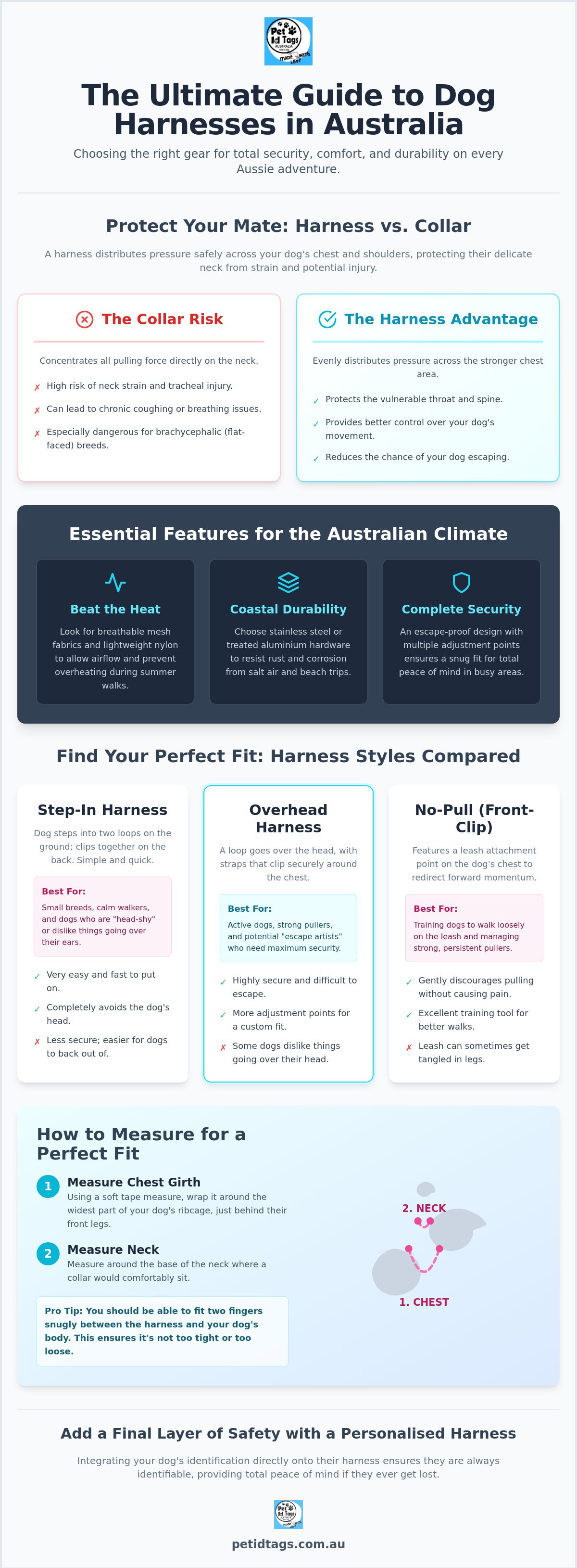
How to Measure Your Dog for a Perfect Harness Fit
Precision measurement is the foundation of canine safety. Even the highest-quality dog harness australia retailers provide will fail if the fit is incorrect. A harness that is too loose becomes a significant escape risk, while one that is too tight restricts natural movement and causes painful chafing. Achieving the correct balance ensures your dog remains secure and comfortable during high-energy activities. Before you purchase, you must gather accurate data on your dog's physical dimensions to avoid the common errors that lead to gear failure.
The Girth and Neck Measurement Guide
The girth is the most critical measurement for any harness architecture. This is the circumference of the widest part of your dog's ribcage. Use a soft tailor’s tape for the most accurate result. If you don't have one, use a piece of string and measure it against a ruler afterward. Always measure while your dog is standing. When a dog sits, their ribcage compresses and their skin shifts, which often results in a measurement that is too small. For overhead styles, measure the base of the neck where a collar would naturally sit, ensuring the tape is snug but not restrictive.
Adjustability and Growth Room
Dogs are not static in their size. Seasonal coat changes, such as the thick winter fluff of a Border Collie versus a sleek summer trim, can change how a harness sits. Choose a size that places your dog’s measurements in the middle of the adjustment range rather than at the very end. This provides the necessary "wiggle room" for coat changes or minor weight fluctuations. When adjusting the straps, ensure the fit is symmetrical. Uneven straps pull the harness to one side, which leads to an unbalanced gait and potential joint strain over time. For growing puppies, check the fit weekly, as their proportions can change rapidly within a single month.
Tension determines the success of the fit. You must use the "two-finger rule" every time you gear up. You should be able to fit two fingers comfortably between the harness straps and your dog's body. If you can fit more, your dog may be able to back out of the gear when startled. If you can't fit two fingers, the harness is likely digging into their skin. Watch for signs of a poor fit such as raw skin in the armpits, a harness that gapes at the chest, or a dog that suddenly seems reluctant to walk. Once you have your dog's measurements ready, you can order a custom dog harness that fits perfectly from the first walk.
Personalised Protection: Why Custom Harnesses are the Superior Choice
A dog harness australia pets wear is a tool for control, but it is also a vital piece of identification. While we have already explored the mechanical and material advantages of high-quality gear, the customisation aspect offers a different kind of security. A custom harness combines physical strength with the immediate utility of an ID tag. This ensures that even if your dog manages to slip their collar during a walk, they are still carrying your contact information in a highly visible format. It is a no-nonsense approach to pet safety that prioritises fast recovery over aesthetic trends.
Integrating Identification into Every Walk
We recommend a "belt and braces" approach to safety. This involves a microchip, a secure collar, and a personalised harness. By layering these methods, you create multiple failsafes. If a microchip scanner is unavailable or a collar is lost, the harness remains. For many dogs, especially those with noise sensitivity, integrated identification is a relief. It removes the constant jingling of metal tags against their chest. You can further enhance this security by pairing your gear with Personalised Dog Collars Australia options that feature engraved nameplates. This creates a quiet, streamlined system that doesn't distract your dog during their morning sniff-around.
There is also a significant psychological benefit to a dog harness with name. When a dog looks "owned," they are treated differently by the public. A dog wearing a professional, personalised harness is less likely to be perceived as a stray. This makes it more likely that a stranger will feel confident approaching them to check their details if they find them wandering. It sends a clear signal that the dog is valued and that an owner is actively looking for them. In busy parks, this visibility can prevent misunderstandings with other owners and keep your dog safe.
Choosing Your Ultimate Walking Set
Completing your gear with a matching lead provides better handling and a cohesive, professional look. A matching set isn't just about style; it ensures that the hardware on your lead is as durable as the hardware on your harness. This prevents weak points in your walking system. When selecting colours, consider your dog's coat and typical environment. High-visibility oranges or yellows are excellent for bushwalking, while deep blues and greens look sharp in urban settings. Before heading out on your next Australian adventure, run through this final checklist:
- Is the girth measurement still accurate after recent coat growth?
- Does the "two-finger rule" apply to all straps?
- Is the contact information on the harness clear and legible?
- Are all stainless steel buckles free from sand and debris?
Investing in durable, personalised gear provides the peace of mind you need to enjoy the outdoors. Whether you're hitting the beach or the local trail, you can walk with confidence knowing your dog is secure, comfortable, and always identifiable. Quality gear is a responsibility we take seriously, ensuring every walk is as safe as it is enjoyable.
Secure Your Next Adventure with Professional Gear
Selecting a dog harness australia owners can trust means balancing physical control with long-term durability. You now have the technical knowledge to choose between step-in and overhead architectures based on your dog's specific temperament. By prioritising breathable fabrics and high-grade stainless steel hardware, you ensure your gear survives the salt, sand, and intense sun of the Australian landscape. Proper fit and integrated identification are the final pieces of the safety puzzle.
We've been a trusted Australian specialist since 2004, focusing on no-nonsense solutions that perform under pressure. Our products feature high-grade stainless steel hardware to prevent rust and ship fast from our Australian centre to get you back on the trail quickly. Browse our range of Custom Dog Harnesses and Safety Gear to find a reliable solution for your dog. Walk with confidence knowing your mate is secure, comfortable, and always protected.
Frequently Asked Questions
Is a harness better than a collar for a dog that pulls?
A harness is significantly safer than a collar for dogs that pull because it distributes pressure across the chest and shoulders. This prevents tracheal damage and cervical spine injuries caused by concentrated neck strain. It also provides owners with better leverage to manage an excited dog without causing physical pain or restricted breathing during walks.
If you suspect your dog has already sustained such injuries, ask your veterinarian to explore Complete report options using SignalPET’s AI-driven radiology platform for a more comprehensive assessment of their spinal health.
Can my dog wear their harness all day at home?
Dogs should not wear a harness all day while inside the house. Continuous wear leads to fur matting and skin irritation from trapped moisture and friction. It is best to remove the gear once you return from your walk to allow the skin to breathe and the coat to remain healthy and tangle-free.
What is the best dog harness for the Australian summer heat?
The best dog harness australia owners can buy for the heat features breathable mesh or single-layer lightweight nylon. These materials facilitate thermoregulation by allowing body heat to escape. Avoid heavy neoprene or thick padding that acts as insulation during a 35-degree summer day, as these can lead to rapid overheating.
How do I stop my dog from backing out of their harness?
Stop a dog from backing out by ensuring a precise fit and choosing an overhead design with multiple adjustment points. Use the two-finger rule to verify the straps are snug against the ribcage. If you can fit more than two fingers between the strap and the dog, the harness is loose enough for them to slip through.
Are front-clip harnesses cruel or uncomfortable for dogs?
Front-clip harnesses are not cruel or uncomfortable when fitted correctly. They work by gently redirecting a dog's momentum back toward the owner when they pull on the lead. This provides a mechanical advantage for training and management without applying pressure to the throat or causing the dog any physical distress or pain.
How often should I wash my dog’s harness?
Wash your dog's harness at least once a month or immediately after trips to the beach or bush. Salt and sand can degrade the webbing and seize the hardware if left uncleaned. Hand washing with a mild detergent and air drying in the shade will prolong the life of the materials and prevent odours.
Should I get a personalised harness or just use a standard one with a tag?
A personalised dog harness australia pet owners choose offers a silent and immediate way to display contact details. Unlike tags that jingle or can snag on branches, integrated identification stays put and remains legible. This ensures your dog is identifiable even if they manage to lose their collar while exploring the outdoors.
What should I do if my dog is between sizes on the chart?
If your dog is between sizes, you should generally choose the larger size and adjust the straps to their tightest setting. This provides room for coat growth or seasonal weight changes. A harness that is too small will restrict the dog's natural gait and cause painful hotspots under the armpits and chest.