

If your dog spots a scrub turkey and your immediate reaction is to brace for a painful rope burn, your current gear is failing you. Walking a powerful mate should be a shared pleasure, not a physical battle that leaves your hands raw and your nerves frayed. When you are searching for the best dog leads for strong pullers australia provides, you need more than just a thick rope. You require a system built to withstand 2026's updated local council safety standards and the unique challenges of our rugged environment.
We understand the frustration of clips that seize up after a single coastal walk or webbing that becomes brittle under the intense Aussie sun. You deserve equipment that offers both a comfortable grip and unyielding reliability. This guide promises to help you identify high-tensile materials and reinforced hardware that won't snap during high-distraction moments. We will preview the most durable leads currently available, focusing on the specific engineering and material science required to keep your dog secure and your walks under total control.
Key Takeaways
- Identify why high-tensile hardware and reinforced box stitching are essential for managing the physical force of a large dog's pull.
- Discover why Biothane has become the preferred waterproof and rot-proof material for durability in the Australian bush.
- Compare fixed-length and bungee styles to find the best dog leads for strong pullers australia that suit your walking environment.
- Learn the 'double-clip' safety technique to ensure a fail-safe connection between your dog’s harness and collar during high-distraction moments.
- Understand the importance of choosing stainless steel components to prevent hardware failure caused by salty air and intense UV exposure.
Taming the Pull: Why Your Choice of Lead Matters in Australia
Walking a powerful dog in a busy Australian suburb requires more than just physical strength. It requires an understanding of the gear connecting you to your mate. A standard lead might look fine on the shelf, but the physics of a sudden lunge can turn a routine walk into a dangerous situation. High-traffic areas, like the popular walking tracks on the Sunshine Coast or Melbourne's inner suburbs, leave no room for equipment failure. When you have a dog that pulls, the lead is your primary safety line and communication tool.
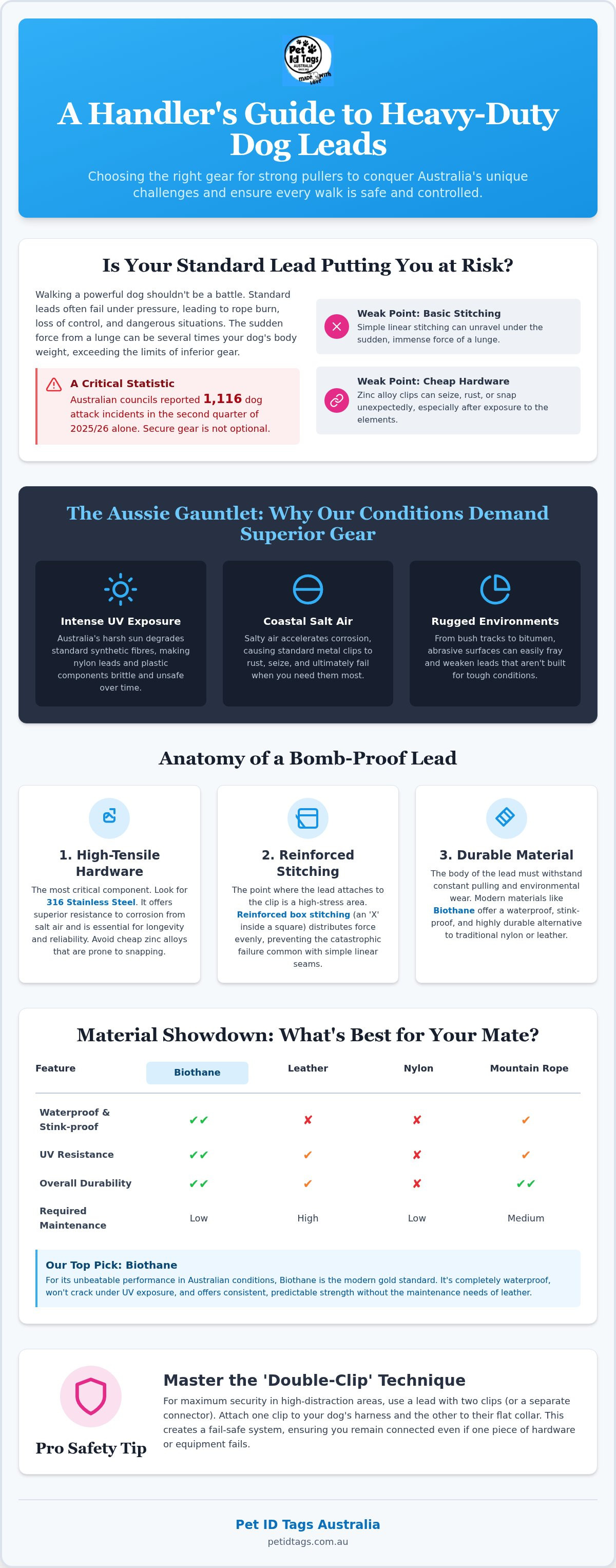
When a 35kg dog lunges at a distraction, they aren't just exerting 35kg of pressure. The dynamic force can spike to several times their body weight in a fraction of a second. Cheap nylon leads, often found in big-box retailers, typically rely on simple heat-sealing or basic linear stitching. These points are prone to snapping under sudden tension. Finding the different types of dog leashes that prioritise safety means looking for reinforced box stitching and high-tensile hardware. This is especially critical given that 1,116 dog attack incidents were reported to Australian councils in the second quarter of 2025/26 alone. A control-first approach is the only responsible way to manage reactive or high-prey-drive dogs in public spaces.
The Difference Between a Standard Lead and a Heavy-Duty Lead
A heavy-duty lead is defined by its resilience and its impact on the owner's comfort. Standard leads are often thin, which provides poor hand feel and can cause significant friction burns if the dog bolts. Heavy-duty options use thicker webbing or padded handles to ensure a secure grip during sudden movements. For any dog weighing over 30kg, you should look for gear with a breaking strain rating that far exceeds the dog's weight. The hardware is almost always the first point of failure. A cheap zinc alloy clip might look sturdy, but the internal spring mechanism is a common weak link that can seize or snap when you least expect it.
Why Australian Conditions Demand Better Gear
Our environment is notoriously harsh on pet accessories. The intense Australian UV levels cause rapid degradation in standard synthetic fibres, making plastic components and thin nylon brittle within months. If you live near the coast, salt air corrosion is another major threat that can cause standard clips to rust and seize. Stainless steel hardware is essential for longevity and reliability in these conditions. To ensure total safety, you must choose the best dog leads for strong pullers australia has to offer, specifically those tested against our climate. In the context of large breed control, tensile strength is the maximum amount of pulling force a lead can withstand before the material or hardware physically snaps.
The Anatomy of a Heavy-Duty Lead: Materials Built for Power
A lead is only as strong as its weakest point. For owners of powerful breeds like German Shepherds or Australian Cattle Dogs, selecting the best dog leads for strong pullers australia provides means looking beyond aesthetics to the core material science. The material must offer high tensile strength while remaining flexible enough for the owner to maintain a secure, comfortable grip. In our harsh climate, the choice of material also determines how well the gear resists the cumulative damage of heat, moisture, and friction.
Double-layer nylon with reflective stitching has become the suburban standard for a reason. It is lightweight, affordable, and provides excellent visibility during early morning or late evening walks. However, for those who frequent the bush or coastal trails, 'Mountain Rope' leads are a popular alternative. These are crafted from high-grade climbing rope, offering a slight natural elasticity that acts as a subtle buffer against sudden jerks. While durable, rope leads can be prone to fraying if they are frequently dragged over abrasive surfaces like sandstone or bitumen.
Biothane vs. Leather: The Battle for Durability
Biothane is the modern gold standard for high-performance pet gear. It consists of a polyester webbing core with a TPU or PVC coating, making it completely waterproof and stink-proof. Unlike leather, it does not require conditioning and won't become heavy or slimy when wet. This makes it ideal for muddy bush walks or trips to the dog beach. Leather remains a classic choice because it moulds to the owner's hand over time, creating a custom fit. However, leather can stretch or crack if not meticulously maintained, especially when exposed to the salt air of the Australian coast. For the absolute 'snap' of a 40kg dog lunging, Biothane often provides more consistent, predictable resistance.
Hardware Essentials: Clips, Rings, and Snaps
The clip is the most likely component to fail during a high-distraction moment. Standard bolt snaps rely on a small internal spring that can weaken or become jammed with grit. 'Carabiner' style clips, particularly those with a locking mechanism, offer the highest level of security for strong pullers. These clips are designed to stay closed even under extreme, multi-directional tension. While the right equipment provides physical security, it works best when paired with consistent technique. Experts at the RSPCA suggest that training a dog not to pull is a necessary step alongside using high-quality gear.
Look for hardware made from stainless steel rather than chrome-plated zinc. Stainless steel is far superior for longevity, as it won't chip or rust, ensuring the moving parts of the clip remain fluid and reliable for years. Integrated 'traffic handles' located near the clip are also essential. These allow you to bring your dog into a tight heel at busy intersections or when passing other reactive dogs, giving you immediate, close-proximity control. You can find this level of durability and thoughtful design in the range of accessories at Pet ID Tags Australia, where gear is built to handle the real-world demands of Aussie dog ownership.
Comparing Lead Styles for Maximum Control and Safety
Selecting the right configuration for your gear is just as vital as the material itself. While we have already established that high-tensile materials are the foundation of safety, the physical style of the lead dictates how you communicate with your mate. For those searching for the best dog leads for strong pullers australia provides, the decision often rests on whether you prioritising training feedback or physical comfort. A lead that is too long or lacks the right tension can compromise your reaction time when you need it most.
Different environments require different levels of restriction. A weekend trip to a crowded market demands a much shorter connection than a quiet walk through the local bush. Understanding the mechanics of each style ensures you aren't just holding on, but actively managing your dog's energy and movement. Whether you are dealing with a high-prey-drive rescue or a powerful young pup, the right style can prevent injury and improve the walking experience for both ends of the lead.
Fixed Leads vs. Shock Absorbers
Fixed length leads remain the gold standard for obedience and loose-lead training sessions. Because there is no 'give' in the material, the dog receives immediate and consistent feedback when they reach the end of the line. This clarity is essential for teaching a dog exactly where their boundaries are. However, for owners of dogs that lunge suddenly, a fixed lead can be jarring on the shoulders and the dog's neck.
Shock absorbing or 'bungee' leads use an elasticated core to dampen the impact of a sudden pull. This is particularly beneficial for older owners or those with existing joint issues. While they provide excellent comfort, they can create a 'rebound effect'. If a reactive dog lunges and the bungee snaps back, the sudden retraction can sometimes trigger a secondary lunge or pull the owner off balance. Use bungee leads for dogs that are generally well-behaved but have occasional lapses in focus.
Why Retractable Leads Are a No-Go for Pullers
Retractable leads are fundamentally unsuitable for powerful dogs. The thin cord and internal spring mechanism are not designed to withstand the force of a 40kg dog hitting the end of the line at full speed. Mechanical failure is a significant risk, often resulting in the lead snapping or the handle being ripped from the owner's grip.
These leads also reinforce poor behaviour. Because the dog must pull to extend the line, they learn that constant tension is the key to exploring. Beyond the lack of control, the thin cords are notorious for causing severe friction burns or entanglement injuries in high-traffic areas. For total security, a short 30-60cm traffic lead is a far better choice for high-control environments like vet visits, ensuring your dog stays at a tight heel where they are safest.
Essential Safety Tips: Beyond the Lead
Even the best dog leads for strong pullers australia can offer are only as effective as the connection point on your dog. If you attach a high-tensile lead to a standard collar, a powerful lunge puts immense pressure on the dog's neck and larynx. This is not just a health risk; it is a security flaw. Many strong pullers are experts at "backing out" of collars by tucking their heads and pulling in the opposite direction. To create a truly secure walking ecosystem, you must look at how your gear works together to distribute force and maintain control.
The 'Double-Clip' method is a professional fail-safe technique for high-risk situations. By using a lead with clips at both ends, or a specialized splitter, you connect one point to the collar and the other to a harness. If a single piece of hardware fails or your dog manages to slip one attachment, you still have a physical connection to your mate. This redundancy is vital when walking near busy Australian roads or in high-distraction environments like local parks where off-leash dogs might approach.
Front-Clip vs. Back-Clip Harnesses
Pairing your lead with a custom dog harness Australia allows for better weight distribution across the chest and shoulders. Front-clip harnesses are particularly effective for strong pullers because they change the leverage point. When your dog lunges forward, the tension on the front clip naturally steers their body back toward you, neutralizing their momentum. Back-clip harnesses are better suited for dogs that have already mastered loose-lead walking or for specific activities like tracking. For a perfectly coordinated and secure setup, you can explore the best custom dog leads and harness sets designed for rugged use.
The Role of Durable ID Tags
Identification is your final layer of safety if a gear failure occurs. A stainless steel dog tag is non-negotiable for powerful breeds that exert significant force on their accessories. Unlike aluminium or plastic, stainless steel won't bend, snap, or wear thin from the constant friction of a heavy-duty metal clip. Ensure your tags are deeply engraved so the contact details remain legible even after years of bush walks and beach trips. A secure, high-quality tag ensures that if the unthinkable happens and your dog gets loose, they can be identified and returned quickly. You can find the full range of durable, Australian-tested safety gear at Pet ID Tags Australia to complete your dog's safety kit.
Finding the Perfect Set-Up with Pet ID Tags Australia
Managing a powerful dog is a serious responsibility. It requires a safety-first mindset that prioritises the physical integrity of your gear over aesthetic trends. We have discussed the science of high-tensile materials and the importance of a secure harness ecosystem. Now, the final step is selecting a provider that understands the specific demands of the Australian environment. Pet ID Tags Australia curates gear designed to withstand the unique pressures of our rugged lifestyle, from the corrosive salt air of the coast to the intense heat of the outback.
A successful walk relies on a three-point safety checklist. If any one of these components is weak, the entire system is at risk. For those seeking the best dog leads for strong pullers australia provides, we recommend this essential set-up:
- A High-Tensile Lead: Constructed from Biothane or double-layer nylon with reinforced box stitching.
- A Secure Harness: Specifically a front-clip design to manage momentum and distribute weight safely.
- A Stainless Steel ID Tag: Deeply engraved and securely attached to ensure your mate is always identifiable.
Why Trust Pet ID Tags Australia?
We are an Australian-owned and operated business that has been a guardian of pet safety since 2004. With over two decades of experience, we understand that local conditions like extreme UV levels and fine bulldust can quickly degrade inferior equipment. Our focus remains on high-grade materials, particularly stainless steel hardware that won't rust, seize, or snap under pressure. We don't just sell accessories; we provide professional-grade solutions that offer long-term utility and peace of mind for owners of powerful breeds.
Next Steps for a Better Walk
Before your next outing, take the time to measure your dog correctly. A harness that is too loose allows for a "backing out" risk, while one that is too tight causes significant discomfort. It is also the perfect time to ensure your contact details are current. Updating your information on a fresh personalised dog collar ensures that your safety net is complete. When you choose the best dog leads for strong pullers australia offers, you are investing in years of controlled, confident, and secure adventures with your best mate.
Browse our range of heavy-duty leads and accessories today!
Take Control of Your Next Adventure
Walking a powerful dog shouldn't be a test of endurance or a gamble with safety. You now understand that taming the pull requires a combination of high-tensile materials and the mechanical advantage of a front-clip harness. Most importantly, your gear is only as reliable as its stainless steel hardware. These components are essential for resisting the harsh Australian sun and salt air that quickly degrade standard alternatives.
Investing in the best dog leads for strong pullers australia ensures that you maintain total control while protecting your hands from strain. Pet ID Tags Australia has been trusted by local pet owners since 2004 to provide professional-grade solutions. We offer deep-engraved stainless steel for lifetime readability and provide fast national shipping across Australia to get you back on the trail quickly.
Secure your mate with Australia's best heavy-duty leads and tags
Enjoy the peace of mind that comes from knowing your gear is built for the rugged Aussie lifestyle; for more ways to enhance your outdoor adventures, visit Torus Pet and explore their innovative hydration range. Happy walking.
Frequently Asked Questions
What is the best lead length for a dog that pulls?
A length of 1.2 to 1.5 metres is generally the ideal range for maintaining maximum control. Longer leads allow a dog to build up significant momentum before hitting the end of the line, which increases the physical force you have to absorb. A shorter connection keeps your mate closer to your centre of gravity, making it easier to redirect their attention before they commit to a full pull.
Can a strong dog snap a standard nylon lead?
Yes, standard single-layer nylon leads frequently fail under the dynamic load of a sudden lunge. While the material itself might hold, the linear stitching or the cast-zinc clip often snaps under the pressure. This is why the best dog leads for strong pullers australia owners choose feature reinforced box stitching and high-tensile hardware designed to handle several times the dog's actual body weight.
Are leather leads better than nylon for large breeds?
Leather is excellent for hand comfort, but high-grade synthetic materials often provide better consistency in our climate. While leather can stretch or crack if it isn't oiled regularly, double-layer nylon or Biothane remains structurally sound regardless of humidity or rain. For large breeds, the reliability of the hardware and the quality of the stitching matter more than the base material choice.
Should I use a head halter or a harness for a strong puller?
Head halters offer the most leverage for steering, but many dogs find them aversive and require extensive training to accept. A front-clip harness is generally the more practical choice for most owners. It effectively manages the dog's momentum by turning their body toward you without the risk of neck or facial injury during a sudden lunge.
How often should I replace my dog's lead?
You should inspect your gear weekly for any signs of wear and tear. Even the most durable gear should be replaced every 1 to 2 years if you walk daily in harsh conditions. If you notice any fraying in the webbing, stiffness in the clip, or rust on the hardware, retire the lead immediately to prevent a mid-walk failure.
Will stainless steel clips really prevent rust in coastal areas?
High-grade stainless steel is the only material that truly withstands salt-air corrosion over the long term. Unlike chrome-plated zinc, which chips and rusts from the inside out, stainless steel remains structurally integral and free-moving. This is a critical safety feature for anyone living within 5 kilometres of the coast where salt spray is constant.
What should I do if my dog lunges suddenly on the lead?
Avoid the instinct to jerk the lead back, as this often triggers an opposition reflex that makes them pull harder. Instead, brace your core and use a traffic handle to bring them to a tight heel. Redirecting their movement in a semi-circle toward you is much more effective than engaging in a direct tug-of-war.
Is a 'hands-free' lead safe for a very strong dog?
Hands-free leads are generally only safe for strong dogs if they are already well-trained and you are using a shock-absorbing bungee. For reactive dogs or very powerful pullers, a waist-worn lead can easily pull an owner off their feet during a sudden lunge. Always maintain a manual grip on the lead in high-distraction areas to ensure you have immediate physical control.