

Table of Contents
- What Pet Identification Laws Australia 2026 Require
- Microchipping Requirements for Pets: What Is Mandatory
- Council Registration, Tags and Pet Licensing Rules
- Pet Registration Renewal 2026: Deadlines and Fee Waivers
- Custom Engraved Cat Tags Australia: Choosing the Right ID
- Breeds, Breeders and Legal Rights in Separation
- Moving, Relocating and Digital ID: What Owners Miss
- Conclusion
- Frequently Asked Questions
Last Updated: September 10, 2026
What Pet Identification Laws Australia 2026 Require
Pet identification laws Australia 2026 operate on three layers: a microchip for permanent identification, a local council registration linked to that chip, and a visible collar tag. Miss any one and your pet is legally under-identified. This guide from Pet ID Tags Australia breaks down what each layer demands, who enforces it, and where owners fall out of compliance. Rules sit in state animal welfare legislation and local government acts, so detail shifts by location.

The three layers of mandatory pet identification
Mandatory identification is the legal requirement that a companion animal carry permanent and visible ID. The permanent layer is a microchip implanted under the skin, encoded with a unique number. The registry layer is council registration, tying that chip number to your contact details in a government database. The visible layer is a collar tag a member of the public can read without a scanner. Each layer covers a different failure point: the chip works when a vet or pound scans the animal, the registry links the chip to you, and the tag works in the street before any scan happens.
Microchipping Requirements for Pets: What Is Mandatory
Microchipping is compulsory for dogs and cats in every state and territory, generally required before a set age or before sale or transfer. A microchip stores a unique number that authorised scanners read at vet clinics, pounds, and shelters.
The chip stores only a number. Your name, address, and phone number live in the registry database the implanter submits to, which is why an unregistered chip is nearly useless. When a pet changes hands, the registry record must be updated, or the previous owner remains the contact of record.
Who can implant a microchip and how it is recorded
Implantation must be performed by an authorised person, typically a veterinarian or accredited implanter, and the chip number is recorded against a registry database. Ask for the paperwork and check that your contact details, not the breeder's or shelter's, are on the record. A common mistake is assuming the breeder updated the registry after purchase, usually the new owner must complete that transfer, and fees can apply.
Council Registration, Tags and Pet Licensing Rules
Council registration is a separate legal step from microchipping and applies in every local government area. You register the animal with your council, pay the annual or lifetime fee, and receive a registration tag. Registration typically requires a microchip number and proof of desexing, since desexed animals attract a lower fee.
Keep the council tag on the collar alongside your own ID tag. Rangers treat a missing registration as a standalone offence, even when the microchip is current. If you move, update both the registry database and your council, because renewal notices follow the address on file.

Pet Registration Renewal 2026: Deadlines and Fee Waivers
Pet registration renewal 2026 deadlines are set by each council, and most run on a fixed annual cycle rather than your pet's registration anniversary. A pet first registered in March may still fall due in the same month as every other animal in the council area, typically aligned to the financial year or calendar year. Councils issue renewal notices before the due date, and late payment usually attracts an extra charge.
The renewal notice is not a formality. Ignore it and the registration lapses even though the microchip remains current, a ranger who scans your pet finds a valid chip number attached to an expired registration, a standalone offence in most jurisdictions.
How the 2026/27 fee cycle works
Most councils set fees for the financial year beginning 1 July, so the 2026/27 schedule applies to renewals between July 2026 and June 2027. A smaller number run on a calendar-year cycle, with renewals due in January. Two owners in neighbouring council areas can therefore face different due dates and fees for identical animals.
Registration fees are almost always tiered. The standard categories are:
- Desexed animal, the lowest fee tier in most council schedules.
- Entire (undesexed) animal, a higher fee, sometimes substantially higher, designed to discourage breeding.
- Pensioner or concession card holder, a reduced rate, and in some councils a full waiver for the first animal.
- Working or assistance animal, a separate category with its own evidence requirements.
- Restricted breed, additional conditions and a higher fee in jurisdictions that regulate specific breeds.
Fee waivers and concessions: what actually exists
Fee waivers exist but vary by jurisdiction, and the categories are narrower than many owners assume. The most common concession is for Commonwealth concession card holders, a Pensioner Concession Card, Health Care Card, or Commonwealth Seniors Health Card. Some councils apply it automatically once you provide the card number; others require an annual application.
A second category is the multi-pet discount: some councils reduce the per-animal fee once you register more than one or two animals at the same address. It is not universal and rarely advertised on the renewal notice.
A third category, most relevant to 2026/27, is cost-of-living relief. Several councils have reviewed fee schedules in response to cost-of-living pressure, and some introduced temporary waivers or frozen fees for concession holders. These measures are typically announced in annual budget papers rather than on the registration page, so they are easy to miss. Check your council's current schedule and its most recent budget or fees-and-charges document rather than relying on last year's amount.
What to check before you pay
- Confirm your pet's microchip details are current in the registry
- Check your council's renewal due date for 2026/27, financial year or calendar year
- Ask whether you qualify for a concession, pensioner, or multi-pet rate
- Confirm whether the concession must be re-applied each year
- Update your address if you have moved since the last renewal
- Keep the registration tag on the collar at all times
guidance on state and territory pet registration requirements
Why the renewal cycle catches owners out
The single most common compliance failure is not a missing microchip but a current microchip attached to a lapsed council registration. The chip was implanted years ago, the owner moved or changed phone number, the renewal notice went to the old address, and the registration quietly expired. Rangers scan the chip, find a valid number, then discover the registration was never renewed, the fine applies regardless of how good the chip is.
The fix: treat the renewal notice as a hard deadline, update your address with both the registry and the council the moment you move, and keep the registration tag on the collar so a ranger can see at a glance that the animal is registered.
Custom Engraved Cat Tags Australia: Choosing the Right ID
Custom engraved cat tags Australia owners rely on do one job the microchip cannot: they let a stranger identify your cat without a scanner. The tag is the visible layer of the three-part system, and for cats that slip out an open door, it is often the only layer read before the animal is handed to a vet.
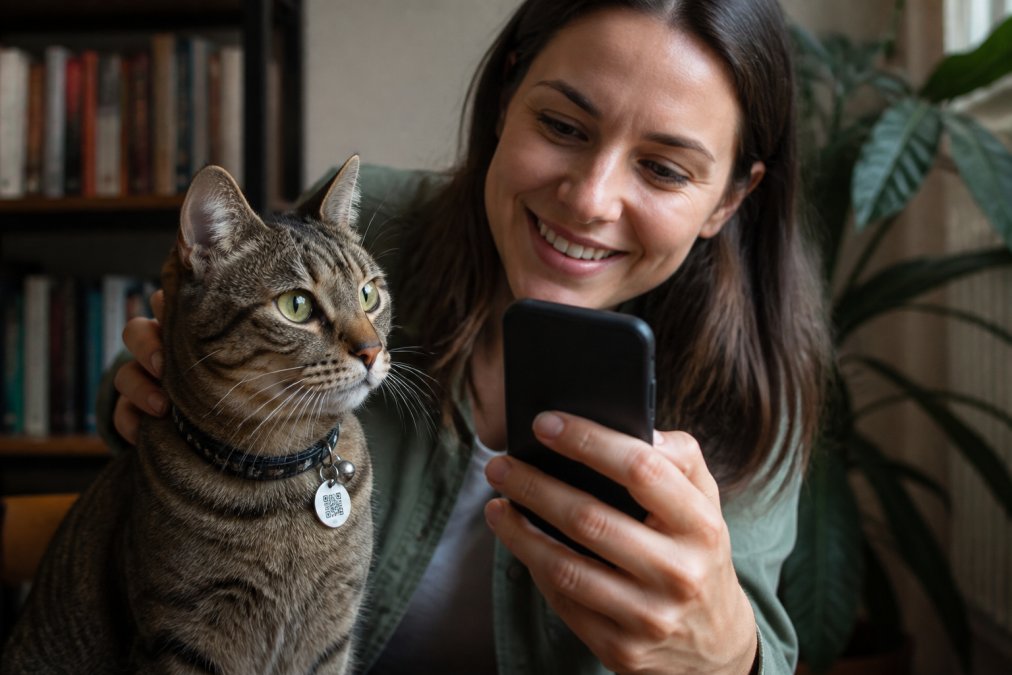
Engraving beats printed or handwritten tags because the text is cut into the metal rather than applied to the surface. Deep laser engraving stays readable after months of scratching against a food bowl or fence. For cats, weight matters more than for dogs: a light aluminium tag moves less on the collar and is less likely to work loose.
What to engrave on a tag and why materials matter
Engrave your phone number first, then your pet's name. A second contact number helps if you miss the call. Avoid your full street address on a visible tag, since anyone can read it. For owners who want both, the Pawzee Smart Pet ID Tag ($34.90) carries a scannable QR code linked to a digital profile, so a finder reaches your contact details by smartphone without your address being printed in the open. For a classic look, the Black Aluminium Bone Pet ID Tag ($17.90) is lightweight anodised aluminium with a deep engraved finish.
| Tag option | Material | Best for | Price |
|---|---|---|---|
| Smart QR ID tag | Aluminium with QR profile | Tech-aware owners, cats and dogs | $34.90 |
| Black bone ID tag | Anodised aluminium | Everyday durability, classic look | $17.90 |
| Blue bone ID tag | Anodised aluminium | Easy-to-spot colour on the collar | $17.90 |
| Reflective personalised collar | Reflective webbing | Dogs walked at dawn or dusk | $34.90 |
Breeds, Breeders and Legal Rights in Separation
Prohibited breed restrictions and breeder transparency rules sit alongside identification law, and both affect what you must prove about your animal. Some jurisdictions restrict specific dog breeds, and ownership of a restricted breed usually carries extra registration conditions, higher fees, and sometimes enclosure requirements. Breeder identification is also tightening: reputable breeders supply microchip paperwork, a breeder identification number, and health records, insist on all three.
Where a relationship ends, a pet is treated as property in most separation settlements, not as a child. Ownership usually turns on who purchased the animal, whose name is on the microchip and council registration, and who paid the vet bills. If you are separating, the registry record is evidence, one more reason to keep it accurate.
Moving, Relocating and Digital ID: What Owners Miss
Interstate relocation compliance is where the three-layer system breaks down most often. Microchip registries are national, but council registration is not. When you move to a new state or council area, your old registration does not transfer automatically. You generally need to register with the new council, and some old councils will not cancel until you tell them, so you can pay two councils at once, or worse, be registered in neither.
The interstate relocation sequence
The order matters, and getting it wrong creates a window where your pet is legally under-identified in its new home.
- Update the microchip registry first. The registry database is national, so a single change of address updates the contact details attached to the chip number. Do this before you move, or as soon as you have a new address, otherwise a vet or pound in your new state will scan the chip and call a number that no longer reaches you.
- Check whether your new council recognises your old registration. Most do not. A small number of councils have reciprocal arrangements with neighbours, but cross-border recognition is the exception, not the rule.
- Register with the new council. You will usually need the microchip number, proof of desexing, and, in some councils, proof of registration in the previous area. Keep your old registration certificate or tag number; it can speed up the process and sometimes reduce the fee.
- Cancel the old registration. Some councils cancel automatically when you notify them of the move; others require a written request. If you do not cancel, you may keep receiving renewal notices and, in a minority of cases, keep accruing fees.
- Replace the council tag. The old tag is not valid in the new area. Put the new tag on the collar alongside your own ID tag.
A common pattern is completing steps one and three but skipping four and five. The pet is compliant in the new area, but the old council still has an active record, confusing if the animal is ever scanned in the old jurisdiction.
Digital vs. physical ID: how QR tags interact with official databases
Digital identification is the second gap, and it is worth being precise about what it does and does not do.
A QR-code tag or digital profile does not replace the microchip or council registration. It sits alongside them as a faster route to your contact details. When a finder scans the QR code, they reach a profile you control, typically hosted by the tag manufacturer, showing your phone number and any details you choose to share. No microchip scanner, council, or vet is needed to reach you.
The mechanism is simple: the QR code encodes a URL, the URL points to your profile, and the profile is editable. That editability is the real advantage. If your phone number changes, you update the profile and the tag still works. With a purely engraved tag, a number change means a re-engrave or a replacement.
The catch: digital ID only works if someone thinks to scan it. A finder who does not recognise the tag as scannable may simply read the engraved text and call the printed number. The strongest setup carries both, a QR code for the finder who scans and an engraved phone number for the finder who does not. Treat digital ID as an addition to the physical tag, not a replacement.
What the microchip database does not do
One more point that catches owners out: the microchip registry and the council registration database are separate systems. Updating your address with one does not update the other, if you move, update both. The registry holds the contact details attached to the chip number; the council holds the registration record and issues the tag. A ranger checking compliance will look at both.
information on microchip registries and [pet identification(/blogs/pet-articles/secure-pet-identification-tags-the-2026-australian-guide-to-pet-safety) standards | nsw.gov.au]
Conclusion
Keeping a pet compliant across three layers, in a system that changes by state and council, is genuinely fiddly, and the renewal cycle catches owners out every year. Pet ID Tags Australia has spent over 20 years engraving tags that stay readable, with deep laser engraving, durable materials, and a 30-day satisfaction guarantee, backed by 4.91 stars from 4,828 verified reviews. Choose a tag that survives the collar, keep the microchip and council records current, and your pet stays identifiable at every layer. Shop dog tags and cat tags at Pet ID Tags Australia and give your pet the visible ID that brings them home.
Frequently Asked Questions
What are the mandatory pet identification requirements for 2026?
Across Australia, most states and territories require pets to be microchipped and registered with the local council. Dogs must also wear a collar with a tag showing the owner's contact details. Microchipping requirements for pets generally apply from around 12 weeks of age or at the point of sale, and registration must be renewed annually or for the lifetime of the pet depending on your council. Always check your local council's specific rules, as penalties for non-compliance can apply.
Do I need both a microchip and an engraved tag for my pet?
Yes, in most cases. A microchip is a permanent form of identification stored on a national registry, but it can only be read by a vet or shelter with a scanner. A visible engraved tag lets any member of the public identify and contact you immediately if your pet escapes. Combining both gives the fastest possible reunion if your pet goes missing, and it is a legal requirement in many jurisdictions to have a tag on your dog's collar.
What information must be included on a pet identification tag?
At minimum, a pet ID tag should include your pet's name and a current phone number where you can be reached. Many owners also add a second contact number, their suburb, or a microchip number. Avoid putting your full home address on the tag for privacy reasons. Custom engraved cat tags Australia owners choose should be deep-engraved so the details stay readable over years of wear, rather than printed or painted on the surface.
How do I update my pet's registration details under new 2026 guidelines?
Contact your local council or log into their online portal to update your address, phone number or pet's microchip details. If you move interstate, you will generally need to register your pet with the new council and update the national microchip database. Keeping your owner contact information current is one of the most important pet owner responsibilities, because outdated details can delay a reunion even when a microchip is scanned.
Are there different identification laws for cats and dogs?
Yes, rules differ. Dogs are required to wear a collar and tag in most jurisdictions, while cats in some states are exempt from the tag requirement but must still be microchipped and registered. Some councils also enforce cat curfews or containment rules that affect identification requirements. Custom engraved cat tags Australia owners use are still strongly recommended even where not legally mandatory, because cats are far more likely to slip out unnoticed and need visible ID.
What happens if I move interstate with my pet?
Interstate relocation compliance means re-registering your pet with the new local council and updating your contact details on the national microchip registry. Registration fees, desexing requirements and prohibited breed rules can vary between states, so check the destination state's animal welfare legislation before you move. Keep your old council informed as well, so they can close your previous registration and avoid sending renewal notices to the wrong address.