

Table of Contents
- Why a Personalised Dog Collar Beats a Standard Tag
- Engraved Dog Collars: How Deep Marking Prevents Fading
- Dog Collar Sizing Guide: Measure Once, Fit Right
- Pet Identification Safety Standards in Practice
- Materials That Survive Mud, Rain and Saltwater
- Choosing Hardware, Buckles and Reflective Details
- Personalised Dog Collar Options Worth Buying
- Frequently Asked Questions
Last Updated: September 12, 2026
Why a Personalised Dog Collar Beats a Standard Tag
A personalised dog collar is a collar with your dog's name and your contact number permanently marked onto the collar itself, so identification stays on your pet even if a hanging tag is lost. At Pet ID Tags Australia, we've spent more than 20 years engraving identification for dogs and cats. The reason is simple. A tag hangs from a ring and can snag, unscrew or fall off. A collar with the details marked directly into the material has nothing to lose.

Faster Reunions When Pets Go Missing
The minutes after a dog slips through an open gate matter. A collar that already carries your phone number means whoever finds your dog can call you immediately, without a vet visit or a microchip scan. Hanging tags work well until they don't: the ring wears, the tag catches on fencing, and one day it's gone. Built-in identification removes that failure point entirely.
Comfort and Wearability for Daily Use
A collar that carries identification has to be comfortable enough to never come off. That means soft, flexible material, rounded edges and a proper comfort fit around the neck, not a stiff strap that rubs. For dogs who wear a collar 24/7, comfort isn't a nice extra. It's the difference between the collar staying on and mysteriously disappearing.
Engraved Dog Collars: How Deep Marking Prevents Fading
Deep engraving is the single biggest factor separating a collar that stays readable for years from one that's illegible within months. Cheap identification is often printed or stamped shallowly onto the surface, so everyday wear, mud and UV exposure erode the text. The customer question we hear most is blunt: how do I know these won't fade or peel like the cheap ones I bought last time?
The answer is depth. Laser engraving cuts into the material rather than sitting on top of it, so the marking survives scratching, washing and weather. On leather, that means the text is burned into the hide. On our reflective collars, your dog's name and phone number are custom engraved, with reflective stitching that improves visibility on evening walks.

Australian Veterinary Association pet identification guidance
Dog Collar Sizing Guide: Measure Once, Fit Right
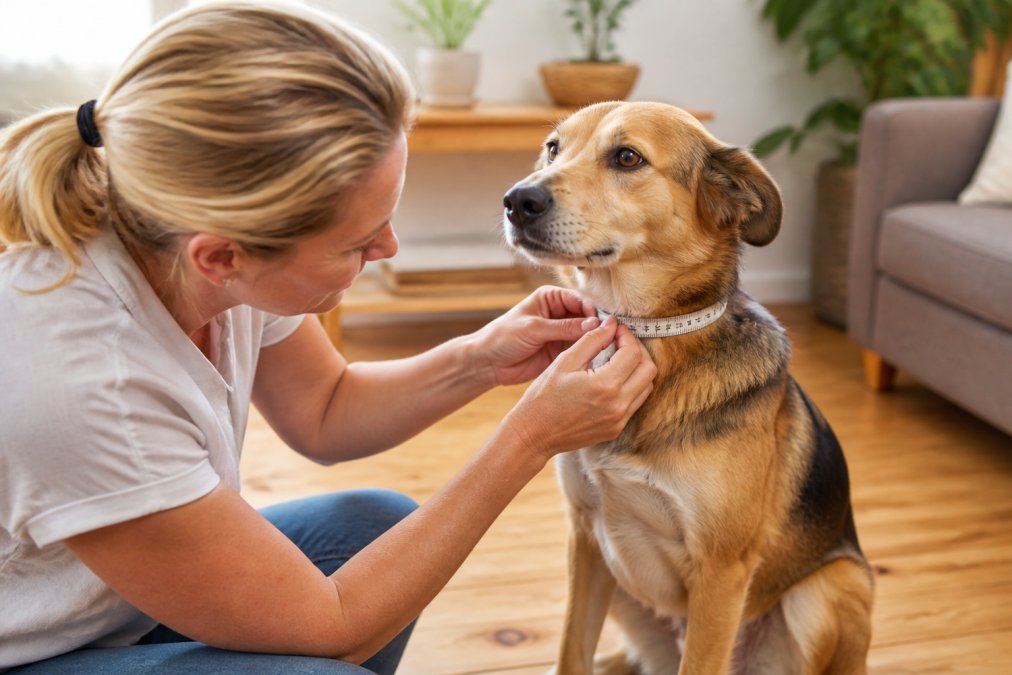
Getting the size right takes one measurement and about two minutes, but the consequences of getting it wrong are not cosmetic. A collar that's too loose can slide over the head during a shake or a scramble through a fence; one that's too tight rubs the coat, restricts the neck and, in the worst case, interferes with breathing or swallowing. Measure the neck circumference at the widest point, then allow a two-finger gap between the collar and the neck.
Step-by-Step Measuring at Home
- Stand or sit your dog calmly and loop a soft measuring tape around the base of the neck, where the collar normally sits, not up near the ears and not down on the shoulders.
- Record the measurement in centimetres at the widest point. If you only have a fabric tape, use a piece of string and lay it against a ruler.
- Add roughly two centimetres for comfort, or check that two fingers fit snugly under the tape. Two fingers is a guide, not a rule, a sighthound's neck needs less slack than a thick-coated breed's.
- Measure twice, ideally on a different day, since fur thickness, posture and even recent grooming shift the number slightly.
- Choose an adjustable length collar when your dog is still growing or between sizes, and re-check the fit monthly.
Why Fit Fails: The Mechanisms Behind Slipping and Rubbing
A collar slips over the head when the neck-to-head circumference ratio is small, that is, when the head is only slightly wider than the neck. Sighthounds, whippets and greyhounds are the classic example: a collar that fits a labrador's neck will slide straight off a greyhound's. For these builds, a wider collar band (38 mm or more) distributes pressure and sits lower on the neck, and a martingale-style or limited-slip design is often the safer choice because it tightens only under load and releases when the dog stops pulling.
Rubbing, by contrast, comes from three things: a strap that's too narrow for the dog's weight, hardware that sits against the throat, and material that doesn't breathe. Short-coated and hairless breeds show rub marks first because there's no fur to cushion the strap. Neoprene padding or a rolled leather edge solves most of it.
Breed and Build Considerations
Dog breed sizing isn't just about weight. A greyhound's slender neck needs a different fit from a stocky bulldog's, and thick-coated breeds can hide a collar that's actually too tight, the fur compresses under the strap, so the collar feels looser than it is. Puppies need room to grow, but not so much that the collar slips; a common pattern is to buy an adjustable collar sized to the puppy's current neck plus about three centimetres, then re-check every few weeks. Senior dogs often do better with lighter hardware and a wider band, since thin straps can press on a thinning coat.
When in doubt, size up and rely on adjustability, but never so far up that the collar can clear the head.
Australian Veterinary Association pet identification guidance
Pet Identification Safety Standards in Practice
Pet identification safety standards often recommend that a dog wears a collar with identification while in public, and that the details remain legible. Microchips are the permanent backup, but they only work when someone has a scanner. A visible collar does the first job: it tells a stranger your dog has a home and gives them a way to reach you.
| Feature | Why It Matters | What to Check |
|---|---|---|
| Legible contact details | Anyone can call you directly | Engraving depth, not just print |
| Secure fastening | Prevents collar loss | Buckle strength, stitching |
| Reflective material | Visibility at night | Reflective stitching or panel |
| Correct fit | Stops slipping or rubbing | Two-finger gap, adjustable length |
| Weather resistance | Survives rain and mud | Material and hardware quality |
For emergency preparedness, keep a recent photo of your dog and a note of the collar's identification details somewhere you can access quickly. If your dog goes missing, you can describe exactly what they're wearing.
Materials That Survive Mud, Rain and Saltwater
Weather-resistant materials are the difference between a collar that lasts one summer and one that lasts several. Leather and high-strength nylon are popular choices for collars, and each suits a different kind of dog.
Leather, Biothane and High-Strength Nylon Compared
Leather is the classic choice for a personalised dog collar. Top-grain leather softens with wear, looks better with age and takes deep engraving cleanly. It needs occasional conditioning and shouldn't be worn for swimming.

Biothane is a coated webbing that shrugs off water, mud and saltwater. It wipes clean, doesn't absorb odours and suits dogs who swim or work in wet conditions. It's less breathable than leather in extreme heat.
High-strength nylon is the budget-friendly workhorse. It's lightweight, washable and available in reflective webbing, though it can fray over time and holds onto smells more than the other two.
| Material | Best For | Care Level | Water Resistance |
|---|---|---|---|
| Leather | Everyday wear, style | Moderate: condition regularly | Low |
| Biothane | Swimmers, wet climates | Low: wipe clean | High |
| High-strength nylon | Active dogs, budget | Low: machine washable | Moderate |
Choosing Hardware, Buckles and Reflective Details
Durable hardware is what keeps a collar on your dog when it matters, and the failure modes are predictable. A D-ring that's bent wire rather than welded can pull open under load. A buckle with a weak spring can release when a dog backs out of the collar. Stitching that isn't bar-tacked at the stress points can unravel where the strap meets the buckle. These are the three components worth checking before you buy.
Buckle Types and the Breakaway Trade-Off
There are three buckle families you'll see on a personalised dog collar, and each solves a different problem:
- Quick-release side buckles are the most common. They're easy to fasten one-handed and comfortable for daily wear, but a poorly made one can pop open under tension. Test it by fastening the buckle and pulling firmly in both directions before your dog wears it outside.
- Traditional belt-style buckles are the most secure and the hardest to accidentally release. They're heavier, slower to put on, and the prong can catch on long fur.
- Breakaway or safety buckles are designed to release under a set load, typically somewhere in the range of a few kilograms of pull, so a collar doesn't become a choking hazard if it snags on a fence, branch or crate. The trade-off is real: a breakaway collar can also release during a walk if your dog pulls hard or backs out of it, so it is not the right choice for a dog who bolts or for use with a leash attachment. Many owners use a breakaway collar for indoor and tag-carrying purposes and a separate, secure collar for walks.
If your dog wears a collar 24/7, the breakaway question is worth taking seriously. A collar that cannot release is a strangulation risk if it catches on something in the yard or the house.
Reflective Details and Visibility
Reflective details matter for evening walks. Reflective stitching or a reflective strip makes your dog visible to drivers well before they'd otherwise see them, and the effect is strongest when the reflective element faces outward and isn't covered by fur or a harness. Reflective webbing and reflective thread both work; the difference is that webbing reflects across a wider band, while stitching reflects in thinner lines. For dogs walked on roads at dusk, a reflective collar plus a reflective lead is more effective than either alone.
D-Rings, Stitching and Comfort Upgrades
A welded D-ring is the standard to look for, it's a single piece of metal with no open seam, so it can't pull apart. Stitching should be heavy-duty nylon or polyester, with visible bar-tacks at the buckle and D-ring attachment points. Neoprene padding is another upgrade worth considering for dogs with sensitive skin or short coats, since it cushions the strap against the neck and reduces rub marks.
Personalised Dog Collar Options Worth Buying
The best personalised dog collar is the one that matches your dog's material needs, fits correctly and carries legible identification. For most owners, a leather collar with deep engraving covers daily wear, while a reflective option is worth adding for dogs walked at dusk.
Our personalised leather collars are handcrafted from top-grain leather and engraved with your pet's details, priced at $39.90. The Personalised Reflective Dog Collar with Name & Phone Number is $34.90 and adds reflective stitching for evening visibility. Both are made in Australia, and our team backs them with a 30-day satisfaction guarantee and a 4.91 rating from 4,828 verified reviews.
If your phone number changes, the honest answer is that a new collar or tag is usually the simplest fix. Deep engraving isn't designed to be altered, and re-marking worn material rarely looks clean. It's worth choosing a number you're likely to keep.
A lost dog with no readable identification is a problem you can only solve after the fact. Choosing a collar with deep engraving, durable hardware and a correct fit means the identification is already there when it counts. Pet ID Tags Australia handcrafts leather and reflective collars, ships fast from our local workshop in Adelaide, and backs every order with a 30-day satisfaction guarantee. Shop dog tags and collars from Pet ID Tags Australia and give your dog identification that stays readable.
Frequently Asked Questions
Are personalised dog collars worth it compared to a separate ID tag?
A personalised dog collar keeps identification attached even if a tag falls off or the D-ring wears through. Engraved details sit directly on the collar, so there is no dangling tag to snag or lose. For dogs that regularly slip their gear, this matters. Combine a personalised collar with a separate engraved ID tag for the strongest backup, since two forms of identification give whoever finds your dog more ways to reach you.
Should I include my phone number on a personalised dog collar?
Yes. A phone number is the fastest way for a stranger to contact you. Add a second number if you have one, and consider a suburb rather than a full street address for privacy. Avoid putting your dog's name in large lettering on the outside of the collar, since it lets strangers call the dog by name and build false trust. Engraved dog collars that show your surname and mobile number give the right balance of reachability and safety.
How do I choose the right size personalised collar for my dog?
Measure the neck circumference with a soft tape, then add two fingers' width for comfort. A collar should sit snug enough that it will not slip over the head, but loose enough to slide two fingers underneath. Puppies need extra room to grow, so check the fit every few weeks. Our dog collar sizing guide above walks through the process, and adjustable length options let you fine-tune the fit as your dog's coat thickens or thins with the seasons.
What materials last longest on an active dog's collar?
High-strength nylon handles mud, water and heavy pulling well. Leather, particularly top grain hide, softens with wear and looks better over time, but it needs occasional conditioning to stop cracking. Look for heavy-duty stitching, a rust-proof D-ring and a quick release buckle that will not jam. Reflective material adds visibility on long walks.