

Table of Contents
- What You'll Need Before You Start Measuring
- How to Measure Your Dog for a Harness Fit: Step by Step
- Dog Harness Size Chart: How to Match Measurements to Sizes
- How to Check Harness Fit: The Two-Finger Rule and Beyond
- Best Harness for Escape Artist Dogs: What to Look For
- Measuring Dogs with Unique Body Shapes, Senior Dogs and Between Sizes
- Common Measuring Mistakes and How to Avoid Them
- Conclusion: Getting the Right Harness Fit for Your Dog
- Frequently Asked Questions
Last Updated: September 25, 2026
What You'll Need Before You Start Measuring
A flexible measuring tape and a few treats are all you need to measure your dog for a harness fit. A soft sewing tape works best because it curves around the body; string and a ruler also work.
Here is your full kit list:
- Flexible fabric measuring tape
- A few small treats
- A second person if your dog wriggles
- A notebook or phone to record numbers
- Your dog standing on a flat surface
How to Measure Your Dog for a Harness Fit: Step by Step
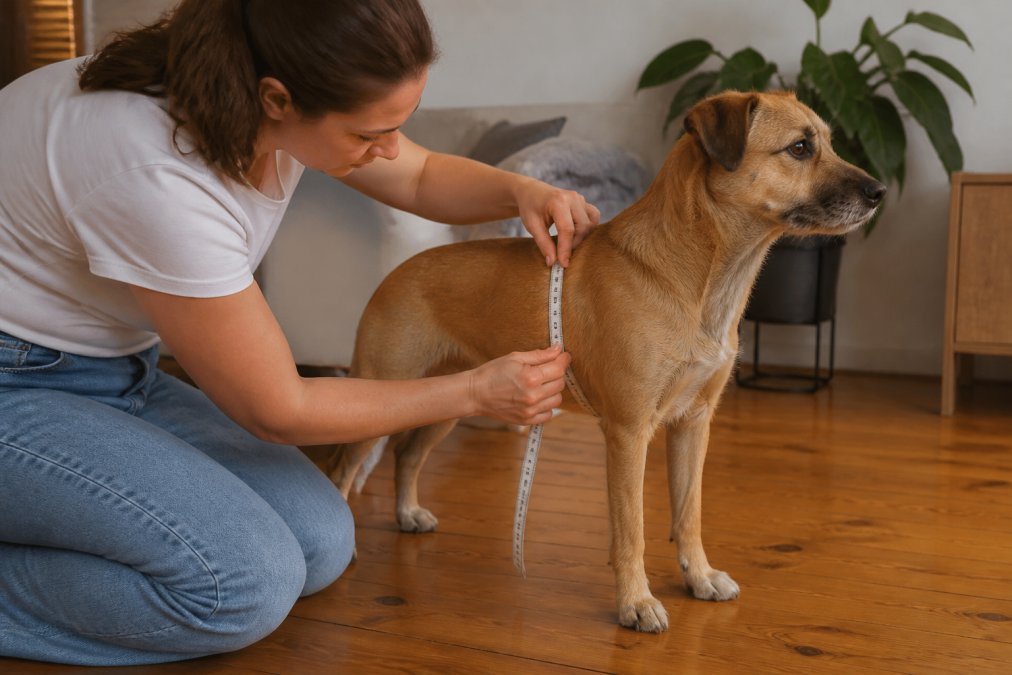
Learning how to measure your dog for a harness fit takes about five minutes and three measurements: chest girth, neck circumference, and body length. Each tells you something different about how a harness will sit.
Step 1: Measure Chest Girth
Chest girth is the most important number for harness fit. Wrap the tape around the widest part of the ribcage, just behind the front legs, snug but not tight, you should still slide one finger under it. Record it in centimetres.
Step 2: Measure Neck Circumference
Neck circumference sets how the harness sits near the throat. Wrap the tape around the middle of the neck, between the ears and the shoulder blades, without pulling tight. A snug fit stops slipping without pressing on the windpipe.
Step 3: Measure Body Length
Body length runs from the base of the neck to the base of the tail, along the spine's natural curve, and matters most for step-in and overhead styles. Record it in centimetres.
Dog Harness Size Chart: How to Match Measurements to Sizes
A dog harness size chart matches your chest girth number to a size band. Size to chest girth first, then check neck and length within that size, chest girth varies most between dogs, so every reputable brand builds its sizing around it.

| Measurement | Where to Measure | Typical Range (cm) | Why It Matters |
|---|---|---|---|
| Chest girth | Widest rib point, behind front legs | 25-100 | Sets the main size |
| Neck circumference | Middle of neck | 20-60 | Stops slipping |
| Body length | Neck base to tail base | 20-80 | Suits step-in styles |
How Measurement Bands Actually Work
Most brands publish a chest girth range per size, such as 40-55 cm for a small and 55-70 cm for a medium. The overlap is deliberate: it gives adjustment straps room to work. A harness with five adjustment points covers a wider girth range than one with two, because each strap adds or removes a few centimetres.
Sizing by Harness Type
Harness style changes which measurement matters most:
- Back-clip harnesses: chest girth is the dominant number. The neck strap is usually fixed or lightly adjustable, so a dog with a thick neck and narrow chest may need a size up and a tightened belly strap.
- Front-clip and no-pull harnesses: chest girth still sets the size, but the front attachment point sits at the sternum. A deep-chested dog needs the chest strap to sit low enough that the front ring does not ride up into the throat.
- Step-in harnesses: body length becomes critical. If the harness is too short, the belly strap sits forward of the ribs and can rub; too long and the rear strap slips behind the ribcage.
- Overhead harnesses: neck circumference matters more because the harness must pass over the head. A dog with a neck close to the top of a size band may need the next size up even if the chest girth fits.
Between Sizes: When to Go Up and When to Go Down
The common rule is to size up, because you can tighten straps but cannot stretch fabric. That holds for most back-clip and multi-point harnesses, with two exceptions:
Personalised No-Pull Dog Harness →
- If the next size up has a neck opening wider than your dog's head, it may slip off over the head. Stay in the smaller size if the chest girth fits its upper range.
- If your dog is between sizes on chest girth but well within one on neck and length, choose the size whose chest range contains your measurement.
Weight Is Not a Size
Weight tells you nothing about chest girth. Two dogs of the same weight can differ by 15 cm or more depending on breed, coat, and body condition, a lean 25 kg dog and a stocky 25 kg dog will not wear the same size. Always measure, never estimate from weight or breed.
How to Check Harness Fit: The Two-Finger Rule and Beyond
The two-finger rule is the fastest way to check harness fit. Slide two fingers under every strap. If they fit comfortably, the strap is snug without being tight.
Here is how to check the full fit:
- Two fingers fit under the neck and chest straps
- The harness does not twist when your dog walks
- Front legs move freely with no rubbing
- The back panel sits flat, not bunched
- No gap large enough for a paw to slip through
Best Harness for Escape Artist Dogs: What to Look For
The best harness for escape artist dogs has more adjustment points, a snug chest panel, and secure buckles, a design that hugs the body at three or more points.
Look for these features:
- Five or more adjustment points
- A belly strap that sits well behind the ribs
- Metal or lockable buckles, not plastic clips alone
- Padded panels that spread pressure
- A front clip to redirect pulling
Measuring Dogs with Unique Body Shapes, Senior Dogs and Between Sizes
Most guides assume a uniform barrel chest, but deep-chested, barrel-chested, narrow-waisted, and long-bodied dogs each need a different measuring technique, and senior dogs need a different harness altogether. General size charts ignore this.
Deep-Chested Dogs
Breeds such as Greyhounds, Whippets, Salukis, and Dobermanns have a chest that drops well below the elbow line and a very narrow waist. Measuring at the midpoint of the ribcage under-reads the girth and buys a harness that is too small.
Barrel-Chested Dogs
Bulldogs, Boxers, Staffordshire Bull Terriers, and Pugs have a wide, rounded ribcage and a short back, so the chest girth number is large relative to body length and a size that fits the chest may be too long in the body.
Narrow-Waisted and Sighthound Crosses
A dog can have a normal chest girth and a waist several centimetres smaller. A harness that only adjusts at the chest will sit loose behind the ribs and rotate during a walk. Look for a separate belly strap that tightens independently, and measure the waist at its narrowest point behind the ribs.
Long-Bodied Dogs
Dachshunds, Corgis, and Basset Hounds have a long spine relative to their height, so body length matters more than for any other shape. Measure from the base of the neck to the base of the tail along the spine, and check the back panel does not end before the last rib, too short a harness concentrates pressure on the shoulders.
Personalised No-Pull Dog Harness →
Senior and Arthritic Dogs
Older dogs with arthritis or reduced mobility often cannot step into a harness or lift a leg through a loop. The numbers may be unchanged, but the harness style needs to change.
- Choose an overhead or step-in design with the fewest possible clips, or a harness that opens fully flat and fastens on top of the back.
- Look for wide padded panels that spread pressure across the chest and shoulders rather than concentrating it at a single point.
- Avoid narrow straps over the shoulder joint, which can press on arthritic tissue.
- Check pressure points after the first few walks and adjust the straps in small increments.
Short-Coated and Hairless Breeds
Breeds with very short or no coat, such as Greyhounds, Whippets, and Xoloitzcuintli, rub more easily at strap edges. After the first few walks, check the armpits, sternum, and behind the front legs for redness. If you see any, loosen the nearest strap by one notch or switch to rolled or padded edges.
Double-Coated and Heavy-Coated Breeds
Huskies, Samoyeds, and Chow Chows carry a thick coat that compresses under a tape. Measure snug against the coat, not tight to the skin, and add roughly 1 cm to the chest girth for coat compression during movement, a harness that fits a groomed dog may pinch at full winter thickness.
Common Measuring Mistakes and How to Avoid Them
Most measuring mistakes come from timing, tension, or the wrong spot. Fix these and your harness fit will be right the first time.
- Measuring while the dog sits or lies down
- Pulling the tape too tight
- Measuring over a thick coat without allowing room
- Using a stiff tape that will not curve
- Guessing size from breed or weight alone
- Forgetting to re-measure a growing puppy
Conclusion: Getting the Right Harness Fit for Your Dog
A harness only works if it fits. Measure chest girth, neck circumference, and body length, then check the fit with the two-finger rule and a short walk test.
Frequently Asked Questions
Should I measure my dog's neck or chest for a harness?
Both matter, but chest girth is the primary measurement for harness sizing. Measure the widest part of the ribcage, just behind the front legs. Neck circumference helps confirm the neck opening won't be too tight or loose. A harness that fits the chest but pinches the neck will cause chafing, while one that fits the neck but is loose around the chest can allow escape. Record both numbers and compare them to the size chart before ordering.
How much room should be between the harness and the dog?
You should be able to slide two fingers flat between the harness strap and your dog's body at every adjustment point. This is the two-finger rule. Any tighter and you risk pressure points, chafing and restricted range of motion. Any looser and your dog may back out of the harness. Check the chest, neck and belly straps separately, because a harness can fit well in one area and poorly in another.
What should I do if my dog is between harness sizes?
Size up rather than down. A harness that is slightly too large can be tightened at the adjustment points, but one that is too small cannot be made bigger and will cause discomfort. If your dog measures at the top of a size range, check whether the next size up still allows the straps to sit correctly without gaps. For dogs with deep chests or narrow waists, prioritise the chest girth measurement over body length.
Why are Y-shaped harnesses better for my dog?
Y-shaped harnesses keep the straps clear of the shoulder blades and sternum, allowing a full range of motion. Harnesses with a straight strap across the chest can restrict the front legs and cause gait changes over time. A Y-shape also distributes pressure more evenly across the chest rather than concentrating it on the throat or a single point. This matters most for active dogs, puppies and breeds prone to joint issues.