
Table of Contents
- Why Standard Collars Fail With Pulling Dogs
- What to Look For in Durable Collars for Pulling Dogs
- Martingale Collars vs Head Halters vs No-Pull Harnesses
- The Best Harness for Dogs That Pull: A Detailed Review
- Heavy Duty Dog Collars Australia: Leather vs Nylon
- How to Stop a Dog From Pulling on the Lead: Training Basics
- Maintenance, Fit Checks, and Transitioning Away From Training Tools
- Conclusion: Matching the Tool to Your Dog
- Frequently Asked Questions
Last Updated: September 9, 2026
Why Standard Collars Fail With Pulling Dogs
A flat collar concentrates all the force of a lunging dog directly on the neck, risking injury to the trachea and spine while reinforcing the habit, because the pressure stops when the dog gets what it wants. For persistent pullers, the answer lies in choosing among durable collars for pulling dogs that redirect force safely. The first lesson is always the same: the tool must protect the neck while giving you a humane control mechanism.
What to Look For in Durable Collars for Pulling Dogs
The term 'durable' gets thrown around loosely, but when a 35 kg dog lunges at a squirrel, the hardware takes a sudden, violent load. A genuinely durable collar must be engineered for that repeated stress, not just assembled from thick-looking materials.
Webbing and Material Construction
For nylon collars, look for 1,500-denier or higher ballistic nylon, which resists abrasion and UV degradation far better than standard 600-denier pack cloth. The stitching is where most collars fail first. Quality manufacturers use bonded nylon thread (not polyester, which degrades in sunlight) and bar-tack stitching at every stress point, the d-ring, the buckle, and the adjustment slider. Bar-tacking is a dense, zigzag reinforcement stitch that distributes force across a wider area.
Leather collars demand different scrutiny. Top-grain or full-grain leather (not bonded leather, which is shredded scraps glued together) should be at least 3 mm thick for dogs over 20 kg, and vegetable-tanned or chrome-tanned with a sealed edge, an unfinished edge will wick moisture and rot from the inside out. Ask the maker whether the leather is cut from the shoulder or belly of the hide; shoulder cuts are denser and more tear-resistant.
Hardware That Actually Holds
This is where most budget collars cut corners. The d-ring, the metal loop you clip the lead to, must be welded closed, not just bent into shape. A welded ring has no gap that can open under load. Check the ring's gauge: for a large pulling dog, you want at least 4 mm thick steel. The buckle should be solid cast metal, not stamped sheet metal, and the prong should seat firmly into the hole without play. Many premium collars now use a side-release plastic buckle rated to 450 kg.
Environmental Durability: The Test No One Talks About
Australian conditions are brutal in specific ways. Saltwater spray from beach walks corrodes cheap zinc alloy hardware within weeks, look for stainless steel (grade 316 marine-grade is ideal) or solid brass with a clear lacquer coating. Mud and dust work their way into woven nylon and act like sandpaper on the fibres; a collar with a smooth, coated webbing finish will outlast an uncoated one in these conditions. Extreme heat (over 40°C, common in much of the country) causes cheap nylon to soften and stretch, and it dries out leather, making it brittle. If you walk in full sun, choose a lighter-coloured webbing that absorbs less heat, and condition leather collars monthly during summer.
The Inspection Routine That Extends Lifespan
A durable collar only stays durable with a monthly two-minute inspection. Run the webbing through your fingers along its entire length, feeling for frayed fibres or rough spots. Flex the d-ring in every direction, it should spring back with no permanent deformation. Check the buckle prong for bending and the hole it seats into for elongation. For leather, bend the collar into a tight U-shape; if fine cracks appear on the surface, the leather is drying out and needs conditioning. Replace the collar at the first sign of structural weakness, a failure at the leash attachment point during a walk can be dangerous for you and your dog.
Martingale Collars vs Head Halters vs No-Pull Harnesses
Three main categories dominate the market for pullers, and each works differently on the dog's body. A martingale collar, sometimes called a limited-slip collar, tightens gently and evenly around the neck when the dog pulls, providing correction without the choking action of a choke chain. Head halters loop around the muzzle and attach behind the ears, giving you control over the dog's direction by steering the head.
No-pull harnesses distribute pressure across the chest and shoulders through a front-clip attachment point, avoiding the neck entirely. The table below summarises how they compare for training and everyday walking.
| Tool | Pressure Point | Best For | Training Range |
|---|---|---|---|
| Martingale collar | Evenly around neck | Dogs that slip flat collars | Moderate |
| Head halter | Muzzle and poll | Strong breeds needing steering | High |
| No-pull harness | Chest and shoulders | Puppies, seniors, trachea-sensitive dogs | High |
The Best Harness for Dogs That Pull: A Detailed Review
For most owners, a padded no-pull harness offers the safest balance of control and comfort, particularly for dogs prone to tracheal issues. Our top pick from Pet ID Tags Australia is the Personalised No-Pull Dog Harness, priced at $39.00. It uses a front-clip design that redirects forward momentum back toward you, with breathable padded mesh and reinforced nylon straps that hold up to determined pullers, distributing force across the chest and belly rather than the throat.

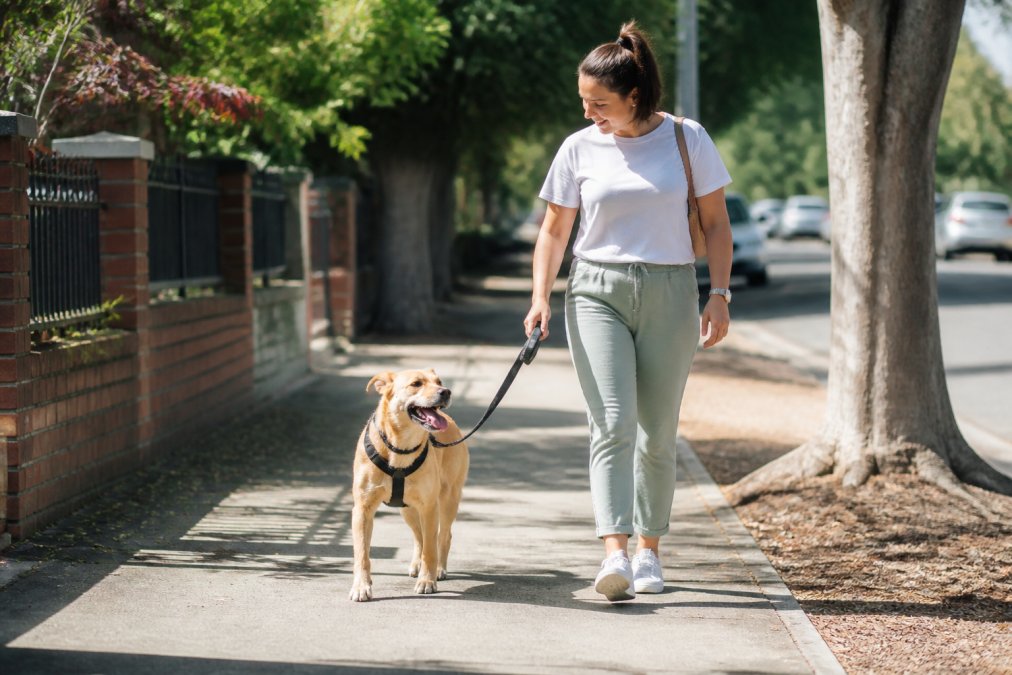
Personalised No-Pull Dog Harness
What sets this harness apart is the combination of three control points: a front clip, a back clip, and a top reach handle for guiding your dog past distractions. It comes in five sizes across all breeds, with fully adjustable straps so you can dial in the fit. The custom heat-transfer printing of your dog's name will not peel, unlike the cheap sticker names found on generic imports, and every harness carries a 30-day satisfaction guarantee.
Heavy Duty Dog Collars Australia: Leather vs Nylon
When the question turns to heavy duty dog collars Australia, the material choice comes down to how you walk and where you walk. Nylon webbing collars are lightweight, quick-drying, and available in bright colours with reflective stitching, making them ideal for beach walks and wet weather. Leather collars offer timeless durability and a classic look that ages gracefully, though they require occasional conditioning to stay supple.
Australian-Made Leather Collars
For owners who want local craftsmanship, Pet ID Tags Australia offers the Personalised Pet Collar Leather - Made in Australia for Pets at $39.90. Each collar is handcrafted from top-grain, soft leather with solid nickel hardware, and your pet's name and phone number are laser engraved directly into the material. This means the identification will never fade or peel, a common failure point on cheaper printed collars.

How to Stop a Dog From Pulling on the Lead: Training Basics
The gear is only half the solution; consistent training is what changes the behaviour. To stop a dog from pulling on the lead, start by rewarding loose-leash walking with treats and praise the moment the lead goes slack. Stop walking whenever your dog reaches the end of the lead and only resume when they return to your side, which teaches that pulling halts forward progress.
Pair this with the right equipment. A no-pull harness gives you gentle control during training sessions, while a martingale provides clear feedback for dogs that understand correction. Avoid retractable leads entirely, as they teach dogs that tension means freedom. Short, frequent sessions of five to ten minutes work better than long, frustrating walks, and consistency across every family member is key.
Maintenance, Fit Checks, and Transitioning Away From Training Tools
A quality collar or harness will last for years, but only with regular inspection. Check the stitching, buckles, and d-rings monthly for wear, and run the webbing through your fingers to feel for fraying. Leather collars need occasional conditioning to prevent cracking, while nylon can be rinsed and air-dried. Replace any hardware that shows rust or deformation.
The Monthly Fit Check
A collar that fit perfectly in winter may be too tight in summer, or too loose if your dog has lost weight. Check the fit every month. For a flat or martingale collar, you should be able to slip two fingers flat between the collar and the dog's neck. For a martingale, the limited-slip loop should never tighten so much that it constricts the trachea; the correct adjustment allows the loop to close only 5-8 cm beyond the resting position. For a harness, check that the front chest strap sits across the sternum, not down into the armpit where it will chafe during movement. A harness that has shifted position during a walk is a sign the fit has loosened, re-tighten before continuing.
The Transition Protocol: Phasing Out Training Tools
Most owners make one of two mistakes: they keep the training tool on forever, or they remove it cold turkey and wonder why the pulling returns. The correct approach is a gradual fade.
Phase 1, Low-distraction environments (Weeks 1-2): Use the training tool (martingale or no-pull harness) on quiet streets with minimal triggers. Reward loose-leash walking consistently to build a strong reinforcement history.
Phase 2, Introduce the flat collar (Weeks 3-4): Switch to a standard flat collar for short walks in the same low-distraction areas. Keep high-value treats ready. If your dog pulls, stop and wait for slack, do not correct with the flat collar, as it offers no training feedback. The moment your dog walks loosely for 30 seconds, reward generously.
Phase 3, Alternate equipment (Weeks 5-6): Begin alternating between the training tool and the flat collar on the same routes. Use the training tool on high-distraction walks (near parks, busy streets) and the flat collar on quiet routes. This teaches your dog that the behaviour is not tied to a specific piece of gear.
Phase 4, Flat collar only (Week 7+): Once your dog walks loosely on the flat collar in moderate-distraction environments for several consecutive walks, retire the training tool. Keep it accessible for high-stress situations, vet visits, busy events, or after a long break from walking, where your dog may regress.
When to Keep the Training Tool
Some dogs never fully outgrow the need for a martingale or harness. Sighthounds, for example, have a strong prey drive that can override training in the presence of a moving small animal. For these dogs, the training tool is not a crutch, it is a safety measure. The goal is not to eliminate the tool entirely but to ensure your dog walks loosely while wearing it. If your dog is calm and loose-leash on a martingale but immediately pulls on a flat collar, the martingale is doing its job.
Conclusion: Matching the Tool to Your Dog
Every dog pulls for a reason, whether excitement, fear, or simply a strong prey drive, and the right tool addresses that reason without harming your pet. A padded no-pull harness suits most dogs, especially those with delicate necks, while a martingale or head halter may suit strong breeds that need firmer guidance. Prioritise durable materials, proper fit, and consistent training to turn stressful walks into enjoyable time together.
Frequently Asked Questions
What is the best collar for a dog that pulls hard?
For dogs that pull hard, a no-pull harness with a front clip is the safest and most effective choice. Unlike flat collars or choke chains, a front-clip harness redirects your dog's forward momentum to the side, reducing strain on the neck. Look for durable collars for pulling dogs that feature reinforced nylon webbing, padded chest panels, and stainless steel hardware. A well-fitted harness distributes pressure across the chest and shoulders, protecting your dog's trachea while giving you better control during walks.
Are flat collars safe for dogs that pull?
Flat collars are not ideal for dogs that pull. When a dog lunges against a flat collar, the force concentrates on the neck, which can cause coughing, gagging, and in severe cases, injury to the trachea or spine. This is especially risky for small breeds and dogs with respiratory issues. If your dog pulls, a padded no-pull harness or a martingale collar is a safer option. These tools distribute pressure more evenly and give you better control without risking your dog's neck health.
What is the difference between a martingale collar and a head halter?
A martingale collar is a limited-slip collar that tightens gently when your dog pulls, preventing them from backing out without choking them. A head halter fits over your dog's muzzle and neck, giving you control by steering their head, similar to a horse's halter. Martingales are good for dogs with narrow heads, like greyhounds, while head halters work well for powerful dogs that need strong directional control. Both are training tools, but a no-pull harness is often easier for most owners to use correctly.
How do I choose a durable collar for a large breed?
For large breeds, focus on material strength and hardware quality. Look for collars made from 25mm or wider nylon webbing or top-grain leather, with solid stainless steel or nickel-plated D-rings. Check the tensile strength rating if available. Measure your dog's neck circumference accurately and choose an adjustable fit. For heavy pullers, a no-pull harness with reinforced stitching and padded panels offers better control and reduces the risk of neck injury compared to a standard collar.
How long should a durable dog collar last?
A well-made collar should last several years with daily use. Nylon webbing collars typically last 2-5 years, while top-grain leather collars can last 5-10 years or more with proper care. Inspect your collar monthly for signs of wear, including frayed edges, stretched stitching, or corroded hardware. Heat, salt water, and mud can accelerate wear, so rinse the collar after beach trips. If you notice any weakness, replace the collar immediately to prevent breakage during a walk.
Pet ID Tags Australia has helped thousands of owners find gear that balances comfort, control, and durability. Our personalised no-pull harnesses and Australian-made leather collars are built to withstand daily use, with deep laser engraving that stays readable for years. Get started with Pet ID Tags Australia and enjoy walks where your dog walks beside you, not ahead of you.