

Table of Contents
- Quick Comparison: Escape Proof Cat Harnesses
- How to Measure a Cat for a Harness
- Cat Harness Training Tips
- How to Stop a Cat from Escaping a Harness
- What Makes a Cat Harness Escape Proof?
- Choosing the Best Escape Proof Cat Harnesses
- Conclusion
- Frequently Asked Questions
Last Updated: September 16, 2026
Quick Comparison: Escape Proof Cat Harnesses
A truly escape proof cat harness combines a snug, adjustable fit with a design that resists backward pull, because cats escape by reversing out of loose straps rather than breaking buckles. This guide from Pet ID Tags Australia covers how to measure, fit, train for, and choose the best escape proof cat harnesses for your cat.
The core problem is simple: most harnesses sold for cats are scaled-down dog designs. They slip because the neck opening is too wide and the chest strap sits too low. A cat that panics will pull backward, and a loose harness slides straight over the shoulders.
Below, we break down measuring, training, and the specific features that keep a harness on a determined cat. Every harness we reference here is a dog harness, because that is what our catalogue carries, and many dog harnesses in small sizes suit confident cats. We will show you exactly which sizes and features to look for.
| Harness | Price | Best For | Standout Feature |
|---|---|---|---|
| Personalised No-Pull Dog Harness | $39.00 | Everyday walks, all breeds | Front + back clip, top handle |
| Harness with Dog Tag Combo | $50.00 | New cats, rescues | Harness plus engraved ID tag |
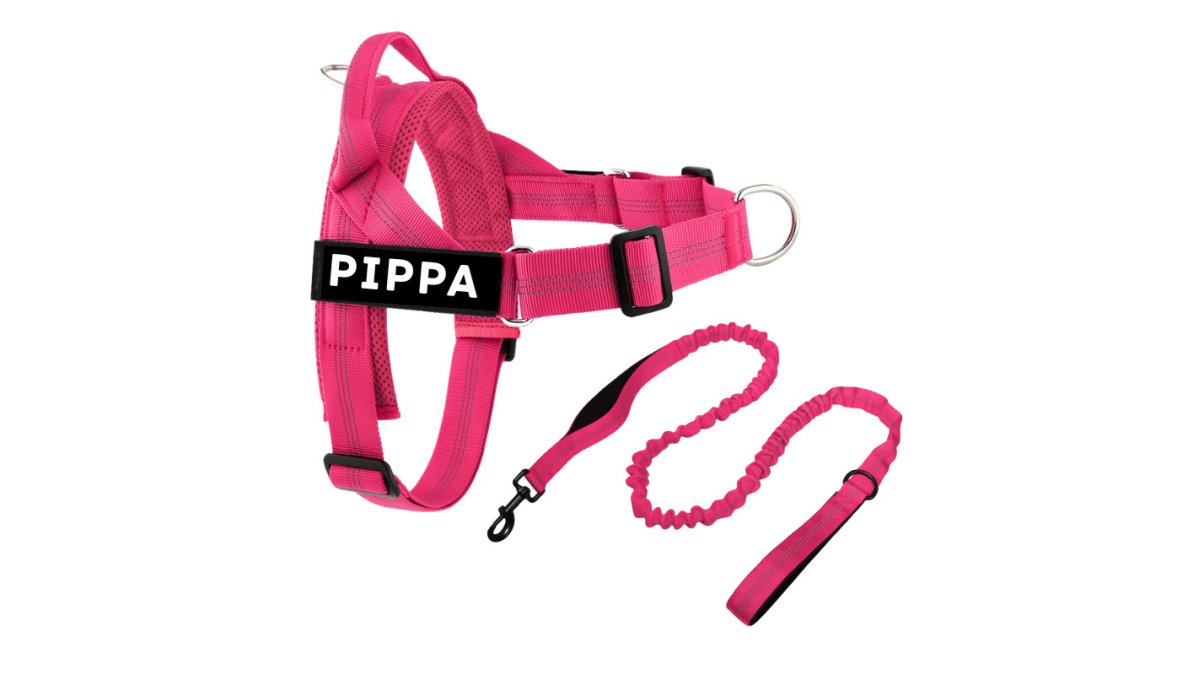
| Personalised Dog Harness & Lead Set | $54.00 | Complete walk kit | Bungee lead included |
| Personalised Dog Harness & Lead Set with Car Seat Belt | $59.00 | Travel and walks | Car seat belt clip included |
| Blue Personalised Dog Harness | $39.00 | Low-light walks | Reflective details |
How to Measure a Cat for a Harness
Measuring a cat for a harness takes two numbers: chest and neck. Measure the widest point of the ribcage just behind the front legs, then loosely around the base of the neck. Write both down before you shop.

A common mistake is guessing from weight alone. Two cats of the same weight can have very different chest depths. Use a soft tape measure, or a piece of string marked and laid against a ruler.
Here is the sequence we recommend:
- Measure the chest at its widest point, just behind the front legs
- Measure the neck loosely at the base
- Add a two-finger gap check: you should slide two fingers under any strap
- If between sizes, size up for comfort
- Re-measure growing kittens every few weeks
The goal is snug enough that the harness will not slip over the head, loose enough that it does not rub. For cats, the neck opening matters most, since a wide neck gap is what lets a cat back out.
Cat Harness Training Tips
Cat harness training works best when you build the association slowly, over days rather than minutes. Most cats accept a harness if the first experience is calm and reward-based.
Start by leaving the harness on the floor near your cat's food bowl for a day or two. Let them sniff it. Then drape it loosely over their back for a few seconds, reward, and remove it. Repeat until the cat is relaxed.
A common mistake is rushing straight to a full walk. The thing nobody tells you about harness training is that the harness itself is rarely the problem; the outdoors is. Cats freeze, flatten, or bolt when the environment changes, not because the straps are uncomfortable.
Personalised No-Pull Dog Harness →
Work through these stages:
- Day 1-2: Harness near food, no contact
- Day 3-4: Drape over back for seconds, reward, remove
- Day 5-6: Fasten loosely indoors, reward, remove
- Week 2: Wear it indoors for short periods
- Week 3: Open the door, let them explore the threshold
- Week 4: Short supervised time outside
How to Stop a Cat from Escaping a Harness
Stopping a cat from escaping a harness comes down to fit and orientation. Cats escape by pulling backward, so the harness must be tight enough at the neck and chest that it cannot slide over the shoulders.
If your cat has already slipped a harness, check three things before buying a replacement. First, the neck opening: if you can fit more than two fingers between strap and fur, it is too loose. Second, the chest strap: it should sit behind the front legs, not over them. Third, the clip position: a front-clip design resists backward pull better than a back-clip alone.
For cats specifically, a harness with a top reach handle gives you a second control point. If your cat backs up, you can hold the handle rather than pulling the lead, which stops the escape attempt without a fight.
What Makes a Cat Harness Escape Proof?
An escape proof harness is one that stays on during backward pull, sudden lunges, and panicked twisting. No harness is literally escape-proof for every cat, but the right design makes escape very difficult.
Four features do most of the work:
- Adjustable neck and chest straps so the fit can be dialled in precisely
- Front-clip attachment that redirects forward momentum and resists backing out
- A top reach handle for a second control point during panic
- Padded, breathable material that lets you tighten the fit without causing rubbing
Material matters more than most buyers expect. Durable nylon with reflective stitching holds its shape after repeated tightening, while thin webbing stretches and loosens over time. Reflective details also help during low-light walks.
At Pet ID Tags Australia, our harnesses use premium nylon with reflective stitching and padded panels. That combination is what separates a harness that stays on from one that does not.
Choosing the Best Escape Proof Cat Harnesses
Choosing the best escape proof cat harnesses for your cat means matching the harness to your cat's temperament and your routine, not just picking the smallest size available. A nervous cat needs a different setup from a confident explorer.
Our top pick is the Personalised No-Pull Dog Harness at $39.00. It gives you front clip, back clip, and a top reach handle in one harness, which is the combination that matters most for cats prone to backing out. It comes in five sizes and eight colours, and you can add your cat's name or a message.
Personalised No-Pull Dog Harness →
For a complete setup, the Harness with Dog Tag Combo at $50.00 pairs a no-pull harness with a deep-engraved stainless steel ID tag. If your cat does slip free, the tag is what brings them home. That is the honest reason we recommend it: a harness reduces escape risk, an ID tag handles the day it fails.
If you walk in low light, the Blue Personalised Dog Harness adds reflective details and removable Velcro name patches. For travel, the Personalised Dog Harness & Lead Set with Car Seat Belt Bundle at $59.00 includes a seat belt clip so the harness does double duty in the car.


Every harness we sell is backed by a 30-day satisfaction guarantee, and personalised orders are dispatched in 1-3 business days from our workshop.
Conclusion
Finding a harness that stays on a determined cat is genuinely difficult, and the wrong fit is the reason most attempts fail. Pet ID Tags Australia has spent more than 20 years helping pet owners keep their animals safe, comfortable, and identifiable, with deep-engraved tags and durable, adjustable harnesses that resist slipping. Our harnesses combine breathable padding and reflective stitching, with personalisation and fast local dispatch. Shop dog tags and harnesses at Pet ID Tags Australia and give your cat gear that stays put.
Frequently Asked Questions
What makes a cat harness truly escape-proof?
An escape-proof cat harness typically features a vest-style design with multiple adjustment points, securing straps that sit behind the front legs, and a snug fit that prevents backing out. Look for padded, breathable materials and strong buckles. The harness should be tight enough that you can fit two fingers underneath, but not so tight it restricts movement or breathing.
How do I measure my cat for a harness?
Use a soft tape measure to check two key areas: the neck (loosely around the base) and the chest (the widest part of the ribcage, just behind the front legs). Write down both measurements in centimetres. Compare them to the harness size chart. If your cat falls between sizes, choose the larger one for comfort and adjust the straps for a secure fit.
Are vest-style harnesses better than strap harnesses for cats?
Vest-style harnesses are generally better for escape prevention because they distribute pressure across a wider area and are harder for cats to back out of. Strap harnesses can be lighter but may allow a determined cat to slip free. For cats that are escape artists, a vest-style harness with multiple adjustment points is the safer choice.
How do I train my cat to walk on a harness?
Start by leaving the harness near your cat's food bowl or bed for a few days so they get used to the sight and smell. Then, put it on for short periods indoors, rewarding calm behaviour with treats. Once your cat is comfortable, attach a lead and let them explore inside. Gradually move to a quiet outdoor area. Keep sessions short and positive.
Can cats easily back out of a harness?
Cats can back out of poorly fitted or strap-style harnesses, especially if they panic. To prevent this, choose a vest-style harness with a snug fit and multiple adjustment points. Always check the fit before each walk and ensure the straps sit behind the front legs. Regular training and positive reinforcement also reduce the chance of escape.