

Table of Contents
- What Makes a Custom Cat Harness Worth Buying
- Quick Comparison: Custom Cat Harness Options
- How to Measure Your Cat for a Harness
- Escape Proof Cat Harness Features to Look For
- Cat Harness Training Tips for Reluctant Cats
- Materials, Fit and Climate Considerations
- Frequently Asked Questions
Last Updated: September 11, 2026
What Makes a Custom Cat Harness Worth Buying
A custom cat harness is a made-to-order walking harness built to your cat's individual measurements, name and colour choice, rather than a one-size-fits-most product pulled off a shelf. This guide from Pet ID Tags Australia explains what separates a secure harness from a decoration, and how to choose the right one for your cat.
The case for custom comes down to one uncomfortable fact: a cat that slips a harness outdoors is a cat exposed to traffic, dogs and native wildlife it cannot safely handle. A standard-sized strap harness leaves gaps at the shoulders, and cats are liquid. They back out of loose webbing in seconds.
At Pet ID Tags Australia, we have spent over 20 years engraving and building pet gear, and the harnesses we offer are measured, padded and personalised. Below, we break down sizing, escape-proof design, training and climate, so you can buy once and buy right.
Quick Comparison: Custom Cat Harness Options
Custom cat harness pricing depends on what you bundle. The table below summarises the main configurations available.
| Option | Price | What's Included | Best For |
|---|---|---|---|
| Personalised No-Pull Harness | $39.00 | Padded harness, printed name, 5 sizes | Everyday walks |
| Harness + ID Tag Combo | $50.00 | Harness plus engraved stainless steel tag | Escape-prone cats |
| Harness + Lead Set | $54.00 | Harness plus bungee lead | Training and daily use |
| Harness, Lead + Car Seat Belt | $59.00 | Full set with seat belt clip | Travel and vet trips |
Pricing and What's Included
Every configuration uses the same core harness: breathable padded mesh, reinforced nylon straps and adjustable fittings across five sizes. The difference is what travels with it.

The combo adds a deep-engraved tag. If your cat does get out, identification is what brings them home, and a harness alone does not carry your phone number clearly at a distance.
How to Measure Your Cat for a Harness
Measure your cat at the widest point of the ribcage, just behind the front legs, then loosely around the base of the neck. Write both numbers down in centimetres before you look at any size chart. Getting this wrong is the single most common reason a custom harness ends up loose at the shoulders and easy to back out of.
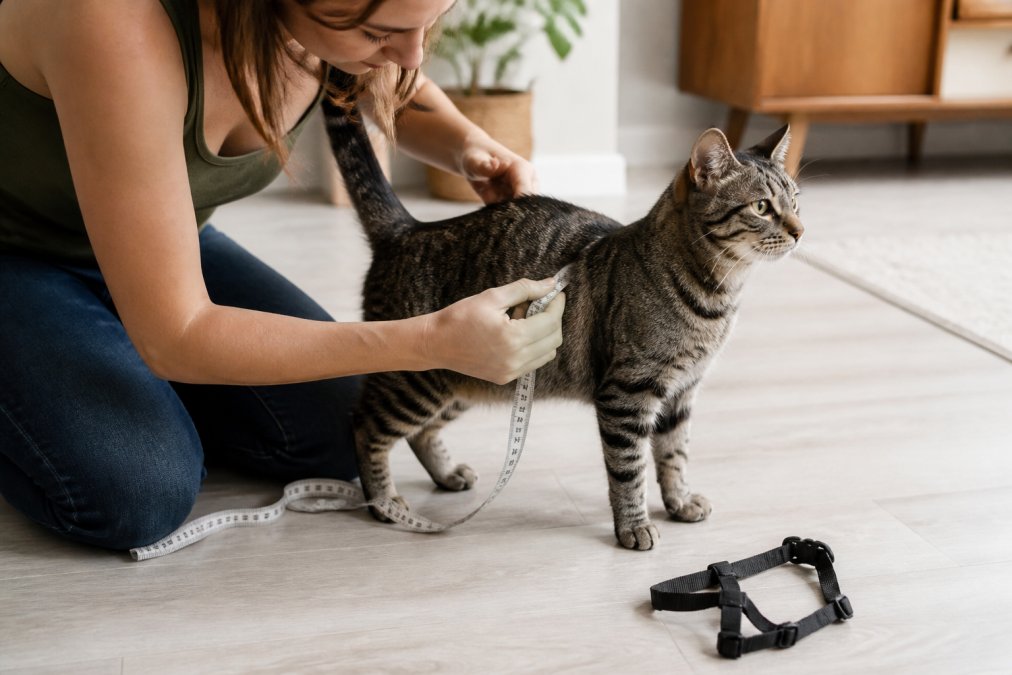
Girth, Neck and Chest Measurements
Three measurements decide the fit.
- Girth: the widest point of the ribcage, directly behind the front legs. This is the primary sizing number.
- Neck: loosely around the base of the neck, allowing two fingers underneath. This controls the head-opening, which is what stops a cat backing out.
- Chest and belly: check the belly strap sits flat on deep-chested cats without pinching, and that the chest panel does not ride up into the throat when the cat lowers its head.
A common mistake is measuring over a thick winter coat or holding the tape tight. Both push you into the wrong size. If your cat falls between sizes, size up, because adjustable straps let you tighten a larger harness but cannot stretch a small one.
Breed and Body-Shape Adjustments
Cats are not a single shape, and a measurement that fits one breed can gap badly on another. A few patterns are worth knowing before you order:
- Long, lean breeds such as the Oriental Shorthair and Siamese have a narrow chest and a long torso. They often need a longer girth strap and a tighter neck setting, or the harness slides forward onto the throat.
- Cobby, broad-chested breeds such as the British Shorthair and Persian need a wider chest panel and a shorter body length, otherwise the girth strap sits too far back and rubs behind the elbows.
- Deep-chested cats such as the Maine Coon and Norwegian Forest Cat need a belly strap that sits flat rather than cutting in, and a chest panel that clears the sternum.
- Small or fine-boned cats, including many senior cats and most kittens, are often between the two smallest sizes. A harness with a wider adjustment range avoids the compromise of a generic small.
If you are unsure, measure twice on different days. A cat's girth can shift slightly with posture, and a relaxed standing measurement is more reliable than one taken while the cat is curled or being held.
The Fit Test
Once the harness is on, run three checks before you attach a lead:
- Two-finger rule: two fingers should slide under every strap, no more and no less.
- Back-out test: with the lead attached indoors, apply gentle backward pressure. The harness should not slip over the head. If it does, tighten the neck strap first, then recheck the girth.
- Shoulder gap check: slide a finger along the shoulder strap. If you can fit more than two fingers under it, the harness is too loose at the exact point cats exploit.
Re-measure every few months, and always after a significant weight change. A harness that fitted a kitten at six months will not fit the same cat at eighteen months, and a senior cat that has lost weight may need a smaller girth setting even if the harness itself is still sound.
Escape Proof Cat Harness Features to Look For
An escape proof cat harness needs three things working together: a snug adjustable fit, more than one attachment point, and quick-release buckles that hold under load. No harness is escape-proof on a cat that is panicking.
Look for these features:
- No-choke design that spreads pressure across the chest rather than the throat
- Front and back leash attachment points, so you can redirect a cat that lunges
- Snap buckles that release quickly if the harness snags on a branch
- Reflective strips for visibility at dusk, when cats are most active
- Padded panels at the chest and shoulders to prevent rubbing
A harness that fits the chest but gaps at the shoulders is the one cats back out of. Adjust the shoulder straps first, then the girth.
Cat Harness Training Tips for Reluctant Cats
Most cats accept a harness if you build the association slowly.
Use positive reinforcement and work in stages:
- Leave the harness on the floor near your cat's bed for two days
- Place it beside the food bowl during meals
- Drape it loosely over the back for a few seconds, then reward
- Fasten it for one minute indoors, then remove and reward
- Extend wear time to ten minutes indoors
- Attach the lead and let your cat drag it indoors under supervision
- Open the door and let your cat choose whether to step out
Expect the first outdoor session to last two minutes. That is a success, not a failure.
Harness Training for Senior Cats
Senior cats need a lighter harness and a shorter runway. Arthritic joints make the step-in motion uncomfortable, so an overhead or clip-on style that requires less leg lifting is often easier.
Start indoors on a non-slip surface, keep sessions under five minutes, and never lift a senior cat by the harness. If your cat has a diagnosed joint condition, check with your veterinarian before starting.
Materials, Fit and Climate Considerations
Breathable mesh and padded nylon are the right choice for most of the country's warmer months, because cats overheat faster than dogs and cannot pant effectively. A harness that traps heat becomes a harness your cat fights. Many global guides are written for mild or cold climates and recommend heavy-duty, densely padded harnesses that are unsuitable for a hot summer walk.
Choosing Materials for Heat and Humidity
A cat's thermoregulation relies heavily on grooming, shade and limited activity, not on sweating or panting the way a dog does. A harness that covers a large area of the torso in thick, non-breathing fabric reduces the small amount of heat exchange the skin can manage. For most of the year, the better choice is:
- Open-weave or mesh panels at the chest and back, which allow airflow while still spreading load
- Lightweight webbing rather than thick padded straps, provided the edges are soft and rolled
- Moisture-wicking lining where the harness contacts the skin, to reduce chafing in humid conditions
- Minimal coverage, a harness that touches less of the body is cooler than one that wraps the whole chest
Heavy neoprene-style padding and fleece linings have a place in cold-climate markets, but in most of the country they are a summer hazard. If you walk in the early morning or late evening during hot spells, a lighter harness is safer than a heavily padded one.
Hardware, Corrosion and Coastal Conditions
Humidity and salt air affect hardware. Stainless steel D-rings and buckles resist corrosion, which matters if you walk near the coast. Plated hardware can flake and pit, and a corroded D-ring is a weak point under load. Look for stainless steel or marine-grade fittings, and rinse the harness in fresh water after beach walks.
Material matters for durability too. Webbing can fray at the buckle points and weaken with UV exposure. Reinforced nylon with reflective stitching holds its shape and stays visible. Check the stitching at the D-ring and buckle anchors every few weeks, this is where wear shows first.
Walking a Cat Without Harming Native Wildlife
For cats that go outdoors, keep them supervised and use a bell on the harness. Native birds, lizards and small mammals are highly vulnerable to free-roaming cats, and a visible, supervised cat is a safer cat for everyone. A harness walk is not the same as free-roaming: the lead lets you steer your cat away from a nesting bird, a fledgling on the ground, or a lizard sunning on a rock before it becomes a target.
A few practical habits reduce the impact further:
- Walk during daylight and avoid dawn and dusk, when many native species are most active and most vulnerable
- Keep the lead short in bushy or grassy areas, so your cat cannot pounce into cover
- Use a bell or a brightly coloured harness so birds and small animals get early warning
- Avoid known nesting or habitat areas, including revegetation zones, wetlands and bushland edges
- Never leave a harnessed cat tied or unattended outdoors
A harness with your contact details also matters here: if your cat does slip free, an engraved tag is what gets them home rather than adding to the number of unowned cats pressuring local wildlife.
Frequently Asked Questions
What is the best custom cat harness in Australia?
The best custom cat harness is one that fits your cat's exact measurements, uses breathable padded mesh, and has secure snap buckles with a metal D-ring. Pet ID Tags Australia offers personalised harnesses from $39, with a Harness and ID Tag Combo at $50 and a Harness & Lead Set at $54. Look for adjustable straps, reflective strips for night walks, and a no-choke design that spreads pressure across the chest rather than the throat.
Are any cat harnesses actually escape proof?
No harness is 100% escape proof, but some come close. The key features are a snug adjustable fit, a design that sits well back from the neck, and multiple attachment points. An escape proof cat harness should pass the two-finger test: you can slide two fingers under the straps, but the harness will not slip over the cat's head or shoulders. Pair it with positive reinforcement training so your cat accepts wearing it calmly.
How do I measure my cat for a custom harness?
Use a soft tape measure and take three readings: the widest point of the ribcage just behind the front legs (girth), the base of the neck (neck circumference), and the belly for deep-chested cats. Write the numbers down and compare them to the size chart. If your cat falls between sizes, size up. Adjustable straps let you fine-tune the fit, so a slightly larger harness is safer than one that pinches.
Is it safe to take my cat for a walk on a harness?
Yes, when done correctly. Start with short indoor sessions, then move to a quiet yard or balcony before attempting a full walk. Keep the lead short, never pull or drag your cat, and watch for signs of stress such as flattened ears, a tucked tail or crouching. Cats that walk on harnesses should always have identification as backup, since a startled cat can slip a harness.