

Table of Contents
- Step 1: Start With Your Phone Number and Pet's Name
- Step 2: Add a Second Contact and Your Suburb
- Dog Registration Tag Requirements: What the Law Expects
- What Not to Put on Dog Tags: Privacy and Safety Risks
- Pet ID Tag Engraving Ideas That Actually Help
- Smart Tags and QR Codes: A Modern Alternative
- Character Limits and Tag Materials: What Fits and What Lasts
- Conclusion
- Frequently Asked Questions
Last Updated: September 24, 2026
Step 1: Start With Your Phone Number and Pet's Name
The single most important thing to put on a dog tag is your mobile number, followed by your dog's name. That's the core of any effective pet identification tag, and everything else is secondary. A finder needs one clear way to reach you, fast.
Here's what belongs on the front:
- Your dog's name (easy to read at a glance)
- Your best mobile number (the one you always answer)
- A second contact number if space allows
Why the name first? A stranger calling "Buddy" calms a scared dog. It also confirms they've found the right pet. At Pet ID Tags Australia, we've engraved tags for over 20 years, and the pattern never changes: name and number, always legible.

A common mistake is using a landline nobody checks. Use the number you'll actually answer, even at 2am.
Step 2: Add a Second Contact and Your Suburb
A second contact number doubles your chances of a fast reunion. If you're at work or on a call, a partner, parent, or neighbour can pick up and get your dog home.
What to add on the back:
- A second phone number (partner, family member, or vet)
- Your suburb, not your full street address
- Space permitting, a short note like "Microchipped" or "Needs medication"
Your suburb helps a finder know if your dog has wandered far. It also gives them a local reference point. Skip the full address. Anyone can read a tag, and you don't want a stranger knowing exactly where you live.
If you're short on room, prioritise the second number over the suburb. A reachable human beats a location every time.
Dog Registration Tag Requirements: What the Law Expects
Across Australia, dog registration tag requirements are set by your local council, and most require a registration tag on your dog's collar alongside your own ID tag. The rules vary by state and council, so check with your local authority for the exact wording.

Here's the general picture:
- Councils issue a registration tag when you register your dog
- Registration tags usually show a number, not your details
- You must keep the tag on your dog while in public
- Lost registration tags can be replaced for a small fee
A council tag alone won't get your dog home.
Smart Pet ID Tag - QR Code Dog & Cat →
What Not to Put on Dog Tags: Privacy and Safety Risks
The biggest mistake owners make is engraving too much personal information. A dog tag is public. Anyone who finds or steals your dog can read every detail on it.
Avoid putting these on a tag:
- Your full home address (a safety risk if the tag is lost)
- Your dog's microchip number (useless to a finder and a privacy leak)
- Your pet's medical conditions in full detail (keep it vague, like "Needs meds")
- Your full legal name (first name is enough)
- Your dog's exact routine or "I'm friendly" claims (thieves look for easy targets)
Pet ID Tag Engraving Ideas That Actually Help
Good pet ID tag engraving ideas all share one trait: they're readable in a hurry. A finder is stressed, holding a wriggling dog, and squinting at a small tag. Clarity wins over cleverness.
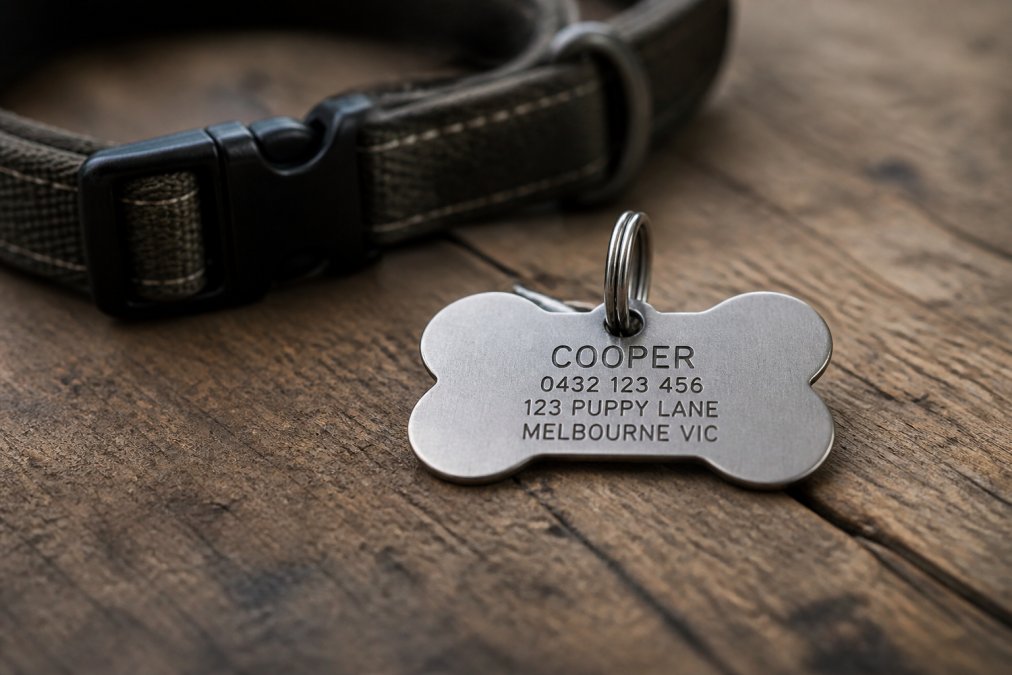
Layout Patterns That Work
Ideas that work:
- Large, simple fonts (avoid cursive and thin scripts)
- High-contrast text (white or light lettering on a dark tag)
- Name on the front, contact details on the back
- "Microchipped" as a short backup note
Ideas that don't:
- Nicknames only ("Fluffy" means nothing to a stranger)
- Decorative fonts that blur at a distance
- Emojis or symbols a finder can't read
Deep engraving beats surface printing every time. Cheap tags with printed text fade and scratch within months. Our deep laser engraving cuts into the metal itself, so the text stays sharp for years. For a clear, long-lasting option, the Stainless Steel Bone Pet ID Tag is deeply engraved on both sides with room for a large name and full contact details.
Privacy-First Engraving: Share Less, Recover More
A dog tag is a public document. Anyone who finds or steals your dog can read every character on it. The privacy-focused approach is to give a finder just enough to contact you, and nothing more.
What to leave off:
- Your full home address
- Your dog's microchip number
- Your full legal name
- Your dog's exact routine or "I'm friendly" claims
What to put on instead:
- A mobile number you always answer
- A second contact number
- Your suburb, not your street
- A short medical note if relevant
The Finder's-Eye Test
Before you order, write your proposed text on a scrap of paper at the actual size of the tag. Hold it at arm's length in dim light. If you can't read the name and number in two seconds, a finder won't either. That's the real test, not how it looks in a product photo.
Smart Tags and QR Codes: A Modern Alternative
A QR code dog tag links to a digital profile a finder can open on their phone. It's the biggest shift in pet ID in years, and it solves the two problems engraved tags can't: privacy and updates.
Smart Pet ID Tag - QR Code Dog & Cat →
How a smart tag works:
- You create a digital profile with your pet's details
- The tag shows a QR code
- A finder scans it with their phone
- They see your contact info and can call or message you
Character Limits and Tag Materials: What Fits and What Lasts
Most dog tags fit around 3 to 4 lines of text, with roughly 15 to 20 characters per line. That's your real limit, and it decides what you can engrave. Plan your text around it before you order.
Character-Limit Cheat Sheet by Tag Size
| Tag size (approx.) | Shape | Lines | Characters per line |
|---|---|---|---|
| 20 mm | Round | 2 | 8-10 |
| 25 mm | Round | 3 | 10-12 |
| 30 mm | Round | 3-4 | 12-15 |
| 38 mm | Bone | 3-4 | 15-18 |
| 50 mm | Bone or rectangle | 4 | 18-22 |
| 50 mm | Rectangle (extra wide) | 4-5 | 22-28 |
A Simple Character Budget
| Line | What to Put | Example |
|---|---|---|
| 1 | Pet's name | BUDDY |
| 2 | Mobile number | 0412 345 678 |
| 3 | Second contact | 0400 987 654 |
| 4 | Suburb or note | RICHMOND |
If your tag is smaller than 30 mm, cut the suburb before you cut the second number. A reachable human beats a location every time.
Formatting Medical Alerts in Tight Space
Medical notes are the hardest thing to fit, because they compete with contact details for the same few lines. A few patterns that work:
-
One word, capitalised:
DIABETIC,EPILEPTIC,DEAF,BLIND -
Two-word shorthand:
NEEDS INSULIN,ON MEDS,ALLERGIC BEE - Symbol prefix: a small cross or asterisk before the word draws the eye without using letters
- Front-of-tag placement: put the medical word on the front under the name, where a finder looks first
Material Comparison
Material matters just as much as text. Here's how the common options compare:
| Material | Best For | Durability | Weight |
|---|---|---|---|
| Aluminium | Puppies, cats, small dogs | Good | Very light |
| Stainless steel | Large, active dogs | Excellent | Medium |
| Silicone | Quiet tags, active pets | Fair | Light |
| Brass | Traditional look, medium dogs | Good | Medium-heavy |
| Acrylic or plastic | Budget, short-term use | Poor | Very light |
Practical Notes
- Font readability: bigger letters fit fewer characters, so shorten your text
- Engraving depth: deeper cuts resist wear and stay legible longer
- Tag silencer: a rubber silencer stops the jingle and protects the metal
- Attachment hardware: a strong split ring keeps the tag on the collar
- Non-toxic materials: look for safe finishes, especially for pets that chew
Conclusion
Getting your dog's tag right takes ten minutes and can save you weeks of worry. Name, number, a second contact, and the right material cover almost every case.
Frequently Asked Questions
What is the best thing to put on a dog tag?
Your mobile number and your dog's name are the two essentials. A second contact number, such as a partner or neighbour, adds a backup if you cannot answer. Adding your suburb helps someone who finds your dog know where it belongs. Keep the text short so it stays readable. Deep engraving, like the laser etching used on Pawzee tags, keeps those details legible through years of wear and scratching.
What legally should be on a dog tag?
Registration requirements differ by state and council. Most councils require a registration tag issued with your pet's registration, and some require a name tag with your contact details. Check your local council's rules, as penalties apply for unregistered pets. Your registration tag and a separate ID tag with your phone number cover both the legal and practical sides of identification.
What should you not put on your dog's ID tag?
Avoid your full home address, your dog's microchip number and any medical details that could be misused. A street name or suburb is enough for someone to identify the area. Never put your dog's name alone without a phone number, as it does not help anyone contact you. Keep personal information minimal so the tag stays safe if it falls into the wrong hands.
How much text can fit on a standard pet ID tag?
Most standard tags fit three to four short lines. If you need more space, a smart tag with a QR code stores unlimited details online, so you can include medical notes and multiple contacts without crowding the tag.