

A disability alert is only useful if a finder can read it quickly and contact you just as fast. Choosing what to engrave if dog is deaf or blind can feel tricky when tag space is limited, but a short, direct message can help someone understand your dog’s needs straight away.
It’s natural to want the tag to explain everything. Prioritise a clear alert, such as “I’M DEAF” or “BLIND DOG”, alongside a current mobile number someone can use immediately. Your dog’s name may help too, if there’s room. Clear wording can also remind a finder to approach calmly rather than calling out or reaching in without warning.
This guide shares practical wording options for deaf and blind dogs, explains which details to prioritise when space is tight, and offers simple tips for keeping engraving readable for everyday wear. It also compares traditional engraved tags and smart tags, so you can decide how to make your furry mate’s essential information easy to find.
Key Takeaways
- For what to engrave if dog is deaf or blind, choose wording that clearly identifies the condition and tells a finder what they need to know.
- Use the tag’s limited space carefully so emergency contact information remains easy to read at a glance.
- Check the wording, available line space and contact details before ordering, then inspect the finished engraving for legibility.
- Keep your dog’s identification details current, and include their name only if it fits without crowding the essentials.
- Compare visible identification with a smart tag’s digital pet profile to decide how the two options could complement each other.
What to engrave if dog is deaf or blind: clear wording for a dog tag
A short, clear alert can tell a finder something important about your dog before they try to call or approach. The aim is simple: help someone recognise your dog’s needs and contact you. For what to engrave if dog is deaf or blind, begin with direct wording such as DEAF, BLIND or DEAF AND BLIND, then make room for a current phone number.
Choose the alert that accurately describes your furry mate. A disability message is practical identification. It doesn’t explain how your dog will respond in every situation or describe their training and role. For general background, Service animals are animals trained to assist people, which is different from identifying a pet’s individual needs.
What should a deaf dog’s tag say?
DEAF is direct and easy to understand. Put it alongside your current mobile number so a finder can see the alert and reach you. If your dog is comfortable with a particular approach, you could add PLEASE APPROACH GENTLY. This takes more space, so include it only if it gives a finder a useful cue specific to your dog.
A tag can’t describe every response your dog may have. Some dogs may startle if touched unexpectedly; others may be comfortable with familiar handling. Keep the wording accurate and concise rather than trying to fit a full set of instructions onto a small tag.
What should a blind dog’s tag say?
BLIND gives a finder a clear visual alert. You could add PLEASE SPEAK BEFORE TOUCHING if that cue suits your dog and may help someone approach more considerately. Keep your phone number prominent, and avoid instructions that don’t reflect your dog’s usual needs.
Blindness can affect dogs differently, so there isn’t one message that fits every furry mate. If your dog has specific support needs or you’re unsure which cue would be useful, ask your veterinarian for guidance on suitable wording. For a dog who is both deaf and blind, DEAF AND BLIND communicates both alerts. Check that the full message and contact number will remain readable on the tag.
The clearest tag is one a finder can understand quickly. Choose words that are accurate for your dog, and keep the message focused on alerting the finder and helping them get in touch with you.
How to choose wording for deaf, blind or deafblind dogs
The best message is one a finder can understand quickly and act on. A single-word alert, such as DEAF or BLIND, is brief and leaves more room for your contact number. A short instruction can add a useful cue, but only if it reflects how your own dog responds. The aim isn’t to explain every detail of their care. It’s to make the next step clear.
A useful disability alert is brief, easy to read and paired with contact details a finder can use straight away. Keep that test in mind as you decide what to engrave if dog is deaf or blind. The American Kennel Club’s overview of Deafness in dogs provides background on how hearing loss can affect a dog. Your tag wording should be based on your furry mate’s individual needs, not assumptions about every dog with the same disability.
Wording for a dog who is both deaf and blind
If both alerts are essential, DEAF AND BLIND states them plainly. Check that the words and a current phone number will fit with enough space to remain readable. If you add another instruction, keep it short and specific, such as a cue that tells a finder how best to approach your dog. Leave out extra description if it crowds the contact details.
Should the tag include an instruction for a finder?
An instruction can help when it gives someone a practical cue, such as speaking before touching a blind dog or approaching in a way that suits your dog. Avoid broad directions that imply every deaf or blind dog behaves alike. If you’re unsure whether a phrase is accurate, check it with your veterinarian or someone who knows your dog well.
Use this quick test before settling on wording:
- Is the alert accurate? Name the disability or disabilities the finder needs to know about.
- Does the instruction help? Include one only if it offers a clear, dog-specific cue.
- Can the number still be read? Keep emergency contact information prominent rather than filling the tag with extra text.
Once you’ve chosen the message, check how it looks at the size it will be engraved. If you’re comparing options for everyday visual identification, explore personalised dog identification tags and consider which format leaves your key details clearest.
What details should come first on a disability ID tag?
Tag space is limited, so choose details in the order they help a finder understand your dog’s needs and contact you. For what to engrave if dog is deaf or blind, start with a clear disability alert and a current phone number. Guidance from Deaf Dogs Rock’s essential ID tag for a deaf pup also supports making the alert explicit.
| Detail | What it tells a finder | Priority |
|---|---|---|
| Disability alert | For example, DEAF, BLIND or DEAF AND BLIND. Makes an important need clear at a glance. | Include the alert that accurately describes your dog. |
| Phone number | How to reach someone who can respond and help reunite you. | Give it space and keep it current. |
| Dog’s name | Identifies your furry mate by name. | Add it if it fits without making the alert or number harder to read. |
| QR code | Can direct someone to a digital pet profile with further information. | Consider it an extra, not a substitute for readable details. |
Which contact details are most useful on a dog tag?
Choose a current phone number that reaches someone able to respond. If your number or circumstances change, update the engraved details so a finder isn’t left calling an old contact. Your dog’s name can be useful, but don’t squeeze it in at the expense of a clear alert or legible number.
A home address is optional. Some owners may prefer to include one; others may favour sharing less personal information on a tag. Consider your privacy preferences and which contact detail will make it easiest for someone to reach you.
Can a QR code or smart tag add more information?
QR codes can link to a digital pet profile, where you may be able to share more information than fits on an engraved tag. Keep visual identification useful on its own: a person should be able to read the essential alert and phone number without scanning a code. A smart tag can add detail, while visible wording remains immediately accessible.
For more background, see Smart Pet Tags Australia: The 2026 Guide to Next-Gen Pet Safety. Before ordering any tag, check its product-specific engraving limits. Line capacity depends on the tag you choose, so don’t assume every shape or size can fit the same wording. Prioritise readable emergency contact information over extra text.
How to make disability dog tag engraving easy to read
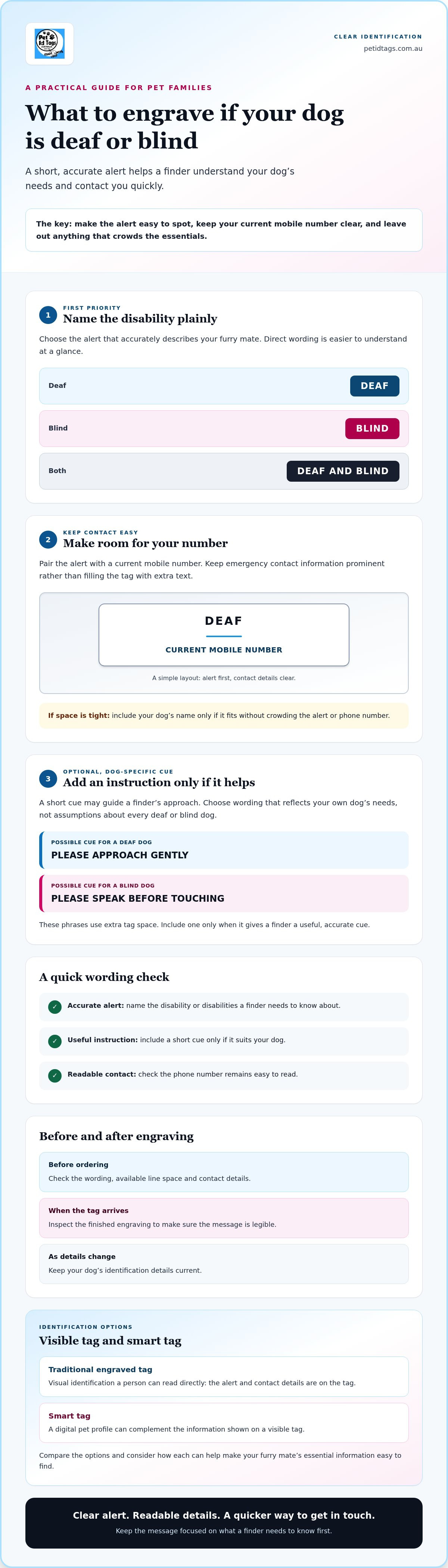
A useful message needs to be readable at a glance. Keep the alert and phone number clear rather than squeezing every possible detail onto one tag. As you settle on what to engrave if dog is deaf or blind, check how the wording looks on the specific tag you plan to choose. Line space varies, so confirm the product’s engraving limits instead of assuming a certain number of lines will fit.
Use this quick check before placing an order:
- Choose the wording: Make sure the disability alert is clear and accurate for your dog.
- Check the line space: Confirm the proposed text fits the selected tag without crowding.
- Confirm contact details: Check the phone number digit by digit and make sure it reaches someone who can respond.
- Inspect readability: Read the full message as if you were seeing your dog and tag for the first time. Would the alert and number be easy to make out?
How to check a tag’s message before ordering
Read the engraving proof or proposed layout carefully. Check the spelling, every phone digit and the disability alert itself. A familiar owner may understand an abbreviation or cramped line, but a finder encountering your furry mate won’t have that context. If the alert or number looks crowded, remove non-essential wording rather than sacrificing legibility. Confirm the selected tag’s text limits before finalising the message.
Engraving terms can describe different methods. Deep-mill engraving refers to mechanical engraving that cuts into the tag material. Fibre engraving uses a high-powered fibre machine to mark metal. These terms aren’t interchangeable guarantees of how a particular tag is made, so check the engraving method for the specific product before relying on a claim. For broader wording inspiration, see Pet Tag Engraving Ideas: The Ultimate 2026 Australian Checklist.
Choosing a durable tag for everyday identification
Wording and material are separate choices, but both matter for practical identification. Pet ID Tags Australia offers stainless steel and aluminium dog tags. Whichever material you choose, check the engraving limits and make sure the message is clear and the tag suits your dog’s everyday wear. For more material guidance, read Stainless Steel Dog Tags Australia: The 2026 Ultimate Buyer’s Guide to Durable ID.
Choosing a dog tag that supports clear identification
The right tag brings together four practical choices: an accurate alert, a readable phone number, a tag suited to everyday wear and contact details that are kept current. For what to engrave if dog is deaf or blind, keep the message focused on what a finder needs to know first. A tag supports identification, but it can’t prevent every incident or replace the care and understanding your dog needs.
Traditional engraved tags and smart tags
A traditional engraved tag offers visual identification: a finder can read its message directly, without scanning equipment. That makes it a practical place for the key alert and phone number. A smart tag can add access to a digital pet profile through a QR code, where you may be able to share extra details that won’t fit on the tag itself.
Choose based on what you want to be immediately visible. If someone needs to know your dog is deaf or blind and call you, keep those essentials readable on the tag. If you’d also like to provide further information, a smart tag can complement that message. Whichever option you choose, check that its details are accurate and useful to someone who has just found your furry mate.
A simple final check before your dog wears the tag
Before attaching the tag, check the practical details. Read the engraving as if you were a stranger seeing your dog for the first time. Is the alert clear? Can you read the phone number easily? Does the number reach someone who can respond? Check that the tag is securely attached, then revisit the contact details whenever they change.
These small checks help keep your dog’s identification useful in everyday life. If you also want to mark travel crates, medication tins, or gear with clear reminders, personalised decals from Chlosha Creations can provide extra visibility alongside your dog’s collar tag. Clear wording and current details give anyone a straightforward way to understand your dog’s needs and get in touch.
Choose clear ID for your furry mate
The clearest tag keeps its message focused: state your dog’s disability, include a readable phone number and add only details that fit without crowding the essentials. For what to engrave if dog is deaf or blind, choose wording that reflects your dog’s individual needs, then check the contact details are current and someone can respond.
A traditional engraved tag makes key information visible without scanning, while a smart tag can provide access to a digital pet profile with extra details. These options can complement each other, but neither replaces attentive care or guarantees a particular outcome.
Pet ID Tags Australia offers personalised identification options, including engraved dog tags and smart pet tags. Explore the available personalised pet identification tags and choose the format that best suits your dog and the information you want to share.
Frequently Asked Questions
What should I put on a tag for a deaf dog?
Engrave DEAF and a current phone number someone can answer. This makes the key alert and contact route easy to find. If a short instruction, such as “PLEASE APPROACH GENTLY”, reflects your dog’s individual needs, include it if there’s room. Keep the wording accurate: the alert helps a finder understand your dog may not hear them, but can’t explain how your dog will react in every situation.
What should a blind dog’s ID tag say?
Use BLIND as a clear alert, followed by a current contact number. You might add a brief cue such as “PLEASE SPEAK BEFORE TOUCHING” if it suits your dog and offers a finder useful guidance. Keep the words easy to read, and don’t let extra instructions crowd the phone number. If your dog has specific support needs, ask your veterinarian or someone familiar with your dog to help check the wording.
What do I engrave if my dog is deaf and blind?
Consider DEAF AND BLIND alongside a current phone number. This states both alerts directly, helping a finder understand that calling out may not get your dog’s attention and that they may need to approach thoughtfully. Add another instruction only if it’s short, specific to your dog and still leaves the alert and number legible. Check the selected tag’s engraving limits before finalising the message.
Should I put my dog’s name or my phone number on the tag?
Prioritise a phone number that reaches someone able to respond. A finder can use it to contact you, while your dog’s name is helpful only if it fits without making the number or disability alert harder to read. Check every digit before ordering. If your contact number changes, update the tag so the information remains useful to someone trying to reach you.
Can a QR code replace engraved information on a dog tag?
A QR code is best treated as an extra, not a replacement for readable visual identification. It can lead to a digital pet profile with more details, but a finder needs a compatible device and must scan the code to access them. Keep the essential alert and a contact number visible on the tag itself. That way, the first useful information doesn’t depend on scanning.
Should I include my home address on my dog’s tag?
A home address is optional, so decide based on your privacy preferences and the details you’re comfortable displaying. A current phone number is a direct way for a finder to contact you, and it may be all you choose to engrave alongside the alert. If you do include an address, make sure it’s accurate. Whatever details you select, keep the message clear and readable.
How can I make sure my dog’s engraved message is readable?
Keep the wording short, check the spelling and phone digits, and confirm the full message fits the specific tag you’ve chosen. Read it as though you’re a stranger meeting your dog for the first time. Can you quickly understand the alert and make out the contact number? If the text looks crowded, remove less essential details rather than reducing readability. Recheck the tag and contact information as your circumstances change.
Ready to choose a clear, personalised tag for your dog? Explore personalised pet ID tags and check the engraving details for the option you select.