

A QR pet tag won’t show you where your furry mate is, but it can help a finder work out how to reach you. If you’re considering smart pet tags australia, it’s useful to distinguish digital identification from GPS tracking. A QR code gives someone with a smartphone a way to access your pet’s details, but it doesn’t report their live location.
It’s also fair to wonder whether a stranger will know what to do with the tag. Pairing a scannable code with clear visual identification gives a finder a simple starting point, even if they don’t scan it. The aim is practical: make your pet recognisable and give someone a clear route to your contact details.
This guide explains how QR code pet tags work, how they differ from traditional visual ID, and what to consider when choosing one for your dog or cat. You’ll learn how to balance visible details with digital information, what to include in a profile and why keeping contact details current matters. That way, you can choose an identification option that suits your furry mate and supports peace of mind.
Key Takeaways
- Understand what happens when someone scans a QR code tag, and why it provides digital identification rather than live location tracking.
- Compare QR access with visual identification to decide what a finder can use at a glance or through a scan.
- Explore smart pet tags australia and consider code readability, useful profile details and how the tag attaches for everyday wear.
- Keep your pet’s contact details current, especially when your circumstances change, so a finder has a practical way to reach you.
- Use the article’s checklist to weigh the benefits and limits of QR-linked details for your furry mate.
Smart pet tags in Australia: What do they actually do?
A smart pet tag adds a digital layer to your dog or cat’s identification. It displays a QR code linked to information that can help a finder identify your pet and contact you. The code gives someone with a compatible smartphone a clear next step: scan it to view the linked details.
A QR pet tag is an identification tag linked to digital information, not a GPS tracker that shows a pet’s live position. That distinction matters. A QR scan can connect a finder with the details in a digital pet profile, but it doesn’t locate your pet on a map or automatically notify you when someone scans the code.
For Aussie families weighing up smart pet tags australia-wide, the practical value is making useful identification easier to access. The tag helps a person take the next step; it doesn’t follow a pet’s movements. Clear information and current contact details give a finder a straightforward way to try to reach the right person.
How does a QR code pet tag work?
A finder points a compatible phone at the tag’s QR code and scans it. The code opens the digital information linked to the tag. What the finder sees depends on the profile details provided. The scan is a way to access identification information, not a signal that tracks your pet.
Your part is to keep the linked details useful and current. A phone number that’s no longer in service won’t help a finder make contact. The basic process is simple: the finder scans the code, reads the information and uses the contact details to try to reach you. Don’t expect a map location or automatic notification from the scan.
What a smart tag can and cannot tell a finder
A QR tag provides a route to the identification information its owner has made available. This can give a finder more context than fits on a small physical tag. The tag still needs to be attached, the code needs to be visible, and the linked contact details need to be current.
A QR code alone can’t tell a finder where a pet is now, show where they’ve been or confirm that a scan has taken place. That’s different from GPS tracking. It’s also different from pet microchip implants, which provide internal identification rather than a scannable code displayed on a collar. Each approach has a distinct role, so don’t assume a QR tag replaces other forms of identification.
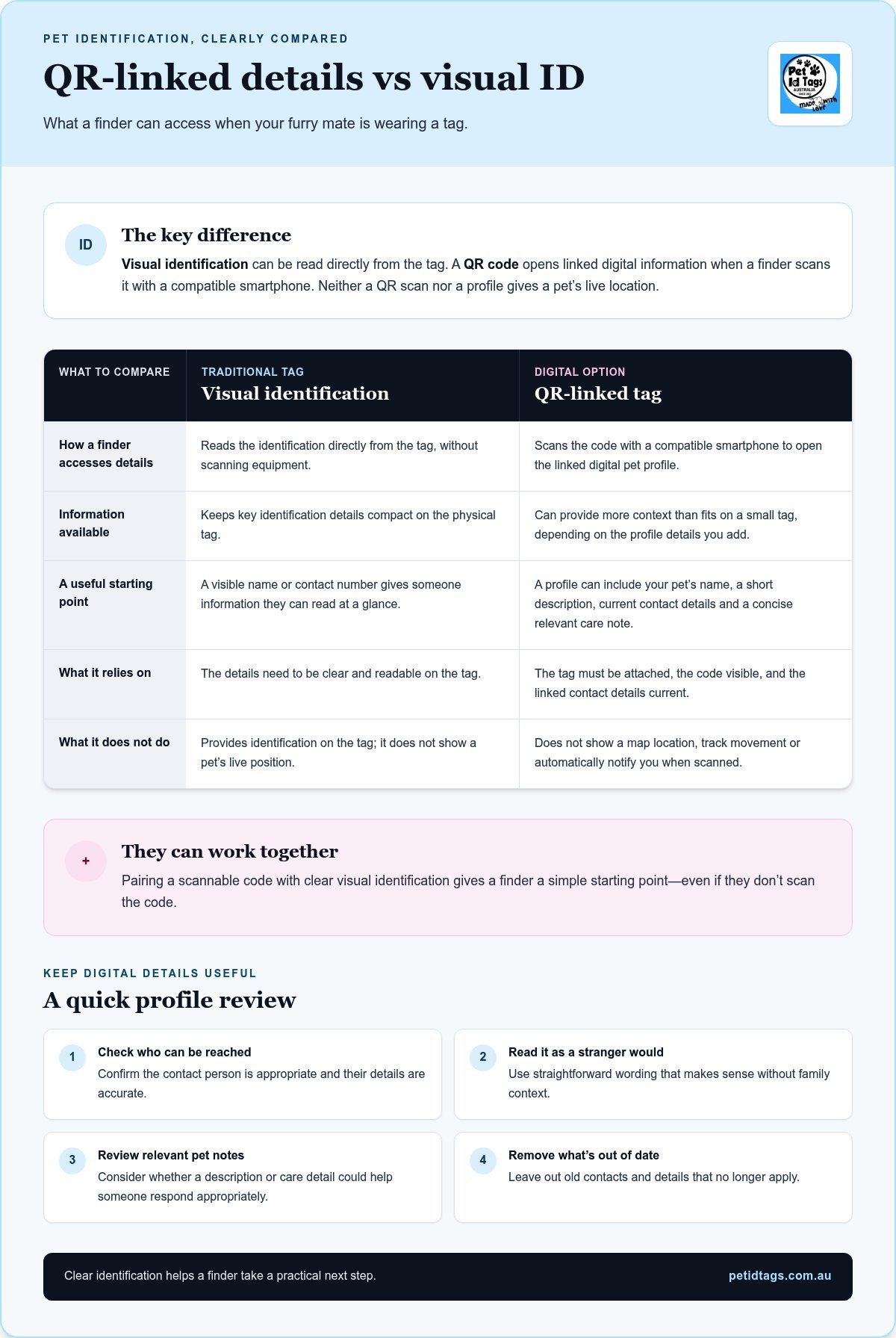
Smart identification is one option alongside traditional personalised tags. A visible name or contact number can be read directly, while a QR code opens linked digital information. The goal is to give someone who finds your pet a practical way to identify them and try to get in touch.
How QR smart pet tags connect a scan to useful identification details
The value of linked pet information depends on the choices made before a finder needs it. Think about what could help someone recognise your pet, understand any immediate care needs and contact a responsible person. Keep details focused on those purposes. A clear profile that’s easy to act on is more useful in a stressful moment than one filled with information a finder can’t quickly interpret.
What should an owner review in a digital pet profile?
Make profile checks part of looking after your pet’s identification. Review the profile using the instructions for your tag, then check the information in this order:
- Check who can be reached. Confirm the listed contact person is still appropriate and their details are accurate.
- Read it as a stranger would. Use straightforward wording that doesn’t rely on family nicknames or context only you know.
- Review pet-specific notes. Decide whether any description or care information could help someone respond appropriately.
- Remove what no longer applies. Outdated contacts or irrelevant notes can distract from the details that matter now.
For example, if someone else is now the best person to respond during the day, make sure the profile directs a finder to a useful contact. Keep the information aligned with your household’s current arrangements.
What belongs in a digital pet profile?
Prioritise details that help identify your pet and guide a finder towards an appropriate next step. Useful information can include:
- Your pet’s name and a short description that could distinguish them from a similar-looking animal.
- A current contact number and, if useful, another person who can be reached.
- A concise note about a relevant health need or behaviour that could affect how someone safely approaches or assists your pet.
Share only sensitive information you’re comfortable making available. A finder may need a way to reach you, but usually doesn’t need details such as your full home routine. Ask whether each entry helps identify your pet or supports safe, practical assistance. If it doesn’t, leave it out.
Pet ID Tags Australia’s Smart Pet ID Tag is a QR code identification option. Whichever identification style you choose, consider what a finder needs to know and keep the profile focused on those essentials.
Smart pet tags versus visual identification: which approach suits your pet?
The choice is less about which format is universally better and more about what suits your household’s routines. A traditional tag keeps key details compact. QR-linked identification can suit owners who want room for additional context. Consider who looks after your pet, how often contact details change and what information you’re comfortable making available.
| What to consider | Traditional visual identification | QR-linked identification |
|---|---|---|
| Information capacity | Best suited to a small number of essential details, such as a name or contact number. | May suit owners who want to provide more context than can fit on a physical tag. |
| Keeping details current | Changes to engraved information may mean replacing or updating the tag. | Profile details may be managed separately from the physical tag, depending on the product. |
| Privacy choices | Only the information marked on the tag is displayed. | Owners should consider carefully which details they want associated with the profile. |
| Best fit | Owners who prefer a simple, limited set of identification details. | Owners who value sharing additional information about their pet. |
When does visual identification help most?
A traditional tag can suit you if you want your pet’s essential contact details to stay simple and easy to read. It may also suit households that prefer not to manage an online profile. Keep the wording focused on what a person needs to identify your pet or get in touch, and choose lettering that’s clear at a glance. The pet ID tag engraving ideas guide can help you decide what to include.
When can digital pet details add value?
QR-linked details may be useful when several people care for your pet or when you want to provide a short description alongside contact information. Think about what a neighbour, pet sitter or family member would need to know if they were helping your dog or cat. Include relevant details, and make sure whoever manages the profile knows when it needs reviewing.
When considering smart pet tags australia, weigh the extra profile space against the simplicity of a physical tag. Some owners prefer one format; others choose to pair them. Either way, prioritise clear, practical identification that suits your pet’s routine and the people responsible for their care.
How to keep a smart pet tag useful, readable and privacy-conscious
Make tag care part of the small routines that already keep your pet safe. Glance at the collar before an outing to notice if the tag has shifted, become difficult to read or needs attention. Review the profile after a change in your household or your pet’s circumstances. These quick checks help keep the identification setup useful rather than letting it become an afterthought.
A simple routine for reviewing a digital pet profile
Choose a natural prompt for checking the profile, such as a phone change, a change in who cares for your pet, or new information that could matter to a finder. Follow the instructions for your tag to view or manage its linked details. Read the information from a stranger’s perspective: is it easy to understand, relevant and useful?
Check the physical tag too. Make sure it’s attached appropriately to your pet’s collar and that the QR code and any visible markings are clear enough to use. If the tag has turned around or is obscured, a finder may not notice the identification details. A quick look during your regular collar check helps you spot problems early.
Use this checklist as a prompt:
- Review the profile after a change in household arrangements or your pet’s needs.
- Check that the information is concise and understandable to someone unfamiliar with your pet.
- Look over the tag and its attachment during ordinary collar checks.
- Remove profile details that are no longer relevant or that you’d rather not share.
Sharing information with care
Think about privacy before adding personal details. Share only what you’re comfortable making available to someone who scans the tag, and consider whether each item helps identify or safely assist your pet. Avoid including information about your household routine or other personal matters unless there’s a clear reason to share it. Read the privacy information for your tag so you understand how its linked details are handled.
In Australia, the Australian Privacy Principles (APPs) are principles under the Privacy Act 1988 that govern how most Australian private sector organisations covered by the Act handle personal information. They include requirements concerning transparency, use and protection of information. This general legal context doesn’t describe how every tag provider manages data, so review the relevant privacy information before adding personal details.
A considered routine helps keep both the physical tag and its linked information useful without sharing more than you intend. Explore smart pet identification options and choose an approach that feels practical for your furry mate.
Choosing a smart pet tag in Australia: a practical next step
A QR tag may suit your household if you’d like a finder to access digital identification details, rather than relying only on the limited space on a traditional tag. It’s an additional identification option, not a live tracking device, and works best when the code is easy to find and the linked information is useful. Someone needs to notice the QR code, scan it and use the details provided.
For some pets and owners, clear visual identification may be the simplest fit. Others may value QR-linked information alongside details a person can read directly. Choose according to your pet’s everyday collar setup, the information you want to share and what a finder can readily use.
A quick checklist before choosing a smart pet tag
Consider how the tag will work in daily life, not just how it looks. A clear, readable tag helps a finder act, while an attachment suited to your pet’s usual collar helps keep identification in place.
- Useful details: Would a QR-linked profile add helpful identification information for your pet and household?
- Readability: Is the code easy to locate, and is any visible information clear enough to read?
- Practical profile: Can you keep the linked details current and share only information you consider appropriate?
- Everyday fit: Does the tag attach securely to your pet’s regular collar without getting in the way of its normal use?
- Realistic expectations: Are you choosing it for identification, rather than expecting GPS tracking or an automatic alert?
If a QR tag is the right match, follow the product’s scan and profile instructions. Don’t rely on features that aren’t described. If a traditional tag feels more straightforward, direct visual identification remains a useful choice. Readability and a reliable way to contact you matter more than appearance or assumed technology.
Pet ID Tags Australia’s identification experience
Pet ID Tags Australia has supported pet identification since 2004, with over 20 years of engraving experience. Its range includes a QR code Smart Pet ID Tag alongside traditional personalised identification tags. These are separate options, so choose the approach that suits your pet rather than assuming different tag types come as a set.
With smart pet tags australia, the key is matching the tag’s role to your needs. A QR tag links to digital information; a traditional engraved tag displays readable identification directly. Think about your pet’s routine, the clarity of the details and how easily a finder can use them. A well-chosen tag offers a practical layer of reassurance for the whole family.
For a simple next step, explore smart pet tags for your furry mate and compare the QR option with traditional identification for everyday wear.
Make identification part of your everyday routine
The most useful tag is one that suits your pet’s daily life and gives a finder a clear next step. Think about who might care for your pet, which contact details should be available and whether the tag stays easy to read and attached during ordinary outings. A quick check of the tag and its linked information can become part of your regular collar routine.
Choosing among smart pet tags australia is less about adding technology for its own sake and more about finding an identification approach your household will keep up to date. You can favour direct, visible details, QR-linked information or a practical mix of both. Choose with your furry mate’s comfort and a finder’s needs in mind.
Ready to consider an identification option for your pet? Explore smart pet tags for your furry mate and take a practical next step towards clearer identification and greater peace of mind.
Frequently Asked Questions
Does a QR code pet tag need a battery?
A static QR code marked on a tag doesn’t need charging just to display the code. It’s different from an electronic tracking device, which needs power to perform its functions. Scanning the code and accessing what it links to are separate steps. The tag displaying a code doesn’t mean an online profile or related service will always be available, so read the information provided with your tag to understand how its linked destination works.
Can someone scan a smart pet tag without downloading an app?
Many modern phones can scan QR codes through the camera, but the exact steps depend on the phone and where the code leads. A finder may need an internet connection to open an online profile, even if the camera reads the code without a separate scanning app. For example, someone who scans your dog’s tag in an area with poor reception may not be able to load the linked page straight away. A scan doesn’t automatically alert you.
Can a QR code pet tag work without internet access?
A phone may be able to read a QR code while offline, but an online digital pet profile generally needs an internet connection to load. The code points to linked information; it shouldn’t be treated as a copy of the full profile stored on the tag. If your pet is found somewhere with limited reception, visible details such as a readable contact number give someone another practical way to try to reach you.
What information should I put in my pet’s digital profile?
Start with contact details a finder can act on, such as a current phone number, then add concise information that could help identify or safely assist your pet. A distinctive coat marking, for example, may help confirm they’ve found the right animal. Share only sensitive details you’re comfortable making available. A short, accurate profile that makes the next step clear is more useful than a long record a finder can’t quickly interpret.
How often should I update my pet’s digital identification details?
Update the information whenever a phone number, contact person or important detail about your pet changes. A periodic review can also catch an old number or a contact who’s no longer available. Try a simple prompt: check the details after changing phones, updating your pet’s care arrangements or adding a new emergency contact. Keep the visible tag information legible too, so it remains useful whether someone scans the code or reads the tag directly.
Are smart pet tags suitable for cats as well as dogs?
Yes, QR-based identification can suit cats and dogs when the tag is appropriate for the individual pet and its collar setup. Pet ID Tags Australia offers smart identification for both. For a cat, consider collar fit and safety features, and make sure the tag doesn’t interfere with comfortable everyday wear. A QR option can add digital identification, while a clear visible detail may help someone who doesn’t scan the code. Choose what best fits your furry mate.