
For a Rottweiler, choose a collar around 1.5 to 2 inches wide and adjust it to leave room for two fingers between the collar and your dog’s neck. A rottweiler strong collar and thick tag set should also make everyday identification clear and easy to read. The right fit matters as much as the collar’s width, especially for a powerful dog that pulls.
A broad collar can feel reassuring, but it still needs to fit securely without rubbing or restricting your dog. This guide explains how to measure your Rottweiler, assess adjustable sizing and choose collar and tag features for a comfortable, dependable fit. It also explains when a collar is best kept for identification and basic control, rather than demanding walks, so you can make a practical choice for your dog’s comfort and safety.
Key Takeaways
- Compare slim, regular and wide collar profiles against your Rottweiler’s build, neck shape and everyday comfort.
- Measure carefully and use the adjustment holes to find a secure fit that won’t rub or slip out of place.
- Inspect the buckle and D-ring as separate parts, and consider where the lead attaches when your dog pulls strongly.
- Choose a clearly readable identification tag, with stainless steel as a durable option for everyday wear.
What’s the best collar for a Rottweiler?
For most Rottweilers, choose a collar about 1.5 to 2 inches wide, then match its fit and hardware to your dog’s build. Strong pullers need a comfortable collar that stays secure without relying on a choke chain.
Recommended Collar Width
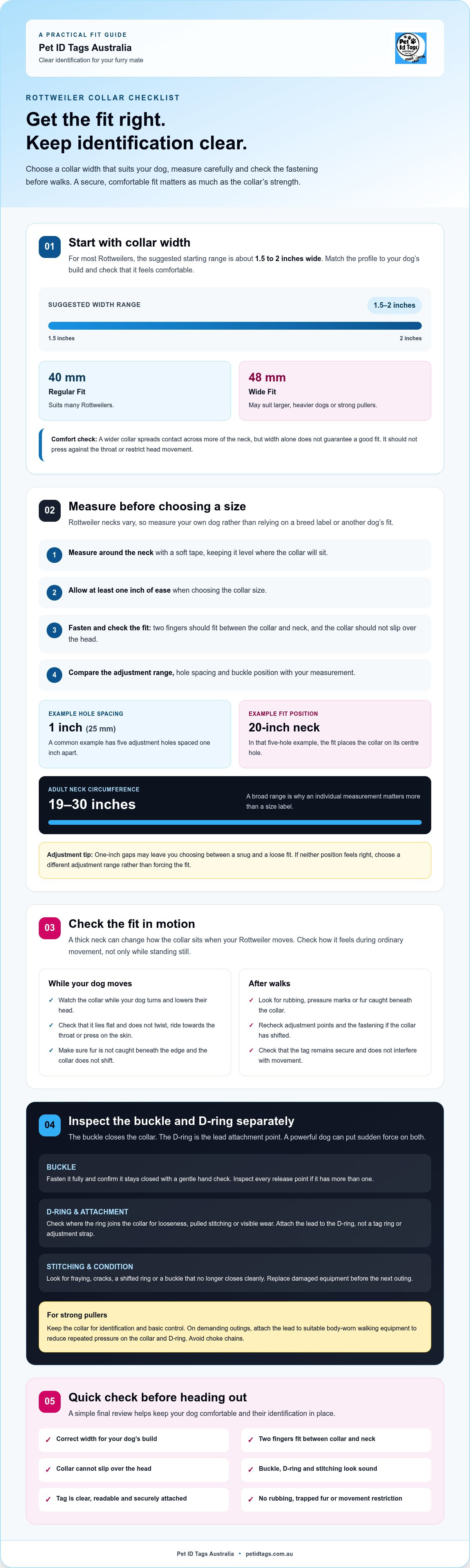
Use the width as a starting point, then compare your dog’s neck and frame. A 40mm Regular Fit suits many Rottweilers, while a 48mm Wide Fit may suit larger, heavier dogs or strong pullers. Both sit within the recommended range of 1.5 to 2 inches. Slim collars have a narrower profile; check that one feels substantial and sits securely on your dog.
Width and Wearing Comfort
A wider collar spreads contact across more of the neck than a slim design. That can feel more comfortable during everyday wear, but width alone won’t ensure a good fit. Check that the collar doesn’t press against your dog’s throat or restrict head movement. During training and walks, watch for rubbing, fur caught beneath the edge, or your Rottweiler trying to scratch it off.
Features for Strong-Dog Safety
Choose a collar with a secure buckle, a firmly attached D-ring and sound stitching. Before each walk, check the fastening and ring for looseness, cracks or fraying. Avoid choke chains, as pulling against one can injure your dog. A well-fitted collar should neither pinch nor slide. After walks, check your Rottweiler’s neck, especially if the collar has shifted or left marks.
Adjustable sizing and hole spacing
Measure around your Rottweiler’s neck with a soft tape, then allow at least one inch of ease. Fasten the collar so two fingers fit between it and the neck, while ensuring it can’t slip over the head. A strong collar and thick tag set for a Rottweiler starts with this secure fit.
Adjustment holes determine how closely the collar can match that measurement. A common example has five holes spaced one inch (25 mm) apart, giving several fit positions. With a 20-inch neck measurement, the example fit places the collar on its centre hole, leaving room to adjust either way.
Rottweiler necks vary considerably. An adult’s neck circumference can range from 19 to 30 inches, so breed alone won’t tell you the correct collar size. Measure your own dog rather than relying on a size label or another Rottweiler’s fit.
- Keep the tape level around the neck where the collar will sit.
- Record the measurement and allow at least one inch when choosing a size.
- Compare the adjustment range, hole spacing and buckle position with that measurement.
- Fasten the collar, then check that it sits securely without pinching or sliding.
Hole spacing affects how precisely you can adjust a collar. One-inch gaps, for example, may leave you choosing between a snug and a loose fit. If neither position feels right, choose a collar with a different adjustment range instead of forcing the fit. Check that a long collar tip stays clear of your dog’s movement rather than catching or flapping.
Strength matters, but even a durable collar must fit properly. Match its size range to your dog’s measured neck, and make sure the tag stays attached without interfering with adjustment. An adjustable personalised dog collar can support a practical fit for your furry mate.
Collar buckle and D-ring security
A powerful Rottweiler can put sudden force on a collar during a walk. The buckle closes the collar, while the D-ring is the lead attachment point, so inspect both separately. A sturdy brass buckle and D-ring are examples of substantial hardware, but secure attachment and good condition matter just as much.
Before each walk, check these points:
- Fasten the buckle fully and confirm it stays closed with a gentle hand check.
- Look where the D-ring joins the collar for looseness, pulled stitching or visible wear.
- Attach the lead to the D-ring, not to a tag ring or adjustment strap.
A dual-release buckle may have two contact points. Although that provides more than one fastening point, inspect both before use. Don’t assume a buckle is suitable just because it looks heavy: the collar’s construction and your dog’s pulling habits matter too.
If your Rottweiler lunges or pulls hard, decide how to manage lead pressure before setting out. A collar can carry identification and provide basic control, while suitable body-worn walking equipment can take the lead during demanding outings. This keeps repeated pulling pressure off the tag and collar.
After a walk, check the buckle and D-ring, especially if your dog has tugged sharply. Look for a buckle that no longer closes cleanly, a shifted ring or loose stitching. Replace damaged equipment before the next outing rather than relying on a weakened fastening.
Collar fit for strong pullers and thick-necked dogs
A thick neck can affect how a collar sits when your Rottweiler turns or lowers their head. Check the fit in those positions, not just while your dog is standing still. Watch for the collar riding towards the throat, twisting or pressing against the skin.
For a strong puller, keep identification separate from walking control. Use the collar for identification and basic control, and attach the lead to suitable body-worn walking equipment on demanding outings. This reduces repeated lead pressure on the collar and its D-ring, helping the identification tag stay in place during daily walks.
Look beyond the size label when assessing fit. Check that the collar lies flat, fastens securely and doesn’t rub as your dog moves. If fur gets trapped or the collar shifts during ordinary movement, reassess its position and adjustment.
- Observe how the collar sits while your dog turns and lowers their head.
- Check for pressure marks or rubbed fur after walks.
- Inspect the adjustment points and fastening as your dog’s body changes.
- Keep identification securely attached without letting it interfere with movement.
Material and construction affect everyday wear too. A full-grain, two-ply leather design is one example of layered construction. Check that the edges sit smoothly against your dog’s neck and that the collar remains flexible enough for comfortable movement.
For a strong puller, choosing a rottweiler strong collar and thick tag set means balancing secure identification with a separate control point for demanding walks. If your dog has a respiratory or throat problem, use body-worn walking equipment and keep a collar on only if it sits comfortably. Let fit and function guide your setup.
Pet ID Tags Australia: Stainless Steel Dog Tags
Pet ID Tags Australia offers Stainless Steel Dog Tags for clear identification on your Rottweiler’s collar. Its 316-grade stainless steel tags are deeply engraved in the professional workshop, creating readable markings for everyday identification. Keep the tag details brief and legible, with your dog’s name and a contact number someone can use to reach you.
A tag supports identification, but it doesn’t replace a correctly fitted collar or suitable walking equipment. Choose a secure attachment and check that the tag remains readable and firmly connected during routine collar inspections.
For a rottweiler strong collar and thick tag set, visit Pet ID Tags Australia.
Make identification part of your Rottweiler’s routine
As your Rottweiler’s routine changes, keep their identification details current and check that their tag remains legible. A clear name and contact number can help someone identify your dog and reach you if you become separated.
Pet ID Tags Australia offers Stainless Steel Dog Tags and Aluminium Dog Tags for visible identification. Choose a tag suited to your dog’s everyday wear, and keep its information clear and easy to read.
Contact Pet ID Tags Australia to explore identification options for your Rottweiler.