

The toughest-looking tag isn’t automatically the safest choice for a teething puppy. Chewing can bring dangling tags and collar materials within curious reach, while a collar that fitted last week may already need adjusting. Choosing puppy teething safe collar and tag options means looking beyond durability: fit, supervision and clear identification all matter. It’s a practical concern for Aussie families who want their furry mate comfortable and easy to identify.
This guide compares personalised collars, engraved tags and QR-code options, including stainless steel and aluminium. You’ll learn how to check a growing puppy’s collar, spot wear and chewing damage, and manage identification during everyday routines. We’ll also cover when a readable tag may be the simplest option and when a QR code linked to a digital pet profile could suit your family. There’s no chew-proof shortcut, but a well-fitted collar, clear emergency contact information and regular checks can help you make a considered choice. Pet ID Tags Australia offers personalised identification options backed by more than 20 years of engraving experience.
Key Takeaways
- Choose puppy teething safe collar and tag options by fit, readable identification and how your puppy responds during supervised wear.
- Compare collar text, an engraved tag and QR codes to decide how a finder can access your contact details.
- Consider 316-grade stainless steel and aluminium as distinct tag materials, and compare readability, weight and attachment for everyday use.
- Check the fit and attachments regularly, supervise initial wear and reassess the setup as your puppy grows.
- Personalised collars, visual ID tags and QR options can work together to keep your furry mate clearly identified.
Puppy teething and collar safety: what can make ID tricky?
A teething puppy may mouth collar fabric or reach for a dangling tag, especially during play. That can leave Aussie owners balancing two needs: keeping their furry mate identified and limiting opportunities to chew or snag equipment. There’s no reliably chew-proof collar or tag. Choose equipment that fits comfortably, carries readable identification and can be checked regularly, then supervise your puppy’s response.
A collar and ID can help someone identify your puppy, but they don’t replace active supervision. Watch how your puppy behaves while wearing them. If chewing persists, the collar irritates their skin or you’re unsure about the fit, seek individual advice from your vet.
Why a teething puppy may mouth a collar or tag
A loose tag can swing or tap against the collar as your puppy plays, attracting their attention. If they start mouthing it, supervise closely and reassess the setup rather than assuming a stronger material will solve the problem. Even a durable tag isn’t safe to chew. Any item that is mouthed or damaged may become a concern.
Look for repeated attempts to bite the collar or tag during wear. Pause and manage access while your puppy is actively chewing instead of leaving them to continue. The right response depends on your puppy and the situation, so seek veterinary advice if the behaviour continues or you have concerns.
Fit and visual identification matter as puppies grow
Puppies grow quickly, so a collar that sits comfortably now may soon fit differently. Check it regularly for rubbing, tightness, looseness and damage. A poor fit can affect comfort and may make it easier for a puppy to mouth the collar or slip out of it. Adjust or replace equipment when needed, and supervise wear while you assess how it sits.
Visual identification is information a person can read directly, without scanning equipment. A clear name and current emergency contact information on a collar or tag can make it easier for someone to reach you. Keep the text legible and update it when your details change. A QR code offers another option, but a finder needs a suitable device to scan it.
For broader first-ID advice, see the Essential Puppy ID Tag Guide. When comparing puppy teething safe collar and tag options, focus on fit, readable details and your puppy’s behaviour during supervised wear. These checks give you a practical basis for choosing identification that can be reassessed as your little mate grows.
Compare puppy collar and tag options by comfort and readability
A useful ID format is one a finder can access easily and your puppy can wear comfortably. A personalised dog collar displays key details on the collar itself, while an engraved tag provides separate visual identification. A QR-code tag can link to more information, but needs a suitable scanning device. Whatever you choose, keep contact details current, check the fit and monitor chewing.
| ID option | What a finder can access | Updating details |
|---|---|---|
| Text on a collar | Visible name and contact number, with no scanning equipment needed. | Changes may require the collar text to be updated or the collar replaced. |
| Attached engraved tag | Readable visual identification, provided the engraving is clear and legible. | New details may mean replacing or re-engraving the tag. |
| QR-code tag | A finder scans the code to access a digital pet profile. | Details may be easier to update through the profile, depending on the service. |
Personalised collar or separate identification tag?
A personalised dog collar can display your puppy’s name and contact number where they’re easy to see. A separate engraved tag gives you another visible surface for emergency contact information. Space is limited on both, so prioritise details that are clear and useful to someone trying to reach you. Check the text regularly, especially when your phone number changes.
Some families prefer collar text, others prefer a tag, and using both can provide complementary visual identification. Consider which details are easiest to read at a glance, as well as your puppy’s comfort and behaviour while wearing the collar and tag.
Traditional engraving or QR codes for a puppy?
Engraved details are read directly from the tag. Deep-mill engraving cuts identification into the tag material. Fibre engraving uses a high-powered fibre machine to create durable, readable markings. QR codes instead link a finder to a digital pet profile, which can hold more information than fits on a small tag.
The practical difference is access: engraved text can be read without scanning, while QR codes need a suitable device. Keep emergency contact information accurate in whichever format you choose. Pet ID Tags Australia offers engraved and QR identification options, as well as personalised collars. No engraved surface or QR code prevents chewing, so supervise wear and check the collar’s fit.
Explore personalised collars and engraved tags as you decide which details will be clearest for your furry mate.
Choose puppy ID materials and attachment options with care
A puppy’s tag needs to be readable, practical to wear and easy to check as part of your collar routine. Material is one consideration, but it doesn’t determine whether a tag is comfortable for your puppy or safe to chew. Compare the tag’s weight, the clarity of its emergency contact information and how securely it attaches.
What to look for in a puppy ID tag
Prioritise legible details over decoration. A finder should be able to read the information easily, and your contact number should be current. Keep the wording focused so the most useful details stand out.
316-grade stainless steel and aluminium are distinct tag material options. Pet ID Tags Australia specialises in 316-grade stainless steel identification and also offers lightweight aluminium tags designed and made in Australia. Compare the materials for their everyday feel, but don’t treat either as chew-proof. No material or finish makes a tag safe for a puppy to mouth.
Deep engraving cuts identification into the tag material rather than simply placing text on the surface. Pet ID Tags Australia uses fibre engraving with a high-powered fibre machine to create deeply engraved markings. Clear engraving supports readable identification, but check the tag over time for wear or damage.
Visual identification is information a person can read directly, without scanning equipment, making it a straightforward way to find your contact details.
How the attachment affects everyday use
A tag attached to a collar provides a separate surface for identification. Text engraved directly on a personalised dog collar keeps those details on the collar itself. Consider which option is easiest to read and check, and watch how your puppy responds to a moving tag during play.
A quick clip can make a tag easier to attach or remove. It doesn’t prevent chewing or snagging, so inspect it alongside the tag and collar. Check attachment points for wear, looseness or damage, and stop using any part that no longer sits securely.
When comparing puppy teething safe collar and tag options, remember that material, attachment and readable details serve different purposes. None replaces supervision or regular fit checks. For more detail on this attachment style, read the Dog Tag Quick Clip Australia guide.
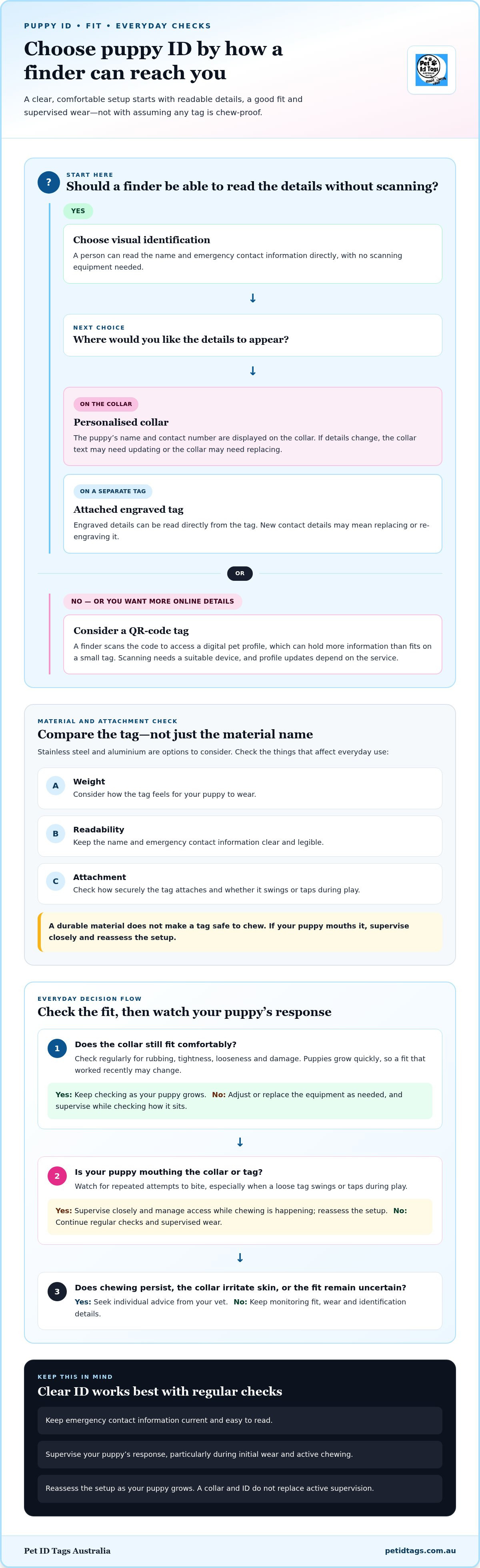
Manage teething risks with a simple collar and tag routine
A quick daily check can help you spot changes early. Puppies grow fast, and play can draw their attention to a dangling tag or attachment. Build a routine around your puppy’s fit and behaviour instead of relying on a one-off check or assuming any material is safe to chew.
A practical fit and condition check
Check that the collar sits comfortably and hasn’t become tight as your puppy grows. Inspect the seams, buckle, tag edges and attachment points for damage or looseness. Read the name and emergency contact information to make sure it’s still clear. If something looks worn or no longer fits well, take it out of use and reassess the setup before your puppy wears it again.
- Check the fit: Make sure the collar sits comfortably and isn’t rubbing or becoming tight.
- Inspect the parts: Look for fraying, cracks, sharp or damaged edges, and loose attachment points.
- Read the ID: Confirm the details are legible and your contact information is current.
- Supervise initial wear: Watch your puppy during closely observed activities and notice whether they try to mouth the collar or tag.
- Reassess as they grow: Repeat the checks regularly and after you adjust or change any part of the setup.
What if the puppy keeps chewing the ID setup?
If your puppy repeatedly turns to chew the collar or tag during play, supervise closely and prevent access to the equipment while it’s being actively mouthed. Don’t assume a stronger tag, collar or attachment will stop the behaviour or make chewing safe. Review the fit and consider whether collar text or a different ID arrangement would suit your puppy better. If chewing persists or you notice skin irritation, ask your vet for individual advice.
There isn’t one rule that suits every puppy for wearing a collar when unsupervised. Consider your puppy’s behaviour and surroundings, and seek veterinary guidance if you’re uncertain about their situation. Before returning damaged or loose equipment to normal use, inspect it carefully and make sure it fits comfortably and the ID is readable.
For more collar-specific considerations, read the Personalised Dog Collars Australia guide. If you’re reviewing your puppy’s ID setup, compare personalised dog collars with your current fit and identification needs.
Build a puppy identification setup that can adapt as they grow
Your puppy’s ID should suit their current size and behaviour while making your contact details easy for a finder to access. Start by considering the collar fit, whether your puppy mouths the tag during play, and which details you want people to see straight away. There’s no single format for every furry mate, so choose for comfort and clarity rather than assuming any option is chew-proof.
A simple decision framework for Aussie puppy owners
Use these points to compare your options:
- Choose collar text if you want a name and contact number displayed directly on the collar.
- Choose a separate visual ID tag if you want a finder to read emergency contact information without scanning equipment.
- Consider a QR-code tag if you want a finder to scan a code and access a digital pet profile.
Whichever format you choose, keep the details current and check that they’re readable. As your puppy grows, reassess the fit and inspect the collar, tag and attachment. If your puppy persistently chews the setup, review how and when it’s worn and whether another ID format may suit their behaviour better.
How Pet ID Tags Australia supports everyday identification
Pet ID Tags Australia offers personalised dog collars, 316-grade stainless steel tags, aluminium tags, smart pet tags and quick clips. These provide different ways to display or access identification, not protection from chewing or snagging. Compare them by your puppy’s fit, the details you want visible and how a finder will access your contact information.
With over 20 years of engraving experience and more than 100,000 pets identified, Pet ID Tags Australia helps pet owners choose identification options. Its engraved tags and smart options give Aussie families formats to consider as their puppies grow. For more about stainless steel, read the Stainless Steel Dog Tags Australia buyer’s guide.
Put comfortable fit and clear identification first, then keep checking as your puppy grows. Explore puppy collar and ID tag options to compare personalised collars, tag materials and attachment choices for your furry mate.
Keep your puppy’s ID ready for every new stage
A growing puppy needs identification that stays comfortable, readable and suited to their behaviour. Compare collar text, a separate visual ID tag and QR codes by how easily a finder can access your details. Check the fit, attachment and contact information as your furry mate grows. No material or ID format removes the need to supervise chewing and inspect the setup.
Choosing puppy teething safe collar and tag options is about practical decisions, not finding a chew-proof solution. Pet ID Tags Australia has identified over 100,000 pets and brings more than 20 years of engraving experience. Tags are deeply engraved in the workshop using a high-powered fibre machine, and the business has over 3,400 five-star reviews.
With regular checks and clear details, you can help your Aussie pup stay comfortable and easier to identify as they grow. Explore personalised collars and pet ID options to find an identification setup that suits your puppy.
Frequently Asked Questions
Can a teething puppy safely wear a collar and ID tag?
Yes, provided the collar fits comfortably, the ID is readable and you supervise your puppy’s response. Check the fit and attachment regularly, especially as your pup grows, and watch for mouthing during play. No collar or tag is chew-proof, and a durable material doesn’t make an item safe to chew. If chewing persists, the collar irritates your puppy’s skin or you’re unsure about the fit, seek individual advice from your vet.
Should I choose collar text or a separate puppy ID tag?
Either can provide visual identification, so choose based on what’s easiest to read and maintain. A personalised collar can display your puppy’s name and contact number directly, while a separate engraved tag offers another visible place for those details. Keep the information concise and current. You can also use both, but check the fit and watch whether an attached tag attracts chewing during supervised wear.
How often should I check a puppy’s collar fit as they grow?
Check the fit regularly and whenever you notice your puppy has grown or the collar sits differently. There isn’t one schedule that suits every growing pup. Look for signs that it’s becoming tight, loose or uncomfortable, and inspect the collar for wear at the same time. If you can’t judge the fit or see skin irritation, pause and ask your vet for individual advice.
Can puppies chew through stainless steel or aluminium tags?
Don’t treat stainless steel or aluminium tags as chew-proof. A puppy may mouth either material, and material strength doesn’t make a tag safe to chew. Supervise your puppy’s response, check the tag and attachment for damage, and prevent access if they’re actively chewing the setup. Choose based on practical considerations such as readability and how it feels during wear, not as a solution to chewing.
Is a QR-code pet tag enough identification for a puppy?
A QR-code tag can link a finder to a digital pet profile, but the finder needs a suitable device to scan it. A tag with readable contact details offers visual identification without scanning equipment. Consider how you want someone to access your emergency contact information, and keep any digital details current. Whatever format you choose, continue checking the fit and supervising your puppy around the tag.
What should I do if my puppy keeps chewing their collar or tag?
Stay calm, supervise closely and prevent access to equipment your puppy is actively chewing. Check whether the collar fits comfortably and whether the tag or attachment is loose or damaged. Reassess the ID format rather than relying on a supposedly chew-proof option, then inspect everything before normal use resumes. If chewing continues, you notice skin irritation or you’re concerned about your puppy’s behaviour, seek advice from your vet.
Can I use a quick clip to attach an ID tag to a puppy’s collar?
Yes, a quick clip is an option for connecting an ID tag to a collar. It doesn’t prevent chewing or snagging, so supervise your puppy and check the clip, collar and tag for wear, looseness or damage. If your puppy mouths the attachment, manage access and reassess the setup. Return it to normal use only after checking that it’s in good condition and the ID remains readable.