

Could the collar that looks simplest be the one your sighthound can slip out of? The martingale collar vs standard buckle collar for sighthounds decision often comes down to fit, not appearance. A sighthound’s narrow head and slender neck can make a fixed-loop collar easier to back out of, while a correctly adjusted martingale-style collar is designed to limit slipping when the lead is under tension.
Neither style is automatically right for every dog. A poorly fitted collar can cause problems regardless of its design, so consider your dog’s shape, how you’ll use the collar and whether it stays comfortable during supervised wear.
This guide compares how each style fits and functions, what to check when adjusting it, and when to seek advice from a qualified canine professional. It also covers identification, so your dog’s name and contact details can be easy to find whichever collar you choose.
Key Takeaways
- For martingale collar vs standard buckle collar for sighthounds, compare the fit and intended use with your dog’s routine rather than assuming one style suits every sighthound.
- A martingale-style collar is designed to tighten under tension to help limit slipping, while a standard buckle collar stays a fixed loop.
- Use your dog’s measurements and the collar maker’s fitting instructions, then check the adjustment while your furry mate is calm.
- During supervised wear, watch for rubbing, slipping or signs of discomfort. Ask a qualified canine professional if you’re unsure about fit.
- Collar style and identification have different roles. A personalised dog collar can display contact details, whichever collar style you choose.
Martingale collar vs standard buckle collar for sighthounds: what is the difference?
When comparing the martingale collar vs standard buckle collar for sighthounds, start with what each style is designed to do and how it fits your individual dog. A sighthound’s narrow head can make slipping out a concern, but breed alone doesn’t determine the right choice. Comfort, adjustment and intended use all matter.
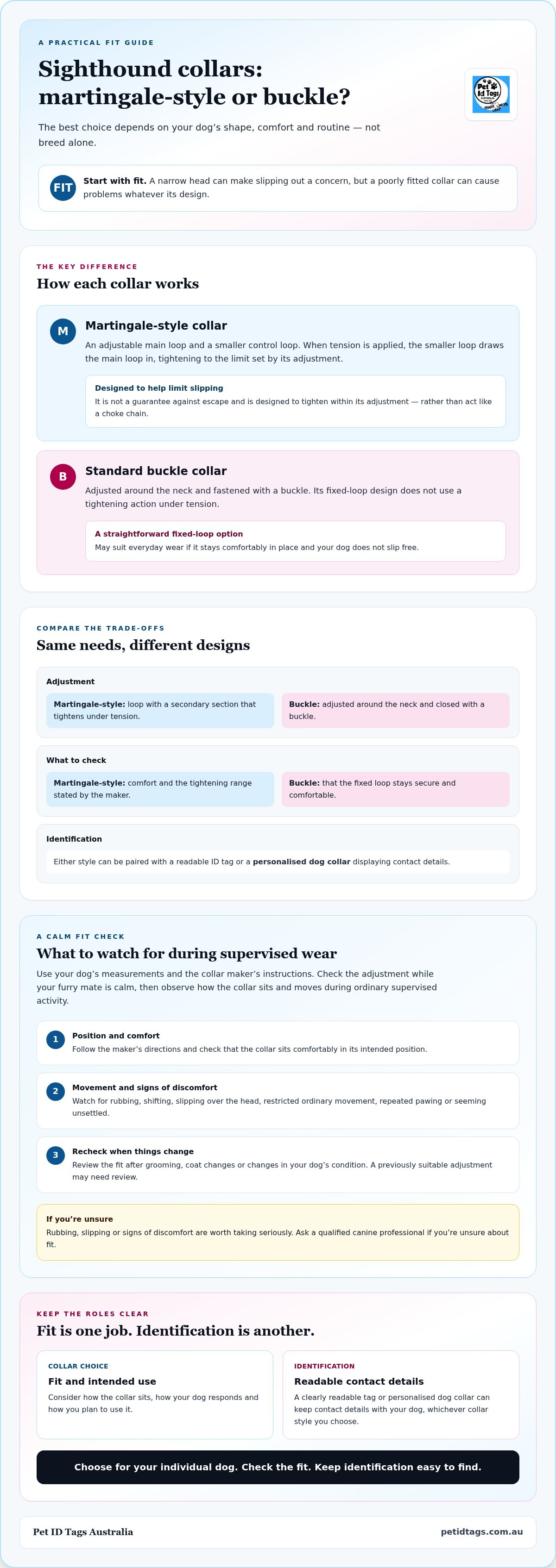
A martingale-style collar has an adjustable main loop and a smaller control loop. When tension is applied, the collar tightens to a limit set by its adjustment. A standard buckle collar closes into a fixed loop and doesn’t use that tightening action. For an overview of the design and history, see Martingale (collar).
| Consideration | Martingale-style collar | Standard buckle collar |
|---|---|---|
| Adjustment | Fits as a loop, with a secondary section that tightens under tension. | Adjusts around the dog’s neck and closes with a buckle. |
| Intended use | May suit owners concerned their dog could back out of a fixed collar. | Offers a straightforward fixed-loop option for everyday wear. |
| Fit check | Follow the maker’s instructions and check the tightening range and comfort. | Follow the maker’s instructions and check that it stays comfortably in place. |
| Identification | Either style can be paired with a readable ID tag or a personalised dog collar that displays contact details. | |
How a martingale-style collar works
When a dog moves forward against the lead, the smaller loop draws the main loop in. This is designed to help the collar sit more securely, rather than act like a choke chain. Owners may consider this style if their sighthound has backed out of a fixed collar. It isn’t a guarantee against escape: adjustment, the dog’s response and supervision still matter. Use it as directed, and ask a qualified canine professional if you’re unsure about fit.
How a standard buckle collar works
A standard buckle collar is adjusted around the neck and fastened with a buckle. Its fixed-loop design can be a simple option for everyday wear if it stays in place comfortably and your dog doesn’t slip free. Check the fit regularly and follow the maker’s guidance. The best option depends on your furry mate, not just their breed.
Neither style replaces identification. A clearly readable tag or personalised dog collar can keep contact details with your dog, while collar choice addresses fit and use. Consider both needs as you compare options.
Sighthound collar fit: the checks that matter more than the style
A sighthound’s build can help you decide what to look for, but it can’t tell you how a particular collar will fit. Dogs of the same breed can have different measurements, coat conditions and responses to wearing a collar. That’s why the martingale collar vs standard buckle collar for sighthounds choice should start with your dog, not a breed-wide rule.
A collar style cannot replace an individual fit check. Follow the maker’s instructions for the specific collar instead of relying on a universal measurement or adjustment rule. Check the fit while your furry mate is calm, then observe how the collar sits and moves during ordinary supervised activity.
What to assess when checking a collar
Look for signs that the collar isn’t sitting as intended. It shouldn’t visibly rub or appear to restrict your dog’s ordinary movement. Notice if it shifts out of position or slips over the head. Repeated pawing at the collar or seeming unsettled while wearing it can also be a reason to reassess the fit. These signs don’t diagnose the cause, but they’re worth taking seriously.
- Check that the collar is adjusted as the maker directs and sits comfortably in its intended position.
- Watch your dog move naturally while supervised. Look for rubbing, slipping or signs of discomfort.
- Recheck the fit after grooming, coat changes or changes in your dog’s condition. An adjustment that was once suitable may need review.
For a martingale-style collar, check that its tightening action works within the maker’s stated adjustment range. For a buckle collar, check that the fixed loop remains secure and comfortable. Don’t assume the same setting will suit every dog or that a style alone will prevent slipping.
When to ask a professional for help
If you’re unsure whether a collar fits properly, or notice rubbing, restricted movement or visible discomfort, ask your veterinarian or a qualified canine professional for individual guidance. This can be especially useful if your dog has handling sensitivities or an unusual fit challenge. A collar choice on its own shouldn’t be treated as a solution for pulling, behaviour concerns or escape risk.
Once you’ve checked fit, consider identification separately. A personalised dog collar can keep contact details visible on your dog, whatever collar style you choose.
Which collar suits your sighthound’s routine? Compare the trade-offs
Your dog’s routine can help narrow the choice. Think about whether the collar will be worn around the house, used for supervised walks or both. Consider, too, whether you can check its adjustment before each use. A collar’s design describes what it is intended to do, not whether every product or fit is suitable for your dog.
| Routine consideration | Martingale-style collar | Standard buckle collar |
|---|---|---|
| Everyday wear | Consider whether its tightening section is appropriate for the way your dog wears a collar. | A fixed-loop option may suit everyday use if it stays comfortably in place. |
| Supervised walks | May be considered if you’re concerned your dog could back out of a fixed loop. | May suit a dog that remains secure and comfortable in a fixed loop. |
| Owner checks | Check the adjustment and tightening range as directed by the maker. | Check the buckle, adjustment and fit as directed by the maker. |
Neither style replaces supervision or thoughtful decisions about lead use. Claims about strength, materials or performance depend on the specific collar. Check the product information rather than assuming those qualities from the style name.
When owners may prefer a martingale-style collar
If your sighthound has backed out of a fixed collar, you may want to consider a martingale-style collar for supervised walks. Its limited tightening action is designed to help reduce slipping, but it isn’t an escape-proof guarantee. Follow the maker’s adjustment instructions and monitor your dog while it’s being worn. If you’re uncertain whether this style suits your furry mate, ask a veterinarian or qualified canine professional.
When owners may prefer a standard buckle collar
A standard buckle collar offers a familiar fastening and straightforward adjustment. It may be a practical choice if your dog is comfortable in a fixed loop and it remains secure during the activities you have in mind. Check the fit and your dog’s comfort during use. A buckle collar won’t suit every sighthound or situation simply because it’s familiar.
For broader points to consider when choosing a collar, see this guide to personalised dog collars. Use it alongside the martingale collar vs standard buckle collar for sighthounds comparison, then weigh your dog’s routine, comfort and your ability to check the collar. The best decision is an informed one, not a blanket rule.
How to choose and check a collar for your sighthound
A clear process makes the choice easier. Start with the concern you’re trying to address, then compare each collar’s purpose with your dog’s routine and fit. The martingale collar vs standard buckle collar for sighthounds decision isn’t settled by breed alone. Your dog’s comfort, behaviour and the maker’s instructions should guide your next steps.
A simple decision checklist
- Name the main concern. Is it a collar slipping off, a straightforward option for everyday wear, ease of adjustment or keeping identification with your dog?
- Compare the stated purpose. Consider whether a martingale-style collar’s limited tightening action or a buckle collar’s fixed loop better matches that concern. Don’t assume either style suits every dog or activity.
- Read the maker’s fitting guidance. Adjust the collar as instructed. Avoid relying on a general measurement or rule that may not apply to your dog or that specific collar.
- Pause if you’re unsure. If neither option seems comfortable or you can’t tell whether it’s correctly adjusted, ask a veterinarian or qualified canine professional before using it.
This checklist helps separate the feature a collar is designed to provide from claims that need evidence about a particular product. A tightening action doesn’t guarantee your dog won’t slip free, and a familiar buckle closure doesn’t guarantee a comfortable fit. Consider what you can check reliably as part of your furry mate’s routine.
Check the collar after choosing
With the collar adjusted as directed, observe your dog during ordinary supervised use. Notice whether it stays in position, rubs, restricts normal movement or appears to cause discomfort. Watch how your dog moves and behaves, rather than judging fit while they’re standing still.
If your dog seems uncomfortable or the collar appears unsuitable, stop using it and seek advice. Reassess the fit if the collar is changed or your dog’s condition or coat changes. A comfortable fit today may need another look later. Keep any contact details displayed on the collar readable and current, too.
For another practical option, explore personalised dog collars as a way to keep contact details visible on your dog. Identification serves a different purpose from collar fit, so choose and check both with care.
Pair the right collar choice with clear identification
Collar fit and identification solve different problems. The style you choose affects how the collar sits and functions; clear contact details give someone a way to reach you if your dog is found. Neither a martingale-style collar nor a standard buckle collar prevents a dog from becoming lost, and identification can’t guarantee a reunion. Both are practical considerations for your furry mate.
A personalised dog collar can display your dog’s name and contact number without relying on a separate tag. If you prefer a tag, choose details that are easy to read and suited to the space available. Check them regularly, especially if your phone number or other contact information changes. Details that are hard to read or out of date may be less useful when someone needs to contact you.
What to consider when adding identification
Whether you choose a tag or a personalised collar, make readability a priority. Consider what contact information will fit clearly, then check that it remains legible during regular use. If you use a tag, make sure it’s attached securely and check the attachment from time to time. For practical steps, read this guide to attaching a dog tag to a collar.
Use the martingale collar vs standard buckle collar for sighthounds comparison to weigh the collar’s purpose and fit, then consider identification as a separate choice. A collar that suits your dog’s routine still needs readable, current contact details. Recheck both the collar’s comfort and the condition of its identification over time.
A practical next step for Australian pet families
Pet ID Tags Australia offers personalised dog collars and identification tags, including stainless steel dog tags. These options can complement whichever collar style you choose, without making a claim about which style is right for your sighthound.
Compare suitable collar options, follow the maker’s fit guidance and choose identification that’s clear and up to date. If you’d like to explore personalised identification options, view personalised dog collars and pet tags.
Choose with confidence, one check at a time
The martingale collar vs standard buckle collar for sighthounds decision depends on your dog’s fit, comfort and routine, not breed alone. Compare what each style is designed to do, follow the maker’s fitting guidance and watch how your furry mate moves while wearing it. If you’re unsure, ask a veterinarian or qualified canine professional.
Keep identification in mind as a separate part of your choice. A personalised dog collar or readable tag can display contact details, but check that they’re clear and up to date. Identification doesn’t guarantee a lost dog will be returned, but it gives someone a practical way to reach you.
Explore Pet ID Tags Australia’s personalised dog collars and identification options to find an option that suits your needs. With a careful fit check and clear details, you can make a considered choice for your sighthound.
Frequently Asked Questions
Is a martingale-style collar better for sighthounds?
Not automatically. A martingale-style collar may be worth considering if your sighthound’s narrow head makes it easier to back out of a fixed-loop collar. Its limited tightening action is intended to help reduce slipping when correctly adjusted, but it doesn’t guarantee your dog can’t escape. Compare your dog’s needs and comfort, follow the maker’s instructions, and ask a veterinarian or qualified canine professional if you’re unsure.
Can a sighthound wear a standard buckle collar?
Yes, a sighthound can wear a standard buckle collar if it fits comfortably and stays securely in place. This style closes into a fixed loop, so consider whether your dog can back out of it during supervised walks. Follow the maker’s fitting guidance, then watch your dog move and check for slipping, rubbing or discomfort. A breed label alone can’t confirm that a particular collar is suitable.
What is the difference between a martingale-style collar and a standard buckle collar?
A martingale-style collar has an adjustable loop and a smaller section that tightens to a limit when tension is applied. It’s designed to help reduce slipping, not to act as a choke chain or correct pulling. A standard buckle collar closes with a buckle and remains a fixed loop. For either style, suitability depends on the individual dog, correct adjustment and the collar maker’s instructions.
How tight should a sighthound’s collar be?
There isn’t one measurement that suits every sighthound or every collar. Adjust it according to the maker’s instructions, then check that it sits as intended without visible rubbing or restricting ordinary movement. Watch your dog while wearing it and look for slipping or signs of discomfort. A martingale-style collar also needs its tightening range adjusted as directed. Ask a veterinarian or qualified canine professional if you’re uncertain.
Can a dog wear a martingale-style collar all day?
Don’t assume a martingale-style collar is suitable for all-day wear. Its tightening loop may create a snagging concern if it catches on something, particularly when a dog is unattended. Check the maker’s guidance about when to use that specific collar and ask your veterinarian or a qualified canine professional for advice tailored to your dog. Monitor comfort during supervised wear and reassess the fit if anything changes.
Should a sighthound wear a collar indoors?
That depends on your dog, the collar and the home environment. Consider whether the collar could catch on furniture, crate fittings or other objects, especially if your dog will be unsupervised. Follow the maker’s use guidance and seek individual advice if you’re unsure whether to leave it on indoors. Whatever you decide, check the collar regularly for wear and make sure your dog remains comfortable.
How can I keep identification details with my sighthound?
You can use a readable ID tag or a personalised dog collar that displays contact details. Choose information that fits clearly, check that it stays legible, and update it if your number or details change. Make sure a tag is attached securely, too. Identification gives someone a way to contact you if your dog is found, but it can’t guarantee a reunion. Check it as part of your regular collar review.