

The best-looking collar isn’t always the best choice for your Labradoodle’s coat. A labradoodle non matting collar and tag combo needs to balance a comfortable fit with clear, easy-to-read identification, without adding unnecessary bulk or noise. That matters when curls or waves can tangle where a collar rubs.
This guide explains what to look for in a collar, how to attach a readable ID tag and how to include coat checks in your grooming routine. You’ll also learn how personalised dog collars and engraved tags serve different purposes, so you can make a practical choice for your Aussie family member. With over 20 years of engraving experience, we know clear identification deserves careful attention.
Key Takeaways
- Think of a labradoodle non matting collar and tag combo as two choices that need to work together, not as a promise of tangle-free fur.
- Prioritise a comfortable fit and check the neck regularly for flattened or tangled fur, rubbing and irritation.
- Compare a personalised dog collar with a separate engraved ID tag for fit, readable details and ease of checking.
- Before buying, consider your dog’s coat and routine, check the fit, choose clear identification and review how the tag attaches.
- Check the collar and tag together as your Labradoodle moves. The tag should stay visible without causing rubbing or getting in the way.
Labradoodle collars and tags: why coat comfort and clear ID both matter
A comfortable collar and clear identification solve different problems, and your Labradoodle needs both. The collar should sit securely without creating avoidable rubbing or trapping fur. The tag should make your contact details easy to see and read. A coordinated look is welcome, but it shouldn’t outweigh either practical need.
No collar can guarantee that a coat will never mat. Labradoodle coats vary in curl, density and length, so the way a collar meets one dog’s neck may not suit another. For background on the breed’s origins and characteristics, see Labradoodle breed information. Judge the fit and coat contact on your own furry mate, rather than relying on a one-style-fits-all claim.
What owners mean by a non-matting collar
Think of “non-matting” as reducing avoidable friction and places where fur can catch, not as a promise of tangle-free coat. Repeated contact as your dog moves may contribute to knots. Debris caught beneath the collar or fur left damp can also make the area harder to keep clear. The risk can vary with the coat and daily routine.
Check beneath the collar as part of regular grooming. Look for flattened or tangled fur, redness or other signs of irritation. If coat or skin concerns persist, speak with a groomer who can assess your Labradoodle’s needs. A collar choice can support coat care, but it can’t replace grooming or resolve every cause of matting.
Why a tag still belongs in the decision
A tag provides visual identification: details a person can read directly, without scanning equipment. Legibility is a separate buying consideration from collar comfort or decorative detail. Check that the lettering is easy to read and that the tag remains visible when attached. A stylish collar is no substitute for identification someone can quickly understand.
Keep the contact details useful and current, and consider how the tag moves alongside the collar during everyday activity. A large or noisy setup may be less appealing to your dog, while details that are too small or obscured may be hard for a finder to read. For wider context on identification options, the article Pet Tag vs Microchip Australia: Why Your Pet Needs Both in 2026 explores how different forms of ID can complement each other.
Before choosing a matching look, check three things together: how the collar contacts your Labradoodle’s coat, whether the fit stays comfortable, and whether the tag’s details remain clearly visible. That’s the practical test for a labradoodle non matting collar and tag combo. The aim isn’t a perfect-looking set at any cost. It’s a comfortable everyday choice that keeps your furry mate identifiable.
How collar fit and coat contact can affect Labradoodle matting
Fit and movement tell you more than a broad claim that a particular collar material prevents matting. A collar that shifts, twists or presses against the same patch of coat can create repeated contact as your Labradoodle walks, plays and rests. The effect depends on your dog’s coat and how the collar sits, so assess the actual fit rather than relying on a label alone.
A collar can reduce avoidable friction, but it can’t guarantee a mat-free coat. Regular checks help you spot friction early, before a small tangle becomes harder to brush out.
Check the fit without guessing
Fasten the collar so it sits securely without looking tight or leaving marks. Watch your dog move normally. Does the collar stay in place, or does it slide, twist or catch the coat? Check beneath it as well. If the fur looks flattened or gathered in one area, adjust the fit or reassess whether that collar works for your dog.
Repeat the check as your Labradoodle’s coat grows or is trimmed, and if their body condition changes. A fit that seemed comfortable after grooming may feel different as the coat length changes. Don’t rely on a single fitting at purchase. Comfort is something to review over time.
Match collar contact to coat-care routines
Make brushing and checking under the collar part of ordinary coat care. When it’s safe and practical, remove the collar briefly for a closer look, then refit it securely. If your dog needs their collar on for identification, choose a safe, supervised moment for the check and avoid leaving them without it in an unsecured setting.
Coat length and grooming frequency can shape how often you need to inspect the neck. A longer or denser coat may need more careful checking beneath the collar, particularly after everyday activity. If the coat is damp or debris is caught there, deal with it as part of your grooming routine rather than leaving it trapped against the skin.
Look for tangles, flattened patches, redness or other signs of rubbing. If irritation appears, stop using the collar that seems to be causing the problem and seek appropriate professional guidance. Persistent coat or skin concerns are best discussed with a groomer or veterinary professional. Changing collar styles alone may not address the cause.
Use this quick check before settling on a labradoodle non matting collar and tag combo:
- Does the collar sit securely without obvious tightness?
- Does it stay put without twisting or catching the coat as your dog moves?
- Can you check the skin and fur beneath it as part of your grooming routine?
- Does the ID remain easy to see after the collar is fitted?
Personalised dog collars and engraved tags are distinct options to consider as you assess fit and identification together. Browse personalised collars and pet ID tags with your Labradoodle’s everyday comfort and coat checks in mind.
Compare collar-and-tag choices for comfort, durability and readable ID
A useful comparison separates two decisions: how the collar sits against your Labradoodle’s coat, and how their details will be read if they’re found. A personalised dog collar carries a dog’s name and contact number directly on the collar. A separate ID tag attaches to it, giving you a distinct tag to assess for readability and everyday movement. These are options to compare, not an assumption that they’re sold as one set.
| Choice | Coat contact and fit | ID legibility | Everyday check |
|---|---|---|---|
| Personalised dog collar | Assess the collar’s contact with the coat and check its fit as usual. | Name and contact number are marked directly on the collar. | Keep the marked details visible and readable; inspect the collar and neck area. |
| Collar with a separate ID tag | Check the collar’s fit and whether the tag moves, catches fur or rubs. | Read the tag while it is attached, not just in your hand. | Check that the tag stays attached and its details remain clear. |
| Separate tag in 316-grade stainless steel | This describes tag material, not a collar feature; assess the collar independently. | Choose an engraving layout that leaves useful contact details easy to read. | Inspect the tag and its attachment as part of routine checks. |
Personalised collar or separate ID tag?
A personalised dog collar keeps identification on the collar itself, while a separate tag attaches to it as an additional component. Compare both arrangements on your dog: can you read the details clearly, and does the tag sit comfortably without getting in the way? The collar still needs to fit your Labradoodle’s coat and routine. For collar-specific considerations, Personalised Dog Collars Australia: The 2026 Ultimate Buyer’s Guide to Safety and Style offers further guidance.
Choose a tag for legibility and everyday use
Prioritise readable engraving and enough room for useful emergency contact information. Small or crowded lettering can be difficult to read, so consider what a person can make out at a glance. Pet ID Tags Australia offers identification tags in 316-grade stainless steel, a corrosion-resistant material used for durable pet tags. For more on this material, see Stainless Steel Dog Tags Australia: The 2026 Ultimate Buyer’s Guide to Durable ID.
For a labradoodle non matting collar and tag combo, treat appearance as the finishing touch. First consider coat contact, fit, a secure tag attachment and details that remain legible. Then check the complete setup while your dog moves: the collar should sit comfortably, and the ID should be easy to find and read. A coordinated colour or decorative detail can follow those practical checks, not replace them.
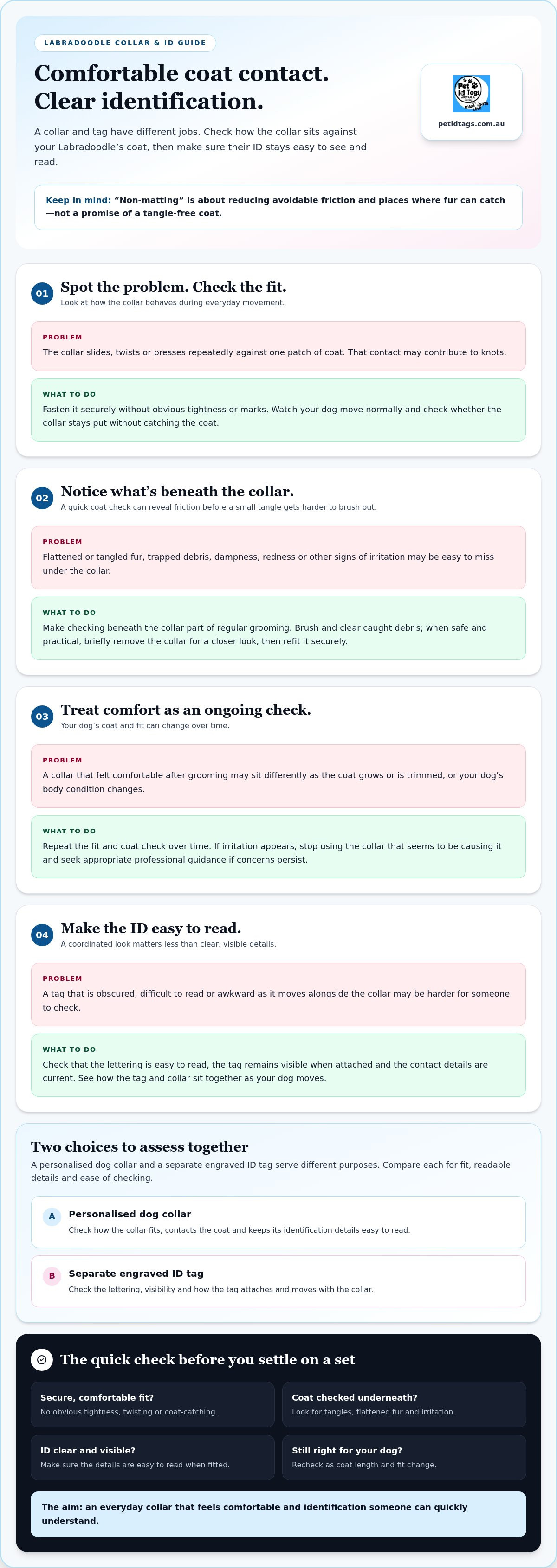
A practical Labradoodle collar and tag checklist before buying
A clear buying sequence makes it easier to judge a collar and ID setup for your Labradoodle’s real routine, rather than choosing by appearance alone. Consider coat and routine first, then fit, identification details and attachment. Finish by checking the collar and tag together, because a comfortable collar is only part of a useful everyday setup.
Before you buy, assess your dog’s coat and routine, check the collar fit, choose readable ID, then review the tag attachment.
- Assess coat and routine. Consider coat length, grooming habits and how your dog moves through an ordinary day. Think about where the collar sits and whether the tag could catch in the coat.
- Check the fit. Use the size guidance for the collar you’re considering rather than guessing from breed or appearance.
- Choose identification. Decide how you want the name and emergency contact information to be displayed, then check that it can be read clearly.
- Review attachment. Check how the tag connects and whether it stays visible without rubbing or catching as your dog moves.
Measure, fit and inspect
Follow the selected collar’s measurement instructions and compare your Labradoodle’s measurements with its sizing guidance. Don’t assume that a size suited to another dog of the same breed will fit yours. Once fastened, check that the collar sits securely without obvious tightness or rubbing, and observe how it rests during normal movement.
After your dog has worn it, look beneath the collar for flattened or tangled fur and signs of irritation. Repeat the fit check after grooming or a noticeable change in coat length, since the collar may sit differently against a shorter or fuller coat. The same review can help you spot a change before it becomes an ongoing source of discomfort.
Confirm the tag details and attachment
Read the tag while it’s attached, not only when it’s in your hand. Confirm that the name and current emergency contact information are clear, and that the tag doesn’t turn in a way that hides the details or become caught in the coat. For ideas on making the engraving useful and easy to read, Pet ID Tag Engraving Ideas: The Ultimate 2026 Australian Checklist covers details to consider. For attachment guidance, see How to Attach a Dog Tag to a Collar: The 2026 Australian Guide to Secure ID.
Before settling on a labradoodle non matting collar and tag combo, try the complete setup during a supervised, ordinary part of your dog’s day. Watch for shifting, rubbing or a tag that disappears beneath the coat. If something catches or feels uncomfortable, adjust the arrangement before making it part of your furry mate’s routine. Explore personalised dog collars and engraved ID tags as separate options for bringing fit and clear identification together.
Personalised collars and engraved tags from Pet ID Tags Australia
Choosing a collar and ID for a Labradoodle means balancing coat comfort with dependable visual identification. Pet ID Tags Australia offers personalised dog collars and engraved ID tags as distinct product categories, so you can consider how each suits your dog’s fit, grooming routine and contact-detail needs. The focus is practical: a collar that sits comfortably, paired with identification that can be read clearly.
What the business brings to pet identification
Pet ID Tags Australia is an Australian pet identification specialist operating since 2004. More than 100,000 pets have been identified. Every tag is deeply engraved in the company’s workshop, with care given to making identification clear and useful in everyday life.
For a separate tag, material is another consideration. The range includes tags made from 316-grade stainless steel, a corrosion-resistant material used for durable pet identification. This material applies to the tag, not the collar, and it doesn’t replace regular checks of the engraving, attachment or collar fit. Clear visual identification depends on details remaining readable, so make sure the chosen information is easy to see.
A personalised dog collar places identification directly on the collar, while a separate engraved tag attaches to it. Neither arrangement removes the need to inspect the fit against your Labradoodle’s coat. Check how the collar sits, whether the tag remains visible and whether the full setup moves comfortably during ordinary activity. No particular collar or tag arrangement can promise a tangle-free coat, so ongoing coat checks still matter.
Choose the next step for your furry mate
Use your Labradoodle’s needs to guide the choice. If you prefer identification marked on the collar, consider a personalised collar. If you want a distinct tag, assess its engraving and how it attaches. In either case, keep comfort, legibility and regular checks ahead of matching colours. Try the collar and ID together, then look for rubbing, shifting or details hidden by the coat.
A labradoodle non matting collar and tag combo is best treated as a considered pairing, not a ready-made promise that matting won’t happen. Match the collar to your dog’s measurements and coat-care routine, then choose clear identification that suits everyday wear. Recheck the fit and tag after grooming or as the coat changes.
For an Aussie family, clear ID can add practical peace of mind. Explore personalised collars and pet ID tags to compare options for your Labradoodle, keeping coat comfort and readable details at the centre of your decision.
Make your Labradoodle’s next ID choice with confidence
Let your Labradoodle’s own coat and routine guide the final choice. A labradoodle non matting collar and tag combo should be treated as a considered pairing, not a promise that tangles won’t happen. As your dog’s coat changes, use grooming time to reassess how the collar sits and whether the ID remains easy to see.
Keep the decision practical: choose a comfortable fit, clear contact details and an attachment that works for everyday wear. The right setup is the one you can check easily and feel confident using for your furry mate.
Explore personalised collars and pet ID tags to find identification options that suit your Labradoodle’s needs. A little attention to comfort and readability can help you make a reassuring choice for your Aussie family member.
Frequently Asked Questions
Can any dog collar guarantee that a Labradoodle’s coat will not mat?
No. A labradoodle non matting collar and tag combo may help reduce avoidable rubbing, but no design can promise a mat-free coat. Labradoodles differ in coat texture and length, and a fit that works after a trim may feel different as the fur grows. Check the neck during grooming. If knots keep returning or the skin looks sore, pause use of the suspected collar and ask a qualified groomer or veterinary professional for advice.
How often should I check my Labradoodle’s coat under its collar?
Check it as part of regular coat care rather than following a fixed calendar. For example, feel through the fur beneath the collar while brushing, and take a closer look after a trim or if the collar starts sitting differently. Note any compacted fur or trapped debris early. If the same patch keeps flattening or tangling, review your grooming routine and seek professional advice if the issue persists.
Should my Labradoodle wear its collar while being groomed?
Follow the groomer’s instructions. The collar may need to come off so the fur underneath can be brushed or trimmed properly. Keep it nearby rather than leaving it where it could be misplaced. Once grooming is finished, refit it before your dog is back in an unsecured setting. Then check that the tag is attached and its details are still readable.
What information should go on a Labradoodle’s ID tag?
Include details that help a finder contact you. Your pet’s name and a current phone number are practical priorities, subject to the space available on the tag. Read the engraving in ordinary light and check each character is distinct. Update the tag if your contact number changes. For more layout prompts, consult the article’s pet ID tag engraving checklist, leaving enough room for clear lettering rather than squeezing in extra text.
Can a separate tag get caught in a Labradoodle’s coat?
Yes, a moving tag can contact long fur, though the chance of catching depends on the fit, attachment and your dog’s activity. Watch the tag during a short walk and after play, then inspect the coat where it sits. If it twists under the collar or repeatedly snags, change the arrangement and check it again before regular wear. No setup is entirely risk-free, so keep checking how it behaves.
When should I adjust or replace my Labradoodle’s collar?
Adjust the collar if it starts shifting, leaves marks or sits differently after a coat trim. Replace it if it’s damaged or no longer stays secure. Recheck the fit as your dog’s coat grows or their body condition changes. After adjusting or replacing the collar, make sure the ID remains attached and readable, then watch your furry mate move comfortably in the updated setup.