

A greyhound’s ID tag is only useful if it stays secure, visible and comfortable to wear. The right greyhound collar id tag attachment starts with a well-fitted collar and a tag positioned where someone can find and read it without creating unnecessary movement around your furry mate’s neck.
It’s understandable to want a secure collar while worrying that a dangling tag might swing, catch or become hard to read. Greyhounds have a distinctive shape, so collar coverage and fit deserve careful thought. A comfortable setup shouldn’t hide identification, and a readable tag shouldn’t come at the expense of neck comfort.
This guide explains how collar style and fit affect everyday comfort, and how to keep visual identification accessible. You’ll learn what to look for when choosing an attachment, including a Pet Tag Quick Clip, and how to check that everything remains secure without tightening the collar too much. With clear, durable identification and a sensible fit, you can give your Aussie mate practical protection and your family greater peace of mind.
Key Takeaways
- See how collar shape, coat and movement can affect where a greyhound’s ID tag sits and how easily it can be read.
- Understand how a martingale-style collar tightens, and why collar design alone can’t guarantee comfort or prevent escape.
- Compare direct tag attachment with a Pet Tag Quick Clip to choose an approach that suits your greyhound’s everyday routine.
- Use a simple, repeatable check to assess fit, attachment security, tag position and readable contact details.
- Learn how the greyhound collar id tag attachment pairs with durable visual identification, including deeply engraved 316-grade stainless steel tags.
Why greyhound collar fit and ID tag placement need to work together
A good setup has two jobs: the collar should sit comfortably, and the identification should be easy for another person to find and read. A tag hidden against the collar or turned inwards may be harder to use. Tightening the collar to keep a tag still can compromise comfort. The aim of a greyhound collar id tag attachment is clear visual identification without an uncomfortable fit.
Collar shape and width affect how much of the neck is covered, but more coverage doesn’t mean the collar should be tighter. A tag can shift as your greyhound walks, turns their head, lies down or moves through the day. Check the complete setup while your dog is relaxed and moving naturally, not only when they’re standing still.
What makes a greyhound’s collar setup different?
Greyhounds are sighthounds, and their head may be narrower than their neck. This is one reason owners consider wider collar coverage or a martingale-style collar, designed for added security without working like a choke chain. The Martingale Collar Function reference explains the collar’s purpose for sighthounds, but no collar design can guarantee comfort or prevent escape in every situation.
Look for a setup that sits comfortably during ordinary movement, including walks and rest. Wider coverage may spread contact over more of the neck, but it doesn’t guarantee injury prevention. Your greyhound’s coat and the collar’s position can affect how the tag hangs, so check where it settles rather than assuming it will stay centred.
What should an ID tag do on a collar?
Visual identification is information a person can read directly, without scanning equipment. An ID tag should be easy to locate, with details that remain legible during everyday use. As your greyhound moves, the tag may swing, turn or sit against the collar. Check its position and readability as practical parts of the setup, not just matters of appearance.
Choose contact details that are clear and current, then view the tag from different angles. If it routinely flips over or tucks beneath the collar, try a different position or attachment to make it easier to read. A personalised dog collar buying guide covers broader collar considerations.
- Check that the collar sits comfortably when your greyhound is standing, walking and resting.
- See whether coat, collar shape or movement hides or turns the tag.
- Make sure the identification is easy to locate and read without tightening the collar to hold it in place.
Comfortable collar fit and readable visual identification are one safety check, not two separate decisions.
How a martingale-style collar works, and what fit can and cannot do
A martingale-style collar has a main loop that sits around the neck and a smaller control loop connected to it. When the lead applies tension, the smaller loop draws the main loop in by a limited amount. When the pressure eases, the collar can loosen again. It’s designed to reduce the chance of a dog backing out, not to act like a choke chain or guarantee that escape is impossible.
A martingale-style collar is a two-loop collar that tightens gently under tension to help discourage a dog from slipping free, without functioning as a choke chain. It still needs to be fitted and used with care. Collar design alone can’t guarantee comfort, prevent escape or protect a greyhound’s neck in every situation.
How does the collar adjust during everyday use?
The control loop changes the fit when the lead becomes taut, then relaxes as tension is released. For example, if your greyhound turns or steps back on a walk, the collar may draw in briefly. When they move beside you again, it should ease. The American Kennel Club’s Greyhound Breed Characteristics offers background on the breed, but fit still depends on your individual dog and collar.
An adjusted collar shouldn’t remain pulled tight during ordinary wear. If it stays constricted after the lead slackens or presses continuously against the neck, reassess the fit before continuing. Follow the collar maker’s fitting guidance, since loop design and adjustment can vary.
How can an owner assess comfort and fit?
Observe the collar while your greyhound is standing, walking and resting. Check that it sits in a consistent position, moves with your dog without rubbing, and relaxes when lead tension is removed. These observations can help you spot a problem, but they aren’t a substitute for professional advice if you’re unsure about fit.
Look for practical signs that the setup needs attention:
- The collar shifts into an awkward position or remains drawn in when the lead is slack.
- You notice rubbing, irritation, sensitivity or a change in how your dog moves.
- The tag or attachment presses against the neck or catches as the collar moves.
If irritation or discomfort appears, remove the collar when it’s safe to do so and seek suitable advice before using it again. Don’t tighten a collar to hold an ID tag in place. Check the greyhound collar id tag attachment separately so the tag remains accessible without changing the collar’s fit.
A Pet Tag Quick Clip is one option for everyday identification. Choose an arrangement that keeps the tag easy to locate, then check that the clip and tag move freely without interfering with the collar. Explore personalised pet ID tags to keep your furry mate’s contact details close at hand.
Compare greyhound collar and ID attachment setups by everyday use
The best arrangement keeps identification readable without interfering with your greyhound’s comfort or routine. Collar shape and tag position affect how the tag moves, so assess the complete setup on your own dog. Breed descriptions, such as the Greyhound Breed Standards for Collar Fit, offer useful background on greyhound proportions, but they can’t determine how a particular collar and tag will sit.
Compare options by checking four things: where the identification sits, how easy it is to read, how it moves during ordinary activity, and what you’ll need to inspect regularly.
| Arrangement | Tag access | Movement | Routine checks |
|---|---|---|---|
| Tag attached directly to the collar | Can sit close to the collar. Check that it remains visible and readable. | Movement depends on the tag, attachment and collar position. | Check the attachment is secure and the tag hasn’t turned or become obscured. |
| Tag attached with a separate quick clip | Can be removed more easily when changing collars or cleaning. | The tag may move or make noise, depending on how it hangs. | Check the clip is closed securely and the tag remains easy to read. |
| Personalised dog collar | Identification is marked on the collar rather than carried on a separate tag. | There’s no separate tag to swing, though the collar still shifts with movement. | Check the marked details remain legible and current, and the collar stays comfortable. |
Direct attachment or Pet Tag Quick Clip?
A tag attached directly may sit closer to the collar. A Pet Tag Quick Clip makes it easier to detach the tag if you swap collars or clean the setup. Neither option is automatically best. Consider whether the tag stays readable and whether its movement suits your greyhound. The Pet Tag Quick Clip guide covers attachment considerations in more detail.
When might permanent collar identification suit an owner?
A personalised dog collar carries identification on the collar itself, while a separate tag can be changed or moved between collars. Consider whether the marked area has room for clear details and whether you can keep the contact information current. The dog tag and collar attachment guide outlines general attachment steps.
Choose the greyhound collar id tag attachment you can inspect consistently. During a normal walk and at rest, check that:
- The collar remains comfortable and doesn’t rub or restrict movement.
- The identification can be found and read without repositioning the collar tightly.
- The attachment stays secure, with no catching or movement that appears to bother your dog.
- Any contact details are legible and up to date.
Small differences matter. If one arrangement shifts out of view or irritates your furry mate, try another setup and repeat the checks. Choose for your individual dog, not by a blanket rule.
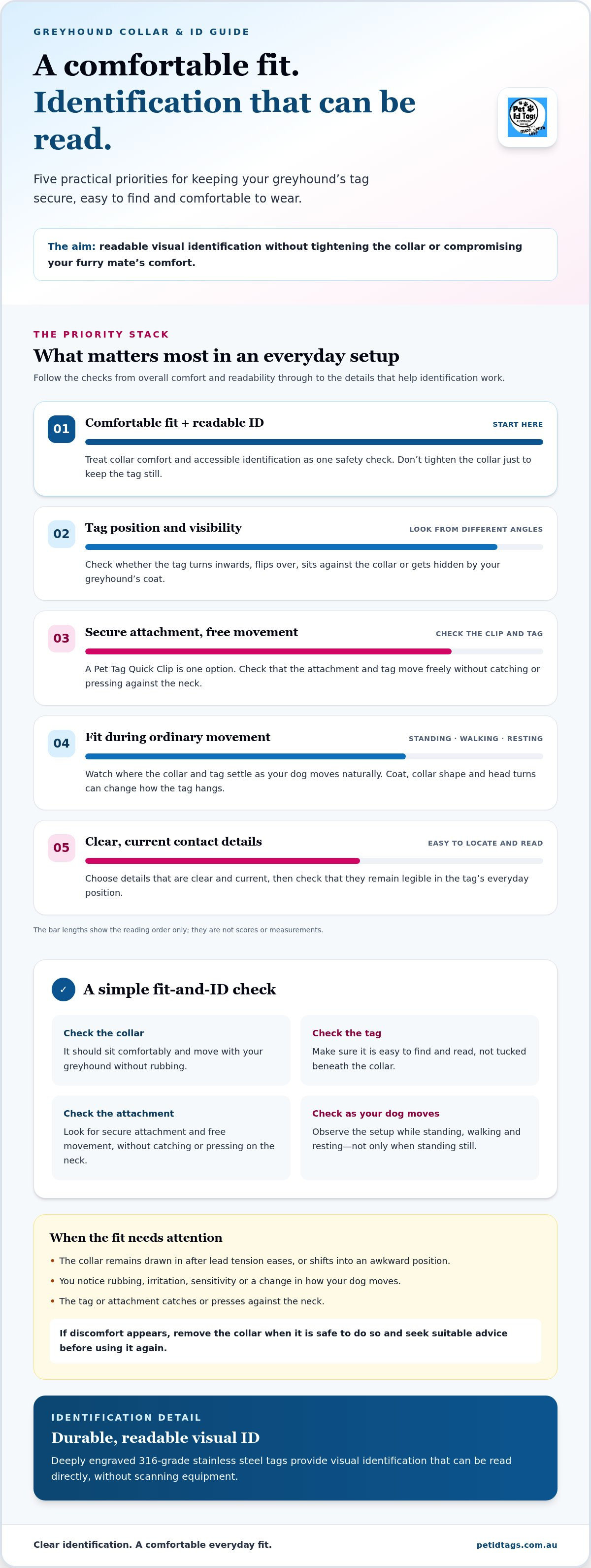
Use this simple routine to check collar fit and readable ID
A quick, consistent check helps you notice when a collar shifts, an attachment loosens or contact details become hard to read. Use this routine after fitting or changing a collar, then repeat it after cleaning or an active outing. It checks comfort and identification together, without relying on a tighter fit to keep the tag visible.
A quick check before heading out
Start with your greyhound relaxed. Look for rubbing, pinching or irritation, and check that the collar sits comfortably as they move. Find the tag: it should be easy to access and read while attached. Finally, inspect the attachment and gently handle the tag to confirm it remains secure. Don’t force the collar or attachment to test it.
- Look over the collar. Check its position and condition. Notice any areas pressing against the skin, catching the coat or sitting differently from usual.
- Watch your dog move. Observe your greyhound standing, walking and turning their head. The collar should move with them without obvious rubbing or restricting ordinary movement.
- Check the attachment. Make sure any clip or fastener is closed and appears undamaged. Gently handle the tag to confirm it stays attached. Stop if the collar or fitting shifts uncomfortably.
- Check the tag’s position. Turn it so the identifying details face outwards. Confirm you can read them while the tag is attached, without needing to remove or reposition it each time.
- Read the contact details. Check that the name and phone number are legible and current. If a detail is hard to read or no longer correct, update the identification before relying on it.
What to review as your dog’s routine changes
Repeat the check after washing or cleaning the collar and tag, after an especially active outing, or whenever you notice the collar has shifted. Reassess fit if your greyhound’s coat, body shape or activity changes. Inspect the attachment for wear, and clean the tag according to its material and care guidance. If you see irritation or your dog seems uncomfortable, remove the collar when safe and seek suitable advice.
Make the greyhound collar id tag attachment part of your regular pet-care checks, not a one-off task. A readable tag supports identification, but it doesn’t replace attentive care or other responsible steps for keeping your furry mate safe. If the details are worn, obscured or out of date, replace or update them so someone can use them to get in touch.
For clear, personalised identification, browse pet ID tags and choose details that are easy to read and keep current.
Choose durable visual identification for your greyhound’s collar
If your greyhound is away from home, a clearly marked tag gives someone a way to read their details directly, without scanning equipment. That makes visual identification a practical part of an everyday collar setup. It works best when the tag is easy to find, securely attached and readable, rather than tucked against the collar or obscured by movement.
Durable materials and clear marking support that goal, but no tag is maintenance-free. Check the engraving and contact details regularly. If the text becomes difficult to read or a phone number changes, update the identification so it can still help someone get in touch.
What supports clear, durable visual identification?
Deep engraving cuts identification into the tag material rather than simply placing text on its surface. This creates a defined mark, but it doesn’t remove the need to inspect the tag over time. Look for clear lettering, check that all details remain legible, and position the tag so a person can turn or read it easily while it’s attached.
Pet ID Tags Australia specialises in 316-grade stainless steel, a corrosion-resistant steel used for durable pet tags. Its tags are deeply engraved in its Australian workshop. Material and marking both matter: a durable tag still needs readable details and a secure attachment. The stainless steel dog tag buying guide explains more about material considerations.
A Pet Tag Quick Clip is another way to attach a tag to a collar. Its weather-resistant stainless-steel construction is designed for everyday use, while the tag still needs regular checks for movement, wear and legibility. Check that the clip is secure and the tag remains easy to access. No attachment removes the need for inspection.
A practical next step for your furry mate
Bring the decisions together: choose a collar that sits comfortably, keep the tag accessible, and use an attachment you can check with confidence. The greyhound collar id tag attachment should keep identification visible without making the collar tighter or interfering with your dog’s ordinary movement.
With over 20 years of engraving experience, Pet ID Tags Australia helps pet families choose identification and engraves tags in its Australian workshop. For your furry mate, prioritise readable contact details, inspect them as part of routine care, and update them whenever they change.
Explore personalised pet ID tags to find a clear identification option for your dog’s collar.
Make readable identification part of your greyhound’s routine
Your greyhound’s needs can change, so make a habit of checking that their identification remains easy to read and the attachment stays secure. A comfortable collar, accessible tag and current contact details give someone a practical way to reach your family if your furry mate is away from home.
Pet ID Tags Australia brings over 20 years of engraving experience to identification for more than 100,000 pets. Its tags include 316-grade stainless steel identification, and its Pet Tag Quick Clips use weather-resistant stainless-steel construction. The greyhound collar id tag attachment you choose should suit your dog’s collar and remain simple to inspect.
For a personalised option to suit your dog’s everyday setup, explore personalised pet ID tags. Clear, accessible identification can give your family added peace of mind.
Frequently Asked Questions
Is a martingale-style collar suitable for a greyhound?
It can suit some greyhounds, particularly for supervised walks, but the right choice depends on your dog and how the collar behaves in use. Follow the maker’s guidance and watch for signs your dog dislikes wearing it. If your greyhound has neck sensitivity, a skin condition or a history of collar-related discomfort, seek advice from your vet before choosing a collar style.
Can I attach an ID tag to a wide greyhound collar?
Yes. Check that the attachment suits the collar’s fastening point and doesn’t interfere with a buckle, adjuster or martingale control loop. The tag should hang without twisting the collar or getting trapped beneath a folded edge. After attaching it, inspect the collar from both sides and gently handle the tag to make sure the attachment sits correctly and stays in place.
How should a greyhound collar fit around the neck?
There isn’t one universal fit for every greyhound or collar design. Use the collar maker’s fitting instructions, since different designs adjust in different ways. Fit and assess the collar in its intended position, then check again as your dog moves. If you can’t tell whether it’s sitting correctly, or your dog shows discomfort, ask your vet for guidance rather than guessing or tightening it further.
Will a dog tag make a greyhound collar noisy?
It might. Noise often depends on whether the tag knocks against a metal ring, buckle or another tag as your dog moves. If jingling is bothersome, try carrying only the essential tag on that attachment point, then listen during a walk around home. Don’t cover the details or alter the attachment in a way that makes the tag harder to read or less secure.
Can a personalised dog collar provide visual identification without a dangling tag?
Yes. Identification marked directly on the collar can be read without a separate tag. One practical consideration is that the information is available only while your dog is wearing that collar. Check the marked area in good light and make sure the details remain clear after ordinary wear and cleaning. If the collar is removed or changed, remember that its identification goes with it.
How often should I check my greyhound’s collar and ID tag?
There’s no single inspection schedule that suits every dog, so connect checks to things you already do, such as cleaning the collar or changing its fit. Look closely at the attachment point, where rubbing or wear may be less obvious, and read the tag under good light. Recheck after the collar has been stored or swapped, especially if it hasn’t been worn for a while.
What information should I put on a greyhound’s ID tag?
Prioritise details someone can use to reach a person who can respond. A phone number that’s regularly answered is more useful than extra wording that makes the engraving crowded. If there’s room, a second contact number can provide another way to get through. Read the tag at arm’s length before using it, and make sure the characters are easy to distinguish, especially at a glance.