

Table of Contents
- Durable Dog Tags for Active Pets: What Actually Survives Mud, Water and Rough Play
- Quick Comparison: Stainless Steel vs Aluminium vs Smart Tags
- Stainless Steel Dog Tags: The Best Choice for Rough and Tumble
- Silicone Dog Tags: When They Work and When They Don't
- Dog Tag Information to Include: What to Engrave for a Fast Reunion
- GPS Trackers for Dogs vs ID Tags: Which Does Your Active Dog Need?
- How to Attach a Tag So It Stays Put
- Conclusion
- Frequently Asked Questions
Last Updated: October 13, 2026
Durable Dog Tags for Active Pets: What Actually Survives Mud, Water and Rough Play
A dog that swims, rolls in wet sand and pushes through scrub will destroy a flimsy tag in a season. This guide covers durable dog tags for active pets, compares stainless steel, aluminium and smart tag options, and explains what to engrave so a finder can actually reach you.

If your dog has already been through two or three unreadable tags, the problem is usually not the shape. It is the material, the depth of the engraving, and how the tag hangs on the collar.
Below, we break down what survives real conditions, what does not, and how to choose for your dog's size, coat and habits.
Quick Comparison: Stainless Steel vs Aluminium vs Smart Tags
Stainless steel is the most durable choice for dogs that swim and roughhouse. Aluminium suits pets that need a lighter tag for comfort. A smart QR tag adds updatable digital contact details. Here is how the three options compare on the things that matter most.
| Feature | Stainless Steel | Aluminium | Smart QR Tag |
|---|---|---|---|
| Weight | Heavier, sturdy | Lightweight | Light |
| Best for | Active, large dogs | Puppies, small pets, cats | Owners who change numbers |
| Engraving style | Deep laser, both sides | Laser, both sides | Printed QR plus profile |
| Water and mud | Rust-resistant | Anodised finish | Depends on the holder |
| Contact updates | New tag needed | New tag needed | Update online anytime |
| Starting price | $21.90 | $17.90 | $34.90 |
The trade-off is simple. Steel lasts longest, aluminium feels lightest, and a smart tag is the only one you can update without reordering. Many owners run a steel tag and a QR tag together.
Stainless Steel Dog Tags: The Best Choice for Rough and Tumble
For dogs that swim, dig and wrestle, stainless steel is the material we recommend first. It resists rust, holds a deep engraving, and keeps its shine through repeated wetting and drying. Our Stainless Steel Bone Pet ID Tag is engraved on both sides at $21.90, so your pet's name stays readable even after a season of outdoor use.
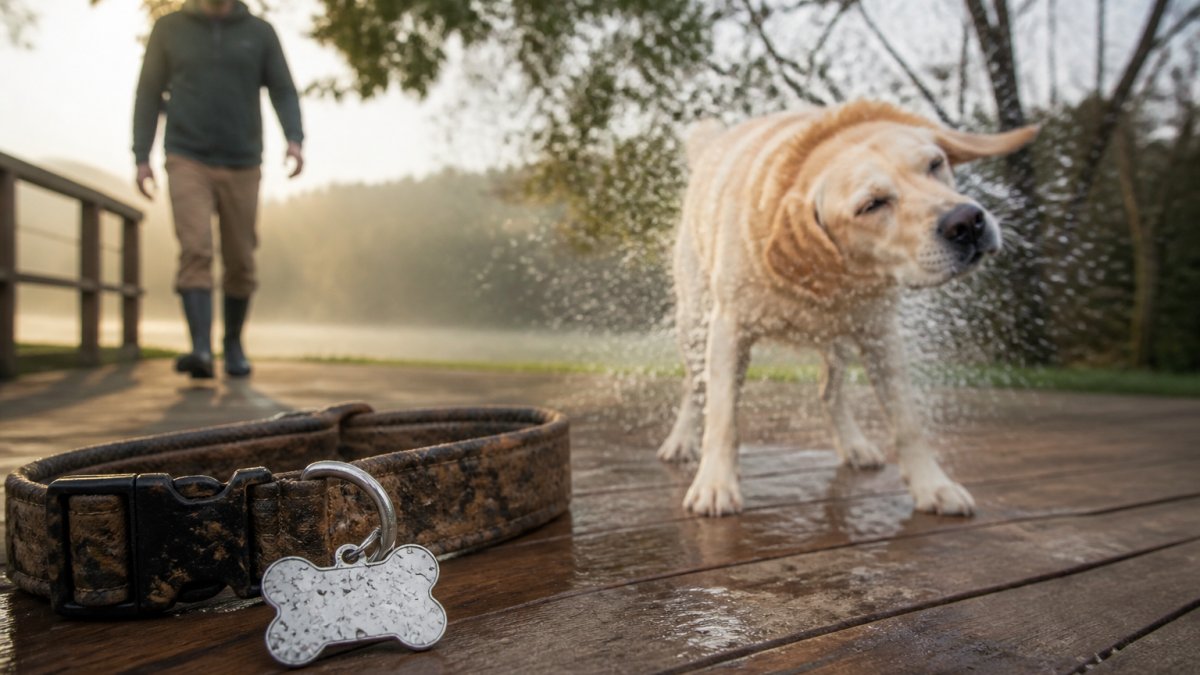
Deep engraving is the detail most cheap tags skip. Printed or shallow-cut lettering wears smooth within months, which is exactly why so many owners end up replacing tags again and again.
Weight is the one drawback. On a small dog or a cat, a heavier tag can feel like a nuisance. For those pets, step down to aluminium.
Silicone Dog Tags: When They Work and When They Don't
Silicone tags are quiet and light, but they are not the answer for a dog that lives outdoors.
Where silicone does earn its place: a dog that is bothered by the jingle of metal, or a puppy still getting used to wearing a collar. It is a comfort choice, not a durability one.
For an active dog, treat silicone as a backup at best. The tag that actually gets your dog home should be metal with a permanent engraving, or a QR tag in a secure holder.
Dog Tag Information to Include: What to Engrave for a Fast Reunion
The fastest reunions come from a tag that answers one question: who do I call right now? Put your mobile number on the front where it is easiest to read, and your pet's name alongside it.
Here is what we suggest, in priority order:
- Your mobile number, in the largest text the tag allows
- Your pet's name
- A second contact number or suburb
- A note such as "microchipped" if space permits
Skip your full street address. A phone number is enough for a finder to reach you, and it protects your privacy if the tag is ever photographed.
This is where a smart tag changes the maths. Our Smart Pet ID Tag at $34.90 links a scannable QR code to a digital profile you can update online. Change your number, and the tag still works. No reordering, no wasted metal.

GPS Trackers for Dogs vs ID Tags: Which Does Your Active Dog Need?
A GPS tracker tells you where your dog is. An ID tag tells a stranger how to return your dog. They solve different problems, and an active dog benefits from both. But "tracker" is used loosely online, and the three technologies sold under that word behave nothing alike. Getting the category right matters more than the brand.
The three technologies, in plain terms
GPS trackers use satellite positioning plus a mobile network to report a live location to an app. They need charging, a data connection, and in most cases a subscription.
Bluetooth item finders (the coin-sized tags designed for keys and bags) work over a short personal range, commonly around 10 to 30 metres in open air, less through walls and fences.
Stainless Steel Bone Pet ID Tag – Personalised Engraved →
QR and NFC ID tags carry no electronics at all. A finder scans the code with their phone and sees whatever profile you have published, your mobile number, an alternate contact, medical notes, even a photo.
What that means for an active dog
| Technology | Range | Power | Ongoing cost | Best for |
|---|---|---|---|---|
| GPS tracker | Unlimited under mobile coverage | Rechargeable, days | Usually a subscription | Dogs that range far in covered areas |
| Bluetooth finder | Metres, crowd network for lost mode | Replaceable battery, months | Usually none | Suburban dogs, finding a tag nearby |
| QR/NFC ID tag | No limit, read in person | None | None | Every dog, as the base layer |
A practical setup for an escape artist:
- A stainless steel tag with your mobile number, worn at all times
- A QR tag for updatable details and medical notes
- A GPS tracker only if your dog ranges far and mobile coverage where you walk is reliable
- A Bluetooth finder only as a supplement, never as the primary safety net
If the tracker fails, loses signal or the battery dies, the engraved tag and the QR profile still do their job. That redundancy is the whole point, and it is why identification, not tracking, is the foundation.
How to Attach a Tag So It Stays Put
Most tags are lost because of the attachment, not the tag. A weak split ring, a worn collar loop or a snagged tag is the usual culprit. Here is how we would set up an active dog, and why each choice matters.
The attachment hardware, ranked
Split rings are the standard and the most common failure point. A thin ring opens under load, and a stretched ring drops the tag silently on a walk.
S-hooks and quick-links are stronger than split rings but can work loose if the closure is not tight.
Tag holders and silencer sleeves wrap the tag in a rubber or silicone pocket that slides onto the collar. They cut the metal-on-metal rattle, reduce wear on the engraving, and stop the tag catching on fences and scrub.
Collar-mounted plates are riveted or threaded directly onto the collar strap, so there is no ring to fail at all.
Matching the attachment to the collar
- Attach to a metal D-ring or welded ring on the collar, not a fabric loop, fabric loops fray and pull out.
- Check that the D-ring itself is welded closed. An open, bent-wire ring can straighten under load.
- Keep the tag hanging free so it does not snag on fences, branches or crate bars.
- For double security, run a small cable or a second ring through the tag hole.
- Recheck the ring after every swim, since water and grit speed up wear.
- On a martingale or slip collar, fit the tag to the fixed loop, not the moving part.
Reducing wear and noise
A tag that rattles less also lasts longer. If your dog wears two tags, a silicone sleeve around the pair cuts the noise and reduces metal-on-metal wear on the engraving. If your dog wears a metal tag against a metal D-ring, a small rubber O-ring between them does the same job.
Conclusion
An active dog will test every weak point on a tag, so it pays to choose for durability rather than looks alone. Stainless steel handles mud, water and rough play, aluminium keeps small pets comfortable, and a smart QR tag keeps your contact details current without a new order. Pet ID Tags Australia engraves every tag to order with deep, permanent lettering, backed by more than 20 years of experience, free delivery and a 30-day satisfaction guarantee.
Pair a steel tag with a QR tag, check the split ring monthly, and your dog's identification will hold up to whatever the backyard throws at it.
Frequently Asked Questions
Is brass or stainless steel better for a dog tag?
Stainless steel holds up better for active dogs. It resists rust and corrosion, and deep engraving stays readable through mud, swimming and scratching. Brass looks classic but tarnishes faster and can bend under heavy pulling. If your dog charges through scrub or swims often, stainless steel dog tags are the more reliable pick. Aluminium is lighter and cheaper, but it scratches more easily, so it suits puppies or calm pets rather than a dog that lives outdoors.
Do silicone dog tags last?
Silicone tags resist stretching and won't jingle, which makes them popular for sensitive dogs. The weakness is the printed or moulded text: it can wear away with constant rubbing against a collar or kennel wall. They also lack the weight to hang straight, so the text may face inward. For an active dog, silicone works best as a backup tag while a deeply engraved stainless steel or aluminium tag carries the main contact details.
What makes a dog tag durable enough for an active dog?
Three things matter: the material, the engraving method, and the attachment. Stainless steel with deep laser engraving resists scratches and fading, while printed or thin-stamped tags lose readability fast. A strong split ring or silicone holder keeps the tag from sliding off during rough play. If your dog swims, rolls in dirt, or pushes through fences, choose a tag that is rust-resistant and engraved on both sides so your phone number stays legible.
Should an active dog wear a GPS tracker or an ID tag?
Both serve different jobs. A GPS tracker for dogs gives live location, which helps if your dog bolts during a storm or escapes from a yard. An ID tag gives instant identification and owner contact, so anyone who finds your dog can call you without waiting for an app. Many owners pair a lightweight engraved tag with a tracker. Just remember trackers need charging and subscriptions, while a simple engraved tag works immediately and never runs out of battery.
How can I stop my dog's tag from falling off?
Check the split ring every week. A worn ring is the most common reason tags go missing. Swap it for a stronger stainless steel ring or a silicone holder that wraps around the collar. If your dog scratches at the collar, a tag that sits flat, like a bone or round shape, snags less. For dogs that swim, rinse the ring and dry it to prevent rust buildup. Replacing a $1 ring is cheaper than replacing a lost tag and a lost dog.
Ready to stop replacing worn-out tags? Shop dog tags at Pet ID Tags Australia and give your pet identification that lasts, with deep engraving, fast local dispatch and a 30-day guarantee.