
Table of Contents
- Custom Pet ID Tags Fast Delivery: What Actually Arrives Quickly
- Quick Comparison: Tag Styles, Prices and Delivery at a Glance
- What to Put on a Dog ID Tag (and What to Leave Off)
- Dog Tag Engraving Ideas That Stay Readable
- Durable Pet ID Tags: Aluminium vs Stainless Steel vs Smart Tags
- Pet ID Tag Delivery Time: Dispatch, Postage and Urgent Orders
- How to Attach a Tag So It Stays On
- Frequently Asked Questions
Last Updated: October 17, 2026
Custom Pet ID Tags Fast Delivery: What Actually Arrives Quickly
If your dog slipped out the gate last week, you are not shopping for a tag. At Pet ID Tags Australia, we have spent more than 20 years engraving tags in our own workshop, so we know exactly which parts of that wait you control and which you do not.

The short answer: custom pet ID tags with fast delivery come down to three things, how quickly the engraving is done, whether postage is included, and whether the tag ships from a local workshop rather than overseas. Get those three right and most orders move within days, not weeks.
Below, we break down styles, prices, materials and realistic timeframes so you can order once.
Quick Comparison: Tag Styles, Prices and Delivery at a Glance
Every tag we make is engraved to order, so the price you see includes the personalisation. Nothing is added at checkout for engraving.
| Style | Material | Price | Best For |
|---|---|---|---|
| Round Pet Tag | Lightweight aluminium | $17.90 | Cats and small dogs wanting a bright, light tag |
| Bone Pet ID Tag (black, blue or pink) | Anodised aluminium | $17.90 | Everyday use on puppies and smaller breeds |
| Stainless Steel Bone Pet ID Tag | Stainless steel | $21.90 | Active dogs and rough players |
| Silver Stainless Steel Round Dog ID Tag | Stainless steel | $21.90 | Long-term wear, backed by a lifetime guarantee |
| Smart Pet ID Tag (QR code) | Digital profile tag | $34.90 | Owners who change phone numbers often |
| Quick Clip | Stainless steel | $7.90 | Replacing fiddly split rings |
Delivery is free Australia-wide on tag orders, and every item is engraved and inspected before it leaves the workshop. If you are ordering more than one tag, the multi-buy discount applies automatically at checkout.

What to Put on a Dog ID Tag (and What to Leave Off)
The best dog ID tags carry three things: the pet's name, one phone number, and a second contact line if space allows. Everything else competes for space engraving needs to stay legible.
Here is what we would engrave, in priority order:
- Pet name on the front, in a large bold font
- Your mobile number on the back, as the primary contact
- A second number or suburb only if the tag has room
Leave off your full address. A finder needs to call you, not navigate to you. Leave off medical history too. A tag is an identification tool, not a medical record.
Dog Tag Engraving Ideas That Stay Readable
Readability beats decoration every time. Deep engraving cut into the metal stays legible after years of collar wear, while printed or surface-marked lettering rubs away far sooner. Our approach: large bold capitals for the name, clear contact details on the reverse, and laser engraving on both sides so nothing is wasted.
Some engraving choices that hold up well:
- Large bold font for the pet's name, readable at a glance
- Contrast lettering where the engraved text shows clearly against the finish
- Both sides used, so contact details sit on the back rather than squeezed onto the front
What does not hold up: tiny script fonts, long messages, and anything relying on colour printing rather than cut engraving.
Durable Pet ID Tags: Aluminium vs Stainless Steel vs Smart Tags
Durability is not a single property. A tag fails in one of three ways: the metal bends or breaks, the engraving wears until it is unreadable, or the attachment lets go.
How engraving wears
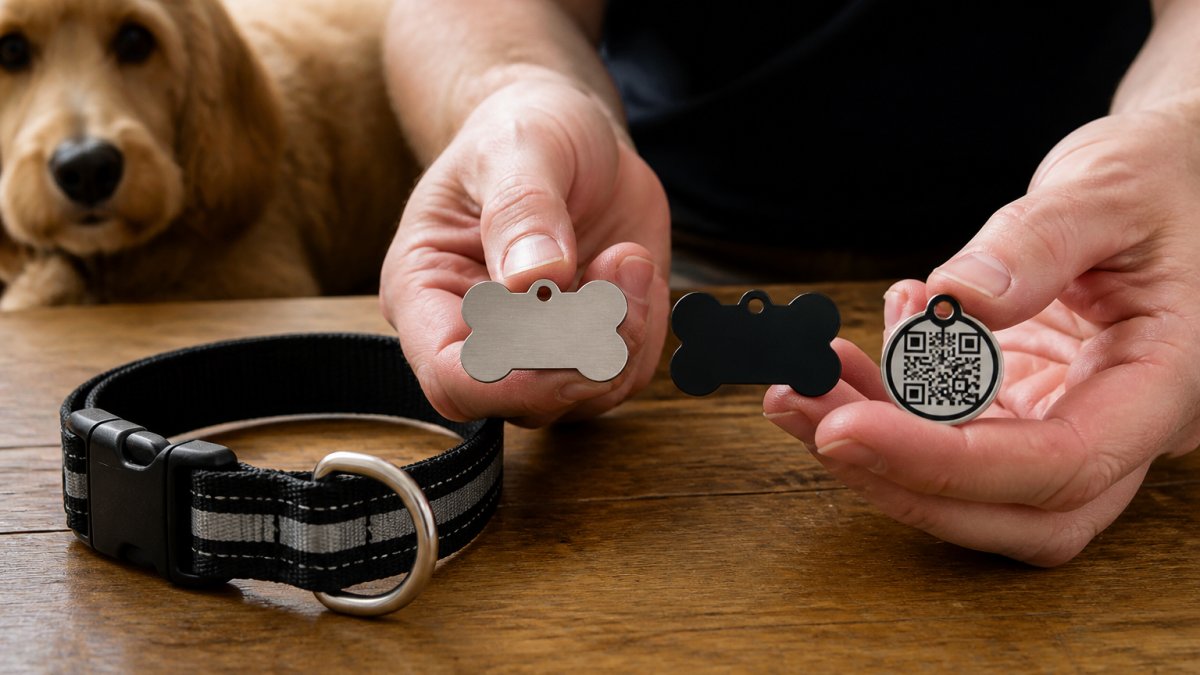
The engraving method matters as much as the metal. Cut or laser engraving fuses material into the surface, so the lettering is part of the tag rather than sitting on top of it. Printed or surface-marked lettering is the first thing to rub away against a collar, food bowl or concrete step, which is why a deep engraving on a modest metal usually outlasts a printed mark on a premium one.
Aluminium: light, bright, and best for gentle wearers
Our aluminium tags are lightweight anodised aluminium with precision engraving and clear lettering. The anodised finish takes colour well, which is why aluminium tags come in bright finishes and suit cats and small dogs that mostly nap. The limit is honest: aluminium is a softer metal. A strong chewer, a digger, or a dog that scrapes its collar against fences will bend an aluminium tag and wear the engraving faster than a harder metal, a false economy, cheaper up front but more expensive over two or three replacements.
Stainless steel: the rough-player default
For chewers, diggers and rough, playful dogs, stainless steel is the better call. It is harder, rust-resistant, and holds a deep engraving without the lettering rounding off. The Silver Stainless Steel Round Dog ID Tag is backed by a lifetime guarantee, and is the long-term-wear option. The Stainless Steel Bone Pet ID Tag adds a polished finish and paw print cut-out without sacrificing the engraving surface.
Smart tags: durability of a different kind
The Smart Pet ID Tag at $34.90 carries a scannable QR code linked to your pet's digital profile. The physical tag still has to survive collar wear, but the contact details live online, so changing your phone number does not require a new tag. The trade-off is dependence on a charged smartphone and a working scan, which is why a smart tag works best alongside, not instead of, a plainly engraved phone number.
| Material | Engraving method | Strengths | Weaknesses | Best for |
|---|---|---|---|---|
| Anodised aluminium | Precision cut engraving | Light, bright finishes, comfortable for small pets | Softer metal; bends and wears under heavy chewing or scraping | Cats and small, gentle dogs |
| Stainless steel | Deep cut engraving | Hard, rust-resistant, holds lettering, lifetime guarantee on the round tag | Heavier than aluminium; higher price | Active dogs, chewers, diggers, rough players |
| Smart QR tag | Printed or engraved code plus digital profile | Contact details updatable online without a new tag | Relies on a smartphone scan; physical tag still wears | Owners who change phone numbers often |
Pet ID Tag Delivery Time: Dispatch, Postage and Urgent Orders
Delivery time is not one number. It is engraving time plus dispatch plus transit, and each stage has its own clock. Because every tag is personalised to order, engraving comes first, there is no shelf of pre-made tags. That is why ordering from a local workshop matters: a tag engraved and posted locally avoids the international shipping leg entirely, which is where most of the delay lives with overseas sellers.
Stage 1: Engraving and production
Most personalised tag orders are engraved and inspected within one to two business days, provided the text you supply is correct and complete. The clock starts when the order is confirmed, not when you open the product page; weekend or public holiday orders typically begin production the next business day. The biggest cause of a delayed engraving is incomplete or ambiguous order details, a missing digit in a phone number, a name spelled two ways, or a blank font choice.
Stage 2: Dispatch
Dispatch is when the finished tag leaves the workshop and enters the postal system. Orders placed before the daily cut-off on a business day typically dispatch same-day or next business day; later orders roll to the following business day. This is where a local workshop pays off: no customs clearance, no international consolidation, and no handover between overseas and domestic carriers.
Stage 3: Transit
Transit is the part nobody controls once the tag is in the post. Standard postage within Australia typically arrives within a few business days of dispatch, though regional and remote addresses can take longer. Express postage shortens transit but not engraving, it moves the finished tag faster, it does not make the engraving happen sooner. If you need a tag by a specific date, calculate engraving time plus the transit estimate for your postcode, not transit alone.
| Stage | What happens | Typical timeframe | What you control |
|---|---|---|---|
| Engraving | Tag cut, engraved and inspected | 1-2 business days | Supplying correct, complete details |
| Dispatch | Tag leaves the workshop | Same or next business day if ordered before cut-off | Ordering before the daily cut-off |
| Transit | Carrier delivers to your address | A few business days standard; longer to regional and remote areas | Choosing express postage if timing is tight |
Urgent orders: what actually helps
If you need a tag before a specific date, these levers genuinely shorten the wait:
- Order the engraving details correctly the first time. A wrong phone number means a reprint and a second full wait, the most common self-inflicted delay.
- Order before the daily cut-off. A tag ordered at 9am and one ordered at 9pm can dispatch a full business day apart.
- Add a Quick Clip if your collar has a worn split ring, so the tag goes straight on when it arrives.
If you need a tag before a specific date, contact us before ordering and we will tell you honestly whether the timeframe works.
If an order is delayed
Delays happen, and the useful question is what happens next. If an order has not dispatched within the expected production window, first check whether the workshop has queried the order details, a missing digit is the usual culprit. If it has dispatched but transit is slow, the carrier's tracking is the source of truth. A tag engraved with wrong details because of an error in the supplied text is not a manufacturing fault, so read the order confirmation carefully before engraving starts.
How to Attach a Tag So It Stays On
A tag only works if it is on the pet. Split rings are the standard attachment and come with every tag, but they fail most often, usually because the ring has stretched or was never fully closed.
Our Quick Clip is a stainless steel alternative with a spring gate that holds, secures and connects the tag to the collar, clipping on and off in seconds.
A few attachment habits worth adopting:
- Check the ring monthly. A ring that has opened slightly will let go at the worst moment.
- Keep the tag on the collar, not a separate loop. Fewer connection points means fewer failure points.
- For cats, keep the tag light. A heavy tag on a small collar is uncomfortable and gets pawed at.
Losing a pet is stressful enough without wondering whether the tag will arrive in time or survive the first week.
Frequently Asked Questions
What information should I put on a pet ID tag?
At minimum, put your pet's name and a mobile phone number on the front, with a second contact number or an address on the back where space allows. A mobile number is the fastest way for a finder to reach you, and a second number covers times when you cannot answer. Keep it short: a large, bold font beats a long list of details. If your number changes often, a QR code tag lets you update details online without buying a new tag.
How quickly can custom pet ID tags be made and delivered?
Engraving is done to order, so the tag itself is usually ready for dispatch within one to two business days. Delivery then depends on the postage service chosen: standard post typically takes a few business days across metro areas and longer to regional addresses, while express post shortens the transit leg only. Order before the daily cut-off and supply your engraving details correctly the first time, because a tag with the wrong spelling has to be remade and that adds days.
Are engraved pet ID tags better than printed tags?
Deep engraving cuts the letters into the metal, so it does not peel, flake or rub off the way printed or painted lettering can. That matters for dogs that swim, roll in sand or scratch at their collar. Laser engraving on both sides also keeps the text crisp over years of wear. Printed tags are cheaper up front but often become unreadable within months, which defeats the purpose of identification. For a tag you expect to last, engraving is the more reliable choice.
What is the best material for a durable pet ID tag?
Stainless steel is the most durable option for large or highly active dogs: it resists rust and holds deep engraving well. Anodised aluminium is lighter and cheaper, which suits puppies, cats and small dogs, but it is softer and not recommended for chewers, diggers or rough players. For pets that lose collars or whose contact details change, a QR code smart tag lets you update information online without replacing the tag.
How do I attach an ID tag securely to a pet's collar?
Split rings are supplied with most tags and work well, but they can stretch or catch on fabric over time. A stainless steel quick clip with a spring gate is easier to open and holds the tag firmly on the collar, and it makes swapping tags between collars simple. Check the attachment weekly, especially on puppies and cats that scratch at their neck, and replace any ring that looks bent or worn before it fails.