

Table of Contents
- What You're Actually Paying For in a Premium Pet Tag
- Pet Tag Material Comparison: Stainless Steel vs Aluminium
- Are Expensive Pet Tags More Durable for Active Dogs?
- The Hidden Cost of Cheap Tags: Replacement Cycles
- Smart Tags vs Traditional Engraved Tags: The Subscription Question
- Legal Requirements for Dog Registration Tags in Australia
- Making the Call: Where Premium Tags Deliver Real Value
- Frequently Asked Questions
Last Updated: September 8, 2026
The question of whether expensive pet tags are worth it usually surfaces after a cheap tag fails: the engraving fades, or the metal corrodes at the split ring. At Pet ID Tags Australia, we have spent over 20 years engraving identification tags. A premium pet tag is a one-time purchase that delivers permanent identification, while a budget tag often becomes a recurring expense that ends with an unreadable piece of metal on your pet's collar.

What You're Actually Paying For in a Premium Pet Tag
A premium pet tag is an investment in material quality, deep engraving, and the readability of your contact details when they matter most. The price difference is not about branding or markup; it is about the physical process that keeps your information legible for the life of the tag.
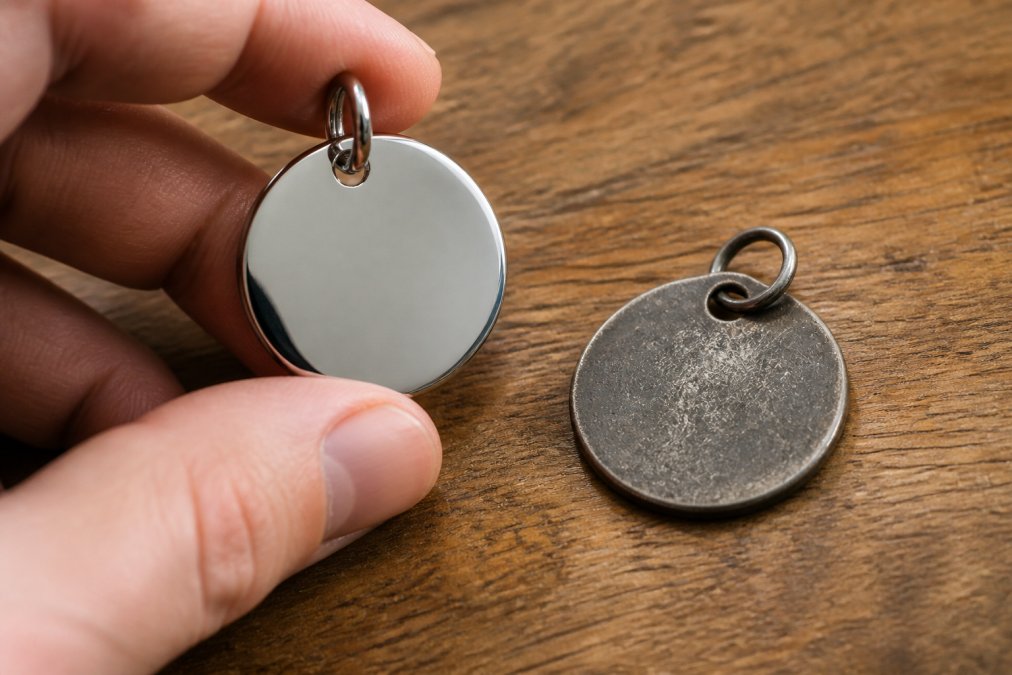
The $5 vs $20 Tag: Where the Money Goes
The gap between a budget tag and a premium tag comes down to three factors: the metal, the engraving method, and the finishing.
Cheap tags are often stamped or surface-printed, so the lettering sits on top of the metal where it can scratch off. Premium tags use deep laser engraving that cuts into the material, keeping lettering readable as the surface wears. The metal matters too: quality tags use stainless steel or anodised aluminium that resists corrosion, whereas lower-grade metals react with moisture and oils from your pet's coat.

Pet Tag Material Comparison: Stainless Steel vs Aluminium
Most guides stop at 'steel is stronger, aluminium is lighter.' That misses the real question: how does each metal actually fail in the specific environments your pet lives in? The answer comes down to three measurable properties: hardness, corrosion resistance, and the way the metal wears against the split ring.
Hardness and Scratch Resistance: The Mohs Reality
Scratch resistance is a function of material hardness. Stainless steel (grade 304 or 316) sits around 5.5 to 6.5 on the Mohs scale; anodised aluminium is softer, around 3.0 to 3.5. A stainless steel tag dragged through gravel will pick up surface scuffs that do not reach the engraving, while an aluminium tag will gouge, and those gouges can obliterate a phone number in a single season.
Brass, often used in budget tags, sits at about 3.0 on the Mohs scale and is the worst offender for both scratching and corrosion. It reacts with the salts in sweat and moisture, forming a green patina that can transfer onto your pet's coat and obscure the lettering entirely.
The Saltwater and Chlorine Test
Corrosion depends on the specific chemistry your tag faces. For coastal dogs, saltwater accelerates galvanic corrosion at the junction where the split ring meets the tag hole. Stainless steel 316 contains molybdenum, providing superior resistance to chloride-induced pitting; grade 304 will show micro-pitting after repeated saltwater exposure. Anodised aluminium fares better than bare aluminium, but once the anodising layer is scratched through, the underlying metal corrodes rapidly.
For dogs that swim in chlorinated pools, the picture is different. Chlorine is aggressive to both metals, but stainless steel's chromium oxide layer self-repairs in the presence of oxygen, whereas anodised aluminium's oxide layer does not.
The Split Ring Hole: Where Tags Actually Die
The most common failure point is the hole, not the face. Every time your dog shakes its head, the split ring files against the hole edge. Aluminium will elongate the hole over time, eventually tearing through entirely. Stainless steel resists this elongation dramatically better.
A Practical Selection Matrix Based on Environment
Instead of a generic weight-versus-colour trade-off, match the metal to the dog's actual lifestyle:
| Environment | Recommended Metal | Why |
|---|---|---|
| Coastal beach dog, daily saltwater swims | Stainless steel 316 | Highest chloride resistance; hole will not elongate |
| Freshwater creek or lake swimmer | Stainless steel 304 | Resists freshwater corrosion; scratches stay superficial |
| Urban dog, footpath walking only | Anodised aluminium | Lightweight; anodising handles mild abrasion |
| Indoor cat or toy breed | Anodised aluminium | Weight is the priority; low wear environment |
| High-activity dog, bushland or rough terrain | Stainless steel 316 | Scratches from rocks and twigs will not reach engraving |
This environment-based approach is the angle most guides miss. Material choice is an engineering decision driven by the specific chemistry and abrasion your pet's tag will face. A stainless steel tag is not universally 'better', it is better for the environments that kill aluminium tags. For a sedentary indoor cat, the lighter aluminium tag is the smarter ergonomic choice.
The Engraving Depth Interaction
Material choice also dictates engraving depth. Stainless steel allows a clean, deep laser engraving without weakening the tag. Aluminium can be cut deeper, but the softer base metal means the edges of the engraved letters are more prone to chipping, which can accelerate wear. Stainless steel's hardness keeps the engraved edges crisp and intact.
For most owners, the decision is simple: if your dog is active, coastal, or a swimmer, the extra weight of stainless steel is a non-issue compared with the certainty of replacement. If your priority is a featherlight tag for a small breed or a cat, anodised aluminium is the right call, just expect to replace it sooner if the animal spends time outdoors.
Are Expensive Pet Tags More Durable for Active Dogs?
For active dogs, the answer is a clear yes, because durability is a function of material hardness and engraving depth, not price alone. A stainless steel tag with deep engraving will outlast several aluminium tags on a dog that swims regularly or crashes through undergrowth.
The weak point on any tag is the hole where the split ring attaches. This area experiences constant friction against the collar ring, and softer metals will wear through or enlarge the hole over time. Stainless steel resists this wear far better. A common mistake is choosing a tag purely on weight or colour, then replacing it every year when the hole stretches or the surface scratches.
The Hidden Cost of Cheap Tags: Replacement Cycles
The true cost of a cheap tag is the replacement cycle that follows. When you buy a $5 tag that fades in six months, you are committing to buying another tag, paying for engraving again, and waiting for delivery while your pet goes without clear identification.
This is where the value of an expensive pet tag becomes clear. A $19.90 stainless steel tag that lasts for years is cheaper than three $5 tags that each fail within months. Add the risk window between replacements, when your pet carries an unreadable tag, and the budget option looks even less attractive. Subscription-based smart tags introduce a different cost model entirely, which we explore next.

Smart Tags vs Traditional Engraved Tags: The Subscription Question
Smart tags with QR codes offer a modern convenience: you can update your contact details online without buying a new tag. The Pawzee Smart Pet ID Tag from Pet ID Tags Australia sells for $34.90 as a one-time purchase, with no ongoing subscription fees. You create a digital profile for your pet, and anyone who finds them can scan the QR code with a smartphone to reach you.
Privacy and Practicality of QR Code Tags
The practical advantage of a smart tag is that your contact details never go out of date. Move house or change your phone number, and you update the digital profile rather than reordering a physical tag. This solves a genuine frustration for pet owners who have bought a new engraved tag after every change of address.
Privacy is the consideration most guides miss. A QR code only reveals the information on your pet's profile when scanned, giving you control over what a stranger sees. Traditional engraved tags display your phone number to anyone who approaches your pet. For some owners, that visibility is a concern, making the smart tag an appealing alternative or companion.
Legal Requirements for Dog Registration Tags in Australia
Beyond the choice of material or technology, every dog owner has a legal obligation for identification. The specific requirements for dog registration tags vary by state and territory, and councils issue their own registration tags that must be worn alongside any personalised tag.
Registration tags prove your dog is registered with the local council, while a personalised pet tag provides your direct contact details. Both serve different purposes. The council tag identifies the dog to authorities, and your engraved tag lets a member of the public contact you immediately. Microchipping is also compulsory for dogs and cats in most jurisdictions, but the Australian Veterinary Association guidance on pet identification notes that a microchip only helps once a lost pet is scanned by a vet or shelter. A visible tag remains the fastest route to reunion.
Making the Call: Where Premium Tags Deliver Real Value
Premium tags deliver real value in two situations: active or outdoor pets that wear through cheap hardware, and owners who change contact details infrequently and want a permanent solution. If your dog swims, hikes, or has a history of escaping, the durability of stainless steel justifies the higher price. If you prefer the flexibility of updating details digitally, a smart tag removes the need to repurchase after every move.
The RSPCA Australia advice on pet identification reinforces that visible identification is one of the most effective ways to reunite lost pets with their owners, alongside microchipping. The cost of a premium tag is trivial compared with the stress of a lost pet and the uncertainty of whether your contact details are still readable.
The Ergonomics Gap: Weight-to-Body-Mass Ratios for Small Breeds
What almost every guide misses is that a tag's value is also about whether it is physically comfortable enough for your pet to wear every day. A tag that is too heavy for a small dog or a cat will cause neck strain, skin irritation, and behavioural resistance. Owners then remove the tag, defeating its entire purpose.
A tag that is too heavy for a small dog or a cat will cause neck strain, skin irritation, and behavioural resistance. Owners then remove the tag, defeating its entire purpose.
For cats, many owners of indoor cats report their cat will not tolerate any tag heavier than 8 to 10 grams, which is why lightweight aluminium tags are the default recommendation for felines.
The Multi-Tag Weight Problem
A hidden issue for Australian pet owners is the accumulation of tags on one collar. In many council areas, your dog must wear the council registration tag. Add a personalised engraved tag and a smart tag, and you have three. Each tag adds weight and creates a clinking noise that some dogs find distressing. The solution is not to skip the personalised tag, it is to consolidate.
When a Premium Tag Is Not Worth It
A premium tag is not worth it for every pet. If you have a strictly indoor cat that never goes outside, a $5 aluminium tag that lasts two years indoors is a rational choice. If you change your phone number every year and prefer to reorder a cheap tag each time, the replacement cycle cost is still lower. And if your pet is microchipped and you live in an area with a very low escape risk, the marginal benefit is small.
The value threshold is crossed when your pet has any of these risk factors: a history of escaping, access to the outdoors without direct supervision, a high-activity lifestyle that wears hardware quickly, or a coat colour that makes a lost pet hard to spot. For those pets, the premium tag is not a luxury; it is the cheapest insurance you will ever buy.
The Final Calculation
For most owners, the smart approach is a durable traditional tag as the primary identifier, with a smart tag as a companion for updated contact information. Pet ID Tags Australia offers stainless steel tags from $19.90 and aluminium options from $16.90, all deeply engraved and made to last. Compared against the replacement cycle of cheaper alternatives, the expensive pet tag is rarely the more expensive choice in the long run.
The final decision should factor in your pet's weight, your environment, and your tolerance for replacement cycles. A premium stainless steel tag for a 30 kg Labrador that swims weekly at the beach is an obvious buy. The same tag on a 3 kg indoor cat is over-engineering. Match the hardware to the animal, and the value question answers itself.
Frequently Asked Questions
Are expensive pet tags more durable than budget options?
Yes, in most cases. The difference comes down to material and engraving method. A budget tag is often stamped or printed, so the details wear off within months. Premium stainless steel tags are deeply laser-engraved, which means the text stays readable for years. For active dogs that swim, dig or roughhouse, a $19.90 stainless steel tag usually outlasts several $5 alternatives, making it the more cost-effective choice over time.
What information should you never put on a dog ID tag?
Avoid putting your home address on the tag. When a pet is lost, the finder needs to contact you, not visit your property. Your mobile number is the essential detail. Adding a secondary number for a partner or family member is useful if you miss the call. If you use a smart tag with a digital profile, you can store the address there and update it instantly, which keeps your personal details private while remaining accessible to a verified finder.
What is the legal requirement for pet identification in Australia?
Laws vary by state and territory, but every dog and cat must be microchipped by 12 weeks of age or before sale. Registration with your local council is also compulsory, and most councils issue a registration tag that must be worn on the collar. This tag is separate from a personalised ID tag. While the council tag proves registration, a personalised tag with your phone number is what helps a finder reunite you with your pet quickly.
How often should you replace your pet's ID tag?
Inspect your pet's tag every few months. If the engraving has become difficult to read, or the split ring shows signs of wear, replace it immediately. A cheap aluminium tag may need replacing every 6 to 12 months for an active dog. A stainless steel tag with deep engraving can last several years. Also replace the tag whenever your phone number changes, or consider a smart tag with a digital profile that you can update online without buying a new tag.
Choosing the right identification for your pet comes down to balancing durability, comfort, and how often your details change. A cheap tag that fails when you need it most is a false economy. Pet ID Tags Australia has spent over 20 years engraving tags that resist fading and scratching, with deep laser engraving for long-lasting readability and fast shipping from our local workshop. Get started with Pet ID Tags Australia and give your pet identification that lasts.